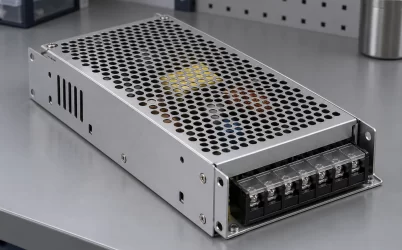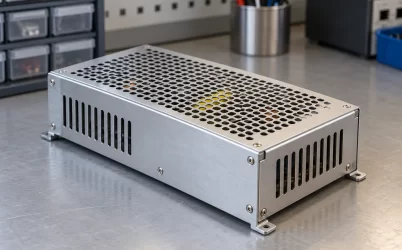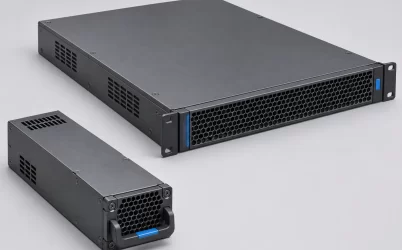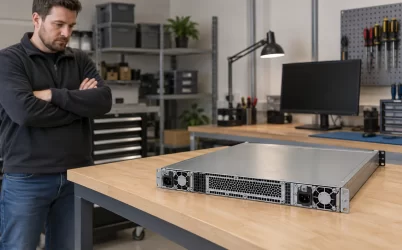
G1429-1300WNA is listed by Powernexu as a 1,300 W hot-pluggable CRPS module with a nominal 12 V output and a 185 × 73.5 × 40 mm body. A buyer searching this exact part number should first resolve one identity detail: Gospower’s English related-model list displays G1429-1300W, while its Chinese official CRPS catalog explicitly lists G1429-1300WNA as a 1300 W T185 member. These records confirm that the suffixed identifier is used by the manufacturer, but do not establish that the two names are interchangeable. The manufacturer page describes the T185 family, but does not establish that every family statement applies unchanged to the WNA assembly. Use the exact label, revision-controlled drawing, and host approval before treating a catalog match as an electrical or mechanical substitute.
What the two public listings actually establish
The Powernexu G1429-1300WNA product page lists 1,300 W output power, 90–264 V input, 12 V output, maximum output current of 108.33 A, and a 185 × 73.5 × 40 mm envelope. Its mounting field says hot pluggable. Those values describe the offered listing; they do not supply a curve showing full output across the input range, temperature, or airflow conditions. Nor does the page expose a mating connector drawing or permitted host platforms.
Gospower’s T185 family page places G1429-1300W in a Titanium CRPS series and calls out a 185 mm body, a +12.2 Vdc output, built-in ORing fault isolation, PMBus 1.2, and fan reversal among family highlights. The Gospower Chinese CRPS catalog separately names the exact G1429-1300WNA identifier and its 1300 W T185 category. That confirms identity and category rather than every electrical or mechanical condition. Its family overview also mentions efficiency up to 96.3%, which is a family maximum rather than a verified efficiency point for this exact suffix.
The difference between “12 V” and “+12.2 Vdc” is not necessarily a conflict: one may be a nominal bus description and the other a regulated set point. But the public information does not prove how the WNA unit is programmed, what tolerance applies, or how the host senses and regulates the rail. Record both descriptions without silently converting one into a guaranteed condition for the other. The WNA suffix, hardware revision, and firmware identity are part of the procurement identity, especially if a server maker uses an approved spare number.
The G1429 suffix is a spare-parts question, not typography
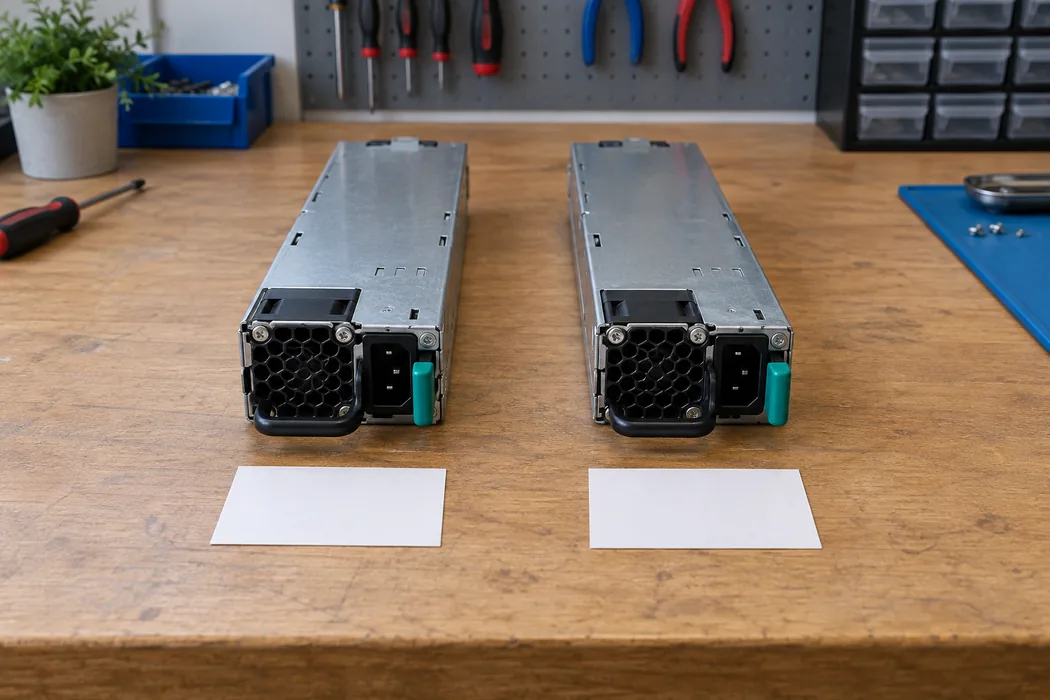
Two slim modules can have the same nominal wattage and body dimensions yet differ in output set point, rear-edge pin allocation, management address, firmware responses, fan behavior, or mechanical keying. Some differences are visible on the rating label; others appear only in a controlled drawing or the server’s compatibility list. The Chinese Gospower catalog explicitly identifies G1429-1300WNA as a 1300 W T185 member. It is not evidence that an unsuffixed G1429-1300W can replace every G1429-1300WNA or that a WNA unit is approved in every T185 bay.
For a field spare, compare the failed unit’s full printed model, any additional suffix, revision, and the host manufacturer’s FRU or option number with the candidate replacement. Photograph both faces of the label before the original unit leaves the site. That record prevents a purchasing description from collapsing related variants into a single line item. If the seller’s listing uses a shortened model string, ask for the exact shipped-label photograph and a written cross-reference to the requested WNA part. A catalog family page cannot supply that cross-reference by implication.
Connector fit alone is a weak acceptance test. A module may slide into a bay while its control signals, enable behavior, sense connections, or management identity differ. Conversely, an assembly may share the intended electronics but have a handle or airflow option that blocks installation. The receiving chassis needs a defined mechanical insertion path, correct mating connector, and an approved electrical interface.
Translate 1,300 W into a 12 V distribution problem
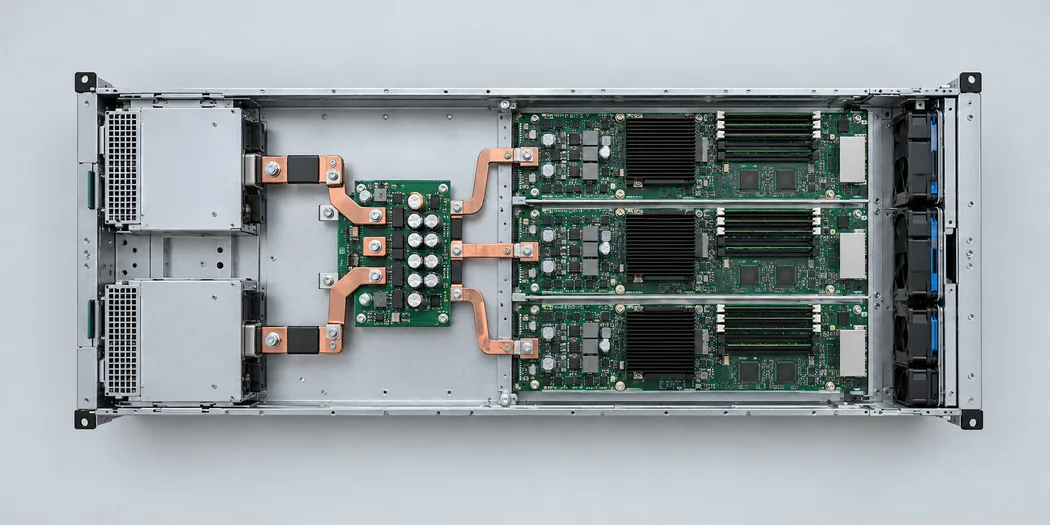
At the Powernexu listing’s nominal 12 V, 1,300 W corresponds to approximately 108.33 A. That is an arithmetic relationship between stated rated power and voltage, not a new measured operating point. A host drawing 90 A from its main bus would nominally consume 1,080 W at 12 V, leaving 220 W between that steady load and the listed 1,300 W figure. That apparent difference is not an automatic transient allowance. It omits input-voltage limits, thermal derating, module-to-module sharing, and the peak behavior of downstream regulators.
The high current makes the receiving power distribution board central. The PSU’s contacts, busbar or copper planes, return path, branch protection, and local converters must be sized for their respective currents and temperatures. A 12 V architecture delivers power at lower voltage and higher current than a 48 V or 54 V architecture at the same wattage. It may suit an established 12 V server backplane, but it cannot be substituted into a higher-voltage bus merely because both products are called CRPS. The bus voltage and pin definition are first-order compatibility properties.
Think about the location of losses rather than the advertised wattage alone. Resistive loss in a contact or conductor grows with the square of current, so a small increase in resistance at a high-current joint can create a disproportionate local heat source. That is why contact condition, insertion force, connector ratings, and a sound return path matter. It is also why a 12 V PDB that was acceptable at a lower output class may need a fresh review at 108 A, even if the new PSU has the same outside dimensions.
For an existing server, the platform maker’s approved configuration is the stronger evidence than a generic wattage calculation. For a new design, map the current through each physical segment from the module contacts to processor, memory, storage, and accelerator converters. The currents in branch paths are not necessarily equal, and the total module current can shift during workload transitions.
The 185 mm body describes the module, not the usable bay
Powernexu’s 185 × 73.5 × 40 mm dimensions align with Gospower’s T185 family envelope, but they do not define a full installation clearance. A bay also needs its guide geometry, connector stand-off, latch travel, and a withdrawal path that remains accessible when the server is cabled in the rack. Confirm whether the listed length includes the handle, rear protrusions, and mating features; a product-summary dimension may measure only the metal body. The controlled mechanical drawing should settle the datum and tolerance used by the chassis designer.
Rear-panel geography is especially important when two modules sit beside networking ports, fans, and cable-management hardware. A power cord must clear the release handle. The module must be removable without bending adjacent signal cables or reaching through another live feed. If an enclosure uses a hinged cable arm or a dense switch rack behind the server, compare the installed and extraction envelopes, not just the space occupied in normal service.
Airflow is another configuration-dependent property. Gospower mentions fan reversal at the T185 family level, but a family capability does not identify the airflow direction of a shipped WNA unit. The host may use front-to-back or another intended path; installing a reverse-airflow variant can oppose system fans. Check the arrow or controlled airflow option on the exact assembly and the server maker’s specification. A visual match at the PSU face does not establish that its fan direction, speed control, or thermal behavior is acceptable in the chassis.
Redundant service requires a surviving 1,300 W path
Built-in ORing fault isolation is a Gospower T185 family highlight. In a correctly designed redundant shelf, isolation helps prevent one failed module from dragging down the shared output bus. It does not by itself prove that a particular G1429-1300WNA and PDB combination supports a given 1+1 configuration. The receiving board, module controls, and host management must be designed for the event, and the surviving module must carry the load available at its actual input and ambient conditions.
If two 1,300 W modules share an 1,100 W server load, the pair is not automatically a 2,600 W redundant supply. With one module removed or failed, a 1+1 arrangement has one remaining module. Its usable output under the specific rack feed and cooling condition defines the continuity boundary. If an application routinely exceeds one module’s permitted output, a two-module arrangement may still operate in parallel while failing to preserve full load after one module is lost.
Hot plugging describes a service capability, not permission to pull a module under any workload. Before replacement, the operator needs the host’s service procedure: confirm the healthy module, verify that its feed is live, assess the present load against surviving capacity, and follow the platform’s cord and latch sequence. After insertion, the controller should report the expected module identity and healthy state. If the public documentation does not specify startup timing, current-sharing behavior, or management commands for the WNA suffix, avoid turning those unknowns into a promised seamless transition.
Interpret the Titanium and PMBus claims at the right level
Gospower describes its T185 family as Titanium and says the series reaches efficiency up to 96.3%. That statement is useful context for why the family is offered in dense servers, where conversion losses heat a constrained bay. It is not a measured efficiency curve for G1429-1300WNA. Efficiency changes with load and input condition, while fan power and system airflow affect the practical thermal result. For an energy estimate, use a model- and condition-specific efficiency curve rather than applying the family’s “up to” value to every operating hour.
The same distinction applies to PMBus 1.2. The protocol family can carry telemetry and status information to a host controller, but the publicly visible T185 description does not publish WNA-specific supported commands, scaling, addresses, thresholds, or firmware behavior. A server that uses telemetry for alarms or power capping must recognize the exact module identity and interpret its readings correctly. If a replacement fits and produces 12 V but reports an unexpected device ID, the platform may flag it as unsupported or lose monitoring functions. Verify the host’s approved firmware combination before relying on management data.
Do not infer certification of the exact WNA model solely from a series marketing label. A procurement file may need the certificate, listed model variation, test conditions, and current revision. This is particularly relevant if the installation is audited or if energy and safety requirements are part of a formal server bill of materials. The relevant evidence is the document that names the shipped assembly or an explicit manufacturer cross-reference, rather than a badge copied from a nearby product page.
What an exact-model request should contain
For G1429-1300WNA, a useful purchase request states the complete suffix, revision if known, host chassis or FRU number, required quantity, input feed, and intended airflow direction. Include the expected 12 V bus and ask the supplier to confirm how the Powernexu nominal 12 V listing relates to Gospower’s +12.2 Vdc family description. Request the controlled electrical and mechanical drawings, rating label, and documentation of any approved substitution if the offered item is labeled G1429-1300W without WNA.
For a new server design, the next documents are the mating connector definition, full-load and low-line rating conditions, output regulation and transient limits, airflow requirements, and management command support. For a field replacement, the approved spare list and shipped-label match may answer the main question more quickly. If those records conflict, hold the substitution until the platform or PSU manufacturer resolves it in writing. A mechanically convenient module that has an undocumented suffix relationship can turn a straightforward spare purchase into a power-bus or serviceability problem.
The manufacturer’s Chinese catalog confirms G1429-1300WNA identity, its 1300 W category and T185 membership. The English page supplies family context and a related unsuffixed identifier. A controlled exact-revision specification is still needed for input-dependent output, setpoint, interfaces and approved substitutions. Match the bay, distribution path, inlet conditions, airflow, redundancy and management identity to that documented assembly.