A high-wattage Titanium server power supply should be compared at a defined operating point, not by headline wattage or efficiency class alone. Four questions must remain separate: how much DC output the exact module can deliver under the proposed conditions, what efficiency evidence applies near the expected load, what capacity survives a required module or feed loss, and whether the host and rack support that configuration. A Titanium record addresses conversion efficiency for a recorded product under defined test conditions; it does not establish server compatibility, redundant capacity, airflow direction, or branch-circuit suitability.
Quick answer: Build one worksheet row for each operating state that matters. Record the exact PSU identity and supply scope, applicable AC input, available DC output, required DC load, load fraction, supported efficiency evidence, estimated AC input, PSU conversion loss, active module count, surviving capacity, and rack-feed consequence. Mark every value as documented, calculated, assumed, or unresolved. Candidates become comparable only after their figures refer to the same electrical boundary and operating state.
Four attractive catalog claims answer four different questions
“High-wattage,” “Titanium,” “redundant,” and “server compatible” are often presented in one product title, but they are not one composite specification. Treating them as interchangeable can produce a shortlist that looks precise while mixing unrelated evidence.
| Claim | What it can establish | What it does not establish |
|---|---|---|
| High wattage | Potential output capacity under documented input, cooling, and environmental conditions | Available output at every input voltage, protected capacity, rack suitability, or host support |
| 80 PLUS Titanium | An efficiency classification associated with an exact recorded product and defined program test points | Output capacity, reliability, redundancy, hot-swap behavior, or compatibility with a server |
| Redundant or hot-plug | A product or assembly may support multiple modules or service-related behavior | Which failures are covered, whether one module carries the workload, or whether live removal is permitted in the target host |
| Server compatibility | A documented relationship to a named platform or assembly when supported by the appropriate manufacturer source | Universal interchangeability with similar-looking PSUs, cages, or power distribution boards |
The separation matters because increasing any one of these attributes does not close the others. A higher-rated module can remain unusable if the rack cannot supply its required input condition. A verified Titanium module can remain unsuitable if it does not mate with the host PDB. Two installed modules can remain capacity-dependent rather than redundant if the workload exceeds one module’s supported output.
Assign every search result an evidence role
Product-heavy search results usually contain several document types. The first worksheet task is not ranking their headline specifications; it is identifying which claims each source has authority to support.
- Family or series page: useful for discovering product classes and possible variants. It should not be treated as proof that every family member has the same wattage, interface, certification, or host relationship.
- Exact product page or datasheet: the primary source for model-specific input, output, mechanical, thermal, feature, and supply-scope claims, subject to the conditions and revision stated in that document.
- Certification record: evidence that the recorded model has an entry for the stated efficiency class. The official 80 PLUS Titanium certification database is the appropriate lookup source, but its record does not prove that a server manufacturer supports the PSU.
- Platform documentation: evidence for supported modules, kits, configurations, firmware relationships, or operating policies in a named host.
- Seller quotation: evidence of what will be shipped, in what quantity, and under which commercial identity. A quotation does not replace the technical sources unless it includes controlled manufacturer documentation.
An exact OEM kit page, an exact redundant-module page, and a Titanium CRPS family page therefore enter the worksheet at different maturity levels. The first two may identify specific products, while the family page may provide only candidate discovery. None should be ranked merely because its search snippet displays a larger number.
Build the comparison around the intended load point
Use one worksheet row for each operating state. Keep AC input at the PSU inlet and DC output at the PSU boundary; exclude PDB, cable, UPS, and cooling losses. Mark every entry documented, calculated, assumed, or unresolved.
| Field | Required entry | Rule |
|---|---|---|
| Identity and scope | Exact manufacturer, model, revision, and module, pair, kit, or assembly | Keep unlike products separate |
| State and input | Workload state, voltage, frequency, and cooling condition | Match the target rack |
| DC values | Available and required output at the PSU boundary | Use the same state and boundary |
| Load fraction | Required DC divided by available DC, per active module | Account for documented derating |
| Efficiency evidence | Exact documented point or curve and its conditions | Do not infer a curve from Titanium status |
| AC input and loss | DC divided by efficiency; AC input minus DC output | Calculate only from defensible evidence |
For example, a hypothetical 2.40 kW DC load against 3.00 kW of available output produces an 80% load fraction. If exact evidence supports 0.960 efficiency near that point, estimated AC input is 2.50 kW and PSU conversion loss is 0.10 kW. These values describe only the PSU boundary. If no applicable model-specific efficiency point exists, leave the loss estimate unresolved.
Redundancy creates a second load point
A high-wattage redundant system normally needs at least two worksheet rows: the ordinary module population and the required one-module-unavailable state. The load presented to each active PSU can change sharply between them, so the relevant efficiency and rack-feed demand can change as well.
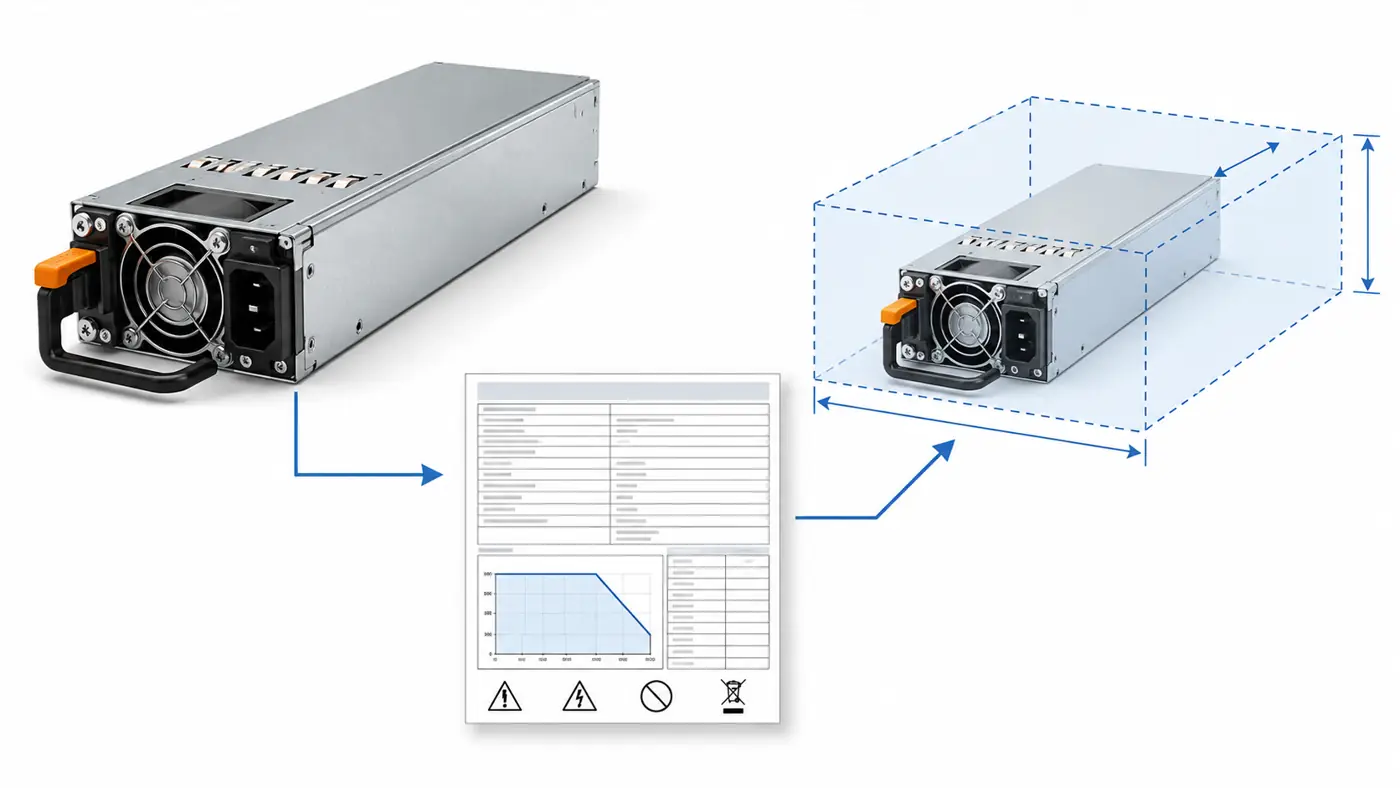
Consider the same hypothetical 2.40 kW DC workload with two 3.00 kW modules in an idealized equal-sharing 1+1 arrangement. During normal operation, each module would deliver approximately 1.20 kW, corresponding to about 40% of its available output. If one module becomes unavailable, the survivor would deliver the full 2.40 kW, corresponding to 80%. Actual sharing tolerance and host policy are platform-specific, so these percentages are planning values rather than proof of system behavior.
This example exposes two different questions:
- At the normal shared state, what are the combined AC input and conversion losses of two modules operating at their individual load points?
- In the degraded state, can one supported module deliver the required output under the remaining feed, input, airflow, and thermal conditions?
The normal row may look favorable while the degraded row fails because the surviving module’s output is derated, the remaining feed cannot support the input demand, or the platform restricts workload after a module loss. Conversely, the degraded state may be technically supported but impose a temporary rack input or thermal condition that operations must recognize. The definitions behind module wattage and protected output are covered in more detail in Powernexu’s explanation of redundant server power supply ratings.
For an A/B-fed configuration, add the source assignment to both rows. Normal operation may divide input across two feeds, while the loss of one source can move the entire permitted workload to the surviving branch. That surviving branch—not the sum of A and B allocations—is the relevant infrastructure constraint.
Keep PSU loss separate from the rest of the rack
The worksheet should calculate losses in layers. Combining them into one unexplained efficiency value prevents useful comparison and can double-count energy.
- PSU conversion loss is the difference between AC input at the PSU inlet and DC output at the PSU boundary.
- PDB, busbar, connector, and cable losses occur downstream of the PSU unless the published efficiency measurement explicitly includes them.
- Rack PDU and upstream distribution losses occur before the PSU inlet.
- UPS losses belong to the upstream facility power path and depend on the UPS architecture and operating point.
- Cooling energy is an infrastructure consequence of heat, not part of the PSU’s conversion-efficiency calculation.
Within the server and rack, electrical losses ultimately appear mainly as heat. The PSU conversion-loss result can therefore inform a cooling budget, but it should remain labeled as PSU heat rather than total cooling demand. Fans, processors, accelerators, storage, PDB conductors, and other conversion stages contribute additional heat at their own boundaries.
This distinction also prevents an invalid product comparison. Candidate A might publish PSU-only efficiency, while Candidate B is represented by measured wall power for a complete server. Those figures cannot occupy the same worksheet column. Either obtain matching evidence or retain the different boundaries explicitly.
Translate the operating point into rack-side limits
An estimated AC input value is useful for energy and heat analysis, but it is not by itself a complete branch-circuit specification. High-output modules may have input-dependent ratings, and the target rack must support the exact conditions under which the selected output is available.
Add these infrastructure fields beside each operating-state row:
- PSU input voltage and frequency required for the documented output;
- manufacturer-documented input-current information and applicable power-factor conditions;
- inlet, cord, plug, receptacle, and rack-PDU compatibility;
- normal current allocation by A/B feed;
- surviving-feed demand after the permitted source or module event;
- inlet-temperature and altitude assumptions that affect output or cooling;
- airflow direction and available chassis airflow;
- PSU conversion heat in normal and degraded states.
A simple real-power calculation should not replace documented input-current, inrush, protection, or cord requirements. Input current also depends on voltage, power factor, waveform, operating state, and manufacturer limits. Use the calculation to understand scale, then use exact product and rack documentation to specify hardware.
When several servers share a rack, retain credible coincident states instead of multiplying every nameplate maximum. The selected method should still preserve required degraded conditions: a feed-loss state can concentrate demand on one PDU even when total rack workload is unchanged. Powernexu’s facility-to-server requirements matrix shows how server operating points can be carried upstream into rack, UPS, and cooling allocations without merging their measurement boundaries.
Uncertainty belongs in the worksheet
Blank cells are easy to overlook, while invented precision can make an unsupported candidate appear complete. Give every important entry one of four evidence states:
- Documented: stated by an authoritative source for the exact model, revision, assembly, host, and applicable condition.
- Calculated: derived from documented inputs using a visible equation and consistent measurement boundary.
- Assumed: a planning input that still requires confirmation, such as an estimated workload or provisional sharing ratio.
- Unresolved: unavailable, conflicting, or not yet tied to the exact candidate.
Uncertainty should also be attached to the result it affects. An unresolved airflow direction is a mechanical and thermal deployment issue. Missing efficiency data blocks a defensible loss estimate but does not necessarily disprove the module’s output rating. Missing host support prevents a replacement authorization even if electrical data are complete. This approach keeps one absent document from being misrepresented as either a universal rejection or an irrelevant detail.
Turn the worksheet into a controlled shortlist
Each candidate can leave the worksheet with one narrow disposition. Retain it when the operating points, exact identity, scope of supply, rack conditions, and required host relationship are adequately supported. Request evidence when the candidate remains plausible but one or more consequential fields are unresolved. Reject for this deployment when documented input conditions are unavailable in the rack, surviving output is insufficient, the host does not support the product, or the quoted item cannot be identified consistently.
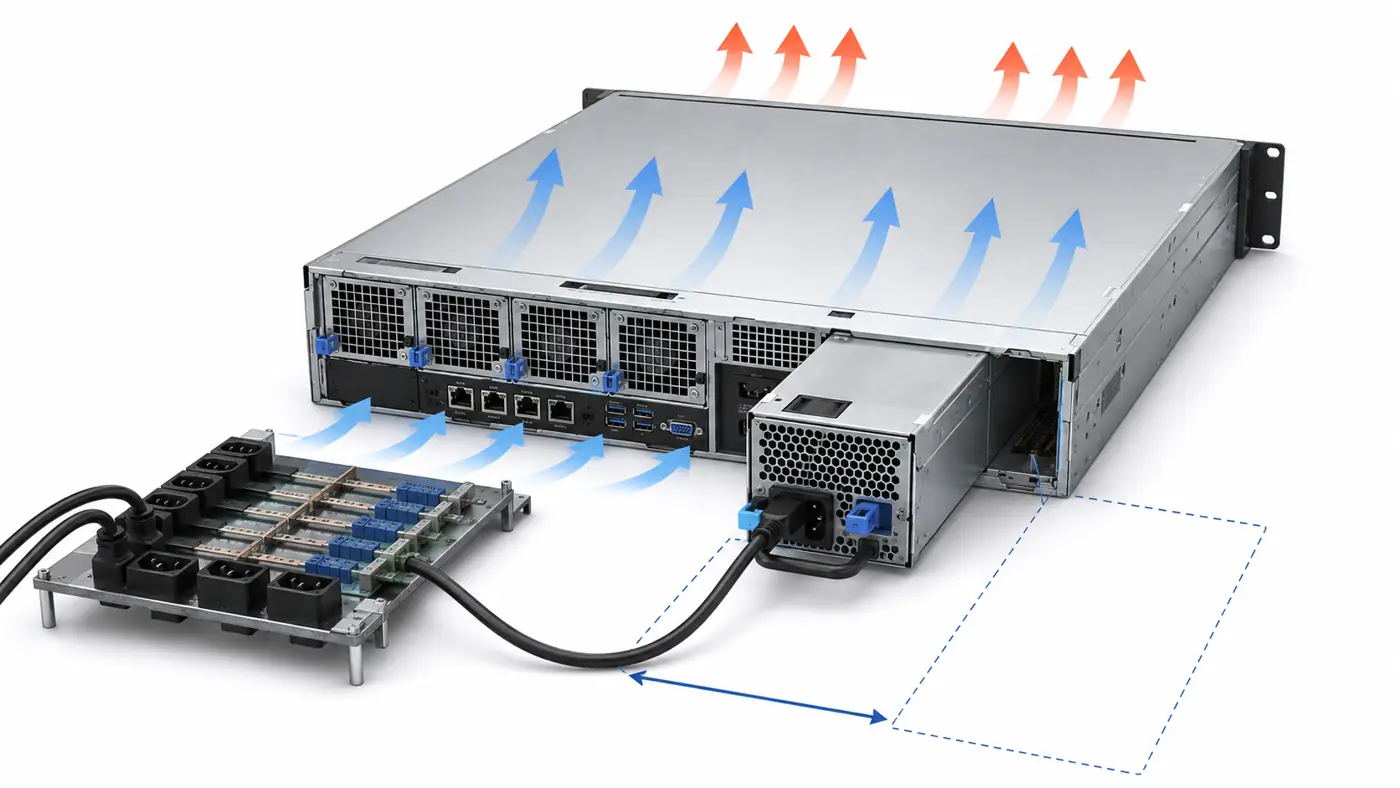
The resulting purchase record should preserve the exact module or kit, quantity, revision rules, included cage or PDB hardware, applicable input and cooling conditions, normal and degraded load points, source assignment, and permitted substitutions. A family name or Titanium badge can remain useful for market discovery, but it should not replace those controlled fields.
The purpose of the worksheet is not to declare one universal high-wattage Titanium PSU superior to every other option. It is to expose whether each candidate’s wattage, efficiency evidence, conversion loss, redundancy state, and rack demand describe the same intended deployment. Once those coordinates are visible, technically unlike products remain separate, missing evidence has an explicit consequence, and purchasing can compare only the candidates that reach a defensible common operating point.