A 1200W Titanium server PSU is not simply a high-efficiency box that can replace any supply carrying the same wattage. In a server, the useful product is an electrical and mechanical system: the removable module, its power bay, the power-distribution board, host firmware, airflow, and redundancy policy all work together. The 1200W rating tells you the module’s maximum output under stated conditions. The Titanium designation describes conversion efficiency at defined test points. Neither one guarantees that the supply fits a particular chassis or that a two-module server can sustain its full workload after one module fails.
For a replacement, the host’s approved part family is the starting point. For a new platform, the job is broader: choose a module architecture that the chassis can cool and service, then make sure the remaining power path can carry the current. This article explains where the 1200W and Titanium claims help, where they stop, and how the answer changes when the PSU is used in a redundant server.
1200W is available output, not constant consumption
A 1200W power supply can deliver up to its rated output when the required input voltage, temperature, airflow, and other conditions are satisfied. The server does not draw 1200W merely because that number appears on the label. Its demand comes from processors, accelerators, memory, drives, fans, network adapters, and motherboard conversion losses. A lightly configured machine may use only a fraction of the rating during normal work, while a dense compute server may approach it during synchronized CPU and accelerator activity.
The distinction matters for both capacity and efficiency. If the server needs 600W of DC power, one 1200W module is operating at roughly half of nameplate output. In a pair that shares evenly, each module may sit closer to 300W. If one module is removed, the survivor moves back toward 600W. Actual sharing will not be mathematically perfect, but the example shows why a redundant pair occupies different operating points without any change in the server workload.
The full 1200W may also depend on input voltage. Some dense server PSUs provide maximum power only on a specified high-line AC range and derate on lower input. The exact behavior must be taken from the approved datasheet for the exact module. A 1200W search result is therefore incomplete until the site input and the module’s input-dependent output curve agree.
Titanium describes efficiency under a defined program
80 PLUS Titanium is an efficiency tier, not a statement about connector compatibility, hot-swap behavior, acoustic performance, or service life. The applicable test points and thresholds depend on the certification category and input conditions. The authoritative place to confirm an entry is the official 80 PLUS program database, using the exact manufacturer and model rather than a reseller’s shortened title.
Certification is valuable because it lets engineers compare conversion performance under controlled conditions. It does not recreate every server installation. Rack inlet temperature, airflow resistance, fan power, input voltage, component population, and load profile can all move the installed result. Titanium should therefore be read as strong evidence about conversion efficiency, while the host design determines whether that advantage appears in operation.
Wattage and efficiency answer different questions. Wattage asks whether the module can supply the required DC load. Efficiency describes how much AC input is needed to produce that output. A Titanium unit that is incompatible with the bay is unusable; a compatible unit that cannot carry the failure-state load is insufficient. The badge becomes meaningful only after architecture and capacity are correct.
The module must belong to the server
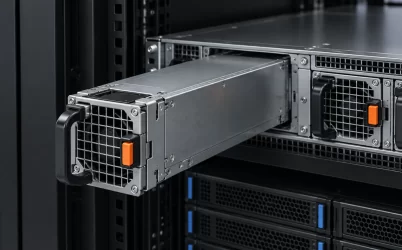
Hot-swappable server supplies often look similar because they are long, narrow metal modules with a fan, AC inlet, handle, latch, and blind-mate output. Similar appearance does not establish interchangeability. Length, cross-section, connector position, keying, airflow direction, standby rail, communication bus, firmware identity, and current-sharing method may differ. Even revisions within one family can have host-specific restrictions.
For an existing server, use its documentation and approved spare-part list. Match the complete part and revision information, not only “1200W Titanium.” Confirm whether a quoted item is the replaceable module alone or a kit containing a cage, PDB, cables, or other hardware. A module cannot provide redundancy by itself; it needs a host designed to combine and isolate multiple sources.
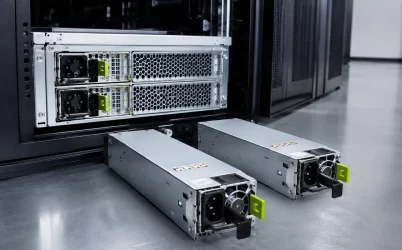
The featured product view for this article shows a complete module beside a server bay because that physical relationship is fundamental. The power rating sits inside a compatibility ecosystem. A module that cannot latch correctly, mate fully, communicate with the controller, or follow the intended airflow is not a valid replacement even if an electrical label appears attractive.
Redundancy is limited by the surviving path
Two 1200W modules create 2400W of installed nameplate capacity, but they do not automatically create 2400W of protected capacity. In a 1+1 configuration, either module is expected to support the protected server load after its partner fails or is removed. The useful redundant ceiling is therefore no greater than one module’s available output under the actual input and thermal conditions.
Some platforms use both modules for combined capacity. They can operate above one module’s limit while both supplies are healthy, then reduce performance or shut down when one is lost. That may be an acceptable availability policy, but it is not full-capacity 1+1 operation. The server’s firmware, power-cap settings, and documented behavior determine which interpretation applies.
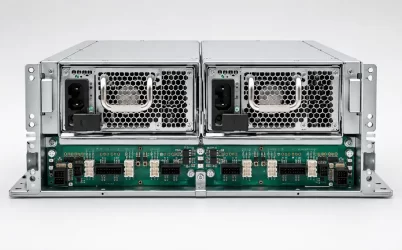
The power-distribution board also has to isolate a failed source and carry the entire survivor current. At a simplified 12V output, 1200W corresponds to 100A before considering auxiliary rails or conversion details. At that scale, connector resistance, busbar geometry, fusing, copper temperature, and voltage drop are system constraints. A higher-rated module cannot upgrade a PDB that was not designed for the current.
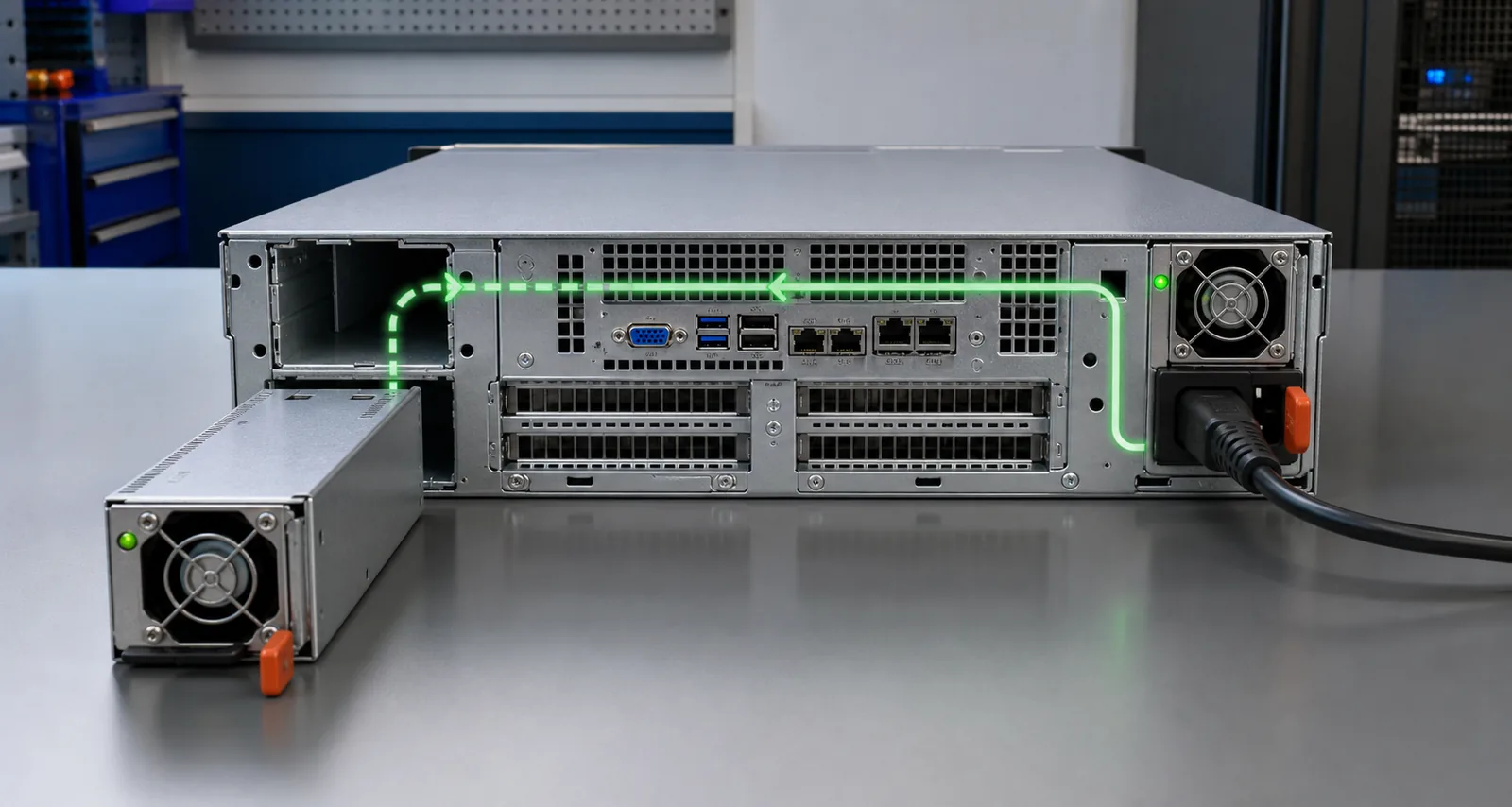
The image illustrates the electrical meaning of a redundant failure: the removed module is no longer sharing load, so the installed supply and common distribution path must support the server alone. This is the state that decides whether 1200W is sufficient for continuity.
Estimate input power and heat at the expected load
Efficiency converts directly into electrical loss. If a PSU delivers 800W at an illustrative 96% efficiency, its input is about 833W and its conversion loss is approximately 33W. At 94%, the same output would require about 851W and produce roughly 51W of loss. These figures are examples, not specifications for an unnamed product, but they show why a few percentage points matter across many servers.
The calculation should use the server’s actual operating region. A system that spends most hours at 350W per module will not realize savings according to a full-load number. A server that shifts from two lightly loaded modules to one heavily loaded survivor needs both points considered. Energy estimates based only on the 1200W nameplate can overstate consumption and conceal where the efficiency advantage occurs.
Loss becomes heat inside the PSU airflow path. In a dense rack, that heat can raise fan speed and add cooling demand. It is still important to keep scale in view: CPU and accelerator loads may dominate total server power, so PSU efficiency improves the conversion portion rather than eliminating the larger IT heat load.
Cooling a dense power module requires the intended airflow
A slim server PSU achieves high power density with a narrow, fast airflow path. Its internal fan and the chassis fans may operate in series or interact through pressure differences. An obstructed grille, reversed airflow option, missing baffle, cable blockage, or recirculated exhaust can reduce the air reaching hot components. Room temperature alone does not describe the module inlet condition.
The failure state can be thermally harder than normal sharing. When one module carries the complete load, its semiconductor and magnetic losses are concentrated in one bay. Its fan may accelerate while the empty or failed bay changes local pressure. The chassis must preserve the designed flow path with the permitted PSU population.
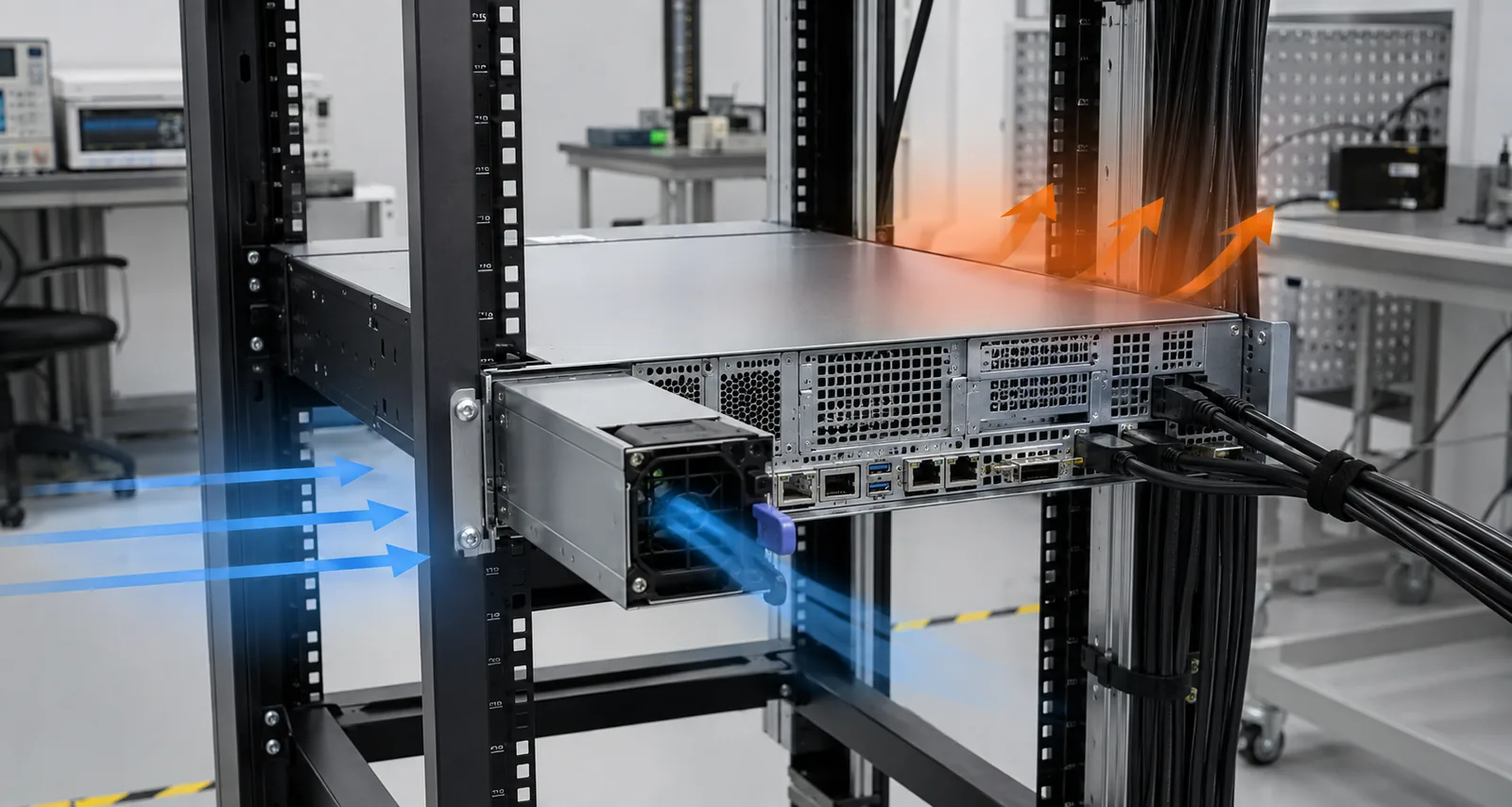
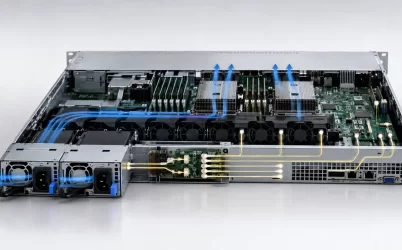
This airflow view supplements the electrical discussion by showing the route that removes conversion heat. It belongs beside the cooling explanation because Titanium certification alone cannot verify the pressure and recirculation conditions of a particular server.
Where a 1200W Titanium PSU makes practical sense
The class is a natural fit for servers whose component population can push a lower-rated supply too close to its continuous or transient limit, while still remaining within the single-module capability required by the availability policy. Examples can include compute nodes with high-power CPUs, accelerator-equipped edge servers, storage systems with many drives, and network appliances whose fans and interface cards add meaningful peak demand. The exact suitability depends on the supported host configuration rather than on the application label.
For a lightly loaded server, a 1200W module may still be the approved spare or the only option that supports future expansion. It should not, however, be selected merely because higher wattage sounds safer. Excess unused capacity can increase acquisition cost and may place ordinary operation at a lower fraction of rated output. Compare the expected load distribution with the exact efficiency curve and with the platform’s supported PSU population.
For fleet purchasing, consistency has operational value. Using the approved module family simplifies spares, service training, firmware management, and replacement handling. Mixing apparently similar modules to chase a small price difference can introduce alarms, sharing problems, or unsupported configurations that outweigh the energy benefit.
A correct selection connects four facts
A sound 1200W Titanium selection connects the host identity, available output, redundancy requirement, and operating load. The host identity determines which module can physically and logically participate. The output rating must remain available at the site input and inlet temperature. The redundancy policy establishes whether one module or the populated set must carry peak demand. The operating load shows where the efficiency data will matter during real use.
When those facts align, a 1200W Titanium server PSU can provide substantial capacity with low conversion loss in a compact, serviceable module. When they do not align, neither the wattage nor the efficiency tier can make the installation correct. Treat the label as two useful measurements, then let the server architecture decide whether the product belongs in the bay.