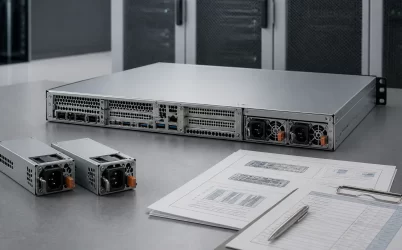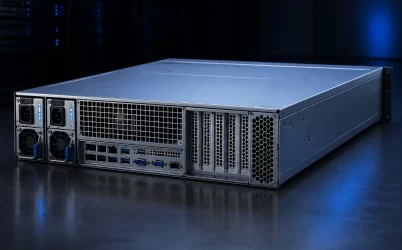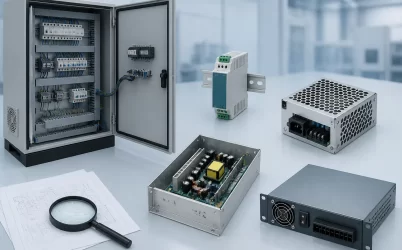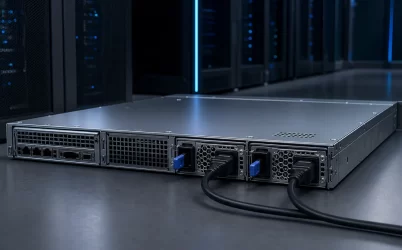
A 500W redundant server power supply is not a universal component defined by wattage. The phrase may describe two removable 500 W modules, a PS2-style redundant assembly, a CRPS-family module and PDB combination, or a proprietary hot-plug kit for a specific server platform. In a 1+1 arrangement, the protected load is normally limited by one module’s documented usable output—not 1,000 W—because the remaining module must support the server after its partner is lost. Before purchasing, identify the packaging architecture, exact host support, assembly contents, electrical interface, airflow direction, input conditions, and manufacturer part identity.
Quick answer: qualify the architecture before comparing prices
Choose a 500W redundant server PSU only after confirming what the quotation includes and whether one module can carry the permitted server load under the intended AC input, temperature, airflow, and workload conditions. Match the exact chassis bay, cage or PDB, connector and pinout, standby and control signals, management interface, firmware support, and airflow direction. For a replacement, use the server vendor’s supported part identity or documented substitute. Equal wattage, a similar handle, or a shared “1U” or “CRPS” description does not establish interchangeability.
The first specification is what the seller is actually supplying
Commercial listings use “500W redundant power supply” for deliverables with very different boundaries. A price may cover one replaceable module, a matched module pair, an outer housing containing two smaller supplies, or a complete system with cage, distribution board, wiring, and output connectors. A listing can also call one 500 W hot-plug module “redundant” because it is intended for a dual-module server, even though a single module does not create redundancy by itself.
The request for quotation should therefore begin with a plain description of the required deliverable. Useful language includes “one field-replacement module for an existing supported server,” “two matched modules with their mating cage and PDB,” or “a complete redundant AC-DC assembly with host-side output harness.” This prevents a capable component from arriving without the hardware needed to install it.
Ask whether the quoted 500 W is the continuous output rating of each module, the rating of the complete assembly, or a seller-created category description. The answer should point to the exact manufacturer datasheet and part number rather than a marketplace title. Accessories such as power cords, mounting brackets, extraction latches, cage hardware, and output cables should be explicitly included or excluded.
Four packaging routes can carry the same 500W description
| Architecture encountered in purchasing | What the buyer may receive | Compatibility evidence that matters |
|---|---|---|
| Removable 1U-format module | One narrow PSU intended for a redundant bay | Exact envelope, insertion depth, latch, mating interface, airflow, host support, and part identity |
| PS2-style redundant assembly | An outer power-supply enclosure containing removable modules or redundant internal paths | Complete enclosure dimensions, chassis mounting, AC entry, DC harness, output connectors, and service access |
| CRPS-family implementation | One or more modules that mate with a cage and power distribution board | Specified CRPS interface or generation, PDB pairing, connector contract, controls, management behavior, and mechanical keying |
| Platform-specific hot-plug kit | A PSU qualified for named server families or configurations | Vendor support matrix, option and spare numbers, server generation, firmware requirements, and installation rules |
“1U” does not resolve this classification. It may refer to the host chassis height, the height of a power-supply assembly, or a seller’s general product category. It does not define width, depth, connector position, latch geometry, pinout, or supported airflow.
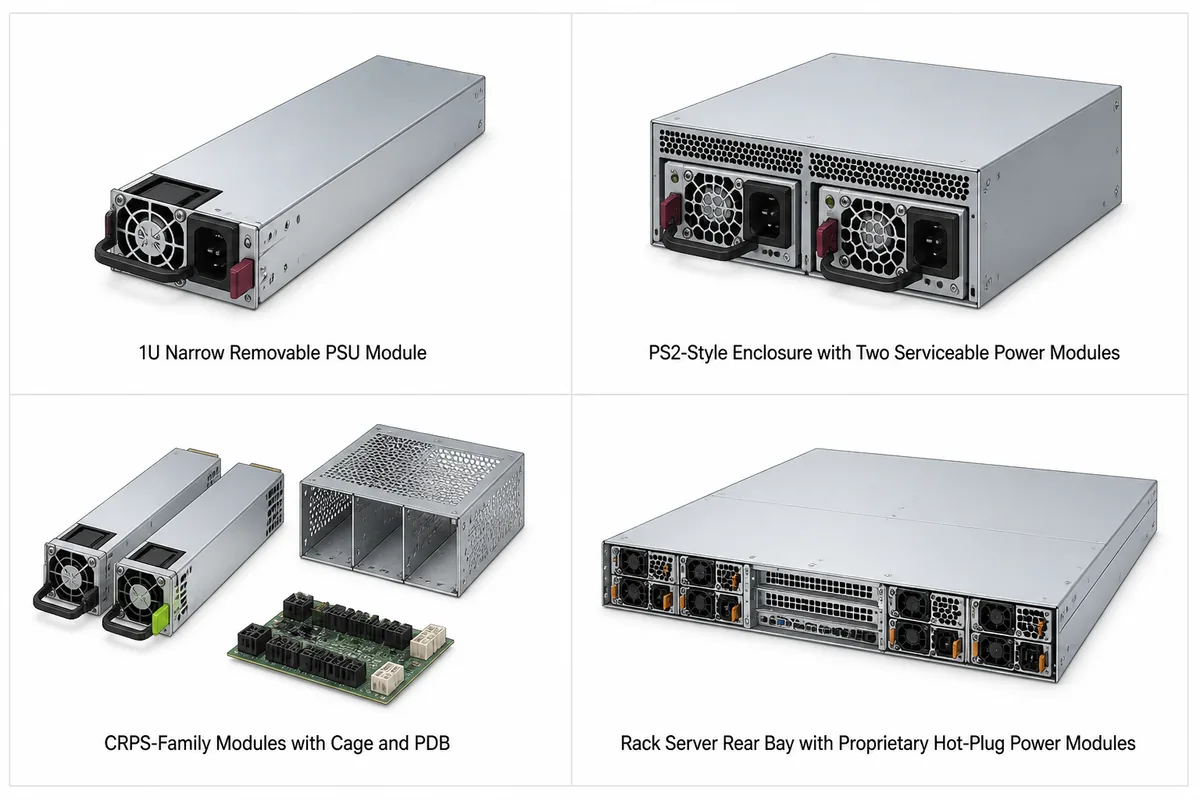
CRPS also needs a complete identity. It describes a common redundant power-supply architecture, but modules from different interface generations, power classes, or platform implementations should not be assumed interchangeable. A CRPS-style module usually depends on a matching cage and PDB rather than connecting directly to ordinary motherboard power sockets.
Proprietary platform options make the same point from another direction. For example, the HPE 500W Flex Slot hot-plug power supply kit is identified within a platform vendor’s server-power ecosystem. Its 500 W rating is not evidence that it can replace an unrelated 500 W supply with a different bay, connector, or host-support contract.
Five hundred watts is a single-survivor boundary
For a conventional 1+1 system, both healthy modules may share the load during normal operation. The capacity question, however, is whether one remaining module can support the permitted configuration after the other module, cord, or input path becomes unavailable. Adding two 500 W labels describes 1,000 W of installed nameplate capacity, but it does not normally create 1,000 W of protected server output.
A useful screening relationship is permitted protected load ≤ usable output of one module. “Usable output” is the lowest applicable limit created by the PSU rating at the deployed input, temperature and airflow, the host platform’s approved operating envelope, and the PDB or downstream connector path. Any model-specific derating or high-line requirement has to be taken from its documentation.
Consider a hypothetical server with a credible maximum DC requirement of 430 W. If the selected module genuinely supports 500 W under the deployment conditions, the nominal difference is 70 W. If its documented output falls to 450 W at a relevant input or thermal condition, the difference falls to 20 W. That remaining interval may be inadequate if workload transitions, fan acceleration, drive startup, component tolerances, or planned expansion consume it. The calculation does not prove transient support; it exposes how little room remains for the conditions that still need evidence.
Do not compare a wall-side AC measurement directly with the PSU’s DC output rating. Conversion loss means AC input is higher than delivered DC output, and management telemetry may report power at a different measurement boundary. The detailed server PSU capacity-envelope method explains how to combine configuration demand, transient behavior, derating, and redundant operation without treating unlike measurements as equivalent.
A 500 W class is most plausible for server configurations whose degraded-state load remains comfortably inside that documented single-module envelope. It can become restrictive after adding a higher-power CPU, accelerator, a large drive population, high-speed adapters, more memory, or a more aggressive fan policy. Suitability must be attached to the configured host, not to a generic label such as “entry server” or “storage server.”
Replacement compatibility is an identity problem
A replacement purchase should begin with the server’s supported spare or option number, the installed PSU’s manufacturer part number, and the host model and generation. Record the hardware revision where it is relevant. Sellers may group several revisions or substitutes under one listing, so the part actually shipped must be visible in the quotation and order acknowledgement.
The mechanical path
Confirm the complete module envelope, insertion direction, mating depth, latch and handle geometry, keying, extraction clearance, and rear-panel opening. Similar-looking narrow modules can place the connector, latch, fan, or stop features differently. For a PS2-style assembly, verify chassis screw locations and whether internal components or cables obstruct installation or module removal.
The main-power and signal path
The host must match the documented DC outputs, return paths, standby supply, control signals, status signals, sense functions, and communications interface. Some server architectures distribute a main intermediate bus through a PDB and generate additional rails downstream; other assemblies expose a harness with several host connectors. Similar connector shells are not proof of a common pinout or current path.
Where a PDB is involved, the PSU module, blind-mate connector, board, cage, bus or harness, and host controls form one assembly contract. The CRPS PDB interface boundaries show why buying a module and board as independent wattage-rated parts can leave mechanical, electrical, control, or cooling gaps.
The firmware and cooling path
A mechanically and electrically plausible module can still be unsupported if the BMC does not recognize its identification data, interprets status incorrectly, or rejects mixed PSU types. Confirm whether modules must have matching part numbers, ratings, firmware, or revisions and whether mixed operation is explicitly permitted.
Airflow direction and impedance are equally model-specific. A supply intended to move air with the server’s fan wall may not behave correctly when installed in an opposing airflow system. The host must also provide the inlet temperature and pressure conditions associated with the documented rating, especially during one-module operation when the survivor carries more electrical and thermal load.
Hot replacement has five electrical moments
A removable handle indicates service intent, but supported hot replacement is a system behavior. The host documentation should describe what happens from the initial fault through restoration of load sharing.
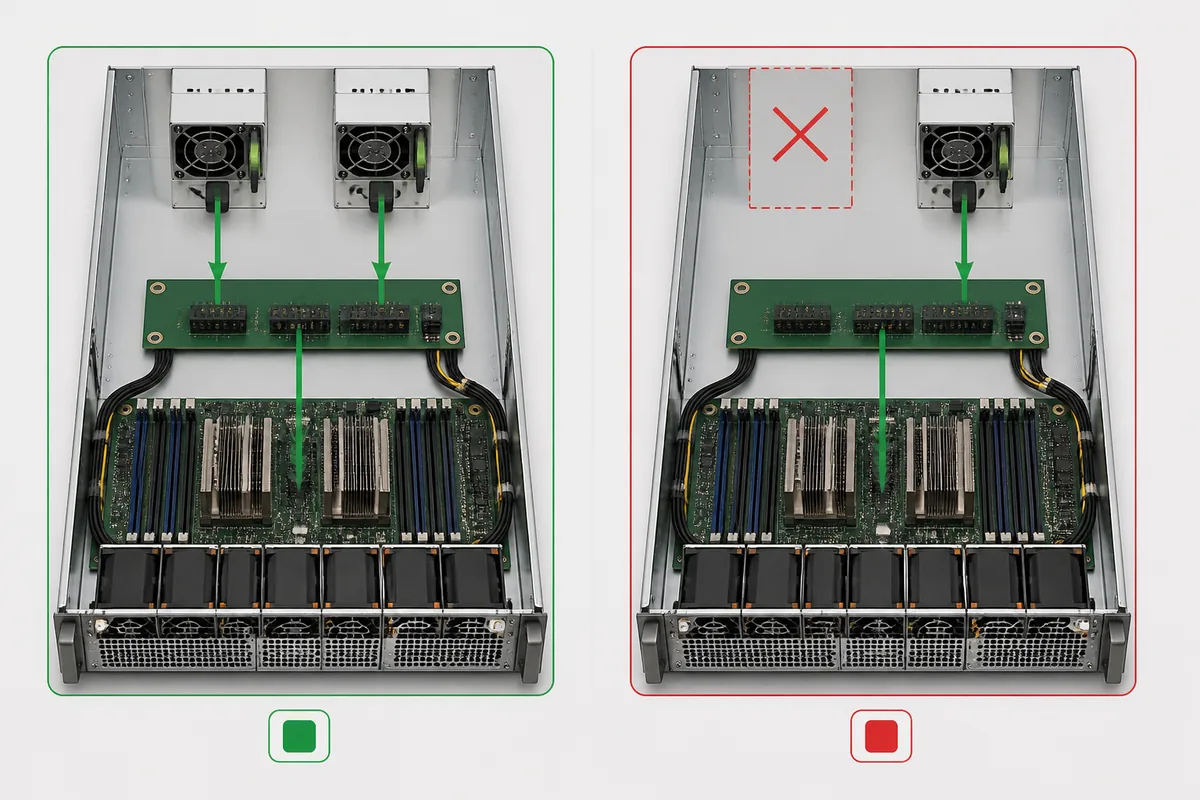
- Fault detection and isolation: the failed or unpowered module must stop disturbing the shared DC bus while the healthy path remains active.
- Single-module operation: the survivor assumes the permitted load without crossing its output, thermal, or input boundary, and the host reports the degraded state.
- Removal: connector sequencing and mechanical guidance separate power and control contacts in the intended order without exposing an unsupported service condition.
- Insertion and startup: the replacement enters the energized system with controlled inrush and the correct startup behavior for the mating PDB or backplane.
- Return to sharing: the new module reaches a healthy state, participates in current sharing as designed, and clears or updates the host alarm.
These moments cannot be inferred from “hot-swap” in a reseller title. Confirm that the exact server, PSU, cage or PDB, and service procedure support live replacement. If the host requires shutdown for a particular supply type or installation state, a physically removable module does not override that requirement.
A quotation should distinguish hardware from capability
A useful supplier response connects every claimed capability to an exact item and operating condition. The quotation package should resolve:
- manufacturer name, full part number, revision policy, and whether the item is new, refurbished, or otherwise classified;
- whether the price covers one module, two modules, a redundant enclosure, or the complete cage/PDB/harness assembly;
- documented continuous output under the intended AC input, ambient temperature, altitude, and airflow conditions;
- host models or platforms for which compatibility is officially supported;
- mechanical drawings and mating-interface documentation appropriate to the purchase scope;
- output rails, connector identity, pinout-controlled documentation, standby and control signals, and management functions;
- supported redundancy, current-sharing, fault-isolation, and hot-replacement behavior;
- airflow direction and any host cooling assumptions;
- efficiency certification, safety approvals, and regulatory evidence for the exact model and operating category when those are procurement requirements;
- included cages, PDBs, cables, brackets, cords, and mounting hardware; and
- warranty, change-notification, traceability, and future-spare terms.
An efficiency tier answers a conversion-efficiency question under defined test conditions. It does not establish that one 500 W module can support the configured server, that two modules form independent failure paths, or that the supply is compatible with a particular host. Those claims require separate evidence.
Three legitimate purchase paths
Buy the exact supported replacement
This is usually the lowest-integration-risk path for an existing branded or proprietary server. Match the platform vendor’s supported option or spare identity and any restrictions on mixing modules. A lower-priced unit with the same 500 W rating is not an equivalent replacement unless the platform documentation or supplier evidence establishes that equivalence.
Buy a complete redundant assembly for a new chassis
For an integration project, purchasing matched modules with their cage, PDB, harness, and interface documentation can close more boundaries than sourcing each part separately. The integrator still has to provide a compatible chassis opening, mounting, airflow, downstream distribution, host controls, and firmware behavior, but the critical module-to-PDB relationship is less ambiguous.
Move to a higher supported class or another architecture
A higher rating is justified when the permitted server configuration cannot remain inside one 500 W module’s usable envelope after relevant derating, transients, and expansion are considered. It may also be preferable when 500 W replacements have weak availability, the existing assembly is obsolete, or a planned platform standard offers better long-term spares. Moving up is not automatically beneficial: the larger supply still needs host approval, suitable load behavior, physical fit, cooling, and an efficiency profile appropriate to the actual operating point.
The field spare is part of the original 500W decision
The purchasing record should remain useful after the first installation. Store the manufacturer part number, approved substitutes, host models, required firmware, module-pairing restrictions, assembly contents, and source documents with the bill of materials. Photographing or scanning the installed label can prevent a shortened reseller description from becoming the only identity available years later.
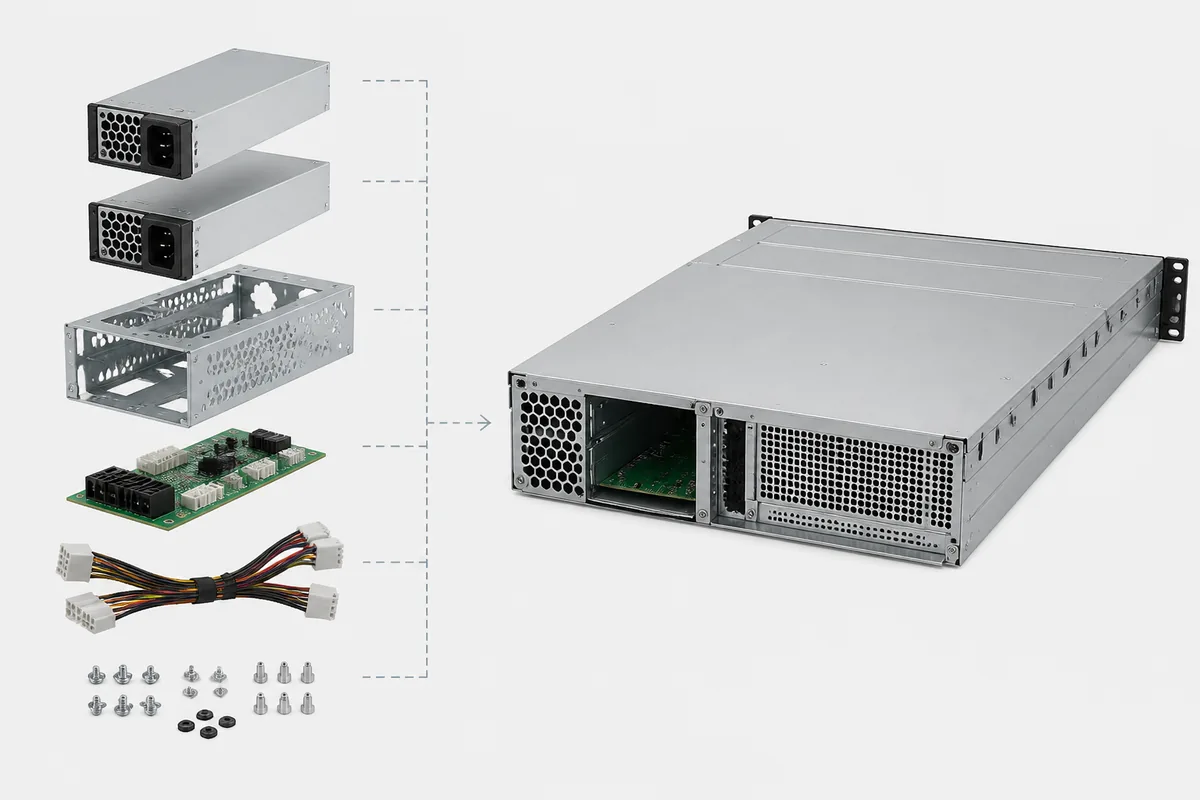
Incoming parts should be compared with that controlled identity before they enter spare stock. On a supported host and under the platform vendor’s service procedure, confirm that the module seats correctly, is recognized by management, reports the expected status, and returns the pair to its protected operating state. A live removal test should be performed only where the host documentation, available load margin, and maintenance plan permit it.
This makes the 500 W rating one part of a durable purchase rather than the entire specification. The successful outcome is an identified module or assembly that fits the intended server, carries the permitted load after one path is lost, behaves correctly through replacement, and can be reordered without reconstructing its compatibility from appearance alone.