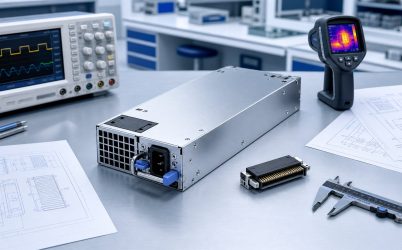
An 80 Plus Platinum redundant server power supply combines a certified efficiency tier with a fault-tolerant module arrangement, but the two claims answer different questions. Platinum describes conversion efficiency under a defined 80 PLUS test category. Redundancy describes whether another compatible power path can support the permitted server load after a module or input failure. The operational value appears where these two systems interact: active current sharing changes each module’s load point, a failed module moves the survivor to another part of its efficiency curve, and independent A/B feeds determine which upstream events the server can tolerate.
Model two operating states, not one headline percentage
Begin with the normal state. If two active modules share an 800 W DC server demand, each handles roughly part of that load, subject to share imbalance and auxiliary consumption. The relevant efficiency is each module’s measured performance at its own operating point. Next model the degraded state: one module carries the complete 800 W and its loss, fan speed, and exhaust temperature change.
The 80 PLUS certificate provides standardized evidence for the exact model and category, while the manufacturer’s full curve supports a more detailed energy model. Do not transfer a threshold table from another voltage or product category. Confirm the tested model and input condition in the official record.
Calculate annual conversion loss by load bin
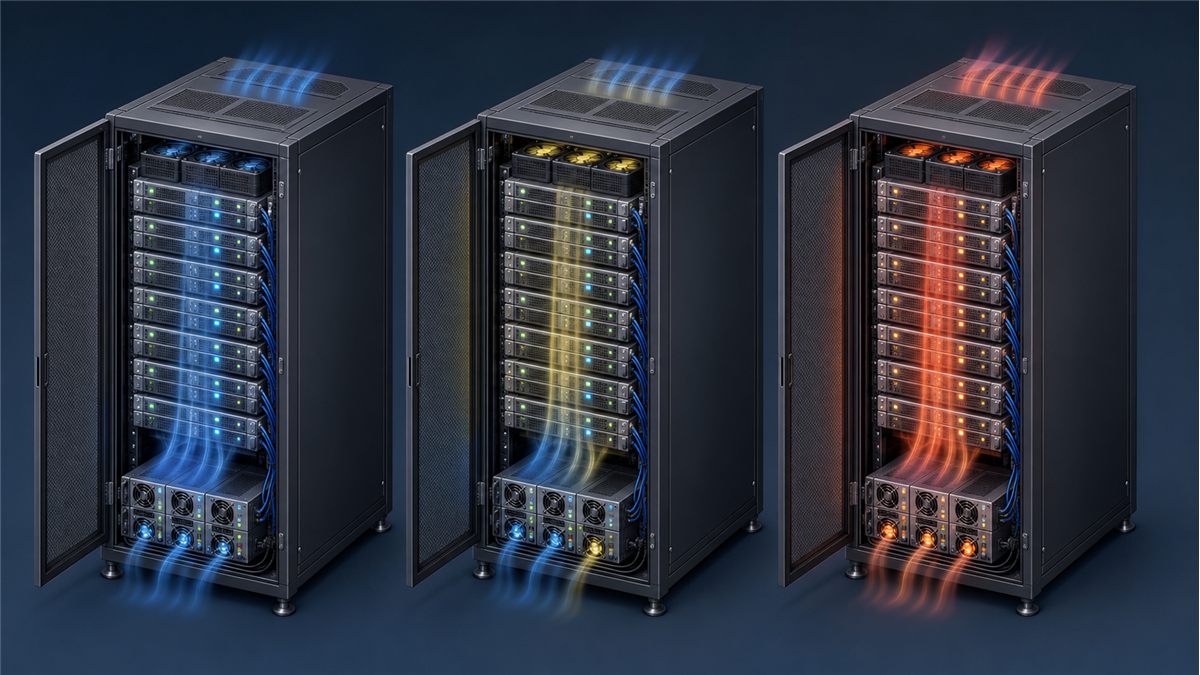
For each workload bin, divide DC output by efficiency to estimate AC input, then subtract DC output to find conversion loss. Perform the calculation per module for the active-sharing policy. Multiply by hours in that bin and repeat for idle, typical, batch, and peak periods. This method avoids assuming that peak efficiency applies all year.
Include degraded operation according to the expected repair interval. It may represent few annual hours, but it determines thermal and capacity limits. Cooling energy can be estimated only with an explicit facility assumption; every conversion-loss watt becomes local heat, while the extra facility energy needed to remove it varies by site.
Platinum certification does not establish redundant capacity
For 1+1 redundancy, either module must support the permitted server load at the actual input voltage, inlet temperature, altitude, and airflow. Some high-power modules provide their full output only in a higher-voltage input region. If low-line output is derated, the server’s redundant ceiling is lower even though the efficiency certification remains valid in its stated category.
Include transient demand. Processor and accelerator excursions can occur faster than management controls respond. The surviving module, PDB, connectors, and downstream bus must keep voltage within limits during the transfer and subsequent peak.
A/B input design controls the protected failure domain
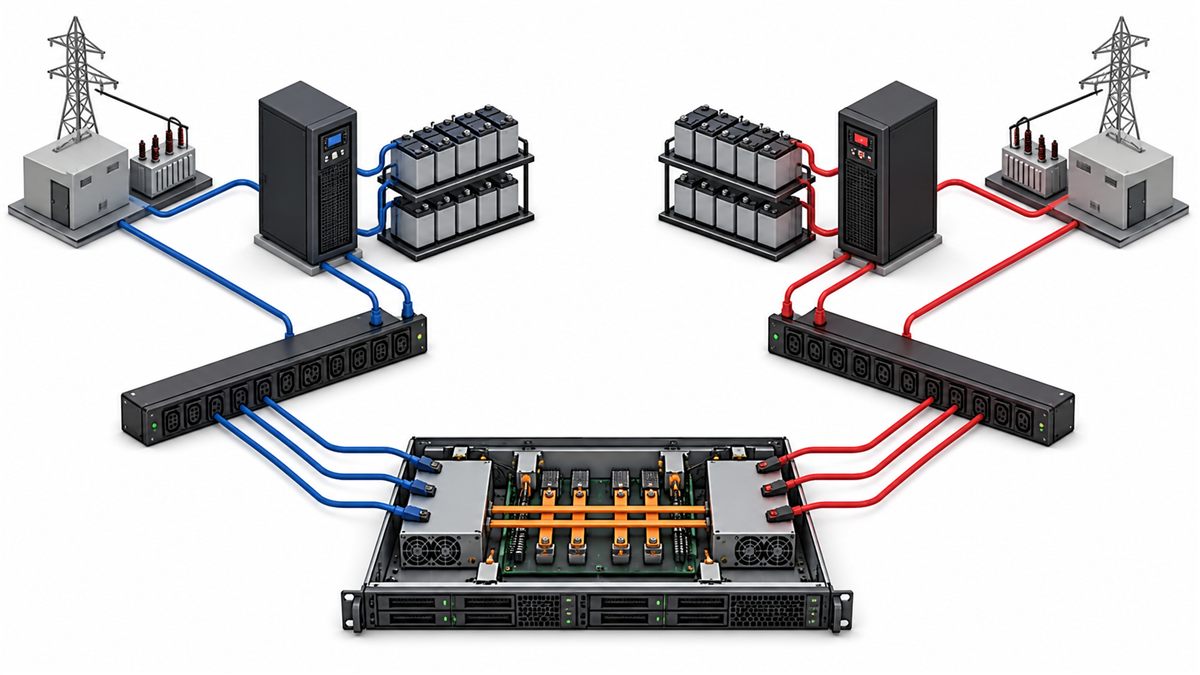
Two Platinum modules connected to one PDU protect against selected module faults but not that PDU or branch. If the availability objective includes upstream loss, connect the modules through appropriately independent A and B paths. Confirm that the surviving branch, PDU, cord, and module can carry the transferred input current.
An efficiency or hot-spare policy can unbalance A/B current during normal operation. Many servers in one rack using the same preferred side may concentrate load on one feed. Facility planning should use measured behavior under the chosen power policy and account for simultaneous transfer after a source event.
Current sharing can improve or reduce system efficiency
Spreading current can reduce conduction loss and component temperature, but it also keeps two modules’ control and fans active. Concentrating load on one unit can move it toward a favorable efficiency region while another waits in standby. The better outcome depends on the exact curves, fan strategy, and supported platform behavior.
Do not create a standby strategy by disabling a module manually. Transition timing, reserve readiness, fault detection, and source balance require coordinated PSU, PDB, and firmware support. Compare energy and resilience with the policy the server actually implements.
Lower electrical loss changes the thermal budget
At a given DC output, a more efficient conversion point produces less heat inside the PSU. Across many continuously operating servers, a modest difference can accumulate into material rack and facility energy. In one intermittently used server, purchase price and compatibility may dominate.
Efficiency tier does not directly specify internal component temperature or acoustic behavior. Fan curve, airflow impedance, inlet restriction, topology, and heat-sink design still matter. Measure both modules in the production chassis, then repeat with one module removed and the survivor at the maximum redundant load.
Compatibility remains model-specific
A Platinum module may share the apparent CRPS shape with another unit while differing in depth, connector keying, pinout, output or standby rail, enable timing, current share, PMBus identity, airflow direction, and firmware acceptance. The server’s approved-parts list and exact interface documents control replacement.
The PDB must carry full survivor current and isolate a failed output. Connector, copper, ORing, and downstream limits may be below the module rating. Upgrading efficiency or wattage does not change those distribution limits.
Light-load behavior matters in oversized pairs
Redundant modules are often sized so one unit can carry an unusually high configuration or future expansion. At ordinary utilization, each active module may operate at a small fraction of rating. Fixed control, fan, and bias losses then represent a larger share of input power. Compare actual curves in this region rather than assuming the standardized mid-load point represents fleet idle.
Oversizing can still be justified by transient margin, future hardware, low-line derating, or standardization, but the energy consequence should be visible. If a platform supports a validated standby-reserve policy, model its savings and its effect on source balance. If not, choose capacity based on the real configuration rather than purchasing the largest available module by default.
Power telemetry can validate the energy model
Where PMBus and the BMC expose input and output power, telemetry can help build load bins and identify how modules share. The values have model-specific resolution, accuracy, and update rate. Compare them with external instruments before using them for financial calculations or automated capacity limits.
Collect data across representative days instead of one benchmark run. Include idle nights, batch windows, backup or rebuild activity, and high-demand workloads. Note whether the server changes its module policy automatically. This evidence turns a theoretical Platinum advantage into a site-specific operating estimate.
Fleet standardization can change the TCO result
A slightly less efficient module that is already approved across a large installed base may reduce spare inventory, qualification effort, and repair complexity. Conversely, a standardized Platinum platform can spread energy savings and simplify replacement. Include the cost of maintaining multiple module families and firmware combinations in the decision.
Standardization must not erase host boundaries. The same module may be approved in one server but not another because of PDB, BMC, airflow, or power-policy differences. Maintain an approved compatibility matrix tied to exact server and PSU revisions.
Efficiency in the degraded state affects repair urgency
After one module fails, the survivor operates at a higher load and may produce a different amount of conversion heat. Facility input current also transfers to one feed. Measure whether this state approaches fan, temperature, PDU, or branch alarms. Those observations can inform the maximum tolerated repair interval.
The degraded state is not the time to discover that full output is unavailable at the rack voltage or inlet temperature. Commissioning should sustain the maximum approved redundant load long enough for temperatures and facility readings to stabilize, while respecting the platform’s operating limits.
Reliability evidence is separate from the efficiency tier
Reduced loss can help thermal margin, but 80 PLUS is not a reliability certification. Evaluate safety and EMC evidence, protection behavior, component and fan strategy, manufacturing controls, warranty, supported environment, and qualification. Overvoltage, overcurrent, short-circuit, and overtemperature labels need thresholds, timing, and recovery behavior.
In a redundant system, the important fault behavior is containment. A failed module must not pull down the common bus. The BMC should report loss of redundancy promptly and distinguish input loss from an internal module fault when supported.
Compare lifetime cost with explicit inputs
| Input | Why it matters |
|---|---|
| Efficiency curve at deployed input | Determines loss at each module load |
| Server load distribution | Weights operating points by time |
| Power-management policy | Changes active module count and A/B balance |
| Electricity and cooling assumptions | Translate loss into operating cost |
| Purchase and replacement cost | Sets the investment difference |
| Service period and utilization | Controls accumulated savings |
Use sensitivity ranges instead of a single precise payback claim. Platinum may be attractive for continuous fleets, higher utilization, expensive energy, or constrained cooling. A lower tier may remain rational for short-lived or lightly used systems if it satisfies every electrical, thermal, and host requirement.
Deployment evidence
- Match the offered part number to its 80 PLUS certificate and exact test category.
- Collect efficiency curves at the planned input and map them to server load bins.
- Confirm one module’s capacity after input and thermal derating.
- Validate connector, PDB, control, PMBus, current-share, and firmware compatibility.
- Measure input power and DC output under normal sharing and the single-module state.
- Interrupt each A/B input and remove each module while monitoring the shared bus.
- Record temperatures, fan behavior, alarms, telemetry, and return to sharing.
- Calculate energy and cost using the measured operating policy.
Powernexu’s Platinum server PSU efficiency article explains certification context in greater depth. The dual redundant server power article covers failure paths and surviving capacity.
The purchase decision
Choose a Platinum redundant server PSU when its certified model matches the host, its efficiency curve benefits the actual per-module load distribution, and either module can carry the server within deployed limits. The business case should combine energy and cooling with platform support, spares, service, and availability. Platinum can make a redundant architecture more efficient; it cannot make an incompatible or under-capacity pair redundant.