An 850W 80 PLUS Platinum server PSU is not necessarily an 850W-at-every-outlet device. Search results mix desktop ATX supplies with removable server modules, and at least one documented redundant server module is rated for different maximum DC outputs at low-line and high-line AC input. The useful question is therefore not whether “850W Platinum” sounds efficient. It is whether the exact server PSU supplies the required output on the facility feed that will actually power it, including after one feed or module is lost. Form factor and the applicable efficiency test record then determine whether the apparent match is real.
The search phrase can describe two different kinds of PSU
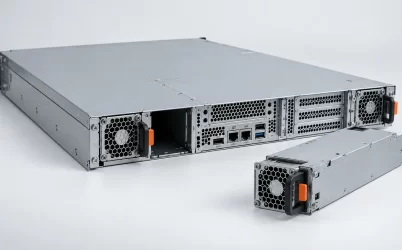
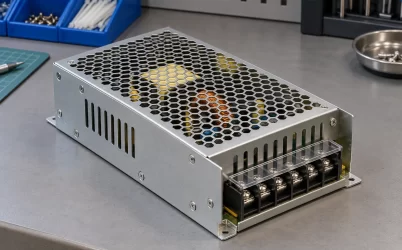
A desktop or workstation ATX supply can legitimately be advertised as 850W and 80 PLUS Platinum. So can a narrow, removable PSU intended for a server chassis. Their shared wattage and efficiency words do not make their output distribution or mechanical interfaces equivalent. An ATX unit generally exposes a harness arrangement for a motherboard and attached devices. A hot-plug server cartridge normally mates with a host-specific power distribution board or backplane and participates in the platform’s service and management arrangement. Neither architecture is inherently better; they solve different installation problems.
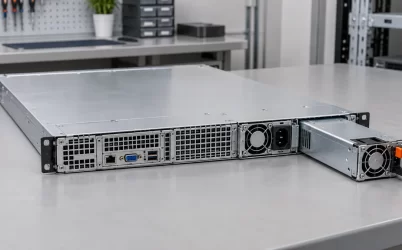
The first useful distinction in a search result is therefore the physical object. Is the picture showing a self-contained ATX box with output cables, or a slim cartridge intended to slide into a server bay? A reseller may describe either as a “server power supply,” especially when selling a workstation system or a part removed from a server. The system integrator still needs a way to route the converter’s output to the intended loads. An ATX harness is not a blind-mate server connector, and a server cartridge does not become an ATX replacement by carrying the same 850W label.
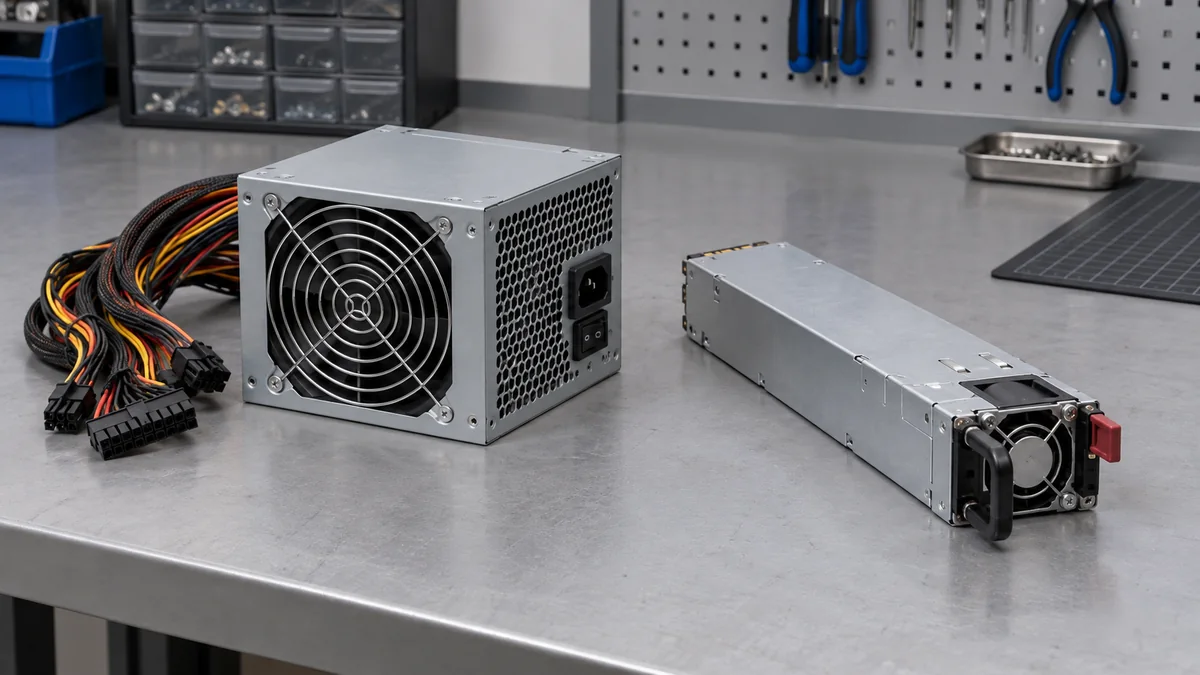
This is not merely a terminology concern. A compact rack server may provide room for two cartridge bays but no ATX mounting position; a workstation-style server may have the opposite arrangement. Even among slim modules, width, depth, latch, electrical contacts, airflow direction, control signals, and host firmware expectations vary by product. An image of a similar cartridge cannot establish interchangeability. The exact module and server or PDB relationship has to be documented by the relevant manufacturer.
For a new design, the choice begins with the intended service model. If a technician must exchange a failed supply without shutting down the host, a compatible hot-swap cartridge and supporting power path are relevant. If the host uses a fixed ATX supply and a maintenance window is acceptable, an efficient ATX unit may be entirely appropriate. The search keyword does not decide this architecture for the engineer.
One documented module has an 850W low-line and 980W high-line rating
The Supermicro PWS-982P-1R is a useful concrete example because its official quick specification gives two output limits: 850W with 100–140 VAC input and 980W with 200–240 VAC input. It identifies the product as a redundant 1U PSU and describes its efficiency as 80 PLUS Platinum. Those are facts about this exact module, not a rule for all 850W Platinum supplies. The document also shows a different maximum 12V current in each input band, reflecting the changed available output.
Why can low-line operation limit output? A converter must accept greater input current to deliver comparable power at a lower AC voltage, while its conductors, switching components, rectification stage, protection system, and thermal path operate within their designed limits. The precise limiting mechanism for any one supply is a matter for its manufacturer’s design and specification; it should not be reverse-engineered from the marketing wattage. What matters to the server is the published output envelope. Asking for 980W from the example module on a low-line feed would exceed the documented 850W maximum even though the same module supports 980W in its high-line range.
Do not interpolate casually between the published input bands. The example document lists 100–140 VAC and 200–240 VAC as its rated ranges. It does not establish an arbitrary output limit for every intermediate voltage. Likewise, a facility nominal voltage is not by itself the voltage at the PSU inlet under every operating state. PDU configuration, UPS output setting, regional distribution, and permitted tolerances all matter. For an actual installation, the relevant value is the input condition supported by the exact module and host when the server is running, not a nominal figure remembered from the building plan.
Two AC feeds can create two different failure outcomes
Consider a hypothetical redundant server equipped with two approved instances of a module that has the same dual rating as the PWS-982P-1R example. Suppose one cartridge is fed from a low-line source and the other from a high-line source, with the host configured for 1+1 operation. If the high-line side fails, the remaining low-line cartridge’s documented ceiling is 850W. If the low-line side fails, the surviving high-line cartridge may have a 980W ceiling under its published conditions. The protected load cannot be described simply as “980W redundant” while either failure is possible. It is bounded by the less capable surviving state, plus any tighter limit imposed by the chassis, PDB, firmware, or environment.
This example is not an endorsement of mixing input arrangements. Some server platforms may not support such a configuration, and the module’s own input specification does not establish host approval. Its purpose is to expose an asymmetry hidden by the attractive phrase “dual power feeds.” Independent feeds provide a path around an upstream failure only when each surviving path can sustain the protected workload and the host permits that operating state.
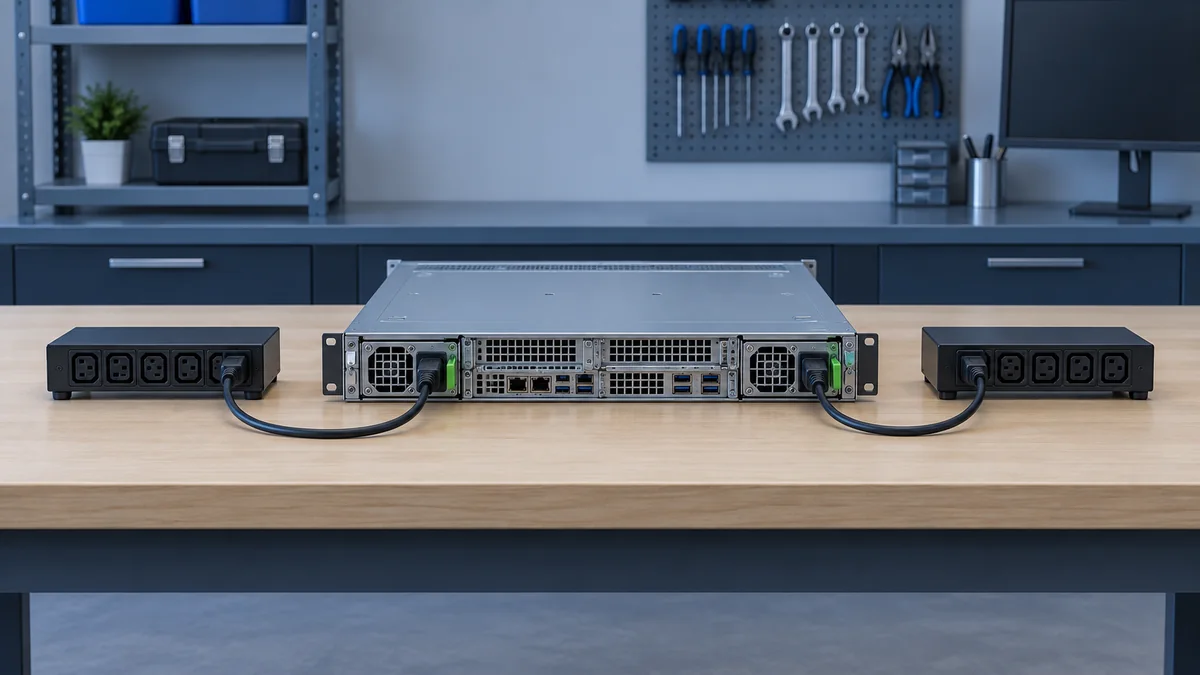
For a simpler pair of identical low-line feeds, the example module would still be limited to its documented low-line output per survivor. Two installed cartridges may share the normal demand, but a 1+1 protected capacity is not the arithmetic sum of their individual nameplates. A pair rated 850W each under the applicable conditions does not thereby provide 1,700W after one cartridge is unavailable. The host’s approved redundancy mode and the remaining module’s effective output define the capacity that matters during failure.
The workload side also needs the right time frame. A server that normally draws comfortably below 850W can still enter a higher-load condition through processor boost, fan speed changes, storage activity, or an added accelerator. That does not justify adding every component’s independent peak as if all peaks coincide, but it does require an application-specific maximum that the platform can actually reach. If power caps are part of the design, the caps and their behavior during a PSU or feed fault belong in the protected-load definition. The source side and load side must describe the same failure state.
Platinum does not tell you the low-line output ceiling
80 PLUS Platinum is an efficiency classification. It is not a promise that a PSU produces a particular output at every accepted input voltage, nor does it specify a connector, bay, redundancy mode, or host compatibility. The relevant certification record belongs to a specific product tested in a defined category and at defined conditions. The 80 PLUS program distinguishes internal supplies used for desktop, workstation, and nonredundant-server applications from supplies for redundant data-center applications. Thus the category and exact model identity matter when comparing two products that both use the Platinum word.
Efficiency describes a relationship between DC power delivered and AC power drawn at the tested operating point. Output rating answers a different question: the maximum DC power the unit may supply under stated conditions. A Platinum-labelled 850W ATX unit and a Platinum-labelled 850W low-line server cartridge can have different electrical interfaces and very different host roles, even if both convert AC power efficiently. Neither certification nor a peak-efficiency phrase supplies a complete load curve for the actual server configuration.
To make the distinction tangible, imagine a server load of 600W DC, an assumed operating efficiency of 92%, and a supply whose documented output limit under that inlet condition is at least 600W. These numbers are hypothetical, not measured results for the Supermicro example. Approximate AC input would be 600 ÷ 0.92, or 652W, with roughly 52W dissipated as conversion loss. Changing the assumption to 94% yields about 638W input and 38W loss. The calculation illustrates what an efficiency difference can do at one load; it does not prove either percentage for a named product or validate an 850W output claim.
The mechanical heat path makes the difference practical. In a narrow server cartridge, heat must leave through a constrained airflow route while the chassis and adjacent modules set inlet conditions. More conversion loss raises the heat to remove, but a high efficiency label cannot compensate for blocked intake, incorrect airflow direction, or an unsupported bay. Conversely, a server operating far below the module’s rated output may sit at a different point on its efficiency curve from a certification headline. The actual load distribution and inlet conditions tell more than the Platinum word alone.
What an 850W-class design can realistically support
The 850W class can fit a range of moderate-power server designs, including some compute, storage, and network appliances. It is not inherently a “small server” rating: available headroom depends on processors, memory, drives, fans, adapters, accelerators, and the host’s distribution losses. Neither the search phrase nor the PSU nameplate identifies a supported CPU/GPU combination. A dense GPU configuration may exceed the protected capacity even if its average draw appears acceptable, while a storage node with a lower steady load may use a fraction of the available output.
For a system with no redundancy requirement, a documented 850W module might serve as the sole converter if the host supports that arrangement and the effective output remains above the highest required demand. In a 1+1 system, the relevant comparison is between the full protected workload and one surviving module under its worst permitted input and cooling conditions. In a capacity-sharing arrangement that intentionally uses both modules to exceed one-module output, loss of one source may cause throttling or shutdown; that is a different service promise and needs explicit host support.
The host and PSU have to agree on the power path
A server cartridge’s output contacts mate to a chassis-specific power path. The PDB or midplane then routes power to motherboard regulators and other load zones, often alongside standby power, status, control, and management functions. This is why a plausible photograph of a cartridge cannot approve a substitution. The module must seat, latch, cool, communicate, and carry the correct output through the host’s actual interface. Documentation for the exact server or chassis is the authority for supported combinations.
That host relationship determines whether a second cartridge is useful. Redundancy needs more than two slots: the PDB must isolate a failed source appropriately, the control system must manage current sharing or another approved operating policy, and the surviving path must carry the protected load. Hot-swap capability also depends on the entire insertion and removal arrangement, not simply on a removable handle. These subjects deserve their own detailed platform review, but they cannot be assumed from “850W 80 PLUS Platinum.”
Where an existing server is being repaired, the installed part number and an approved replacement or supersession path take precedence over a broadly similar search result. Where a new chassis is being integrated, the chassis documentation, PSU specification, PDB design, and cooling layout define the candidate set. This article addresses the operating meaning of the 850W label; it does not establish that the Supermicro example or any other third-party module is compatible with a Powernexu product.