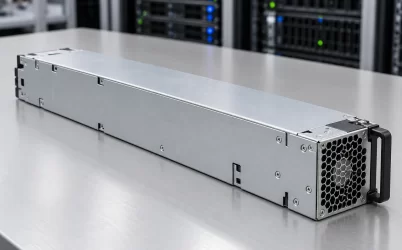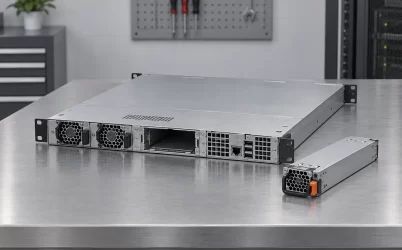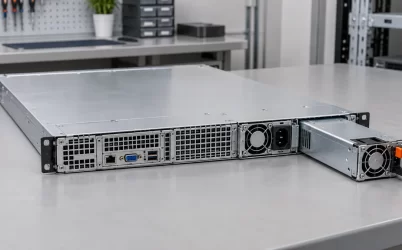
For HKS2700D1-P rack-feed selection, the available evidence is insufficient to approve an input voltage, usable output rating, or replacement fit. Powernexu lists the exact-suffix item as 2700 W with a 12 V output, but these are unverified seller claims. Huntkey’s official page identifies HKS2700D1 without “-P”. Its specifications cannot be assigned to HKS2700D1-P without manufacturer documentation explicitly covering that suffix and the relevant revision.
The exact -P model remains unverified in the available manufacturer material and cannot yet be treated as an approved selection. Before sizing a rack feed or ordering a spare, obtain exact-model manufacturer evidence and the host maker’s approval for the intended installation.
Separate the seller listing from manufacturer evidence
The Powernexu HKS2700D1-P product listing is a sourcing lead. Its 2700 W and 12 V descriptions identify what the seller offers; they do not verify the module’s output capability under a particular input voltage or operating condition. Any exact-suffix dimensions, standby output, efficiency, redundancy, hot-swap, environmental, or interface specifications presented by the seller remain unverified claims.
The official Huntkey product page names HKS2700D1 in both its title and specification table. That is manufacturer evidence for the unsuffixed model only. The shared base designation does not establish that HKS2700D1-P has the same electrical design, connector, enclosure, firmware, or operating limits. Neither a seller’s description nor matching values across the two pages closes that identity gap.
Keep these evidence categories separate in the purchasing record: seller description, exact-model manufacturer documentation, and host-system approval. Procurement acceptance requires the latter two; a catalog listing alone is not an engineering release.
What the no-suffix input table illustrates—and what it cannot establish
Huntkey’s HKS2700D1 table lists different maximum +12 V currents at different AC inputs: 110.7 A at 110 Vac, 208 A at 210 Vac, and 221.6 A at 230 Vac. These figures belong to HKS2700D1 without the suffix. They illustrate a general selection issue: an input range and a headline power rating do not necessarily mean that the same output is available at every input voltage.
Do not use those rows to size HKS2700D1-P, calculate its output or current, establish its 1+1 surviving capacity, infer compatibility, or accept it for procurement. The table does not verify either high-line or low-line operation for the -P assembly. It also cannot be used to assign the unsuffixed model’s stated DC-input capability to HKS2700D1-P.
For the exact -P model and revision, request rated output limits across the intended input-voltage range, including any low-line restrictions. A nominal rack voltage is not the whole operating condition: the module sees voltage variation and losses through the branch circuit, PDU, and cord. The approved rating must cover the lowest credible voltage at its input under load.
Identify the complete assembly before ordering a spare
Start with a readable photograph of the installed module’s full label. Record the complete model suffix, manufacturer part number, hardware revision, firmware identification where available, and any host-specific spare or option number. Also record the server or power-shelf model and its power-distribution-board configuration. Do not shorten HKS2700D1-P to HKS2700D1 in the service record.
Request a manufacturer cross-reference that explicitly names HKS2700D1-P and explains its relationship to any other designation used in drawings or certificates. The suffix might distinguish a mechanical, electrical, firmware, or commercial variant, but its meaning is not established by the available evidence and should not be inferred.
The host maker must also approve the proposed module and pairing. Confirm whether both installed modules must have matching part numbers, revisions, or firmware, and whether mixed pairs are permitted. A common manufacturer, similar appearance, or matching advertised wattage does not demonstrate interchangeability.
Check the AC feed against exact-model input requirements
Once the exact assembly is identified, obtain its manufacturer-approved AC-input specification: voltage and frequency limits, maximum input current at the intended operating conditions, inrush behavior, protective-earth requirements, and approved inlet and cord arrangement. Do not derive branch-circuit requirements from the seller’s 2700 W description or from the unsuffixed model’s output-current table.
Check the entire feed path, including the branch circuit, PDU outlet, cord, inlet, and upstream protection. Apply the relevant installation rules and equipment ratings, including continuous-load requirements where applicable. PDU capacity must account for the other equipment sharing the feed, not just the module under review.
For redundant installations, assess the post-fault feed load as well as normal operation. If one AC source is lost, the remaining path may carry more input power as surviving modules take over. Confirm that the intended A/B wiring provides the required independence and that the remaining feed can support the approved failure-state load.
Verify the bay, connector, and management interface
The dimensions published for HKS2700D1 are not verified dimensions for HKS2700D1-P. Even an exact dimensional match would not establish bay compatibility. Use an exact-suffix manufacturer drawing and the host’s approved configuration to check insertion depth, guides, latch position, connector location, extraction clearance, and airflow direction.
Electrical verification must cover the mating connector, power-contact allocation, standby rails, grounding, contact sequencing, and current limits. Check the downstream distribution board and cable assemblies for the approved load and fault conditions. High-current connections require adequate contact and conductor ratings; physical seating alone does not demonstrate electrical suitability.
Management compatibility is a separate requirement. Confirm the host-required presence, enable, power-good, fault, and load-sharing signals, along with any management-bus protocol, telemetry, and firmware requirements. Do not apply a generic CRPS pinout or the unsuffixed model’s advertised interface functions to HKS2700D1-P.
Size for derating and the surviving module
Define the host’s highest credible sustained load, transient demands, standby requirements, and supported power-management behavior. Then compare those requirements with the exact module’s approved capacity at the actual input voltage and thermal conditions. Neither the seller’s headline rating nor the no-suffix table establishes that capacity for HKS2700D1-P.
In a two-module 1+1 arrangement, the required load must remain within one surviving module’s usable capacity under the relevant failure condition. Adding two nameplate ratings does not establish fault-tolerant capacity. Verify the host’s approved sharing behavior, transfer response, and any power cap needed after a module or feed fails.
Request exact-model input and thermal derating data. Evaluate inlet-air temperature, airflow direction, host fan control, recirculation, altitude, and restrictions in the installed bay. Huntkey’s unsuffixed dimensions, cooling method, and environmental limits cannot be treated as -P limits. An operating-temperature range, even when verified, does not by itself establish full output throughout that range.
Treat hot swap as an approved system procedure
Huntkey advertises redundancy, cold standby, and hot-swap functions for HKS2700D1 without the suffix. Those statements do not verify the same functions for HKS2700D1-P. Any seller claims about -P hot swap or redundancy require exact-model manufacturer confirmation and approval for the receiving host.
Before replacement under load, follow the host’s service procedure. It should establish the permitted load, the health and capacity of the remaining source, the correct removal and insertion sequence, and any required stabilization or fault-reset steps. The approved configuration must manage connector engagement, inrush, startup, and load transfer; a module description alone cannot establish safe live replacement.
Resolve efficiency evidence before procurement acceptance
The official HKS2700D1 page is internally inconsistent: its introductory prose says 80 PLUS Platinum, while its energy-efficiency field and rated-power table refer to Titanium. Do not select either tier from that conflicting page. Neither description verifies an efficiency certification for HKS2700D1-P, and a seller’s tier claim does not resolve the conflict.
If certification is a purchase requirement, obtain the applicable program listing or certificate for the complete model. If it uses another designation, require manufacturer documentation explicitly linking HKS2700D1-P to that certificate and identifying the covered revision and conditions. Use verified efficiency data—not an assumed tier—for input-power and heat-load planning.
Release the purchase only when the evidence package covers exact identity, host-approved pairing, mechanical and interface compatibility, feed requirements, input and thermal derating, surviving-module capacity, and the service procedure. Until then, HKS2700D1-P remains an unverified candidate. The no-suffix Huntkey page helps frame the questions; it does not answer them for the -P assembly.