Server power supply specifications are useful only when each number is tied to its condition and system consequence. “1600 W” might apply only above a stated input voltage. An efficiency tier refers to a defined certification category, not every operating point. A mechanical dimension does not prove connector alignment. PMBus support does not mean every command is implemented. This article is organized as a specification-reading reference: it explains what each major field tells an integrator, what it leaves unresolved, and which comparisons prevent an incorrect substitution.
Identity and revision: the fields that control every other field
Record manufacturer, exact model, part number, hardware revision, firmware revision, option code, and applicable datasheet issue. Similar family names can cover different input connectors, airflow directions, power levels, or management features. Certification reports and host approved-part lists should match the offered unit, not merely the product series.
Revision control becomes important during replacement. A later module may be electrically compatible but report a different identity to the BMC, while a visually identical earlier revision may lack a required command or fault behavior. Procurement records should preserve the validated configuration and define whether alternates require engineering review.
AC or DC input specifications
| Field | What it establishes | What to investigate |
|---|---|---|
| Input voltage range | Permitted source range | Full-power region, low-line derating, abnormal source events |
| Frequency | Supported AC frequency range | Generator and UPS compatibility where relevant |
| Maximum input current | Upper current under stated conditions | Cord, inlet, PDU, branch, and protection sizing |
| Inrush current | Startup current event | Duration, test condition, multiple-server startup, breaker behavior |
| Power factor | Relationship between real power and apparent power | Load and input dependence, harmonic information |
| Hold-up time | Output ride-through after input loss | Load condition, bus tolerance, UPS transfer coordination |
Input range and maximum output must be read together. A high-power module may provide its full rating only over a higher-voltage range. At lower line, output can be reduced to protect input components and thermal limits. Redundant capacity should use the rating available at the rack’s actual source voltage.
Main output: voltage, current, and power
The main rail specification normally includes nominal voltage, regulation, maximum continuous current, and output power. Some modules support a single high-current bus; others provide several rails or auxiliary outputs. Never infer the rail from form factor. Compare the exact PDB and downstream converter requirements.
Peak or overload capability needs duration and repetition conditions. A short boost does not increase continuous rating. Current-limit mode may be constant current, foldback, hiccup, or latch-off, producing different server behavior. For dynamic loads, examine transient response: step size, slew rate, permitted voltage deviation, and recovery time.
Standby output and power-state timing
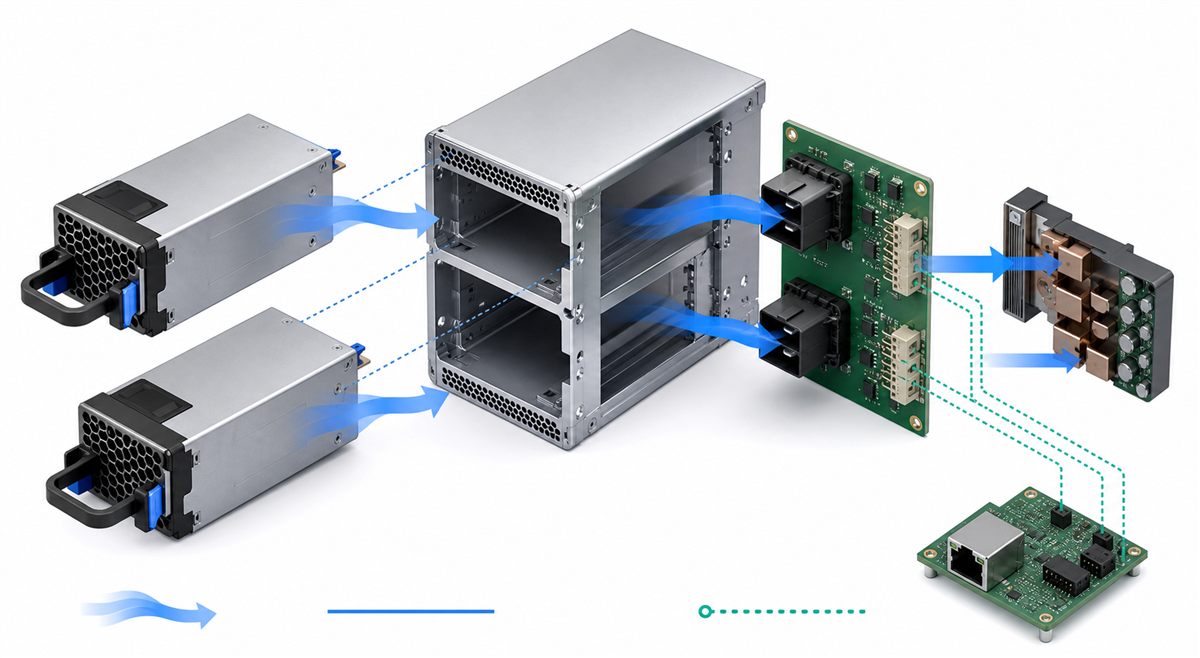
The standby rail can power the BMC and startup logic while the main output is disabled. Its voltage, current, ripple, sequencing, protection, and availability after AC application affect server management and boot. A replacement with insufficient standby current can appear present yet fail during initialization.
Timing specifications may cover standby rise, enable-to-output delay, main-output rise, power-good assertion, power-good removal, and discharge. Draw these signals on one timeline with the host requirements. Polarity, pull-up voltage, and default states also matter. A signal with the same name can behave differently across interfaces.
Ripple, noise, regulation, and transient response
Initial tolerance, line regulation, load regulation, temperature drift, ripple, and transient deviation contribute to the voltage seen by downstream converters. Ripple measurements often specify bandwidth, probe method, and local capacitance. A result obtained with a long ground lead or different bandwidth is not directly comparable.
Fast processors and accelerators create changing demand, but the PSU does not feed them directly; the PDB and point-of-load converters shape the interaction. Server-bus capacitance, distribution impedance, and control-loop behavior all influence the observed transient. Use module specifications to establish limits, then measure at the relevant PDB and load points.
Efficiency and 80 PLUS data
Efficiency equals DC output divided by AC input under stated conditions. The curve changes with load and input voltage. An 80 PLUS tier indicates that the certified model met thresholds for a particular category and set of load points. It is not a universal efficiency value and does not certify reliability or compatibility.
For energy analysis, use the server’s time-at-load distribution. In 1+1 active sharing, each module operates at part of the server load; after a failure, one moves to a higher point. Compute loss for both states using the candidate’s curve. Lower conversion loss reduces heat, but fan design and chassis airflow still determine local temperatures.
Mechanical envelope and insertion interface
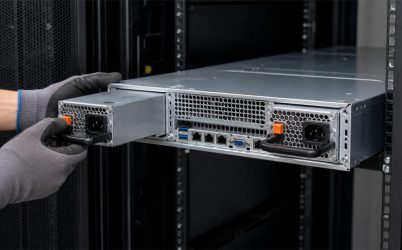
Height, width, and depth are only the beginning. Review connector datum, keying, guide features, latch, handle travel, mounting tolerance, airflow direction, inlet and exhaust grille, and extraction clearance. A module may enter the bay yet fail to seat fully against the blind-mate connector.
Exact dimensions must come from the controlled drawing. Compare them with the chassis and PDB stack-up. Test several hardware samples where tolerance is tight. The server should not use connector force to correct rail misalignment.
Connector and pinout specifications
The connector can carry main output, returns, standby, remote sense, enable, power-good, presence, fault, current share, address, and management signals. Longer and shorter contacts may create a live-mating sequence. Every contact needs a defined function, direction, voltage domain, current, logic behavior, and disconnected state.
A pinout from a similar module is not acceptable evidence. Contact current ratings depend on temperature, number of energized adjacent contacts, engagement, and termination. Return contacts deserve the same current analysis as positive contacts. Sense routing should follow the host architecture and include open- or short-sense behavior.
PMBus and management fields
PMBus can expose voltage, current, power, temperature, fan speed, warning and fault status, identification, and control. Implementation varies by module. A datasheet statement that PMBus is supported should be followed by a command list, revision, addressing method, data format, accuracy, update behavior, and any manufacturer-specific extensions.
As of the current PMBus organization listing, revision 1.5 is the current published specification, but a product may implement an earlier revision or only a subset. The host BMC’s expectations determine compatibility. Compare telemetry against external instruments before using it for automated capacity or billing decisions. The official PMBus specification page is the appropriate source for current revision information.
Protection specifications
Overvoltage, overcurrent, short-circuit, overtemperature, input fault, and fan fault may be listed. Useful documentation gives thresholds or ranges, delays, response mode, and recovery. In a redundant pair, the failed module must be isolated so it does not collapse the common output. Protection in the PSU must coordinate with PDB isolation and downstream branch protection.
A broad protection label does not tell the operator whether the unit retries, latches off, or needs input cycling. That recovery policy affects alarms and service. Controlled fault testing should observe both the rail and BMC report.
Thermal, airflow, acoustic, and environmental limits
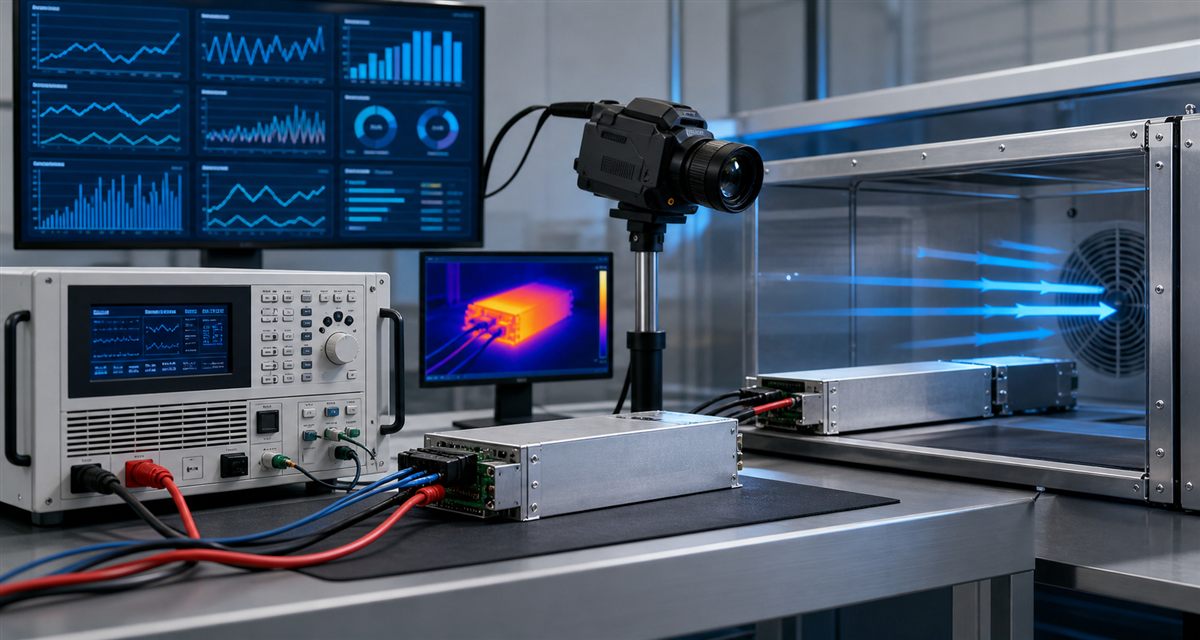
Read operating temperature with the stated measurement location, airflow direction, altitude, humidity, storage limits, and derating curve. Fan speed and acoustics vary with load, inlet temperature, and system commands. A reverse-airflow variant may share an enclosure but be unsuitable for the chassis.
Environmental specifications may include vibration, shock, or other conditions. Their test scope should match the application. Safety, EMC, and efficiency certifications need exact model and report references; a logo or family statement should not be generalized beyond its scope.
Redundancy and hot-swap fields
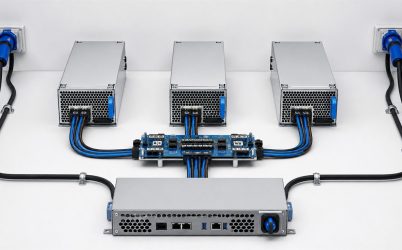
Current-share method, imbalance tolerance, output isolation, reverse-current behavior, insertion inrush, contact sequence, and single-module capacity determine redundant operation. Hot swap is a system behavior involving the PSU, PDB, connector, chassis, and host controls. The specification should state the conditions under which live removal is supported.
For 1+1 redundancy, the allowed server load remains within one module’s usable output after derating. For N+1, N modules support the load and one provides reserve. Input-feed redundancy is separate and depends on how modules are connected upstream.
Turning a datasheet into an acceptance specification
- Lock exact identity, revisions, drawings, reports, and host support evidence.
- Mark every rating with its input, load, temperature, and airflow condition.
- Cross-reference mechanical and connector requirements with the PDB and chassis.
- Map standby, main output, control, share, and management timing.
- Calculate normal and degraded current through each distribution path.
- List unresolved optional features instead of assuming they are present.
- Create tests for startup, transients, thermals, faults, redundancy, hot swap, and BMC behavior.
- Retain results with the production hardware and firmware configuration.
Powernexu’s CRPS power supply specification checklist provides a deeper example for common redundant interfaces. The server power supply architecture article explains how these fields interact inside the complete system.
Specification questions that prevent bad substitutions
Is the maximum wattage available at every input voltage?
Not necessarily. Read the input-dependent output and derating information. High-power modules can have a reduced rating at low line.
Does the same physical form factor mean the same pinout?
No. Use the exact connector and pin definition for both module and PDB. Shape alone cannot establish rails, signals, or management behavior.
Does PMBus guarantee compatibility with the server BMC?
No. Command coverage, addressing, scaling, identity, revision, and firmware policy vary. Host acceptance must be established for the exact unit.
Does an efficiency tier describe quality or lifetime?
It describes performance against efficiency criteria in the applicable certification category. Reliability, safety, thermal margin, manufacturing quality, and host compatibility require separate evidence.