Server power supply wattage is a capacity boundary, not a direct measurement of what a server always consumes. The number on a PSU states the maximum supported output under defined input, thermal, and airflow conditions. A server’s required wattage comes from its configured hardware, workload, transient demand, distribution losses, and redundancy policy. For a 1+1 platform, one module generally needs to support the permitted server load after its companion is lost; adding both labels can overstate redundant capacity. The practical task is to turn a variable workload into a defensible continuous and transient power envelope.
Separate four wattage values that are often confused
| Value | Meaning | Use |
|---|---|---|
| Component rating | A vendor-defined limit or design point for one device | Initial configuration estimate |
| Server DC demand | Power delivered to internal loads | PSU output capacity |
| AC input power | DC demand plus conversion loss | PDU and facility planning |
| PSU nameplate wattage | Maximum output under stated conditions | Capacity and redundancy boundary |
These values are related but not interchangeable. A 1200W PSU does not force the server to draw 1200W. An 800W DC load can require more than 800W at the wall because conversion is not lossless. A CPU or GPU rating should not automatically be treated as the exact peak measured at the PSU bus.
Build the configuration model from actual installed hardware
List processors, memory modules, storage devices, network adapters, accelerators, motherboard conversion, fans, and auxiliary loads. Use platform or component data appropriate to the intended workload and control settings. Include supported future options only when the procurement decision genuinely needs that capacity.
Avoid simply summing every absolute maximum when those states cannot occur together. Conversely, do not use average utilization if simultaneous fan ramp, accelerator load, and storage activity can happen. A state matrix shows which combinations are credible.
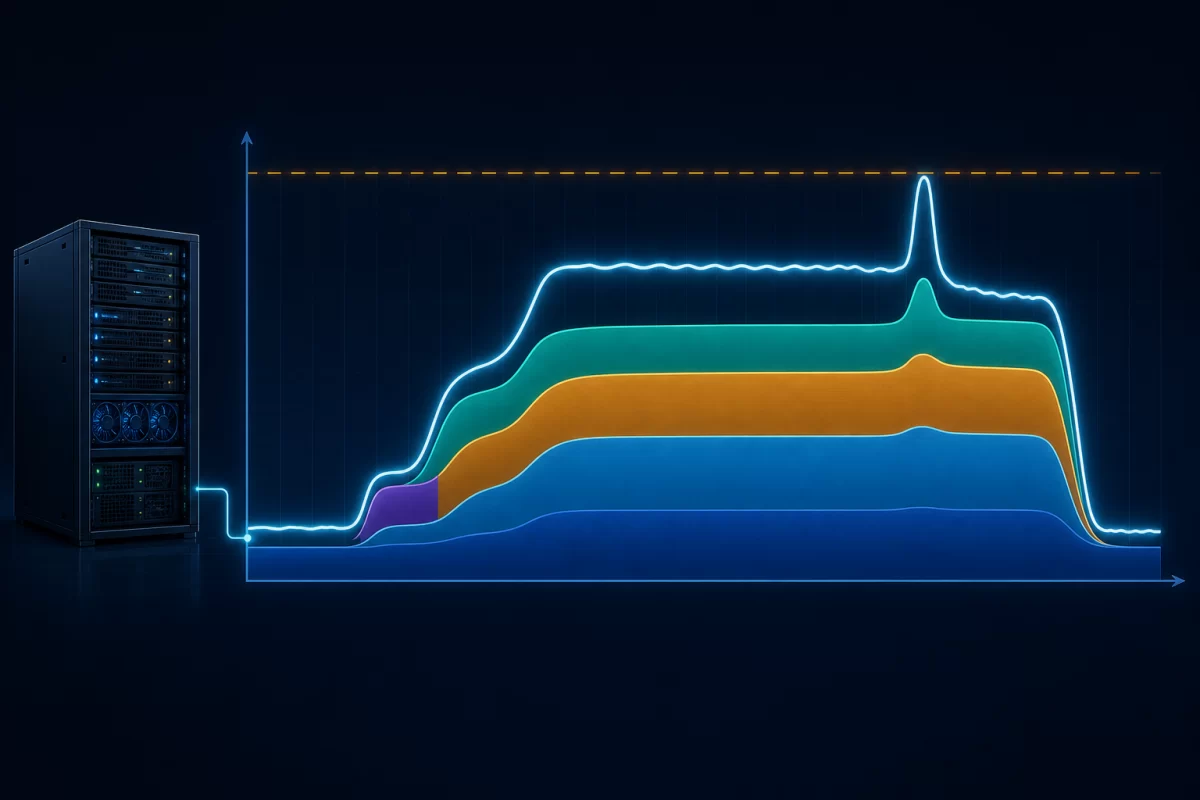
A useful model therefore contains at least three operating states: idle or low utilization, the highest sustained production state, and the credible short-duration event. For an AI server, the last state may combine an accelerator transition with CPU activity and a fan response. For a storage server, drive spin-up or rebuild activity can matter more. The states should reflect the platform’s real scheduling and power-control policy rather than a generic workload benchmark.
Transient demand can set the PSU requirement
Processors and accelerators can change power rapidly. Fans may ramp during thermal events, and drives can add startup demand. The PSU, PDB, bulk capacitance, and point-of-load converters must keep the bus within limits. Slow BMC telemetry can miss the highest and fastest events.
Describe transients by magnitude, slew rate, duration, repetition, and allowed voltage deviation. Use supported platform test methods or representative workloads. A short overload feature is useful only when its documented duration and recovery match the event.
Apply derating before adding margin
Determine available output at the deployed AC input, inlet temperature, altitude, and airflow. High-wattage server modules can have lower output at low line. A label maximum that applies in a data-center high-voltage rack may not be available on a laboratory circuit.
Then add justified margin for measurement uncertainty, load variation, aging, or planned expansion. A universal percentage can oversize one system and under-protect another. State what the margin covers and avoid counting the same uncertainty twice.
Turn the model into a usable wattage interval
Instead of producing one deceptively precise number, calculate a lower bound and an upper planning bound. The lower bound is the greatest of the derated continuous requirement, the capacity needed after the specified module or feed failure, and any documented requirement derived from the transient test. The upper planning bound reflects approved future hardware and the practical PSU choices supported by the chassis.
Consider a hypothetical server whose measured sustained DC demand is 980W and whose credible load event reaches 1,180W briefly. If the selected module’s available continuous output in the deployed input and thermal condition is at least 980W, its documented transient behavior must still be compared with the 1,180W event. In a 1+1 design, the same comparison applies to one surviving module. This example is a method illustration, not a recommendation for a particular rating or platform.
The interval prevents two common errors. Purchasing exactly at the sustained observation can leave no route for a supported expansion, while choosing the largest module offered can shift both supplies into an inefficient light-load region during normal sharing. Discrete platform options may still make the larger module sensible, but the reason becomes visible and reviewable.
Redundancy changes how module wattage is interpreted
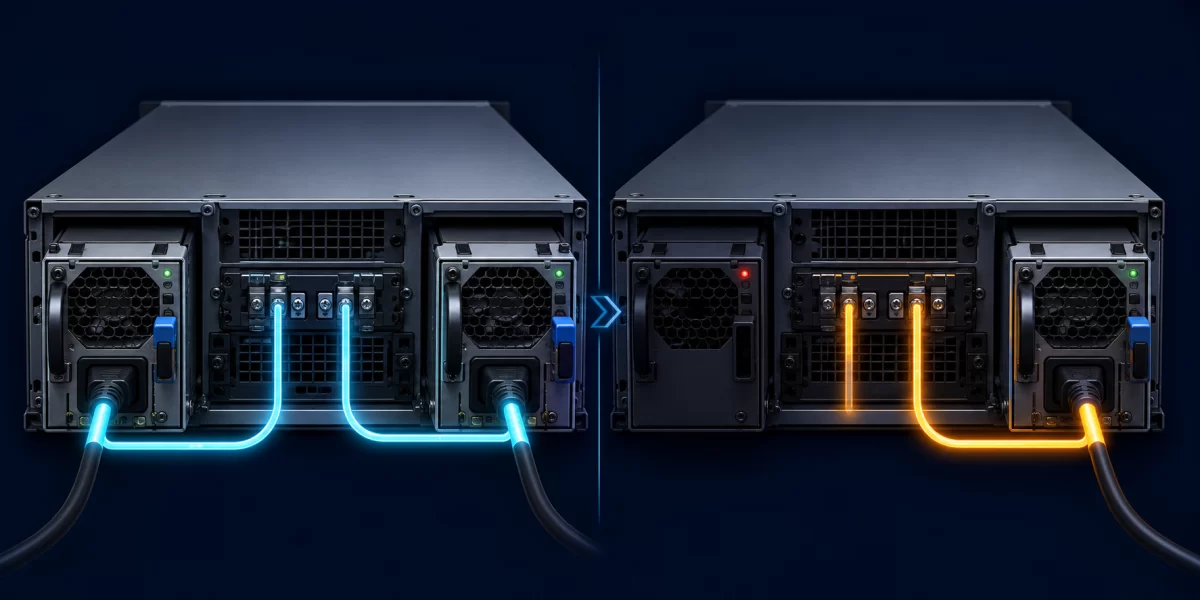
In 1+1 operation, either module should carry the allowed server demand after the other is removed. Two 1600W modules do not create 3200W of 1+1 redundant capacity; the redundant ceiling begins with one module’s usable output. If normal load exceeds that value, both modules may provide combined capacity but a single failure requires load reduction or shutdown.
In N+1 systems, N healthy modules support the load and one provides reserve. Source grouping also matters: losing an A feed can remove several modules at once. Calculate both single-module and whole-feed events when those failures are in scope.
Efficiency converts output wattage into facility demand
Estimated AC input equals DC output divided by efficiency. For a hypothetical 900W DC load at 94 percent efficiency, input is about 957W and conversion loss about 57W. This example demonstrates the calculation and is not a claim for a specific PSU.
Efficiency changes with load and input voltage. In active 1+1 sharing, calculate each module at its own operating point. Add server fan and auxiliary loads to the DC demand model rather than treating cooling as entirely external.
The PDB and connectors can impose a lower limit
PSU wattage reaches loads through blind-mate contacts, copper planes, ORing devices, shunts, busbars, cables, and downstream connectors. Their current and thermal ratings can cap usable power. A higher-wattage drop-in module does not upgrade those components.
Measure voltage drop and temperature at maximum supported load and after one redundant path is lost. Low-voltage systems carry high current, making milliohms important. Uneven contact resistance can overload individual pins before total power reaches the PSU rating.
Do not translate a PSU label directly into branch-circuit current
The module’s output wattage is on the DC side, while branch protection and rack distribution are sized from AC input current under the applicable facility rules. Input current varies with output load, conversion efficiency, power factor, and line voltage. The PSU datasheet may also state a maximum input current that supports protective-device and conductor selection; this is not interchangeable with a typical power reading.
Redundant cord routing creates another distinction. With balanced A/B feeds, each feed may carry roughly part of the normal server input, but either surviving path can receive a rapid transfer after a failure. Rack planning should evaluate that transferred state across all servers sharing the feed, not merely double a single average measurement.
Wattage affects rack and branch planning
Facility planning uses AC input, not just DC output. Include PSU efficiency, power factor, input voltage, redundancy policy, and simultaneous rack workload. After an A/B feed failure, the surviving PDU can receive transferred current from every dual-cord server. Its branch capacity must support that credible state.
Nameplate sums are conservative for some capacity exercises but can be too crude for deployment density. Measured workload distributions, supported power caps, and diversity assumptions can improve the model when their conditions are documented.
Choose wattage using a decision range
The minimum candidate must meet continuous and transient demand after derating and within the desired redundancy mode. The upper end should accommodate justified expansion without placing normal operation unnecessarily far into a light-load region. Compare available approved modules within that range for efficiency, thermals, acoustics, cost, spares, and host support.
If the platform offers only discrete wattages, a larger module may be appropriate. The decision remains conditional on connector, pinout, PDB, firmware, and airflow compatibility. Wattage alone cannot authorize a replacement.
Where a measured wattage estimate is weakest
PSU telemetry is valuable for mapping idle, typical, and sustained production demand, but its update rate and averaging can hide a short peak. An external AC meter answers a different question because it includes conversion loss. Oscilloscope or faster rail measurements may be needed when a rapid event, not the long-term average, is setting the capacity boundary.
The degraded redundancy state also deserves its own observation. Remove each module only under an approved service procedure, then watch rail behavior, surviving-module output, connector temperatures, and alarms at a representative high load. A reading collected only while both modules share current cannot prove that either module supports the same server alone.
Powernexu’s server PSU requirements article shows how to turn this limit into an acceptance specification. For rack deployment, the data center server power planning guide connects module wattage to feeds and cooling.
When the recorded wattage boundary expires
A capacity record should identify the hardware bill, firmware and power limits, workload state, AC input, inlet temperature, airflow configuration, redundancy mode, measurement method, and observed duration. Record both DC output and AC input when each is needed. This turns a statement such as “the server needs 1200W” into evidence another engineer can interpret.
Reopen the record when a processor, accelerator, memory population, drive count, network adapter, fan policy, BIOS setting, or rack input changes. The existing PSU may remain suitable, but the decision should follow the changed state rather than the old label.
What a defensible server PSU wattage means
Select the smallest approved PSU rating that supports the server’s credible continuous and transient load after input and thermal derating, while preserving the required redundancy state and planned expansion. Record the assumptions so a later CPU, GPU, memory, drive, fan, firmware, or facility change triggers a capacity review. This makes wattage a controlled engineering boundary instead of a number chosen by habit.