A search for a modular redundant server power supply returns unlike commercial objects rather than one interchangeable product category. One result may represent an OEM option family, another a manufacturer’s module series, another a technical specification record, and another a packaged cage containing two modules and a power distribution board (PDB). Comparing wattage, efficiency, or price before resolving those scopes creates false equivalence. The first useful task is to identify what each result actually supplies, which exact hardware its claims cover, and which host or integration questions remain unanswered.
Quick answer: classify the result before reading the headline specifications
Assign every result a stable product scope: exact removable module, OEM option family, manufacturer series, module pair, populated cage/PDB assembly, or technical document. Then normalize its exact identity, quantity, included hardware, rating conditions, interfaces, host relationship, and service claims. Similar terms such as modular, redundant, CRPS, M-CRPS, hot-swap, and a shared wattage do not establish interchangeability. A candidate should advance only to the type of review its evidence supports: exact-host review, new-assembly integration review, clarification, or exclusion.
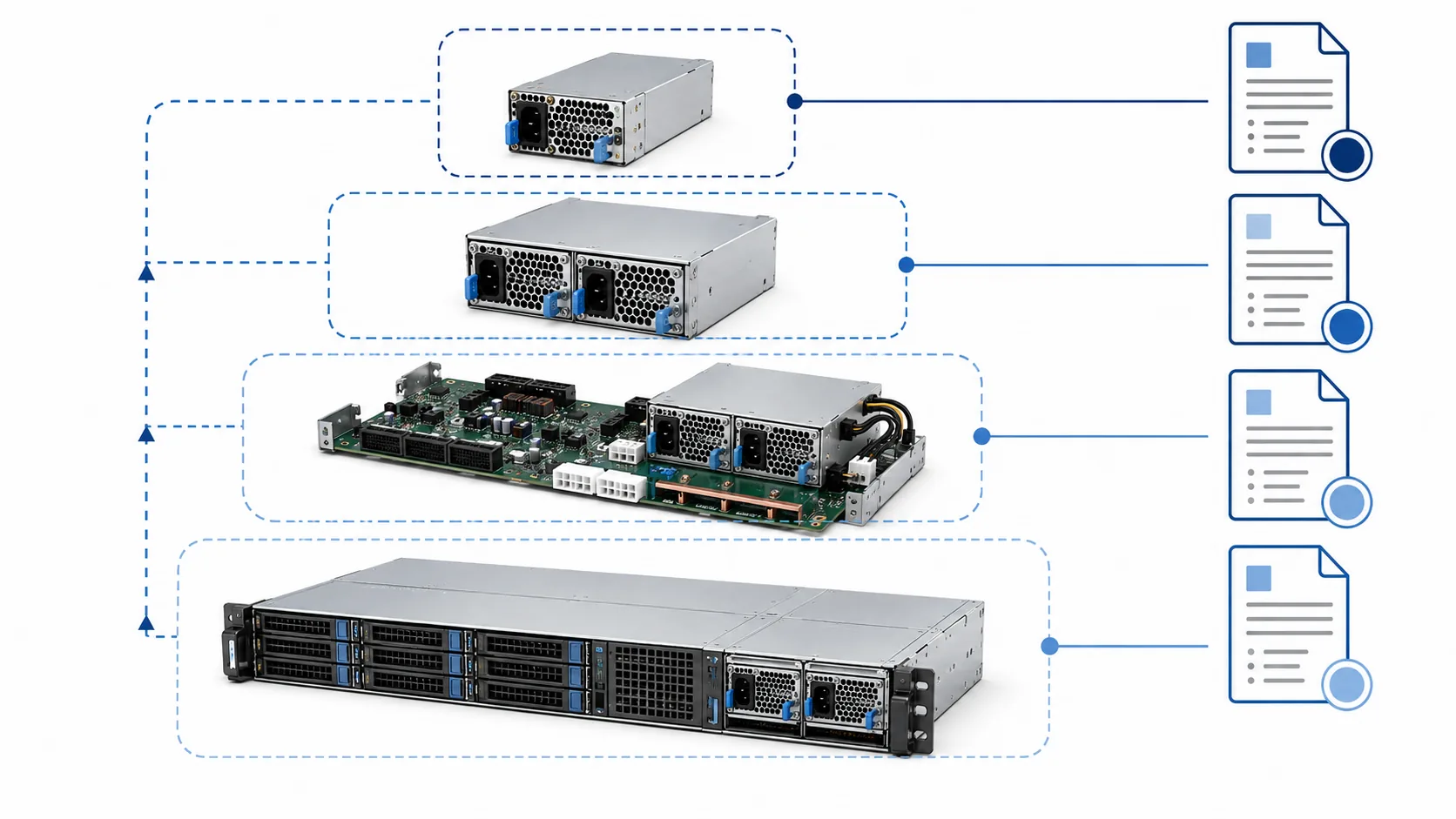
Four result classes can appear to describe the same product
The search results look comparable because they use overlapping server-power language. Their commercial and evidentiary functions are different, however. A family page helps discover options. A series page describes a manufacturer’s product architecture. A technical record supports particular documented claims. A retail listing describes what one seller proposes to ship. None should silently inherit facts from another class.
| Result class | What it represents | What it can support | What remains unresolved |
|---|---|---|---|
| OEM option family | A group of power-supply options associated with a server-vendor ecosystem | Commercial option identity, family relationships, and documented specifications within the stated scope | Support for the buyer’s exact server configuration unless the applicable platform record is identified |
| Manufacturer module series | A portfolio of removable front-end or CRPS/M-CRPS products | Available architectures and family-level characteristics; exact model data where individually documented | Host approval, mating PDB, included cage, harnesses, firmware behavior, and platform service procedure |
| Technical specification record | A QuickSpecs page, datasheet, drawing, or integration document | Only the claims, models, conditions, and revisions explicitly covered by that document | Whether a seller will supply the documented item and whether another product is equivalent |
| Packaged retail assembly | A seller-defined bundle that may contain modules, a cage, a PDB, cables, or mounting hardware | Quoted contents and seller representations when the listing identifies them clearly | Manufacturer identity, revisions, interface evidence, host support, rating conditions, and controlled substitutions |
The distinction between hardware and documentation is especially important. The HPE Modular Common Redundant Power Supplies QuickSpecs, for example, is an OEM technical record for the options and specifications within its stated HPE scope. The document is not itself a PSU, and its presence in search results does not turn an unrelated module or retail assembly into an HPE-supported option.
A manufacturer M-CRPS series page has another role. It can establish that a manufacturer offers a defined series and may provide model-specific electrical, mechanical, thermal, or management information. It does not by itself establish that a particular server accepts every member of the series. The server manufacturer, assembly integrator, or controlling interface documentation must support that separate relationship.
Give every candidate a stable noun
Product comparison becomes more reliable when each row begins with a precise noun instead of a collection of adjectives. “Modular redundant 2U power supply” is not sufficiently precise because it could refer to one removable module, two modules, a complete assembly, or a chassis-level option. Rewrite it as one of the following:
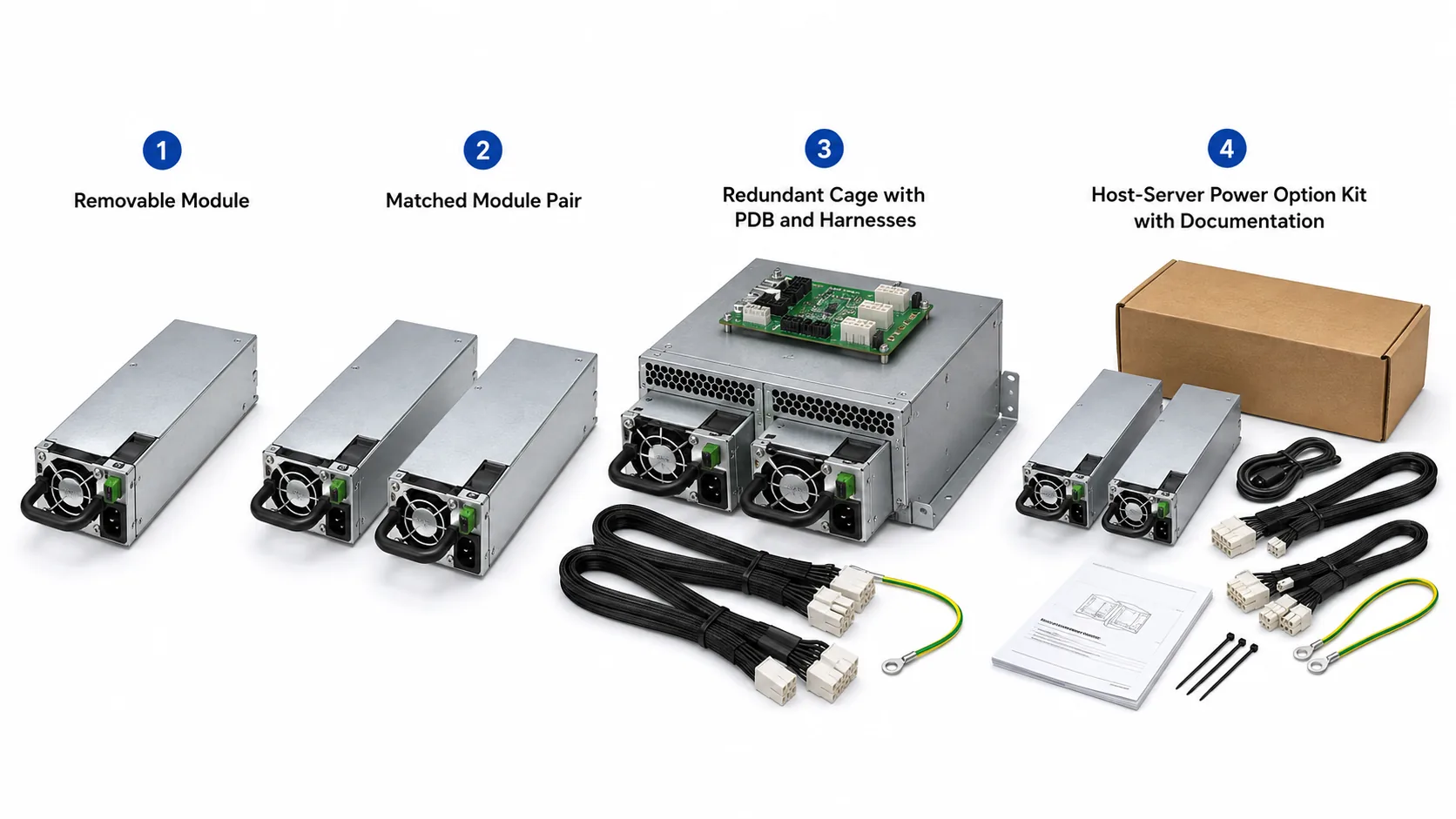
- one removable PSU module, identified by manufacturer, model, revision, and quantity;
- one OEM option or kit, identified by the OEM ordering number and documented contents;
- two specified modules supplied as a pair, without a cage or PDB;
- one populated redundant power assembly containing specified modules, cage, PDB, harnesses, and mounting items;
- one unpopulated cage/PDB assembly intended for separately purchased modules; or
- one technical record used as evidence, not as a purchasable line item.
This classification is not merely purchasing terminology. It establishes who owns each interface. A bare module leaves the mating connector, PDB, host outputs, mechanical retention, airflow path, and management implementation outside the supplied item. A complete assembly may close some of those boundaries, but only if its bill of material and documentation say so.
Marketplace descriptions often compress the assembly into a single phrase. Powernexu’s analysis of a fully modular redundant server power assembly explains how module, cage/PDB, and cable boundaries can be separated when the seller’s noun is ambiguous. For the present search, that decomposition should be used only to identify the supplied object; it should not be treated as evidence that any two assemblies share interfaces.
Normalize claims without pretending the hardware is equivalent
Normalization means recording every candidate through the same fields while keeping each value attached to the exact object and evidence source. It does not make dissimilar modules, option families, or complete assemblies interchangeable.
| Field | Record | Comparison consequence |
|---|---|---|
| Identity | Manufacturer, exact model or ordering number, relevant revision, and document revision | A family name cannot carry model-specific claims unless the source explicitly applies them. |
| Supplied scope | Module quantity, cage, PDB, harnesses, cords, mounting items, and exclusions | Module-only and populated-assembly prices belong in separate comparisons. |
| Power rating | Rated output, input condition, temperature, airflow, and applicable derating | A shared headline wattage may represent different usable output conditions. |
| Efficiency | Exact model, classification or curve, input voltage, load point, and source | Efficiency evidence does not prove capacity, redundancy, or host support. |
| Interface and host | Mechanical envelope, mating connector, PDB relationship, control signals, and named platform | Similar format names or connector geometry do not establish equivalence. |
| Service behavior | Supported hot-swap procedure, telemetry, firmware dependencies, and redundancy state | A removable handle or PMBus reference does not prove live replacement in the target host. |
Interpret ratings by scope and condition
State whether wattage belongs to one module, a complete assembly, or a host-supported configuration. Do not add two module nameplates and label the sum protected capacity unless the controlling documentation defines that operating state. In a documented 1+1 implementation, the relevant limit is commonly the load supported after one module becomes unavailable. Input voltage, cooling, and derating conditions must remain attached to that value.
Apply the same discipline to efficiency. A certified class, selected efficiency values, and an unsupported “high efficiency” description are different evidence types. Keep the field unresolved when the record does not identify the exact model or applicable conditions, and do not transfer a module-level result to the cage, PDB, or complete retail assembly.
Keep hot-swap and redundancy at the assembly level
Physical removability alone does not establish supported removal under load. Hot-swap behavior depends on connector sequencing, isolation, inrush control, surviving capacity, host management, and the platform procedure. Redundancy likewise belongs to a configuration containing multiple sources and a distribution path. A module may be intended for redundant systems while the cage, PDB, mating interface, and validated host behavior remain outside the offer.
Route each unresolved claim to the authority that can answer it
Missing information should not be filled from a nearby search result. Record the gap and route it to the source that owns the claim. This preserves the difference between a plausible candidate and an authorized use.
- Exact host support: use the server OEM’s option matrix, service documentation, or configuration record for the named host and relevant revision.
- Module electrical and thermal ratings: use documentation for the exact manufacturer model, including stated input and cooling conditions.
- Mechanical and mating interfaces: use controlled drawings, interface documents, and the records for both the module and mating assembly.
- Assembly contents: use the quotation, bill of material, assembly drawing, and explicit exclusions tied to the offered part number.
- Hot-swap and redundant behavior: use host or assembly documentation that describes the supported configuration and operating states.
- Efficiency: use the strongest applicable record for the exact model and retain its test conditions and scope.
- Seller substitutions: require the proposed substitute to receive its own identity and evidence record rather than inheriting the original item’s status.
A structured claim-to-evidence matrix for server power supplies can hold these relationships without forcing every missing field into a pass/fail compatibility verdict. For example, absent host approval may exclude a candidate from replacement use while leaving it eligible for a controlled new-assembly integration review. Missing model identity is more fundamental: without it, electrical, thermal, efficiency, and interface claims cannot be attached reliably to the offered hardware.
Use an unresolved-evidence record instead of blank cells
A blank comparison cell is easy to overlook or misread as “not applicable.” Every unknown should instead record its consequence and next evidence source. This transforms incompleteness into a visible commercial condition.
| Unresolved item | Status language | Shortlist consequence |
|---|---|---|
| Seller does not identify an exact model | Product identity unresolved; family description only | Hold for clarification because other specifications cannot be attributed safely |
| Listing shows two modules but does not mention a cage or PDB | Pair offered; combining and distribution hardware not documented as included | Do not compare its price with a complete assembly |
| Module series is documented but target server is not named | Component evidence available; host relationship unresolved | Eligible for integration research, not an exact-host replacement shortlist |
| Wattage is published without applicable input or thermal conditions | Nominal rating found; deployment rating unresolved | Hold the capacity comparison open |
| Hot-swap wording appears only in a seller title | Service capability not supported by host or assembly evidence | Do not authorize removal under load |
| Quotation permits an unspecified equivalent | Evaluated identity is not preserved in the transaction | Return the quotation or require controlled substitution approval |
The record should remain attached to the candidate even if purchasing requests a rapid shortlist. Removing unknowns from the visible table makes a less-documented offer appear cleaner than a thoroughly documented one. Retaining them allows price and lead time to be interpreted together with the engineering work and commercial uncertainty still carried by each option.
Give each result one defensible shortlist disposition
The output of this search is not a universal ranking. It is a set of candidates assigned to the narrowest use supported by their current evidence.
- Eligible for exact-host review: the result identifies an exact option or module and points to evidence connected to the named server ecosystem. Remaining checks are limited to the buyer’s actual configuration and operating conditions.
- Eligible for new-assembly integration review: the exact component is documented, but the integrator must provide or select the cage, PDB, host outputs, cooling path, control implementation, and system-level qualification.
- Return for clarification: the result may be relevant, but its model, quantity, supplied hardware, rating conditions, or evidence scope is too ambiguous for comparison.
- Exclude from the present shortlist: the product class, input type, package scope, host relationship, or documentation does not match the project’s defined use.
An OEM family, an M-CRPS manufacturer series, and a retail redundant assembly can all be legitimate results for “modular redundant server power supply.” They should not occupy the same comparison row as though they were alternate stock numbers for one object. The family can identify an ecosystem, the series can expose component candidates, the technical record can substantiate bounded claims, and the retail offer can propose a shipment. Only after identity, scope, conditions, and unresolved responsibilities are normalized should specifications or prices be compared.
The strongest shortlist may therefore contain fewer candidates than the original search page. That is a useful result. It means each retained item has a stable noun, an attributable set of claims, an explicit package boundary, and a defined next review. Candidates that remain ambiguous are not silently treated as equivalents simply because their titles contain modular, redundant, server, CRPS, hot-swap, or the same wattage.