A search for an 1800W 80 PLUS Platinum server power supply does not currently identify one unambiguous, purchase-ready product. A defensible candidate must pass two independent gates: the exact quoted model must have evidence supporting a Platinum classification, and its documentation must establish that 1800W applies under the proposed input, thermal, airflow, and host conditions. A multi-wattage label does not prove unconditional 1800W output, while a Titanium result does not automatically satisfy an exact-Platinum request. Even after both gates close, the buyer must still resolve host support, interfaces, redundant capacity, cooling, management behavior, and whether the shipment contains a module, pair, kit, or complete assembly.
Why the current result set does not answer the query
The search results combine several types of information that serve different purposes. The 80 PLUS database can substantiate a recorded efficiency classification. A manufacturer page can identify a product or kit and describe selected attributes. Retail and marketplace listings propose commercial shipments, often with abbreviated titles. A redundant assembly listing may describe several pieces of hardware under one combined power-supply label.
None of these result types should inherit authority from the others. A seller cannot establish Platinum status merely by displaying a badge or repeating the term in a title. A certification entry does not establish that the recorded PSU fits a particular server. A manufacturer’s broad power-supply category does not prove that every product in that category supports the target host. An assembly advertised with two modules does not establish the protected output available after one module becomes unavailable.
The immediate procurement objective is therefore not to select the most convincing-looking result. It is to decide which result, if any, can become an exact 1800W Platinum candidate and which results belong in separate commercial lanes.
Two independent coordinates define the first pass
Use a two-axis screen before considering price. The first axis asks whether the Platinum claim belongs to the exact manufacturer model being quoted. The second asks whether 1800W is a documented operating capability of that same model in the intended configuration.
Coordinate 1: exact-model Platinum identity
Search the official 80 PLUS Platinum certified PSU database using the manufacturer and exact model identity. Reconcile differences among the certification record, manufacturer documentation, PSU label, distributor record, and seller quotation. Alternate ordering numbers may be legitimate, but their relationship to the certified identity needs documented support rather than a visual or textual resemblance.
The useful certification record should preserve the recorded manufacturer, model designation, product category where applicable, and enough identity information to connect the entry to the quoted unit. A family name, wattage search filter, nearby model, or seller-created description is not a substitute for that connection.
Coordinate 2: documented 1800W applicability
The 1800W coordinate asks what the rating applies to and under which conditions. It may describe one removable module, a particular operating point within a multi-wattage product, or a platform-level configuration. Available output can depend on documented input voltage, thermal conditions, airflow, host policy, or another model-specific constraint. Those dependencies cannot be inferred from the headline number.
A label such as “1800W–2200W” needs an explanation before it can satisfy an 1800W requirement. The range might represent operating conditions, product variants, configuration options, or marketplace shorthand. Until the controlling documentation states what produces each rating, treat the result as conditional rather than interpreting the lower number as guaranteed applicability.
| Platinum evidence | 1800W evidence | Initial disposition |
|---|---|---|
| Exact recorded identity | Documented for the proposed conditions | Provisional exact candidate; continue to deployment review |
| Exact recorded identity | Conditional or unresolved | Conditional-wattage candidate; request the applicable rating conditions |
| Seller claim only | Documented | Clarification required; wattage evidence cannot substantiate Platinum status |
| Different efficiency class | Documented | Separate alternate or nonresponsive offer, depending on procurement policy |
| No stable model identity | Unresolved | Exclude from technical comparison until the seller identifies the product |
Passing this table does not establish server compatibility. It establishes only that the product is sufficiently identified to undergo the next review without combining unsupported wattage and certification claims.
Give every mismatch a controlled disposition
Mixed search results become manageable when every item receives a disposition that describes what it is authorized to do next. Avoid a generic “possible” status, because it allows unresolved offers to drift into price comparisons as though their claims had already been reconciled.
- Exact candidate: The quoted model is connected to a Platinum record, and manufacturer evidence supports 1800W under the intended operating conditions. Host and assembly questions remain open until separately resolved.
- Conditional candidate: Platinum identity is supported, but the 1800W rating depends on an input, thermal, airflow, variant, or configuration condition that has not yet been matched to the deployment.
- Policy-approved alternate: The product is documented in a different accepted class, such as Titanium, and the purchasing authority permits that substitution. It remains a separate product evaluation rather than an automatically improved version of the requested item.
- Clarification required: The seller has not supplied an exact model, certification identity, rating conditions, or stable shipment scope. The quotation should not enter commercial comparison until the missing field is answered.
- Exclude: Available evidence contradicts a mandatory requirement, the seller reserves an uncontrolled substitution, or the offered object cannot be identified well enough to evaluate.
The certification database itself belongs in none of the product-offer lanes because it is an evidence source rather than a shipment. Generic 1800W listings remain discovery leads until they identify a manufacturer model. A redundant assembly may become relevant, but only after the buyer determines whether its efficiency and wattage claims apply to each module, the complete assembly, or a host configuration.
A Titanium result must remain separate from an exact-Platinum bid. A multi-wattage manufacturer listing such as 1800W–2200W also requires documentation showing which input, thermal, host, or configuration condition applies to each output rating.
If the specification requires Platinum exactly, classify Titanium as nonresponsive unless an authorized deviation is issued. Do not silently reinterpret the requirement as “Platinum or better”; the named class may be tied to an approved bill of materials, qualification baseline, spare policy, customer term, or comparison method.
If Platinum is only a minimum acceptable class, a documented Titanium model may enter a policy-approved alternate lane. Record the requested and offered classes, approving authority, exact model, price basis, and unresolved deployment conditions. That approval resolves only the class mismatch; it does not prove 1800W availability, host support, shipment completeness, interfaces, or rack suitability.
A module, kit, and redundant assembly are different bids
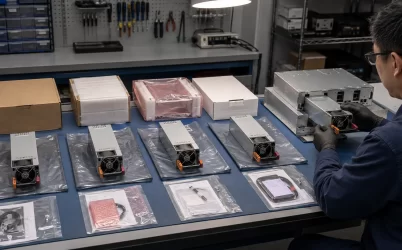
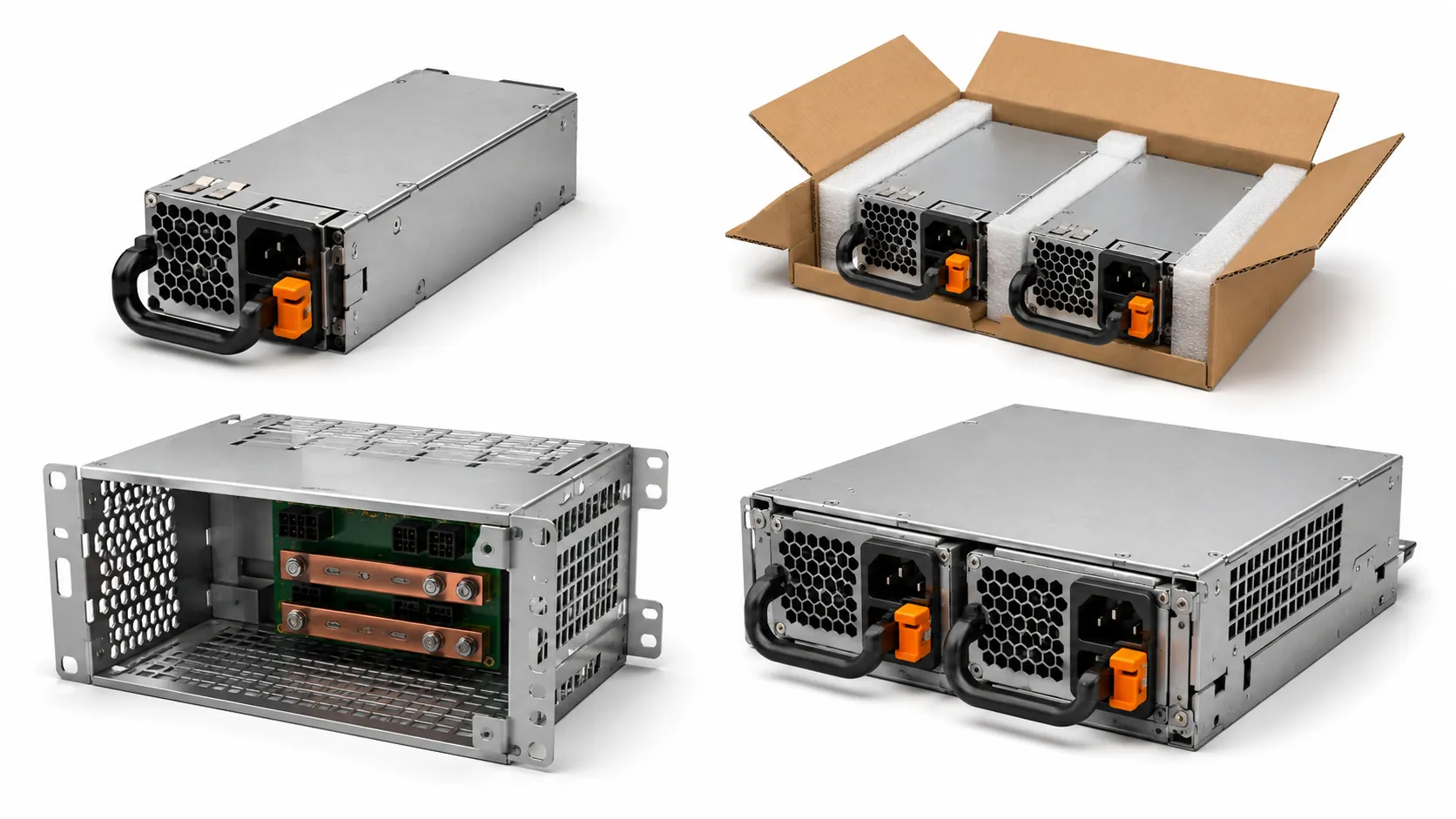
The quoted noun determines both price and integration responsibility. One 1800W hot-plug module may be the correct spare for an existing supported server. A pair may contain two modules but omit the cage or power distribution board. A manufacturer kit may include host-specific hardware. A complete redundant assembly may add the cage, PDB, harnesses, mounting parts, and other accessories required for new integration.
This distinction is especially important when comparing a manufacturer kit with generic marketplace listings. The lowest price may represent one bare module, while a higher price may represent a complete host option. The two offers are not commercially equivalent even if both contain “1800W” in the title. The method for classifying modular redundant server power-supply scope helps keep unlike shipment boundaries out of the same price column.
| Quoted object | What the quotation must identify | What remains outside unless stated |
|---|---|---|
| One module | Manufacturer, exact model, revision, quantity, condition, airflow orientation | Mating cage, PDB, second module, harnesses, host approval |
| Module pair | Both module identities, pairing rules, quantity, applicable rating evidence | Combining hardware, host interface, protected capacity, mounting |
| Hot-plug kit | Kit number, included parts, supported platform relationship, module identities | Any accessory or host component not listed in the kit contents |
| Complete assembly | Modules, cage, PDB, output interfaces, harnesses, mounting parts, revisions | Server-level support and rack deployment conditions unless documented |
In a 1+1 system, two 1800W module labels should not be converted automatically into 3600W of protected output. The relevant continuity figure is the load that the documented surviving module and common distribution path can support after the permitted failure. If both modules are required to serve the workload, the configuration may provide combined capacity without preserving that workload after one module is lost.
Certification screening opens six deployment gates
An exact 1800W Platinum match is a qualified commercial lead, not yet a deployable server PSU. The following gates determine whether it can serve the proposed host or assembly:
- Host relationship: Identify the exact server, chassis, or integration platform and the document supporting the proposed PSU configuration. Manufacturer identity alone does not prove support across every server family.
- Input condition: Match the PSU’s documented input envelope and applicable output rating to the rack source, PDU, outlet, cord, and frequency. Record the condition under which 1800W is available rather than retaining only the headline value.
- Mechanical and electrical interface: Confirm the bay envelope, rails, latch, insertion stop, blind-mate interface, PDB relationship, downstream outputs, and service clearance. A structured way to map every server PSU interface prevents a certification match from being mistaken for connector compatibility.
- Cooling direction and environment: Establish airflow direction, inlet-air condition, fan-control relationship, altitude or temperature restrictions when documented, and whether neighboring hardware obstructs ventilation. Do not generalize thermal limits from another model in the same family.
- Control and management: Determine whether the host supports the PSU’s enable, status, fault, sharing, and management behavior. The presence of a communication interface on one product does not establish firmware recognition or feature equivalence in the target server.
- Redundant operating state: Record the module population, feed assignment, load that must continue after a permitted fault, and the shared PDB or distribution components outside the module. Hot-plug wording should be connected to a platform-approved replacement procedure rather than treated as universal permission for live removal.
These gates should not be collapsed into a single compatibility checkbox. A candidate may be certified as Platinum and documented at 1800W yet remain unsuitable because the host does not support it. Another may fit mechanically but provide a different interface or airflow direction. Keeping the gate results separate makes the reason for rejection or clarification visible.
Write 1800W and Platinum into the same line-item record
The request for quotation should force the two primary coordinates to remain attached to one product identity. Ask each supplier to state the manufacturer, exact model and revision, offered efficiency classification, supporting certification identity, documented conditions for 1800W output, product scope, quantity, included hardware, target-host relationship, airflow direction, and permitted substitutions.
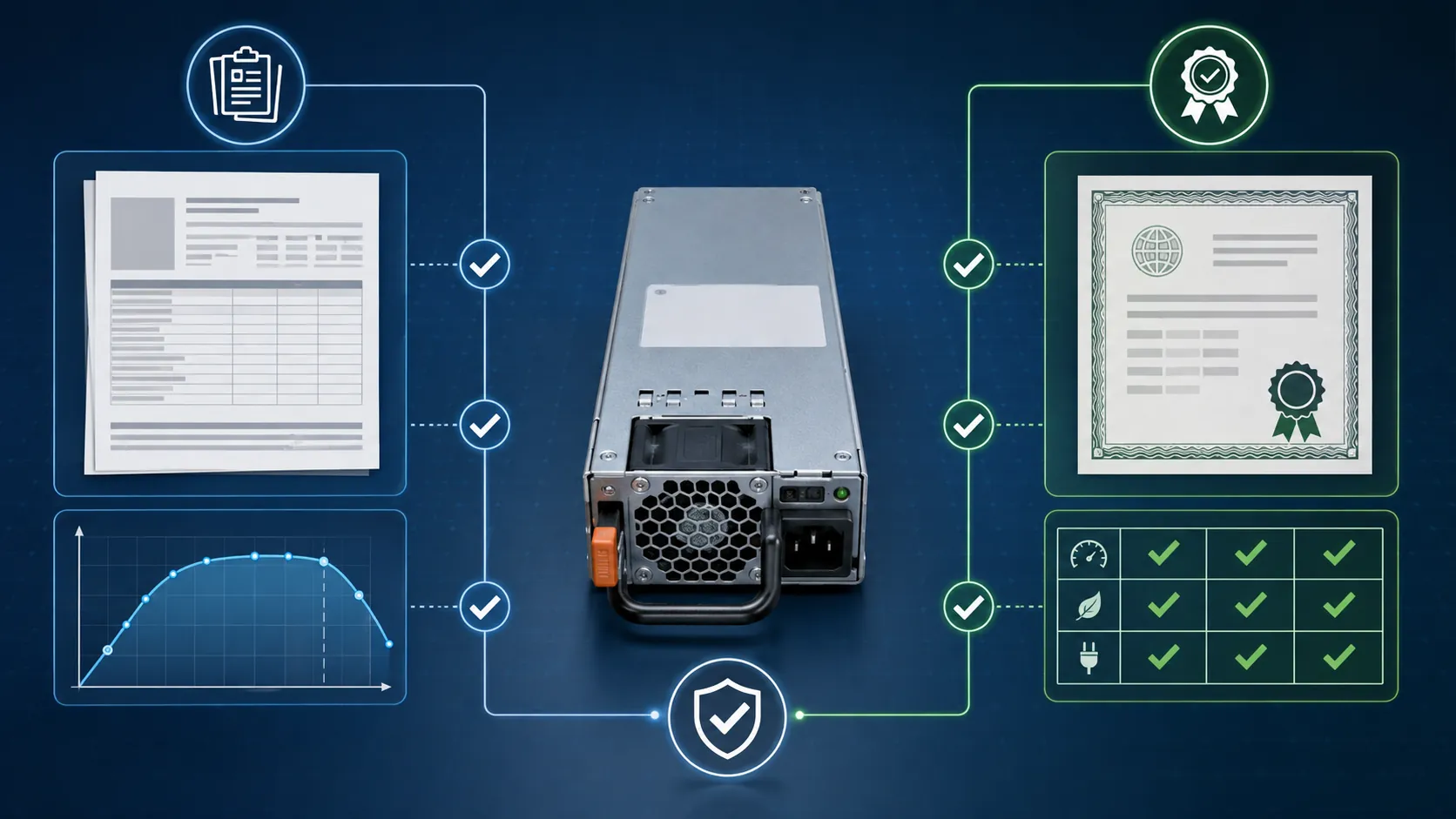
Where a multi-wattage title appears, require the quotation to explain which condition or variant corresponds to 1800W and which corresponds to the other stated rating. Where a Titanium product is proposed against a Platinum request, require it to be marked as an alternate rather than allowing the class change to disappear inside a generic “equivalent” description. Where a complete redundant system is needed, list the module count, cage, PDB, harnesses, mounting hardware, and accessories instead of relying on “kit” or “assembly” alone.
Receiving inspection should compare the delivered label, model, revision, quantity, and package contents with that line-item record. Certification evidence should still reconcile with the delivered identity; a seller’s right to ship an unspecified equivalent would break the chain established during review. Physical condition and connectors can be inspected at receipt, but installation and powered checks should follow the applicable server or assembly procedure.
The search is resolved when every retained offer has one honest disposition. An exact candidate combines documented 1800W applicability with an exact-model Platinum record and then passes its platform gates. A Titanium product remains a separately authorized alternate. A generic listing remains a clarification item, and a contradictory or unidentified offer is excluded. This outcome may produce no immediate award, but it prevents four different propositions from being compared as though they were the same 1800W Platinum server power supply.