A “1200W Platinum server power supply” combines two different claims. The 1200W figure describes an output-capacity limit under stated conditions. Platinum describes an efficiency tier verified under a defined certification category and test method. Neither term, by itself, identifies the physical format, proves compatibility with a server, or guarantees redundant and hot-swap operation.
That separation is the key to choosing correctly. Search results for this phrase can include ATX power supplies for workstations, hot-plug modules for branded servers, CRPS-style units, and complete redundant assemblies with a cage or power-distribution board. They may share a wattage and an efficiency label while serving very different systems. Architecture comes first; the efficiency badge becomes useful after the correct type of supply has been identified.
First determine what kind of “server power supply” is required
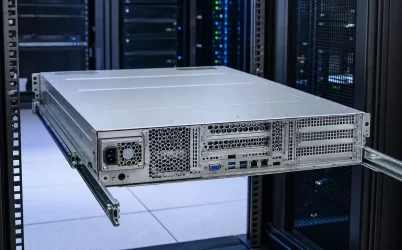
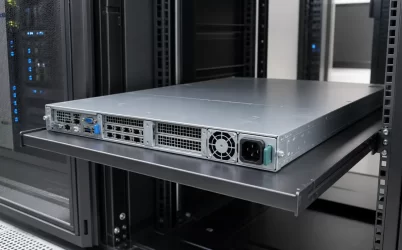
An ATX unit is a self-contained supply with motherboard and peripheral cables. It can be appropriate for a tower server or a rack chassis built around the ATX format. A hot-plug server module is different: it usually slides into a dedicated cage and mates with a backplane or PDB. Its output connector, mechanical keying, handle, fan control, communication, firmware behavior, and power-sharing method are part of a host-specific system.
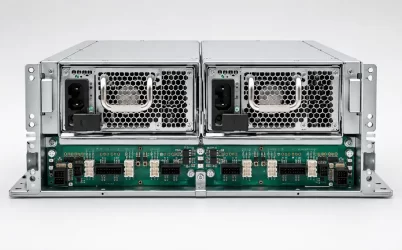
A complete redundant assembly is different again. It can include two replaceable modules plus the cage, isolation or ORing circuitry, output harness, and management connections. Buying one 1200W module does not necessarily provide these surrounding functions. Likewise, two supplies installed in a server do not prove that the machine can continue at full workload after one is removed.
| Product described as 1200W Platinum | What must match | What the label does not prove |
|---|---|---|
| ATX or workstation PSU | ATX size, motherboard connectors, rail allocation, chassis cooling | Fit in a hot-plug server bay |
| Hot-plug server module | Approved host, cage, blind-mate connector, firmware, airflow | Compatibility with another server family |
| Redundant power assembly | Module pair, PDB, harness, control and failure-state capacity | Full-load continuity merely because two modules are present |
This distinction prevents the most expensive category error: comparing efficiency numbers between products that cannot perform the same mechanical and electrical job.
What 1200W tells you—and what it leaves unanswered
The 1200W value is normally the maximum rated DC output of the supply, but the conditions matter. Full output may depend on the AC input range, ambient temperature, airflow, and rail combination. Some server modules provide a lower maximum output on low-line input. An ATX product may distribute capacity across several outputs, while a server module may place most of its capability on a main bus with a smaller standby output.
The server will not continuously consume 1200W just because the PSU has that rating. Load is set by processors, accelerators, memory, drives, fans, and board conversion losses. A 1200W supply delivering 600W is operating at approximately 50% of rated output. The same server fitted with two load-sharing 1200W modules may place roughly 300W on each during balanced operation, although real sharing is not perfectly exact and platform controls may alter the split.
That difference matters because efficiency changes with load. It also means that a larger PSU is not automatically more efficient in the actual server. The useful comparison places the expected operating distribution—not just one peak number—on the performance data for the exact candidate.
What the Platinum designation actually contributes
80 PLUS Platinum is an efficiency classification, not a compatibility standard or a reliability grade. The applicable thresholds and test points depend on the program category and input conditions. A redundant data-center supply should not be compared casually with a nonredundant desktop supply just because both display “Platinum.” The official 80 PLUS program and its certified-product records are the appropriate place to confirm which exact product was tested and under which category.
Certification provides valuable, standardized evidence, but it does not reproduce every server environment. Rack inlet temperature, airflow impedance, fan power, input voltage, component aging, and the server’s operating load can differ from the certification setup. Platinum therefore narrows the expected conversion-loss range under defined points; it does not promise one efficiency value at every load.
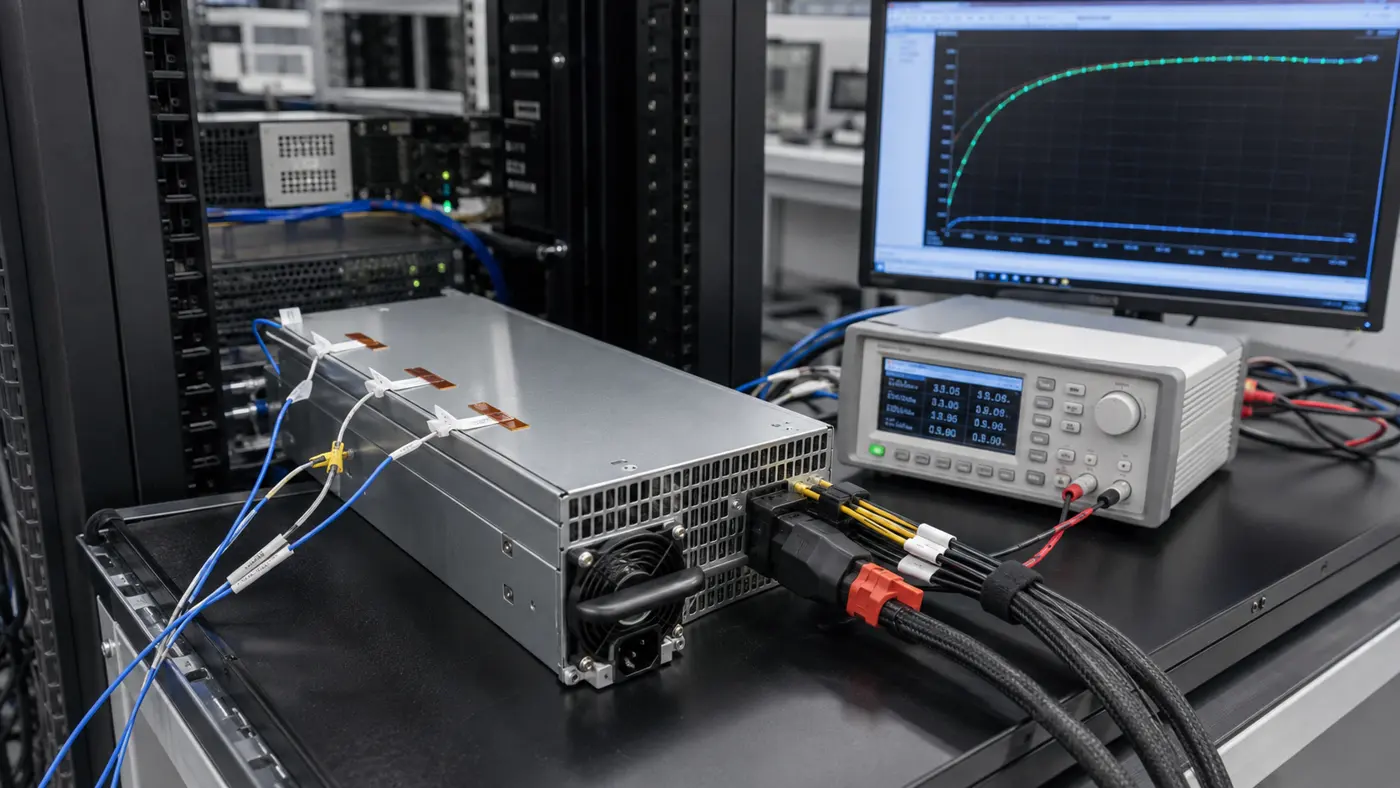
The efficiency test image below is relevant because the central question is how a module converts power across controlled load points. It should be read as an illustration of measurement, not as test data for an unnamed Powernexu product.
Conversion loss turns into heat inside the rack
Efficiency is useful because the difference between AC input and DC output becomes heat. For illustration, a supply delivering 600W at 94% efficiency would draw about 638W and dissipate about 38W in conversion loss. At 92%, the same 600W output would require about 652W and produce about 52W of loss. These are calculations, not claims about a particular certified unit.
The 14W difference in the example may look small beside a server’s total power, but multiplied across hundreds of machines and many operating hours it affects cooling load and electricity use. At the individual chassis, concentrated PSU heat also affects fan speed and acoustics. This is where Platinum has practical value: it can reduce wasted input power, but the benefit must be estimated at the load points the server actually occupies.
Rated output and efficiency should remain separate in the calculation. Output capacity answers whether the supply can support the load. Efficiency helps estimate the input and heat associated with that load. A 1200W label does not mean the unit loses 6% of 1200W at all times, and the highest certification tier does not compensate for insufficient capacity.
Redundancy can move the operating point
Suppose a server requires 800W of DC power. With two 1200W modules sharing evenly, each might carry around 400W, or about one-third of its rating. If one module fails, the survivor must move to roughly 800W, or two-thirds of its rating. The efficiency, fan behavior, temperature, and input current all change at the moment redundancy is needed most.
A well-matched selection considers both states. Normal shared operation determines day-to-day energy use. Single-module operation determines whether service can continue without overload, excessive temperature, or platform power capping. A certification badge does not state how the PDB isolates a failed module, how current sharing behaves, or whether the host firmware accepts the replacement. Those are server-system properties.
For this reason, “2 × 1200W Platinum” should not automatically be interpreted as 2400W of protected capacity. A genuine 1+1 policy usually limits the protected workload to what one module and the common power path can carry. Systems designed for combined capacity may use more than one module’s rating but cannot promise the same failure response at peak load.
Airflow can separate a good module from a good installation
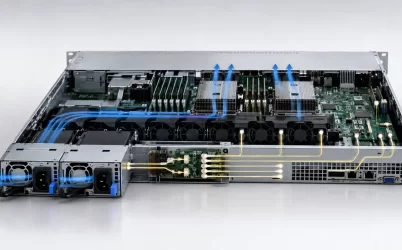
Dense hot-plug supplies rely on a narrow, high-velocity airflow path. The server chassis may assist their cooling, the modules may contain their own fans, or both systems may interact. Direction and pressure matter. A supply with the wrong airflow orientation can recirculate exhaust or oppose the fan wall even if its connector appears to mate.
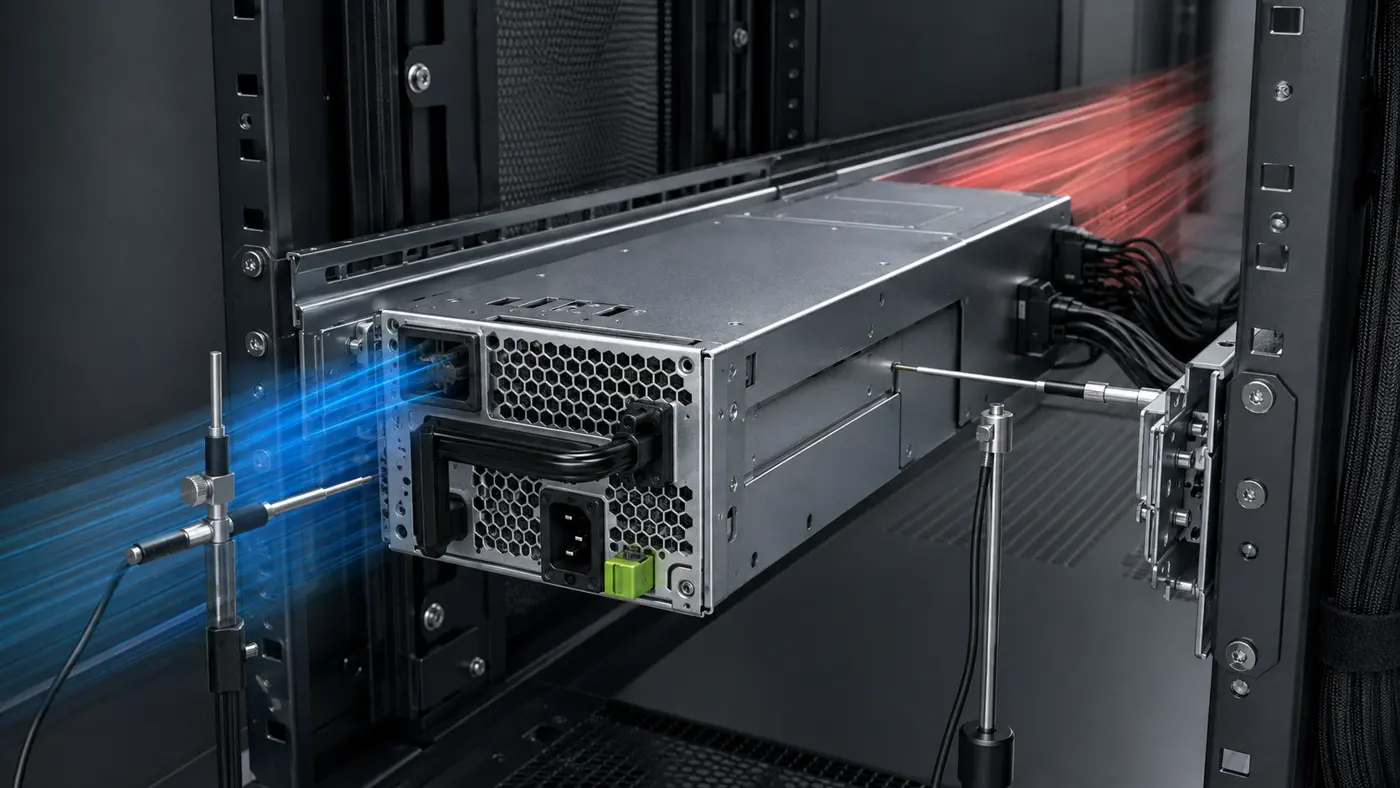
Thermal performance also changes as redundant modules change load. Two lightly loaded converters distribute losses across two bays; one surviving converter concentrates them in a smaller region and may increase fan speed. The illustration below shows the kind of combined power-and-airflow behavior that must be considered around a rack PSU. It complements the efficiency discussion by showing why a laboratory tier cannot describe the complete installed thermal result.
How to choose between products carrying the same label
Start with the server architecture. For an existing branded or purpose-built host, use only the modules and revisions approved for that platform. Match the cage, connector, input range, output bus, standby behavior, communications, firmware expectations, airflow direction, and extraction mechanism. A unit that is electrically impressive but unsupported by the host is not a valid substitute.
Next, establish the required capacity from the configured server rather than from the largest number in a catalog. Include sustained workload, permitted component population, fan maximum, start-up behavior, and credible transients. If uninterrupted operation after one PSU failure is required, compare that demand with the single-module capability under the site’s input voltage and inlet temperature.
Only then compare efficiency. Confirm that the certified record belongs to the exact manufacturer and model, not a related family name. Check the test category and input condition, then examine how the relevant load points relate to the server’s normal and failure-state loads. Two Platinum supplies can have different efficiency curves, acoustics, telemetry, or thermal limits even when both meet the applicable tier.
Finally, distinguish the replaceable module from the complete power subsystem. A hot-plug module may require a specific PDB and management interface. A redundant cage must carry the full failure-state current through its common output path. For a new custom server design, these interfaces are engineering requirements; for an existing server, they are compatibility constraints that normally rule out arbitrary substitution.
The meaning of “1200W Platinum” in one sentence
It means that a particular PSU offers up to 1200W under its specified operating conditions and has met the applicable 80 PLUS Platinum efficiency criteria in its certified category. It does not tell you whether the unit is ATX, hot-plug, CRPS-style, redundant, compatible with a given host, or able to carry that host after another module fails. Choose the correct architecture and supported module first, prove that one or more modules can support the intended load, and then use the Platinum data to estimate conversion loss at the operating points that matter.