A 1U server can use a 1500W power supply, but the number does not describe a universal, drop-in component. In this context, 1500W is normally the maximum DC output of a dense server power module under specified input and cooling conditions. The server must be designed around that module: its power-distribution board, mating connector, airflow path, firmware, and redundant-power policy all have to support it. A mechanically similar supply from another platform is not automatically interchangeable.
The useful question is therefore not simply whether 1500W fits inside 1U. It is whether the complete server can deliver, distribute, and cool the required power in both normal and failure states. That distinction matters in accelerator servers, storage appliances, network systems, and other compact equipment where a large nameplate rating can conceal limits elsewhere in the chassis.
“1U” describes the server envelope, not a universal PSU shape
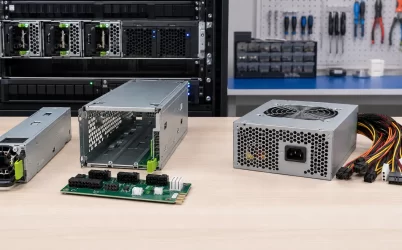
One rack unit is 44.45 mm high. That dimension constrains the server chassis, but it does not define one standard power-supply length, connector position, handle design, airflow direction, or communication interface. Some 1U servers accept long hot-plug modules from the rear. Others use narrower modules, a fixed internal converter, or a proprietary cage and midplane. Even supplies sold within the same broad wattage class can differ in all of these details.
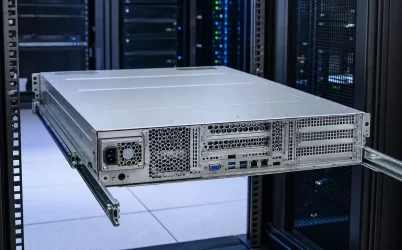
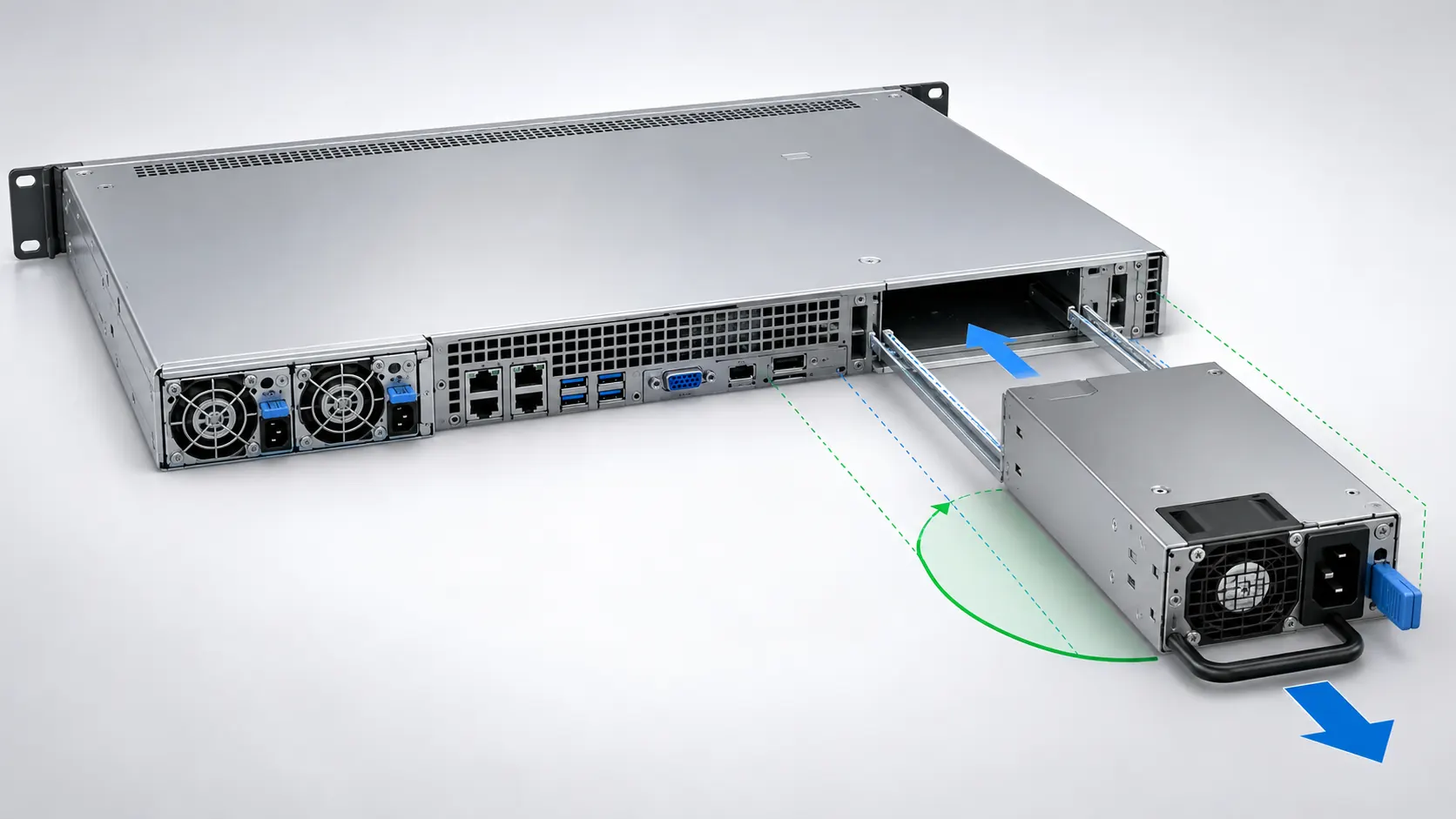
Mechanical compatibility begins with the approved module and cage, not with the words “1U power supply” in a product title. The inlet, latch, extraction handle, fan grille, blind-mate connector, and keying must line up with the host. Insertion depth also matters: a module that enters the bay can still interfere with a fan wall, riser, cable bundle, or motherboard component. The following chassis view illustrates why clearance and mating geometry belong to the server design rather than to the wattage label.
What the 1500W rating means electrically
A 1500W rating is an output ceiling under the conditions stated for the particular supply. It is not a promise that every wall outlet, server configuration, or ambient temperature can sustain that output. Dense server PSUs commonly have an input-dependent power envelope. A unit may provide its full rating on high-line AC while offering less power on a lower input range. The applicable input voltage, frequency, current, and any derating curve must come from the approved documentation for the exact module.
The number is also easy to misread in redundant systems. If a chassis contains two 1500W modules, that does not necessarily create a 3000W continuously usable server. In a 1+1 design, the pair may share the load during normal operation while either single module must be capable of carrying the protected load after its partner is removed or fails. The installed nameplate total is then 3000W, but the redundancy-preserving capacity is still bounded by one 1500W module and by the rest of the host power path.
Conversely, some systems use both modules for combined capacity rather than full redundancy at peak load. Such a server may operate above 1500W while both supplies are healthy, yet lose performance or shut down if one module disappears. The distinction is a system behavior, not a property that can be inferred from the two labels on the rear panel.
At 12V, 1500W represents roughly 125A
The scale becomes clearer through a simple calculation. If all 1500W were delivered on a 12V main output, the idealized current would be 1500W divided by 12V, or 125A. Actual architectures may use a different main-bus voltage, auxiliary rails, and conversion stages, but the calculation shows why the connector and power-distribution board are central to a dense server design.
At this current level, milliohms matter. A resistance of only 1 milliohm in a shared path would dissipate about 15.6W at 125A because conductive loss rises with the square of current. That does not mean a real server necessarily has that exact resistance; it shows why contact condition, busbar geometry, copper thickness, current sharing, and local airflow can determine whether the nominal wattage is usable. The motherboard voltage regulators must then convert the intermediate bus into the lower voltages required by CPUs, accelerators, memory, storage, and other loads.
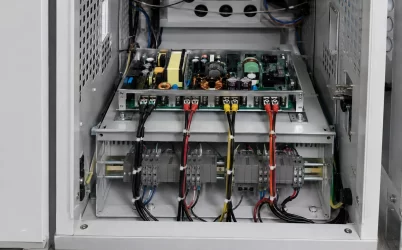
A high-wattage replacement cannot correct an undersized downstream path. If the cage, PDB, connector, fuse, cable assembly, or board plane was designed for a lower-current module, installing a physically similar 1500W supply may create heat or protection problems even before the server reaches the PSU limit.
When a 1U server actually benefits from 1500W
Many ordinary web, file, and virtualization servers do not draw 1500W. The rating becomes relevant when a compact platform combines high-power processors, accelerator cards, dense memory, numerous drives, high-speed network adapters, and fast fans. Start-up events, fan ramp, drive activity, and accelerator transients can also lift short-duration demand above the long-term workload average.
The appropriate capacity follows the host’s supported configuration and measured power behavior. Begin with the platform vendor’s approved PSU options and component limits. Then distinguish sustained demand from brief peaks. A server that averages 700W may still need considerable headroom if synchronized CPU and accelerator activity produces a much higher transient. On the other hand, selecting 1500W solely because it is the largest available option may place a lightly loaded machine away from its most useful operating region and may add cost without improving availability.
Capacity planning should include the worst permitted component population, fan state, storage activity, and environmental condition. It should also account for any system-enforced power cap. Modern servers may reduce processor frequency, restrict accelerator power, or increase fan speed as they approach an electrical or thermal limit. Those controls are part of the platform response; they do not make an unsupported PSU compatible.
Redundancy changes the meaning of sufficient capacity
For a nonredundant server, the supply needs enough continuous and transient capability for the intended configuration. For a 1+1 server, the more demanding case often occurs immediately after one module is lost. The surviving module takes the full protected load, its conversion loss becomes concentrated in one bay, and its fan may have to move more air through a restricted path. The chassis can remain powered only if the single-module capacity, distribution path, and cooling system all tolerate that state.
Upstream feeds matter as well. Two modules connected to the same branch circuit protect against an individual PSU failure but not against loss of that circuit. Separate feeds may improve resilience only when the server supports the arrangement and each feed can supply the surviving module. The required AC current must be calculated from actual input power rather than from DC output alone because conversion is not lossless.
This is why “dual 1500W” should be translated into an operating statement. Does the platform support the full workload after one supply is removed? Does it cap performance? Does it require both high-line inputs? Those answers determine useful availability far better than adding the two nameplates together.
Power density becomes a heat-removal problem
If a PSU delivers 1500W at 94% efficiency, the illustrative input is about 1596W and the converter loss is roughly 96W. This is an example, not a claimed efficiency for a particular model. The exact loss changes with input voltage, load, temperature, and the tested supply. In a 1U enclosure, even tens of watts concentrated inside a narrow module are significant because the airflow channel is small and the surrounding server is already producing substantial heat.
The PSU fan and chassis fans must operate as one airflow system. A blocked inlet, excessive rear pressure, recirculated exhaust, missing air baffle, or incompatible fan-control strategy can reduce cooling even when room temperature appears acceptable. Airflow direction is especially important for hot-plug modules: reversing the intended flow can make the PSU fight the chassis fan wall.
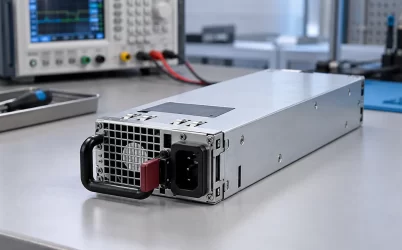
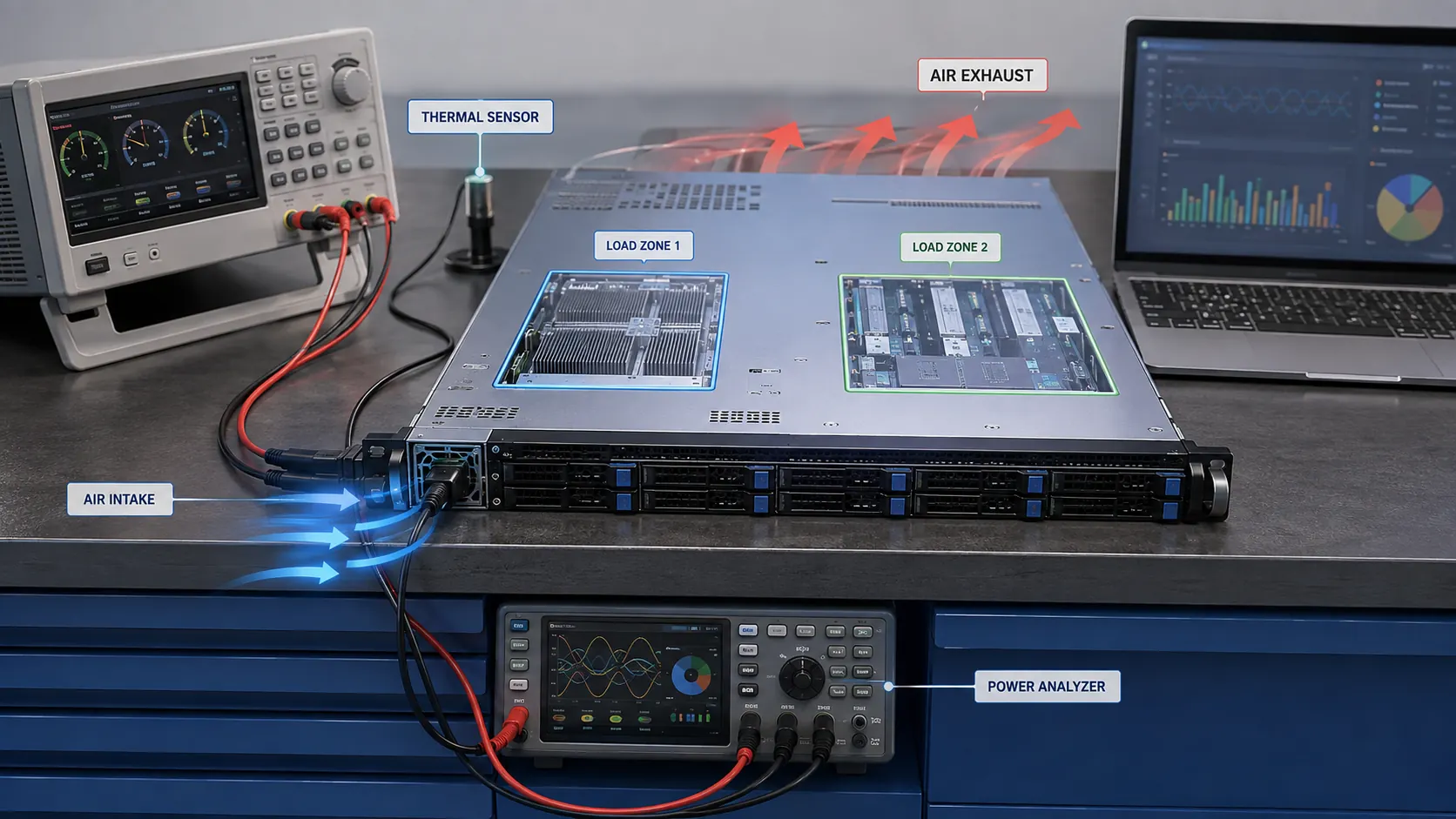
Thermal behavior must be considered in the single-module state, not only when two supplies share the load. The image below represents a load-and-airflow evaluation in which temperature and power are observed together. That relationship is more useful than treating electrical rating and cooling as independent specifications.
A practical way to interpret a 1500W 1U option
Consider a 1U accelerator server whose measured sustained demand is 1050W and whose short peaks reach 1250W. A host-approved 1500W module may provide reasonable electrical headroom if the rating applies at the installed input voltage and ambient condition. With two such modules in a genuine 1+1 configuration, the server could potentially survive one module loss without exceeding the survivor’s output ceiling.
That conclusion changes if the site supplies an input range at which the module is derated below 1250W, if the platform restricts full-power operation to two active modules, or if the cooling design cannot support the survivor at the required load. It also changes if the 1250W figure excludes storage start-up, fan maximum, or another permitted operating state. The example shows why the rating is useful only when attached to the server’s electrical and thermal context.
The short answer
Yes, a 1U server can use a 1500W power supply when the server was designed and qualified for that exact power architecture. The rating should be read as conditional module capacity, not as a universal description of size or compatibility. Confirm the approved module and cage, the input range for full output, the single-module behavior required by the redundancy policy, the high-current PDB path, and the cooling available in that state. If those elements agree, 1500W can be a practical response to dense compute. If they do not, the large number on the label cannot make the system deliver 1500W safely.