A 1200W Platinum server power supply search must split into two purchasing routes before price or specifications are compared. A platform-specific hot-plug kit is selected as an approved option or replacement for a documented server family. A PS2/ATX supply is usually a chassis-mounted, cabled component whose mounting, outputs, connectors, and cooling must fit the intended system. The shared 1200W rating and Platinum designation do not make these architectures interchangeable. First classify each result, then compare candidates only with products from the same route.
Quick answer: Treat “1200W Platinum” as a search filter, not an orderable identity. If the target server has removable PSU bays and a blind-mate power interface, follow the hot-plug-kit route and require evidence connecting the exact part to the host. If the chassis accepts a conventional PS2/ATX supply, follow the fixed-supply route and resolve mounting, cable outputs, connector assignments, rating conditions, and airflow. Do not compare the prices of the two product classes as though they supply the same hardware or solve the same integration problem.
The first filter is architecture, not efficiency class
Current results place an HPE Common Slot Platinum hot-plug kit beside a Supermicro PS2/ATX Platinum supply. Shared 1200W-class and Platinum wording does not establish a common enclosure, host interface, service method, or package scope.
| Architecture | Purchasing route | First required evidence |
|---|---|---|
| Common Slot or other platform hot-plug kit | Supported option or replacement | Exact kit-to-host relationship |
| PS2/ATX cabled supply | Fixed-supply integration | Chassis, connector, rating-condition, and cooling evidence |
Use retail categories and marketplace listings only to discover offers. Require an exact manufacturer model and stated package before comparing price, and keep each candidate within its architecture route.
Route A: the hot-plug kit must lead back to the server
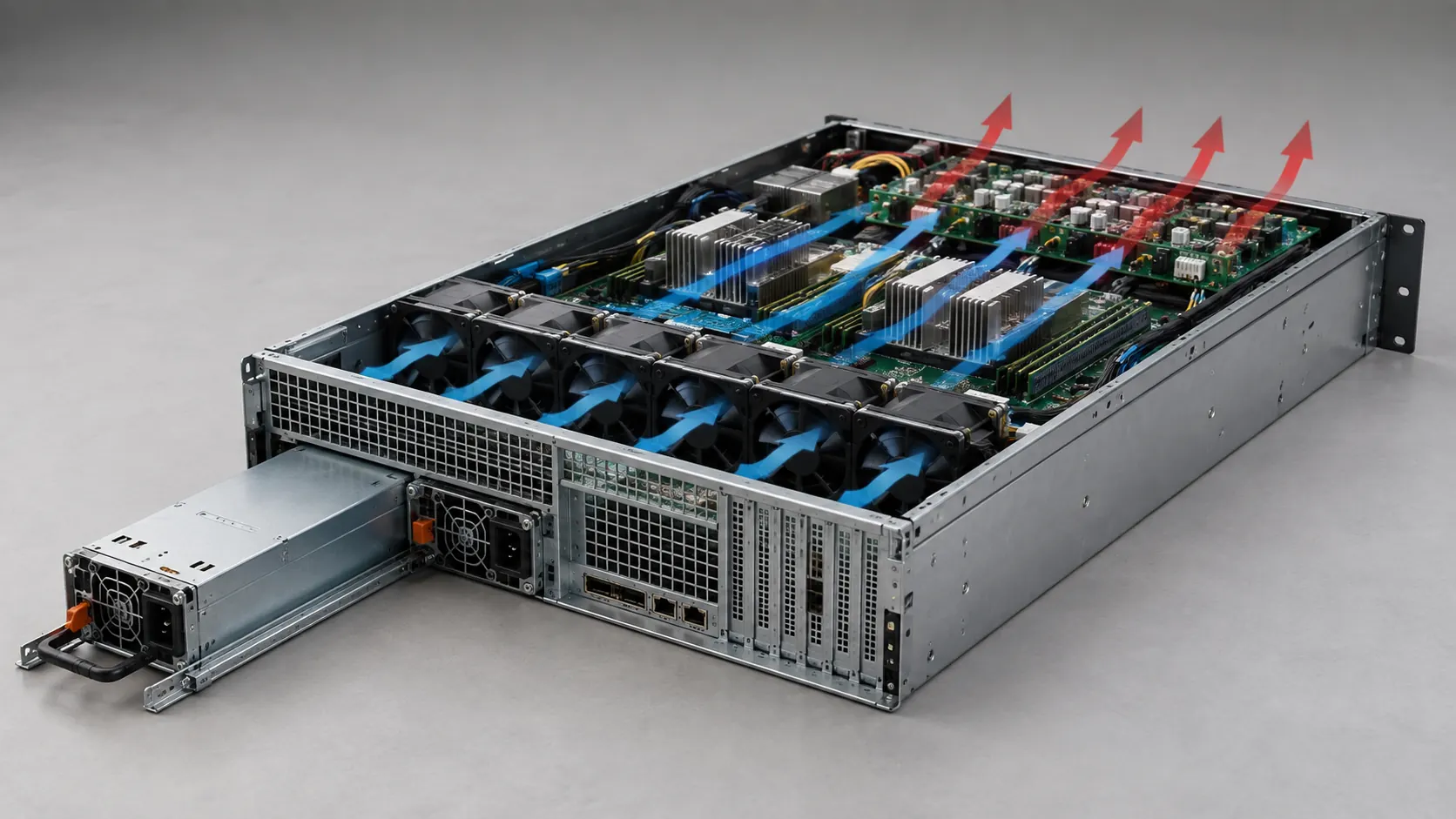
A hot-plug server PSU is part of a platform power assembly. The module inserts through a defined bay, seats against a blind-mate interface, transfers output and control signals through a power distribution board, follows a particular airflow direction, and is retained by platform-specific rails, stops, latches, or handles. Even if a module can physically enter another bay, that observation does not establish correct seating, contact alignment, output behavior, management support, or safe live replacement.
The controlling question is therefore not “Which 1200W Platinum module is least expensive?” It is “Which documented option or replacement belongs to this exact server and installed power assembly?” The evidence path normally begins with the target server model and applicable revision, followed by its option, service, or spare-parts documentation. That platform record should connect the server to the exact kit or part number offered by the seller.
Preserve the kit identity
The word “kit” may cover more than one converter module. Depending on the documented product, the package could include mounting or installation hardware, cords, adapters, instructions, or other platform-specific items. It may also be sold as a module-only service part under a different identifier. The quotation should preserve the exact manufacturer ordering identity and state what is included rather than reducing the product to “1200W hot-plug PSU.”
This matters when comparing an OEM kit with a marketplace spare. The marketplace item may be a used module removed from a server, not the complete kit represented by the manufacturer record. That item can still be commercially useful when it is the correct supported spare, but its condition, revision, warranty, included hardware, and host relationship must be represented accurately.
Keep live service within the documented operating mode
Hot-plug construction does not by itself authorize removal under every load condition. The host must have a supported redundant configuration, enough surviving capacity, and a documented service procedure. A platform operating with both modules for required capacity may contain removable hardware without being able to maintain the workload after one module is extracted.
For this route, hot-plug behavior belongs to the complete server state: installed module population, power policy, workload, input source, cooling, firmware, and management status. Purchasing an exact supported replacement avoids redesigning that state; it does not eliminate the need to follow the platform procedure.
Route B: PS2/ATX is an integration boundary
A PS2/ATX candidate commonly uses a chassis-mounted enclosure and cabled outputs rather than a removable module that mates directly with a server PDB. That changes the selection problem. The supply must fit the allocated enclosure volume, align with mounting points and the AC inlet opening, reach its loads without strained cable routing, and provide the connector set expected by the motherboard and installed devices.
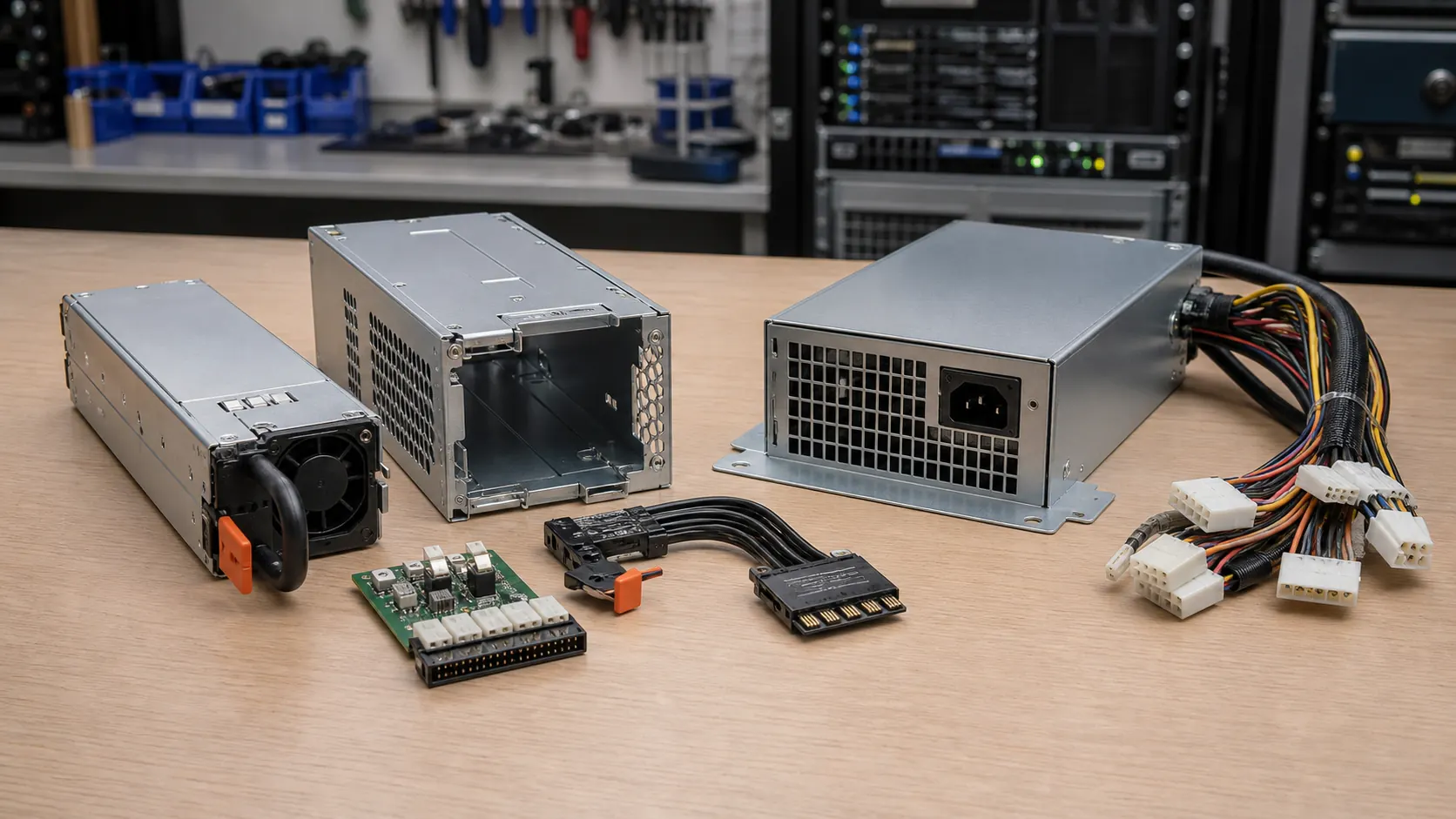
A current manufacturer example is Supermicro’s PWS-1K25P-PQ product record, which describes the exact model as a 1000/1200W PS2/ATX supply with an 80 PLUS Platinum designation. That description is useful because it identifies a specific product and shows that the advertised output may have a condition-dependent rating structure. It does not make the model a generic replacement for every tower, workstation, or rack server that uses a roughly similar enclosure.
The mechanical screen includes cables and service access
Height, width, and depth are only the beginning for a fixed supply. The integration envelope also includes the mounting flange, screw pattern, inlet and switch location where applicable, fan openings, cable-exit zone, connector bend radius, and the space needed to remove the unit. Power cables that technically reach a motherboard can still obstruct fans, memory, storage, accelerator cards, or chassis service.
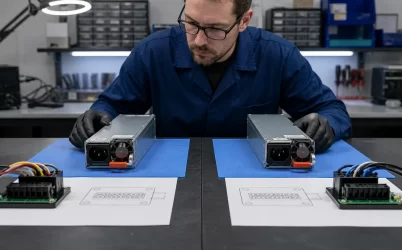
Where dimensional evidence is incomplete, build a host-to-supply drawing rather than relying on a familiar PS2 silhouette. The process described in the server PSU mechanical fit drawing reference is especially useful when the enclosure, cable exit, or extraction path is close to a chassis boundary.
Connector names do not close the electrical interface
A PS2/ATX listing may show recognizable motherboard, CPU, peripheral, or accelerator connectors, but purchasing requires the exact supplied harness and model documentation. Determine which connectors are present, how many are available, which rails or outputs serve them, and what current or combined-output limits apply. Do not infer an undocumented assignment from cable color, shell appearance, or a photograph.
This distinction is particularly important in GPU and high-current server builds. Having enough connector shells does not prove that the supply, harness, board terminals, and distribution arrangement support the intended simultaneous load. If an interface must be interpreted beyond the manufacturer’s documented connector list, the server PSU pinout verification method explains why model, revision, orientation, and mating hardware must remain attached to any contact-level information.
Fixed installation does not inherit hot-plug redundancy
A PS2/ATX supply may be appropriate for a tower server, workstation-class compute system, industrial computer, or another chassis designed around that form. It should not be treated as a hot-plug redundant module merely because another search result at the same wattage has that capability. Creating redundancy around fixed supplies would require an architecture that addresses combining or transfer behavior, fault isolation, service states, host support, and distribution. Those functions are not established by the PS2/ATX package name.
Read 1200W as a documented operating point
After the architecture fork, examine what 1200W means for the exact model. The output rating may depend on the input range, temperature, airflow, or another documented condition. A dual-number description such as 1000/1200W is a signal to find the manufacturer’s rating table rather than selecting the larger number automatically. The applicable value is the one supported at the rack or installation site’s actual input and environmental condition.
Also keep four quantities separate:
- Rated DC output: the documented output capability of the exact supply under stated conditions.
- Server demand: the power required by the configured host and workload, including relevant startup or transient states.
- AC input: the upstream demand after conversion loss, not another name for the 1200W output rating.
- Protected capacity: the load that remains supported after an allowed source or module loss, when redundancy is part of the platform.
The Platinum designation should remain attached to the exact certified or manufacturer-documented product identity and applicable conditions. It can help evaluate conversion loss and operating cost, but it does not increase the unit’s rated output, establish a server’s redundancy mode, or prove host support. Detailed efficiency comparison is useful only after the candidates belong to the same architecture and can operate at comparable load points.
Compare within each branch before comparing commercial offers
A defensible shortlist has two lanes. Hot-plug kits compete with other documented options for the same host or supported platform requirement. PS2/ATX units compete with other fixed supplies that satisfy the same chassis, electrical, connector, and cooling requirements. A candidate should not move laterally between the lanes because its price, wattage, or Platinum label looks attractive.
| Comparison field | Hot-plug-kit route | PS2/ATX route |
|---|---|---|
| Controlling identity | Exact kit, option, spare, or module number connected to the server | Exact PSU model and supplied cable or accessory set |
| Host relationship | Platform option or service documentation | Chassis and motherboard integration evidence |
| Mechanical boundary | Bay, rails, latch, insertion stop, blind-mate position, extraction clearance | Enclosure envelope, mounting pattern, inlet opening, cable-exit and removal space |
| Electrical boundary | Module-to-PDB power, control, standby, and management interface | Cabled outputs, connector assignments, rail limits, and load distribution |
| Cooling boundary | Platform-defined module airflow and server fan behavior | PSU fan orientation plus the host chassis airflow and cable obstruction risk |
| Service model | Potential live replacement only in a supported operating state | Usually shutdown replacement unless the complete host architecture states otherwise |
| Commercial scope | Kit, spare module, pair, or other documented OEM package | One fixed supply with the explicitly listed harnesses and accessories |
Only after these fields agree should price and availability enter the comparison. Within the hot-plug lane, compare equivalent supported parts while accounting for new, used, or refurbished condition and the contents of each offer. Within the PS2/ATX lane, compare units that satisfy the same host requirements and include the necessary cables or accessories. A low price loses meaning if it excludes required hardware or transfers unresolved integration work to the buyer.
Cross-lane pricing is meaningful only at a larger platform-design level. For example, a system designer might compare the total cost of a server platform built around OEM hot-plug redundancy with a custom chassis using a fixed PS2/ATX supply. That analysis must include the server or chassis architecture, distribution hardware, service objectives, engineering work, spares strategy, and operational consequences. It is not a unit-price comparison between two 1200W boxes.
Give every listing one of four purchase dispositions
The two-route method should end with a narrow commercial status rather than a blended ranking. An approved exact option is connected to the named host, has applicable rating conditions, and is offered with an unambiguous identity and package. It can proceed to purchasing under the platform’s installation and service rules.
A candidate needing host evidence has a credible exact identity but lacks the record connecting it to the intended server, chassis, or motherboard. It remains a candidate; matching wattage and efficiency do not fill that gap.
A wrong-architecture result can be a legitimate product while being irrelevant to the planned purchase. A PS2/ATX supply is not a drop-in substitute for a Common Slot hot-plug kit, and a platform-specific hot-plug module is not a conventional cabled supply for a generic chassis. Excluding the result does not criticize its quality; it recognizes that it solves a different integration problem.
A commercially ambiguous listing fails to state the exact model, condition, supplied hardware, or rating basis. Marketplace availability and an attractive price cannot compensate for an unidentified shipment. Request clarification or exclude the offer rather than assigning missing facts from a similar photograph or title.
The useful outcome of a 1200W Platinum server power supply search is therefore not one universal winner. It is two separate shortlists with different entry requirements: host-supported hot-plug options on one side and mechanically and electrically integrated PS2/ATX units on the other. Once that fork is preserved, 1200W, Platinum efficiency, package contents, availability, and price can be compared without treating incompatible power architectures as equivalent products.