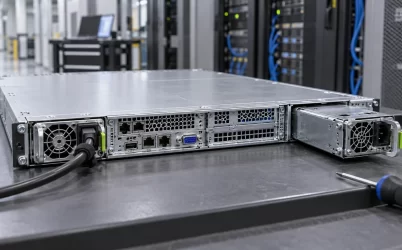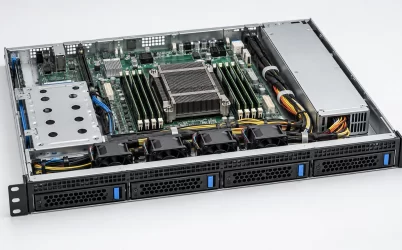
A 700W 1U 80 PLUS Gold server power supply is a compact AC-to-DC converter whose efficiency claim must be read alongside its exact certification category and operating conditions. “Gold” describes measured conversion efficiency at defined load points; it does not certify that a 700W supply fits a particular 1U chassis, delivers 700W on every input feed, or keeps a server cool. A buyer should identify the certified model, its test category, the intended AC voltage, the system’s typical DC load, and the host’s physical and airflow requirements. Those facts reveal whether the Gold rating will matter in the actual rack and whether the unit can do the electrical job.
Gold is a measured efficiency tier, not a constant percentage
The 80 PLUS program evaluates how much AC input power becomes useful DC output at specified operating points. Efficiency is DC output divided by AC input. The remainder becomes conversion loss, predominantly heat that the enclosure must reject. A Gold classification means the model met the threshold for its particular test category and load points. It does not mean the supply runs at one Gold percentage regardless of load, voltage, temperature, or system configuration.
The category matters. The program publishes different criteria for 115V internal non-redundant supplies and for 230V internal redundant data-center supplies. For example, the official 80 PLUS rating chart lists 87%, 90%, and 87% Gold thresholds at 20%, 50%, and 100% load for 115V internal non-redundant units. Its 230V internal redundant Gold row lists 88%, 92%, and 88% at the same three points. These are certification thresholds under different test categories, not promised efficiencies for every 1U server installation. Do not transfer the 115V table to a unit certified as 230V redundant, or assume a result at 230V predicts the result at a lower facility voltage.
The useful evidence is the certificate or test report for the exact manufacturer model, with its input category and measured results. A reseller’s “Gold efficiency” label may be accurate yet omit the conditions that give the label meaning. Some vendors also describe a “Gold-level” design without providing an identifiable 80 PLUS listing. Treat that as a manufacturer claim until the exact model can be matched to an official certification record. The distinction is especially important for OEM modules whose retail name, module part number, and host assembly name may differ.
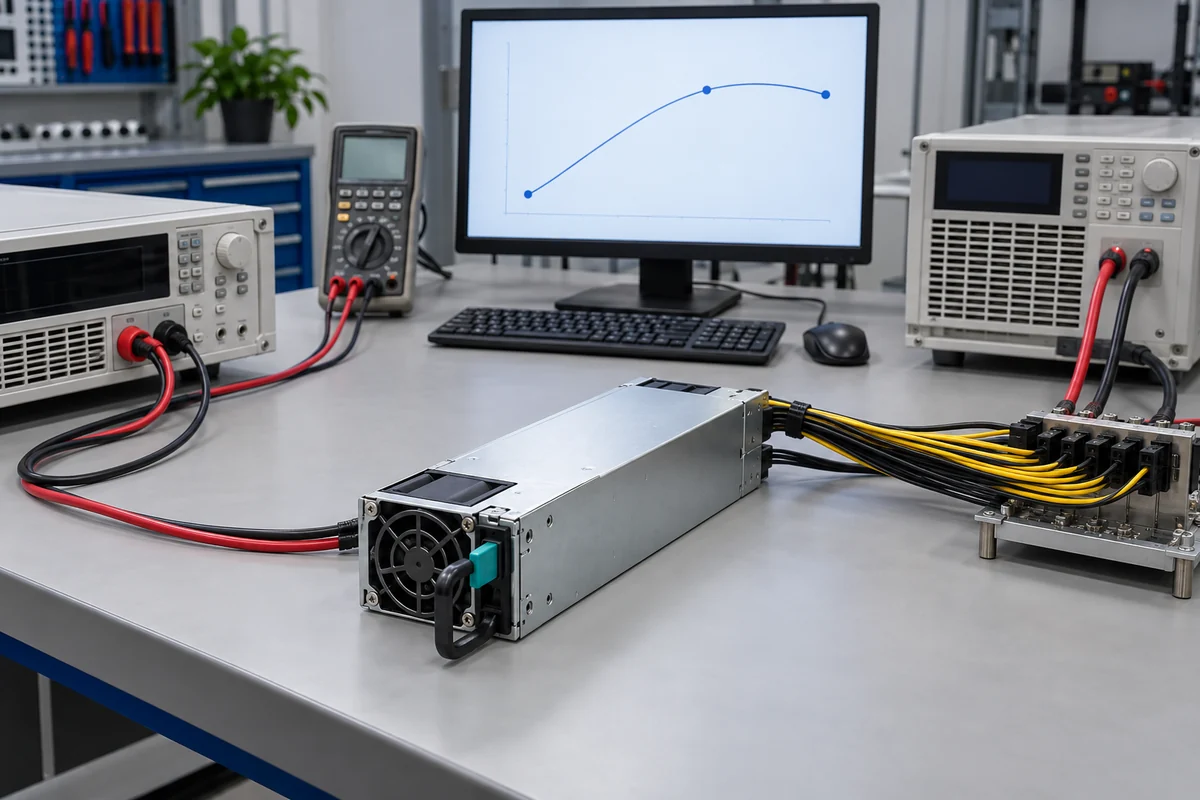
A 700W nameplate intersects the efficiency curve at the server’s real load
Certification load percentages refer to the PSU’s rated DC output, not the server’s utilization percentage or its AC draw. For a supply rated at 700W under the applicable conditions, 20%, 50%, and 100% correspond to 140W, 350W, and 700W of DC output. A server that spends most of its day near 250W sits between the first two certification points. The Gold tier alone does not state its exact efficiency there. A server that regularly approaches 700W reaches a different part of the curve and leaves less output headroom for workload peaks.
As a hypothetical illustration, suppose a server requires 350W DC and the exact supply achieves 90% efficiency at that point. Its approximate AC input is 350/0.90, or 389W, and conversion loss is about 39W. If another otherwise suitable supply achieves 92% at the same DC load and input conditions, its AC input is about 380W and loss about 30W. The difference is roughly 9W for that operating point. These values illustrate the method, not the performance of any named 700W product. Real savings require the two units’ measured curves and the server’s time spent at each load.

One test point is rarely the entire energy story. A rack server can idle for long periods, run near a steady mid-load, or make short excursions under storage and network activity. The relevant comparison is a weighted estimate over those states. If the machine spends nearly all its time at low output, a small advantage at full load may have little annual effect. If it is consistently busy, mid-to-high-load efficiency has more weight. A profile from the actual host is more useful than treating 50% load as the default operating point just because certification tables display it prominently.
For a fleet estimate, take measured DC demand or trustworthy host power data for each recurring workload state, pair it with the candidate’s efficiency near that operating point, and multiply the AC-input difference by the hours spent there. Keep the assumptions visible: 80 PLUS certification points are not a continuous field-performance curve, and a server’s reported power may not equal PSU DC output. Without suitable data, a broad annual-savings claim would imply precision the evidence does not support. The immediate design benefit of the calculation is often identifying which load range deserves a manufacturer curve or bench measurement.
In a redundant system, two active modules may share the server load. If a 350W DC load is split approximately evenly, each module can operate around 175W, or about 25% of a 700W rating. That can move both converters away from their 50% certification point. Sharing need not be exactly equal, and some systems manage modules differently; use the host’s actual operating mode before predicting energy consumption. The thermal and capacity outcome after one module fails is a separate question from normal-operation efficiency: the survivor could then carry the entire 350W.
In 1U, electrical loss becomes an airflow problem quickly
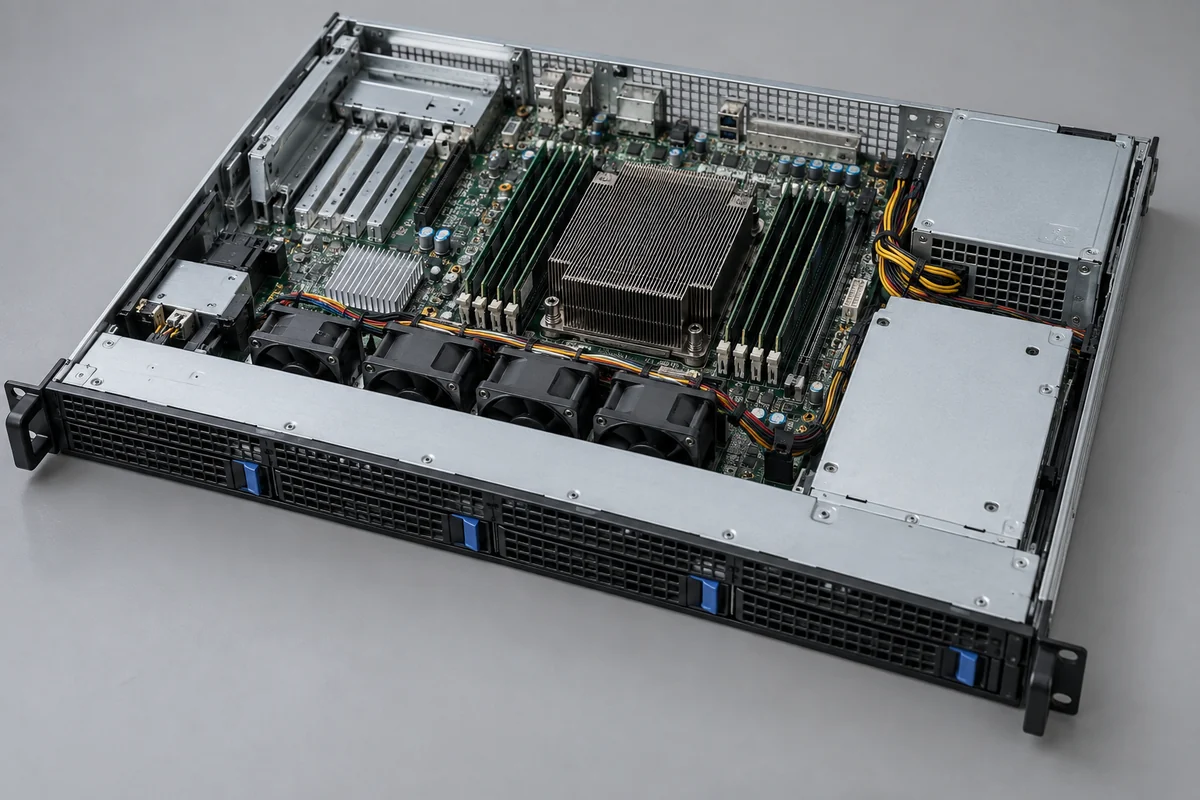
A 1U enclosure has limited vertical space for components, heat sinks, and airflow passages. The PSU’s conversion loss adds heat in a narrow channel that may also contain a fan, grille, power components, and a dense rear connection area. A Gold-rated converter can reduce this heat relative to a less efficient alternative at a given output and condition, but the rating does not describe how effectively the assembled server moves the remaining heat away. A blocked inlet or mismatched airflow direction can overwhelm a small efficiency advantage.
Cooling depends on the host layout as much as the supply. Some 1U modules draw air from the front of the chassis and exhaust toward the rear; others rely on a different path or a chassis fan system. A replacement that faces the wrong direction may recycle warm air or deprive neighboring components of flow. In a redundant cage, both PSU bays and their seals can affect the air path. During a service interval, an empty bay may become a bypass around the intended cooling channel. Gold certification does not test the module inside every compatible-looking enclosure.
At a fixed DC output, higher efficiency lowers converter loss, but a percentage-point improvement should be translated into watts before it is used to justify a mechanical choice. At 350W DC, the hypothetical 90%-versus-92% comparison above changed loss by about 9W. That is meaningful over a large fleet and may help a tight thermal budget, yet it does not rescue a unit with inadequate airflow or insufficient rated output. Conversely, a mechanically correct Gold unit whose fan path is supported by the server may outperform a higher-tier module that was never designed for that bay. Compare verified module options within the same host constraints.
Temperature ratings require similar care. A manufacturer may specify maximum output only within a defined inlet-temperature range, with derating at higher temperatures. The air reaching a PSU inside a server can be warmer than the room or cold aisle because of recirculation or upstream components. Neither “1U” nor “Gold” supplies that thermal envelope. Read the actual model’s documentation and the chassis cooling specification, then compare them with the intended rack conditions. Avoid assuming that an efficiency certificate is an operating-temperature approval.
One search phrase covers mechanically different products
Search results for 700W Gold hardware include removable redundant server modules, complete redundant assemblies, and standalone 1U or Flex-style supplies. The same headline terms can hide different output connectors, dimensions, airflow directions, and service arrangements. A supply intended for a proprietary midplane is not interchangeable with a cabled unit simply because both are approximately 1U tall and carry Gold branding. A 1U server chassis also does not guarantee that its PSU cartridge has a standardized width or depth.
An official Supermicro product listing, for example, describes a specific 700W/750W 1U Gold redundant module whose published output differs between low-line and high-line AC input. That is evidence that such a configuration exists; it is not a generic specification for all Gold units. The exact host support list, module identifier, connector, and input-dependent output must be taken from that model’s documentation. Other 700W products may be non-redundant, may use cables rather than a card-edge interface, or may meet Gold under a different test category. The certification label cannot resolve those hardware differences.
For an existing server, match the approved part and configuration first. For a new design, the system engineer has the freedom to choose a converter and design the surrounding cage or cabling accordingly, but that makes the PDB, airflow path, and protection behavior part of the design. These are different purchasing tasks. A spare order should not become an unplanned integration experiment; a new platform should not assume a server-specific module can be used outside its intended mechanical and electrical environment.
Read the Gold record and the product sheet as two different documents
The certification record answers whether the particular model met an efficiency tier in a specified category under a defined test method. The product sheet answers different questions: continuous DC output, input-voltage range, rail ratings, connector interface, physical dimensions, temperature range, fan arrangement, protective behavior, and management features if present. One does not replace the other. A model can genuinely carry Gold certification while still being unsuitable for a 700W workload at the site’s AC voltage or mechanically incompatible with the host.
Look for the exact model designation on both documents. A family name or marketing suffix may cover several revisions or output variants, and the pictured device may not be the one whose report is shown. If the certification listing and supplied unit cannot be matched, avoid treating the label as verified for that item. If a seller offers a 700W/750W module, determine which figure applies at the facility input and whether the entire host is approved for the installed pair. The 700W figure describes DC output capability, not an instruction to draw 700W continuously or an estimate of utility power.
Management features also live outside the Gold label. A server may expect status pins or PMBus telemetry from its supported PSU. A Gold-rated module with the wrong control behavior could leave the host unable to report a fault or recognize redundancy, even if the electrical power conversion works. The same caution applies to standby output and startup timing. These features may be specified by the module and host but are not consequences of an efficiency tier. They deserve attention when a replacement is proposed or when a new chassis-PDB combination is designed.
Finally, compare complete operating states rather than isolated catalog adjectives. A credible 700W 1U Gold choice has a verifiable certification record, a product specification that covers the actual rack input and load, and an interface and airflow path supported by the host. Gold can lower energy use and heat at relevant loads, but its contribution must be interpreted through the server’s duty cycle. If the unit is a redundant module, the single-survivor output limit remains a separate capacity condition. This is why a short “700W 1U Gold” listing is a useful search starting point but not a finished server-power specification.