A dual-processor server does not need a power supply rated at twice one processor’s TDP. It needs a supply arrangement that can support the entire configured system at its permitted operating and failure states. The two CPU packages are major loads, but memory, storage, PCIe cards, motherboard conversion losses, and fans draw from the same power system. A processor’s published thermal design power is not a measurement of the server’s maximum electrical demand. For a redundant pair, the decisive question is whether the configured load can be carried by one surviving module under the platform’s stated input and cooling conditions.
Two sockets change the load map, not just one line of arithmetic
Adding the second CPU can change more than the CPU subtotal. A two-socket build may populate memory channels attached to the second processor, enable another set of PCIe lanes, add network or accelerator cards, and use a different fan policy from a one-socket build. Some platforms do not permit every memory or slot configuration with only one CPU installed. The exact dependency belongs to the server-board manual; it cannot be inferred from the number of empty sockets.
The electrical load also has multiple destinations. A common server PSU may deliver a main DC bus through a distribution board, while voltage regulators near each processor create the low-voltage, high-current rails the silicon actually uses. The CPU package power is therefore not equal to the current leaving the PSU. The regulators have conversion loss, and the motherboard, memory, and cooling system consume power independently. A server with two nominally similar processors can have a meaningfully different total than another two-socket server because the rest of its configuration and power policy differ.
Two chassis with the same processor family can diverge: one may have many drives, another accelerators. Both are dual-processor servers, yet their non-CPU loads can dominate the PSU choice.
Why two CPU TDP figures do not equal the PSU requirement
Thermal design power is a processor-cooling design reference under the vendor’s defined operating conditions. It is not a promise that package electrical power stays fixed at that number in every workload, nor does it include the system loads around the processor. Processor base-power, turbo-power, and platform power-limit terminology can also differ by generation and vendor. A planner must use the definitions for the actual installed CPU and firmware policy, rather than substituting a familiar TDP figure from a different product.
Modern servers may enforce sustained and short-duration CPU power limits. Workload, cooling headroom, firmware configuration, and installed processor count influence whether those limits are reached together. A stress test that fully loads both sockets can expose a different condition from a production workload that spends most of its time memory-bound. Conversely, measuring a lightly loaded production hour does not establish an upper bound for future workloads or a fan-speed increase at a hotter inlet.
The source of the number matters too. A wall meter reads AC input to the complete system and includes conversion losses. PSU telemetry may report input power, output power, or another quantity depending on the platform. A BMC “system power” value must be interpreted according to its documented meaning. Those observations are useful, but they cannot be added to CPU TDP as though all were independent DC loads. Mixing measurement boundaries is a common way to overstate or understate the requirement.
For a concrete illustration, imagine two hypothetical processors each configured for a 220 W sustained package limit. Their combined configured package allowance is 440 W, not a prediction of constant CPU consumption. Memory, regulators, fans, drives, and cards would still require separate accounting. A brief peak could also differ from that sustained allowance under a platform policy. The example illustrates the boundary of the CPU figure; it is not a recommended PSU size or a specification for any Powernexu or OEM product.
The second processor brings its own memory and I/O consequences
A dual-socket board commonly divides memory channels and I/O resources between processors. Populating the second socket may require or enable DIMMs on its side, so the incremental power of moving from one CPU to two includes those DIMMs. Memory demand changes with module count, density, type, activity, and power-management state. Counting slots rather than installed modules gives a poor estimate; using a single generic “watts per DIMM” figure can be equally misleading across generations.
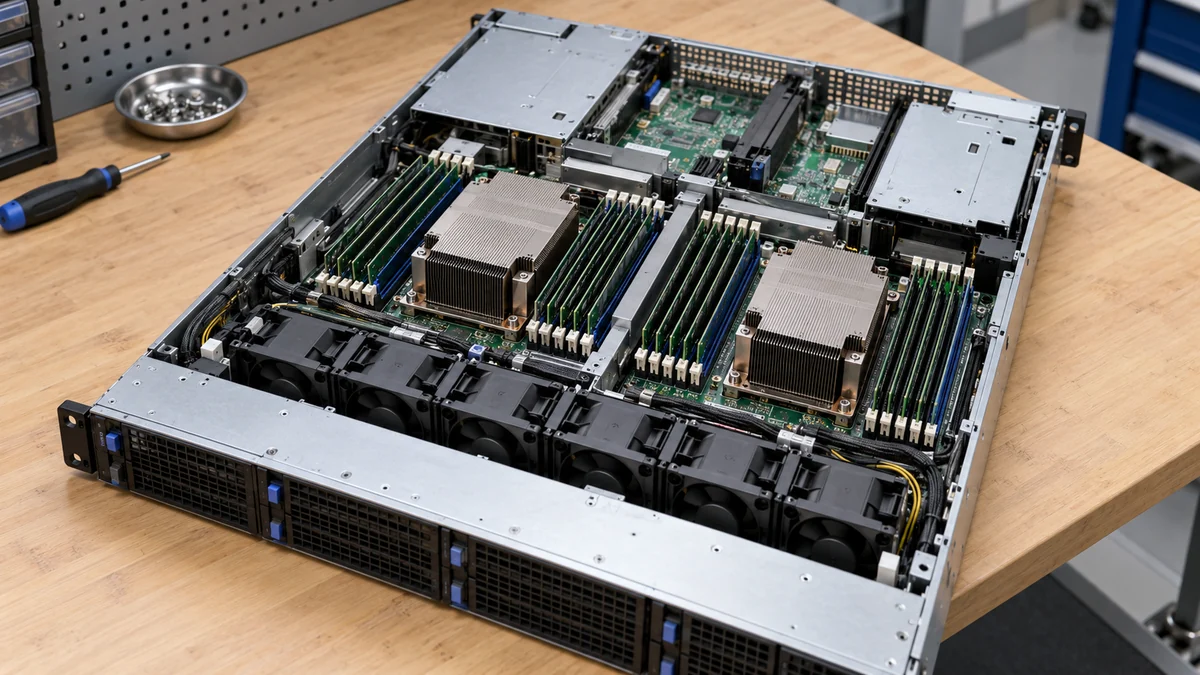
PCIe topology can also move the total. An additional NIC, storage controller, or accelerator may sit on lanes provided by the second CPU. Its board power does not become CPU package power simply because the CPU supplies the lanes. The card has a separate electrical path through the slot, an auxiliary connector, or a platform-specific distribution board. Some cards can draw substantially different power depending on feature enablement and workload, so a platform budget has to reflect the installed card and its allowed configuration.
Drives and cooling are not passive background items. A storage array can draw a startup current that differs from its running consumption; the platform may stagger startup, but that must be confirmed for the actual controller and backplane. Higher CPU and card heat can cause fans to move to a more demanding operating point. A fan wall’s electrical demand is part of the same server budget, and its increase may coincide with the compute load rather than occur at a convenient separate time.
These relationships explain why the most useful inventory is a configured-system bill of materials, not merely a CPU model pair. It should identify processor power policy, DIMM population, card power allowances, drive and backplane population, and the chassis cooling configuration. A board maker’s power budget tool, where available for the exact platform, can tie these items together more reliably than an unrelated online calculator. Intel, for example, publishes a power-budget and thermal-configuration tool for its M50CYP family; that tool is a platform-specific resource, not a universal dual-socket formula.
Follow the power from PSU output to both processor regulators
Before choosing a PSU, distinguish the module’s rated output from the motherboard’s distribution architecture. Some servers use blind-mate power modules and an internal PDB; others use a fixed supply with a harness. The board may distribute a main DC bus to two processor VRM areas and other loads. The PSU’s wattage label describes the module under specified conditions, but each distribution element still has a current and thermal limit. A sufficiently rated converter does not make an undersized connector, trace, fuse, or PDB branch suitable for an added CPU and card population.
A dual-socket motherboard may have two processor-power connectors, one near each socket. That does not mean two PSU modules are required, one per CPU. Nor does a dual-PSU chassis imply that each module is dedicated to a processor. In many platforms the modules feed a common distribution system and share the system load when both are operating. The exact connector population and supported CPU configuration must come from the host documentation. Matching a cable by shape or assuming that a second connector can be left empty is not a defensible power plan.
Voltage regulation introduces another important boundary. A processor’s low-voltage rail may carry very high current, but that current is not the same as current on the PSU’s higher-voltage distribution bus. The regulator transforms voltage and current while dissipating some power. A planner who multiplies a guessed CPU rail current by the PSU output voltage will get a meaningless result. The electrical question at the PSU boundary is the total output power demanded by every downstream branch, including the losses between that bus and each load.
Distribution capacity becomes particularly visible when the second processor enables more devices. If an additional accelerator is connected through a platform-approved auxiliary branch, it needs its own power allowance and protection. The server’s validated configuration—not a generic claim about “dual CPU support”—defines whether the existing power bay, board, cable set, and cooling path support that addition.
A redundant pair is not a doubled protected budget
Two identical PSU modules can be installed for different reasons. They may form a 1+1 redundant pair, or a platform may use both to provide a combined nonredundant output above one module’s capacity. These modes have very different implications for a dual-processor server. In 1+1 operation, one module must be able to carry the permitted system load after the other is lost, subject to that module’s input-voltage and thermal rating. Adding two faceplate wattages together and calling the sum “redundant capacity” would misstate what survives a failure.
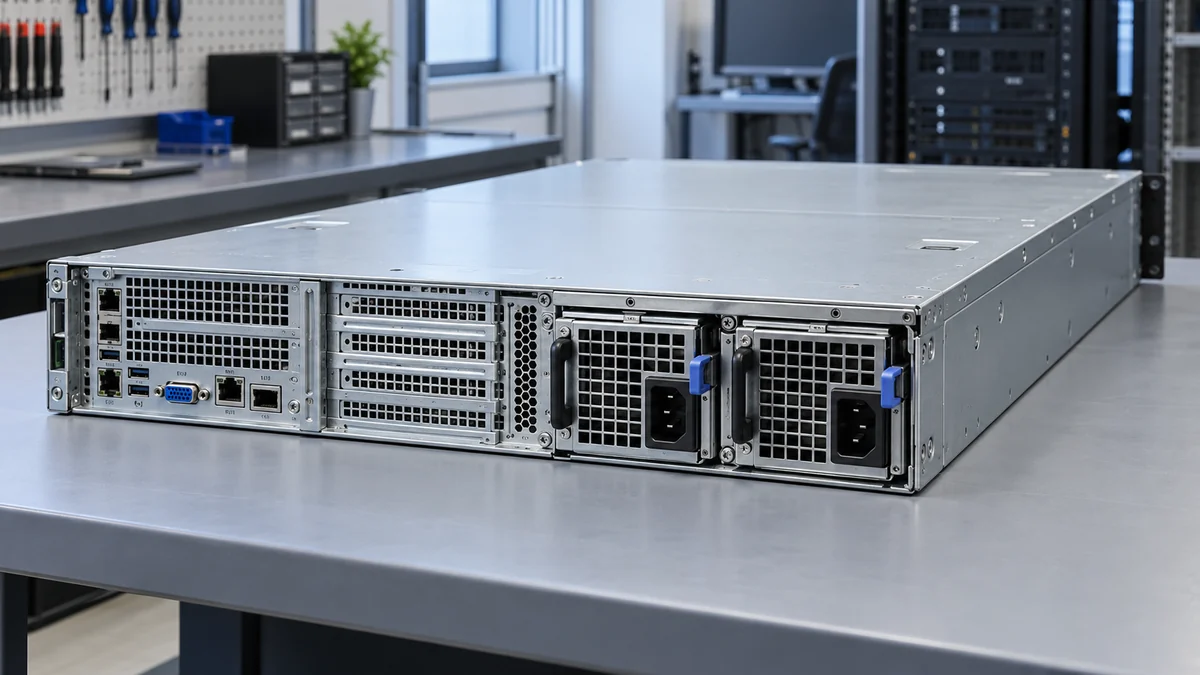
The processor configuration can change that state. A server that remains within one module’s available output with one CPU and modest memory may exceed that limit after a second CPU, additional DIMMs, and more cards are installed. Some platforms respond by changing their power policy or by reporting that redundancy is unavailable; others impose a configuration limit. Those are model-specific management behaviors, not universal consequences of installing two CPUs. The operator needs the server’s own power-budget and redundancy status, not merely the count of installed PSUs.
Consider a deliberately hypothetical platform whose configured maximum DC demand is estimated at 1,050 W. If it has two 1,200 W modules and each can actually provide 1,200 W at the installed input voltage and ambient temperature, 1+1 operation may be feasible from a power-capacity perspective. The same two modules do not provide 2,400 W of protected capacity. If the available single-module rating falls below 1,050 W under the real input or thermal condition, the numerical comparison changes. This example is a method for interpreting a platform budget, not evidence that any specific server or module supports the configuration.
One also has to distinguish module redundancy from upstream feed resilience. Supplying two modules from separate approved feeds can protect against an upstream event that a pair on one circuit cannot, but it does not raise the DC output capacity of the surviving module. A/B input design is a separate electrical-infrastructure question. Here it matters only because a two-CPU workload may run near the surviving-module boundary when one source disappears.
Why measured AC watts and the DC module rating differ
A platform-specific budget is most useful when its operating assumptions are visible. It should state which processor power policy is enabled, what memory and cards are installed, whether storage startup overlaps with compute demand, what fan condition is represented, and whether the total is DC output or AC input. It should also state whether the target is normal two-module operation or surviving one-module operation. Without those distinctions, even a seemingly precise total can answer the wrong question.
Measured power has a different role. AC input metering can show the actual energy and demand of a deployed dual-socket server under a known workload. PSU telemetry, if documented, can reveal how output or input is distributed between modules. Neither a short measurement nor a tool estimate alone proves that every supported workload, temperature, and component failure state is covered. Measurements can challenge an unrealistic budget and expose unexpected fan or card demand; the platform’s documented limits still define the allowable configuration.
Efficiency should not be silently mixed into the DC budget. If the module’s DC output requirement is the quantity being compared with its rated DC output, adding conversion losses to that requirement would double-count them. For AC branch sizing or energy cost, those losses do matter: AC input will generally exceed delivered DC power. The efficiency varies with operating point and product. This is why a DC output budget and an upstream circuit estimate are related but distinct calculations.
A second CPU changes the package-power subtotal and often the population of memory, cards, and cooling loads. Compare the documented configured-system demand with available single-module output if redundancy is promised, then account for the platform’s distribution and power-policy limits. CPU count starts the investigation; it does not finish the budget.