A search for a 48V DC server power supply can lead to three quite different purchases. One unit accepts a telecom-style −48V feed and makes a 12V rail for a server. Another accepts AC or high-voltage DC and delivers 48V to downstream equipment. A third design puts the conversion in a rack power shelf, so a server tray takes power from the rack’s positive 48V-class bus rather than containing a conventional AC-input PSU. The number 48 alone does not identify which part belongs in the server. Before ordering, locate the 48V measurement point, its polarity and return, and the assembly that performs the next conversion.
Three purchases hidden behind the same 48V label
The phrase is ambiguous because voltage labels often omit direction. “48V DC input” names what arrives at a converter. “48V DC output” names what leaves it. A “48V server” may instead describe an entire rack-and-payload architecture, with no plug-in converter at the location a conventional server has a PSU. Those products can all be found in searches for server power, yet their input terminals, output interfaces, protection responsibilities and replacement procedures are unrelated.
Think of the power path as a chain with three possible handoff points. A telecom plant may send a nominal −48V feed to a server-mounted converter, which then produces +12V. An AC-fed supply may send a regulated positive 48V output toward an engineered distribution assembly. Or a rack shelf may produce a positive 48V-class bus that a purpose-designed server tray accepts directly. In each case, a manufacturer’s electrical limits and the receiving equipment’s interface define compatibility. The shared number does not.
| Hardware role | Where 48V appears | What the next assembly must accept |
|---|---|---|
| DC-input server module | At the module input, often as a negative telecom feed relative to return | The module’s regulated output and host/PDB interface, which may be 12V rather than 48V |
| 48V-output source | At the source output terminals or downstream bus | A designed 48V distribution path and compatible loads or converters |
| Rack-bus server tray | At a rack busbar and tray input connector | Tray hot-swap and local voltage regulators designed for that bus envelope |
An input listing needs the source range, polarity, termination and accepted transients. An output listing needs its regulated voltage range, current and distribution interface. A rack-bus tray needs the shelf, busbar, connector, hot-swap and board-regulation specifications as one matched system.
A negative 48V feed can end at a positive 12V server rail
Telecom-style DC plants commonly describe a conductor as −48V relative to its return. That sign identifies the reference used for the incoming feed; it does not imply that processors operate from a negative supply. A DC-input server converter accepts the defined pair, performs the required conversion and isolation or regulation specified for that model, and supplies the rails its host expects. Reversing the conductors or treating a chassis connection as the return can make a seemingly plausible installation unsafe or inoperative. The exact grounding and bonding arrangement belongs to the particular plant and equipment documentation.
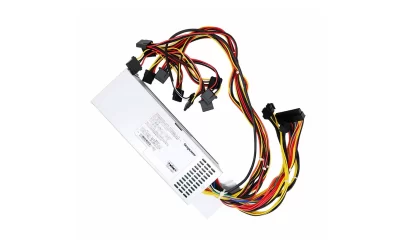
For a concrete Powernexu catalog example, the CRPSD1300 DC-input CRPS module lists a −40VDC to −72VDC input and a +12V main output. Its page identifies 1300W rated output and a +12V/106A main rail. Those published values establish its input and output roles; they do not establish that it mates with an arbitrary server bay or that another −48V module is interchangeable. The host must support the module’s mechanical envelope, power contacts, control and standby behavior, cooling direction, and PDB arrangement.
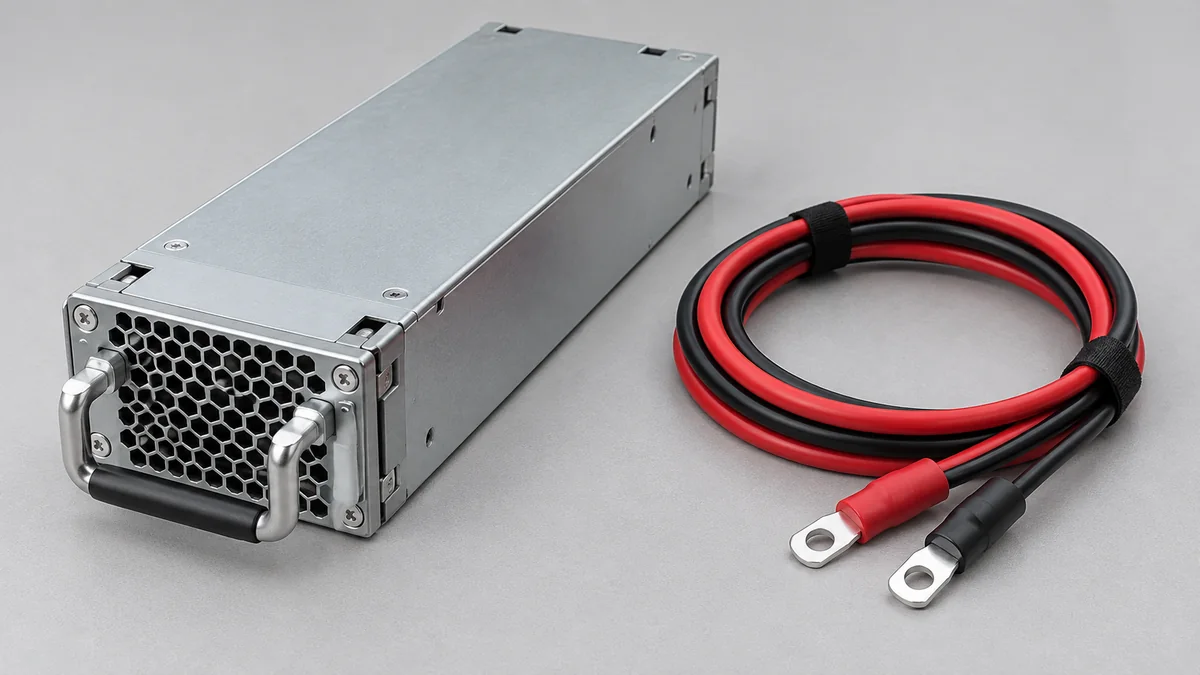
A battery-backed site makes the input range especially important. The nominal name “−48V” is not the entire voltage that appears at the input over charge, discharge and operating states. A branch conductor also drops voltage while carrying current. If the source falls toward a candidate module’s lower accepted limit, connector and cable loss can consume the remaining margin at the PSU terminals. This is an input-acceptance issue, not a reason to change the motherboard’s output voltage. The module’s own documented limits, including any load or temperature qualifications, govern its usable capacity.
An AC-fed 48V source is upstream hardware, not a blind-mate spare
Some supplies produce a regulated 48V DC output from AC or a different DC source. Great Wall’s GW-GSP3200H series datasheet, dated 8 July 2025, identifies GW-GSP3200H-48 as an enclosed 48V, 3200W output candidate with 180–264Vac or 250–370Vdc input. The same datasheet prints conflicting 52.1A and 66.7A output-current entries for this model, so neither is used here as a confirmed current limit. Its stated parameters are generally measured at 230Vac input, rated load and 25°C ambient unless noted; available output is subject to the manufacturer’s derating curves. This is upstream distribution hardware for a designed system, not a plug-compatible replacement for the DC-input CRPS described above. Rack suitability still depends on the downstream bus, connections, protection, thermal design and controls.
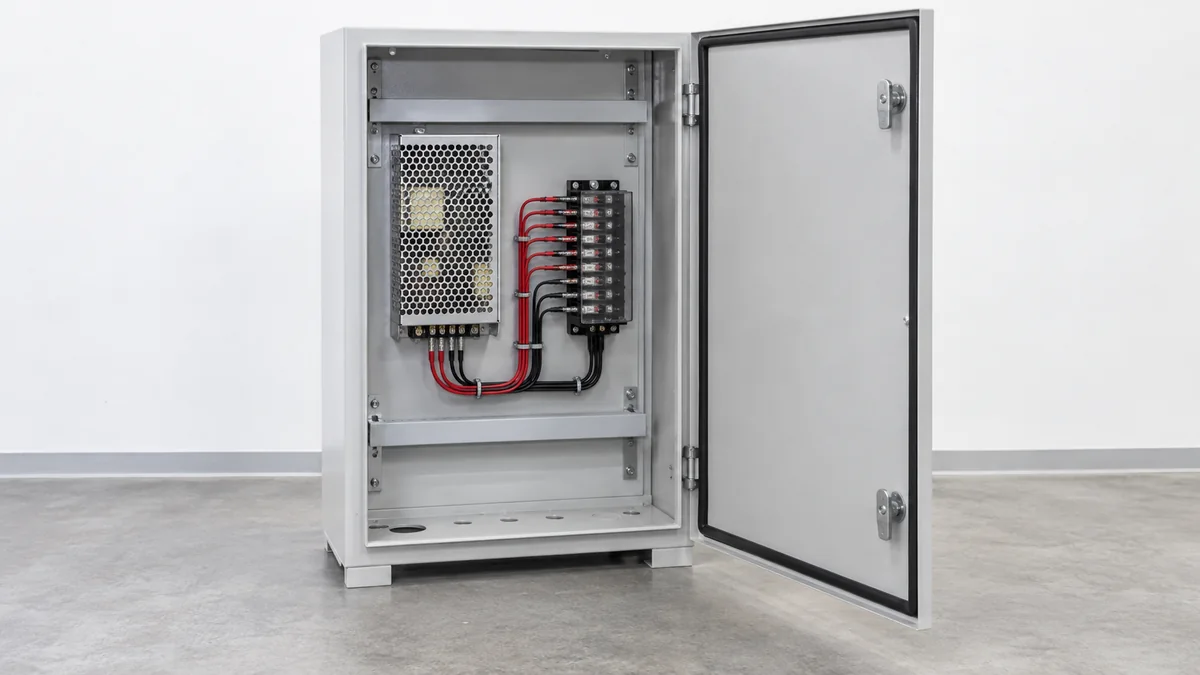
Putting conversion upstream transfers work to the distribution path. At a given voltage, current rises with delivered power; a kilowatt-class 48V bus therefore needs conductors, joints and protection selected from a verified source rating and actual load. The unresolved GW-GSP3200H-48 current entries are not an installation limit. Terminal hardware, cable length, connectors, busbar joints, branch protection and local hot-swap circuits must be qualified for the final design. A 48V output connection does not automatically provide the blind-mate contacts, short-circuit selectivity or software-managed service behavior of a server PSU bay.
Nor does “adjustable” authorize setting a convenient voltage by eye. The receiving hardware may require a nominal bus above or below 48V, and the acceptable window must be obtained from its own specification. Remote sensing, when implemented, compensates for voltage drop only within the source’s supported scheme; it does not increase connector current ratings or eliminate a poor joint. At the same time, changing the source setting to compensate for one distant load can expose a nearby load to a different voltage. Distribution architecture has to be engineered around the actual endpoints.
Another difference is service scope. A stand-alone enclosed source may be removed with the system de-energized or through a separately designed redundant shelf. A hot-plug server module is part of a particular cage, isolation path, control scheme and load-transfer policy. A seller’s description of a 48V source as “server power” should not be read as proof that it can be exchanged live in a server bay.
A rack bus changes where the server’s PSU disappears
In an Open Rack-style arrangement, power conversion can be concentrated in a rack shelf. The shelf feeds a common busbar; a payload tray such as a server accepts the rack bus and converts it near its electronic loads. The Open Compute Project Open Rack v2.1 specification gives one concrete 48V-class example: its IT-tray input is nominally +54.5V DC with a specified +40V to +59.5V operating range. That is an example of a particular architecture, not a claim that every product described as “48V DC” accepts that range.
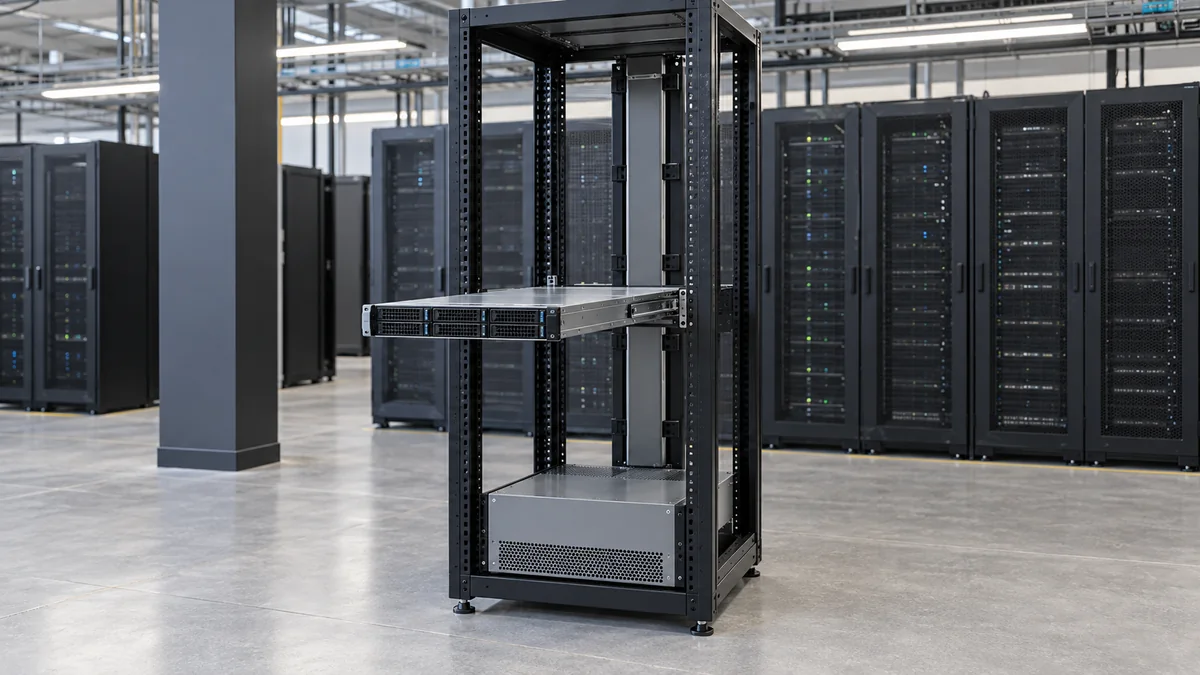
The stated tray interface includes positive and negative-return power contacts, chassis ground and a hot-swap enable function. The specification also places fuse and hot-swap functions at the tray input. Those details show why the tray is more than a pair of wires attached to a converter. It expects a defined rack source, mating connection and sequence. A conventional server with AC-input CRPS bays does not become an Open Rack payload because a 48V cable is available nearby.
Terminology can be deceptive here. The rack shelf may be called the “server power supply” because it powers many server trays, while the tray itself contains local DC-DC regulation and no separate AC front end. If an equipment list says “48V PSU,” ask whether the item is the shelf module, the complete shelf, the rack distribution hardware, the tray input board or a board-level converter. Their ownership and spare-part inventories differ even when the bus voltage is shared.
Likewise, +54V and +56V output designs should not be silently relabeled as an exact 48V source, and a −48V telecom feed should not be connected to a positive rack bus by matching magnitudes. Polarity notation, accepted ranges and where the return is referenced all matter. The number on a search result describes at most one point along the chain; it does not certify a route from the facility battery or AC service to the processor.
The current advantage ends where a new converter begins
Higher distribution voltage can reduce current for the same transferred power. For an intentionally simplified 2400W example, a 12V bus carries 200A and a 48V bus carries 50A. The relationship comes directly from power divided by voltage and ignores conversion losses. That fourfold current difference can ease long busbar or conductor runs, but it does not turn every part of the server into a 48V load. At the point where a 48V-to-12V converter feeds a 12V device, high current returns on the low-voltage side.
The more useful question is how far each voltage travels. A short 12V path adjacent to an accelerator board has different copper and connector consequences from a long 12V rack distribution run. A rack-level 48V bus can move the first conversion boundary closer to the load, but adds local conversion, its own heat, power-stage control and failure points. Whether the net system improves depends on conductor lengths, current distribution, converter efficiency across the real load range and cooling arrangement. A single current ratio is not an energy-savings estimate.
Protection changes with the move. At a common 48V bus, a faulted tray branch should not collapse every payload if the system is designed to isolate it. Upstream rectifier or shelf protection alone may not selectively clear a short at a tray input or downstream converter. Conversely, isolating each tray does not protect the rack from a shared shelf or busbar fault. The rack, tray and board owner must allocate fuses, electronic hot-swap devices, reverse-current prevention and monitoring to the correct boundary. It is unsafe to infer that those features exist simply from the bus voltage.
Redundancy is equally location-dependent. Two converters feeding a common bus may protect against one converter failure, but they may still share an AC branch, controller, rack busbar or return path. A server with two DC-input modules may protect a different boundary: loss of one host module, assuming the remaining path supports the load. A tray taking power from one rack bus cannot gain independent rack feeds simply because its board has multiple regulators. “Dual supply” is therefore incomplete until the exact failed component and surviving path are named.
Use the terminal pair to identify the part
When a drawing or quotation is unclear, identify two terminal pairs for each candidate: the conductors feeding the assembly and the conductors leaving it. Write the voltage, accepted range, polarity, current limit and physical interface beside each pair. Then mark the rack shelf, module, PDB, busbar, tray connector and point-of-load converters that exist in the actual installation. This is not a formality. It reveals whether “48V” is a source requirement, a generated bus or an input accepted by the server tray.
The three purchase paths then separate without inventing a universal part. A telecom-fed server needs a documented DC-input module and host match. A designed 48V distribution system needs an output source and suitable protection, conductors and loads. A rack-bus tray needs the specified shelf-to-tray ecosystem, including its connector and local conversion stages. If the available product information stops at “48V DC server power supply,” the item is not yet described precisely enough to order as a spare. The missing fact is the electrical direction at the named interface, not another adjective in the title.