A server power supply can report its main output ready while a board inside the server still has several power stages to start. The incoming bus, local regulators, sequencing logic, and powered devices do different jobs. For server power supply startup sequencing and power-good signals, the design question is therefore more precise than “Which voltage comes first?” It is which observed condition permits the next action, and whether the controller waits for that condition or merely waits for a timer.
That choice matters on a server board or accelerator assembly with several local rails. A correctly ordered list of enable commands does not prove that the corresponding voltages became usable in that order. Equally, a rail-ready indication does not establish that every device powered by the rail has initialized. Build the sequence around the actual load requirements, keeping commands, electrical conditions, and functional readiness separate.
The server PSU starts a bus, not every device rail
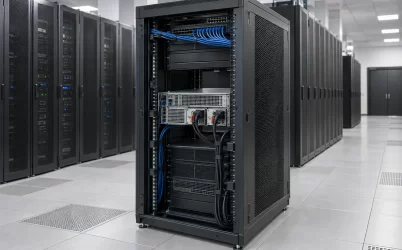
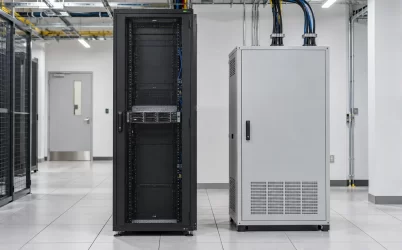
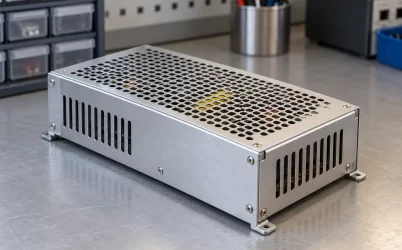
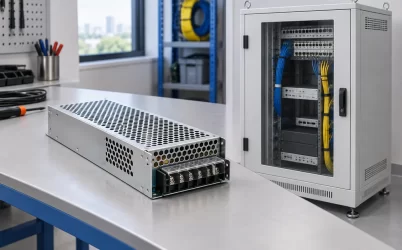
Begin the design boundary at the interface the server actually provides. A removable supply may deliver a main bus through a distribution assembly, with its own control and status relationship. The host can interpret individual module indications before presenting a system-level condition. Signal names, assertion polarity, thresholds, timing, and fault behavior belong to that exact supply and platform; a familiar power-good label is insufficient interface documentation.
Downstream, motherboard regulators generate the voltages required by particular devices. An accelerator board can have another set of local conversion stages. Their power-good outputs describe their own documented conditions, not necessarily the same boundary represented by the server PSU. The upstream bus being acceptable is a prerequisite for those stages in the proposed architecture; it is not evidence that their outputs have completed startup.
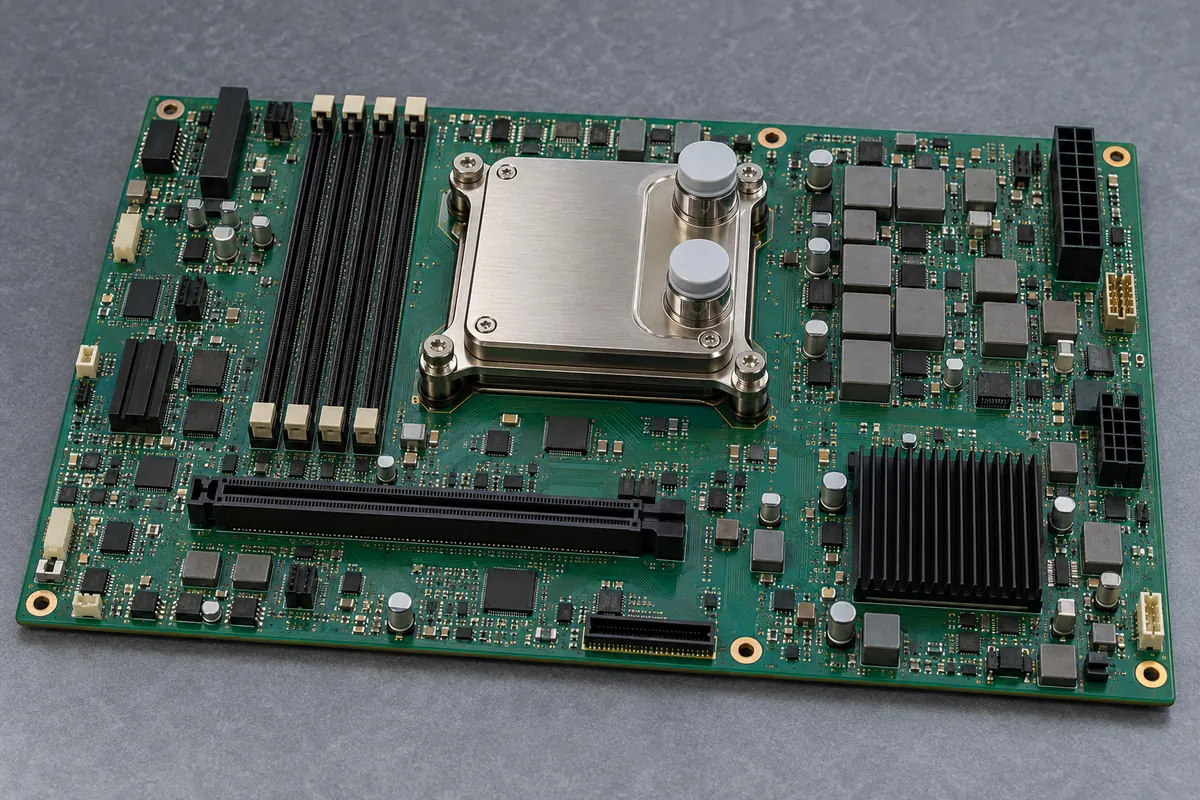
Draw these layers before drawing a timing diagram. Mark the incoming supply, local converters, sequencing controller, and devices whose requirements impose an order. Include the source that powers the sequencing logic itself. A controller cannot be assumed to supervise a transition while its own operating supply is unavailable. Its documented powered and unpowered states must fit the intended sequence.
For an existing branded server, use its approved design and service information rather than replacing platform behavior with a generic circuit. The discussion here concerns board-level design reasoning and review. It supplies neither a PSU connector map nor permission to connect one module’s status output directly to another device’s enable input.
Write dependencies before choosing sequencing hardware
Represent a dependency as a condition followed by an allowed action. For example, a fictional board might permit Rail B to start after Rail A meets a documented readiness condition. A second branch, Rail C, might start from the same prerequisite independently of B. This forms a branching dependency graph, rather than an arbitrary list that forces every rail to wait for every earlier rail.
The example does not assign a preferred order to processor, memory, auxiliary, or I/O supplies. Obtain each connected device’s actual requirements first. Some requirements concern order; others concern ramp behavior, relative voltage during a transition, maximum delay, or the state of interconnecting signals. A sequence can satisfy the first requirement while violating another. Naming the dependent condition prevents “A before B” from concealing those distinctions.
Keep required and optional relationships distinguishable. If C has no documented dependency on B, putting it behind B can make an unrelated B fault prevent C from starting. That may be an intentional system policy, but it should have an engineering reason. Conversely, enabling two branches together is appropriate only when the load requirements and available upstream power support that arrangement.
For every arrow, identify the producer and consumer of the condition. “Rail A valid” needs a defined observation point and criterion. “Device A initialized” may require a different mechanism altogether. A regulator status output cannot be assumed to report software initialization, clock availability, or completion of a peripheral’s internal reset sequence.
This representation also makes missing information visible. If a device’s documentation leaves a critical transition relationship unresolved, changing the sequencer does not supply the missing requirement. Resolve that relationship with the device manufacturer before selecting a control strategy around an assumed order.
A timer schedules a command; a monitor qualifies a state
A time-based sequence issues actions after defined intervals. A monitored dependency advances when an identified condition is satisfied, possibly with an additional delay. These approaches answer different questions: when should an action be requested, and what evidence must exist before it is requested? A design can need both. An elapsed interval alone does not measure the previous rail.
Texas Instruments’ Power-supply sequencing for FPGAs, SLYT598, fourth quarter 2014 distinguishes these approaches. It describes power-good-to-enable cascading, reset-based monitoring, timer-based up/down sequencing, and monitored sequencing. In its examples, an ordered enable sequence can exist without monitoring the preceding rail; adding a readiness condition changes that relationship. This historical FPGA application note supports the conceptual distinction, not a current server wiring recipe or a universal voltage threshold.
Consider two hypothetical startups with identical command schedules. In the first, Rail A reaches its required state before the scheduled enable for B. In the second, A is delayed by an unresolved operating condition. The timer still issues B’s command unless another mechanism inhibits it. The same command trace can therefore accompany different electrical histories. Whether the second history is acceptable follows the actual connected-device requirements.
Now suppose B’s permission explicitly depends on A’s qualified status. The delayed startup can stop progress instead of issuing the next command on schedule. That is useful only if the design also defines what happens when the condition never arrives. Remaining indefinitely in a partially powered state is an operating behavior, not automatically a satisfactory fault response.
The sequencing controller produces commands; the converters produce the rail responses those commands request. Keeping those physical functions separate helps a reviewer ask whether the chosen implementation observes the required result. A controller that records its own enable transition has recorded an action. It has not thereby recorded the voltage at the receiving device.
Power-good cascading leaves electrical questions to answer
Using one regulator’s power-good indication as a prerequisite for another stage can express a simple dependency. It does not eliminate interface design. Confirm the status output’s electrical type, reference, valid supply domain, startup state, and documented meaning. Confirm the receiving enable’s requirements separately. Logical compatibility on a block diagram does not establish that the two pins can be wired together.
A pull-up source deserves particular attention where the selected output requires one. If its supply is not available at the relevant time, the receiver may not observe the intended status. An asserted level while another part is unpowered can raise a different interface question. Review those states against the exact component documentation rather than choosing a resistor or voltage from a generic example.
Likewise, the condition used to assert power good must support the intended dependency. A regulator can declare its output acceptable under one documented criterion while a connected load requires another condition before the next stage starts. Do not replace the load’s requirement with a convenient status threshold simply because the signal is available. Independent monitoring can be considered when the required condition is not provided by the converter’s own status.
Delays need defined initiating events. A delay measured after an enable request differs from one measured after rail qualification. Even with the same nominal interval, the second action can occur at a different point in the startup history. Preserve that distinction in requirements, configuration records, and waveform interpretation so two teams do not implement different meanings of the same timing entry.
A longer chain also accumulates dependencies. A missing early condition can withhold several later stages, while a false early indication can release them prematurely. This does not make cascading inherently unsuitable. It makes the membership and meaning of each dependency important, especially when an optional board or rail shares a chain with functions the host needs for management or fault reporting.
Controlled shutdown and interrupted startup are separate contracts
A successful upward sequence does not define the downward sequence. The simple cascading approach described in TI’s application note is presented as a power-up method with limitations for power-down control. Do not extend that observation into a prohibition on every circuit using power-good dependencies. Additional circuitry or a different controller can implement other behavior, but that behavior needs its own design evidence.
Define the required shutdown relationships from the loads rather than automatically reversing the startup list. The enabled state and the actual rail voltage can diverge while stored energy discharges. A command to disable B before A does not establish that B crossed its required lower boundary first. Loading, capacitance, converter behavior, and any supported discharge mechanism affect the actual transition.
Also distinguish a controlled shutdown from unexpected upstream loss. A controller may have time and operating power to issue an orderly sequence after a requested stop, yet lose that capability when its own source disappears. The design must identify the conditions under which a controlled sequence remains possible and the permitted device behavior outside those conditions. No generic delay setting creates energy that is no longer available.
Interrupted startup adds another state. Suppose A qualifies, B is enabled, and the incoming bus then becomes unacceptable before C starts. Decide whether the system waits, withdraws commands, latches a fault, or follows another documented recovery path. Consider what each connected device experiences during that partial sequence. Those choices should follow the platform’s requirements, rather than being accidental consequences of whichever signal drops first.
A retry can begin from residual voltages rather than from a fully discharged board. The next attempt may therefore encounter a different initial condition from the first. Record any required off-state conditions and supported restart behavior. A sequence that works after a long power-off interval has not established the behavior of an immediate repeated attempt.
Choose control complexity from the dependencies it must enforce
A short, well-defined startup dependency can justify a simple implementation when the relevant electrical interfaces and fault responses are established. Separate monitoring becomes useful when converter status does not represent the required condition. More configurable sequencing can be appropriate when several branches, operating modes, shutdown relationships, or fault responses must be controlled. Added functionality brings configuration and verification work of its own.
Keep the design record readable across hardware and firmware ownership. It should connect each required relationship to the signal or measurement implementing it, the action it permits, and the response when that condition is lost. Store the actual configuration with its applicable board and component revisions. A configuration copied from a similar accelerator is not evidence that its rail requirements match this one.
The resulting startup architecture can be reviewed without pretending that all server power-good signals mean the same thing. The server PSU establishes its documented upstream condition; local converters and monitors establish named downstream conditions; sequencing logic permits actions according to the required dependencies. Timers remain useful where elapsed time is the actual requirement. Where the requirement is a valid rail, the design needs evidence of that rail.