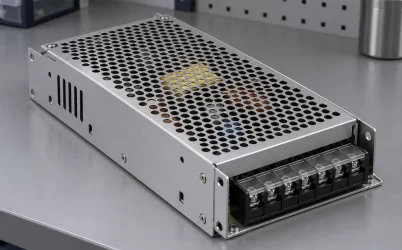
The Great Wall CRPSHD1600D2 is a 1,600 W, 12 V CRPS module listed for 90–264 Vac or 180–400 Vdc input. Its most useful distinction in a server fleet is the published set of three main-output current figures: 75 A, 82 A, and 132 A. They are not three rails to add together. Nor does the public listing explain which input or temperature condition belongs to each figure. For a storage or general-purpose compute node whose demand may cross one of those thresholds, the answer is to identify the applicable rating before assigning this module as a standard spare. The CRPSHD1600D2 product record is a useful starting point; the missing conditions require the model’s detailed documentation.
Why the current figures create three different capacity bands
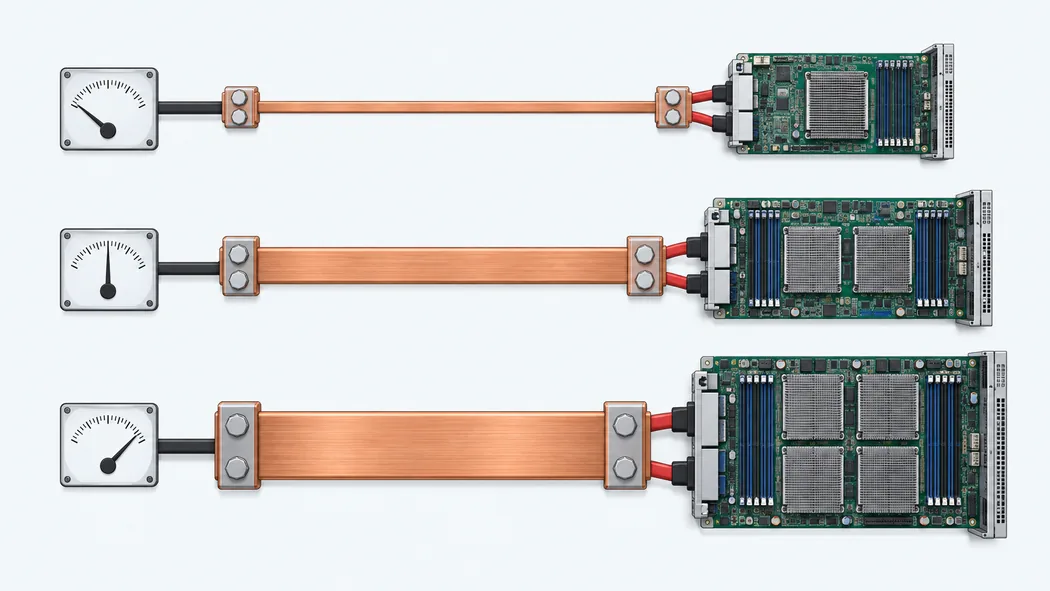
At a nominal 12 V, 75 A corresponds to 900 W, 82 A to 984 W, and 132 A to 1,584 W of main-output power. These products of voltage and current are arithmetic, not independently certified operating points. They are nevertheless revealing: the two lower figures are close together, while the highest is exactly 600 W above the middle one. Treating the headline 1,600 W as equally available throughout the input range could therefore put a server load on the wrong side of a real operating limit.
The Great Wall manufacturer listing publishes those values but gives no mapping from current tier to AC line voltage, DC bus voltage, inlet temperature, or other conditions. A similar-looking PSU’s nameplate cannot fill that gap. Even if its tier pattern looks familiar, differences in revision, control, and input implementation may change the allowed operating region. The useful question for Great Wall or the platform vendor is precise: under which input and ambient conditions is each of the 75 A, 82 A, and 132 A main-output limits available for CRPSHD1600D2?
Consider an illustrative storage node drawing 850 W continuously from its 12 V input. That is about 71 A at nominal voltage, so it sits below all three published figures in simple steady-state arithmetic. A different node drawing 950 W is about 79 A: it clears the 82 A and 132 A figures but not 75 A. A 1,300 W node is about 108 A and therefore needs the highest listed tier. These are examples of demand bands, not claims that any node is compatible. Startup, drive spin-up, CPU bursts, local converters, and the distribution board may change the actual current profile.
A model-specific power-versus-input table makes these bands actionable. Without it, a fleet with mixed AC and high-voltage DC feeds cannot assume that a spare approved on one feed has the same capacity on another. The current row is a flag for further interpretation, not a menu from which the largest figure can be selected at will.
A 1,600 W spare fits a particular fleet, not every bay with the same outline
The CRPSHD1600D2 occupies a useful middle position in Great Wall’s published HD series. The manufacturer’s listing shows 800 W, 1,300 W, 1,600 W, and 2,000 W HD entries with the same stated 180–400 Vdc input interval and 185 × 73.5 × 40 mm envelope. On paper, that creates a range of output capacities for systems that use this input architecture. It does not establish that the four modules share a connector, control protocol, mechanical latch, or approved host list. Capacity selection and physical interchangeability are separate questions.
For a fleet with substantial numbers of servers below roughly 1 kW on the 12 V bus, the 1,600 W nameplate may appear generous. Yet if those systems must operate where only a lower published current tier applies, the useful headroom may be far smaller. A fleet whose nodes often approach 1.3 kW needs the 132 A tier under its actual feed condition. An operator should segment hosts by measured or modeled 12 V demand and feed, then compare each segment with the applicable documented tier. That is more informative than classifying every host as simply a “1,600 W server.”
Spare stocking follows the same logic. One spare part number can simplify inventory only when the host vendor approves it across the intended servers, and when its rating covers each host’s operating region. A same-size 2,000 W HD module might serve a higher-demand host, but it should not be presumed to replace the 1,600 W module in every bay. Conversely, reducing to a lower-power family member requires proof that the remaining capacity covers the host, including the failure state in a redundant assembly. Keep the exact model, revision, and approved host association with the spare record; a generic “CRPS 12 V” label loses the distinctions that matter.
Input acceptance and available output answer different questions
The HD designation is associated in the public listing with two input families: 90–264 Vac and 180–400 Vdc. These ranges say where the module is listed to accept a source. They do not say that full 1,600 W output is available at every voltage in either range. The presence of three 12 V current figures makes that distinction especially important. If a server can be fed from low-line AC in one site and a high-voltage DC distribution bus in another, the supported main-output current for both sites must be known before treating the spare as common stock.
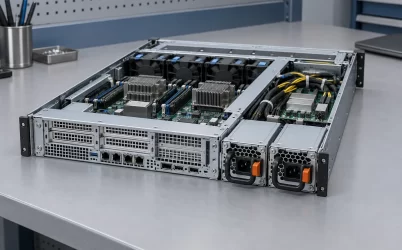
The distinction also affects how a redundant shelf is operated. If two modules share the load while healthy, losing one changes the current carried by the survivor. For a host with 1,200 W of 12 V demand, the surviving unit would have to supply about 100 A at nominal 12 V, before accounting for distribution losses or transients. That is below 132 A but above both lower listed tiers. The example shows why a pair of modules cannot be treated as a protected 2,400 W supply merely because each has a 1,600 W headline. The relevant rating is the surviving module’s documented capacity at the actual source and environment, together with the host’s redundant power design.
Input architecture must be matched at the system level as well. An AC input and a high-voltage DC input are alternatives in the product row; the row does not promise a single unit can switch between live sources without interruption. DC distribution also has its own connection, polarity, protection, and service requirements. These are properties of the installed system and approved interface, not conclusions from the input-voltage line alone.
The 12 V path can limit a seemingly comfortable load
Current leaves the module through a mating interface, passes through the host’s power distribution board or bus structure, and reaches local loads or converters. A 132 A listed main-output figure is meaningful only if the entire path is rated and thermally managed for the intended duty. A visibly similar connector is not proof of current capacity. Contact construction, plating, insertion state, copper cross-section, and cooling can all matter in a dense server bay. The public Great Wall row does not publish a pinout or mating-connector rating for CRPSHD1600D2.
The +12VSB / 3 A line is a separate published standby output. At nominal voltage, 3 A corresponds to 36 W. That figure helps bound a standby-load discussion, but it should not be added automatically to the maximum main-output figure as if the complete module could continuously provide both maxima without restriction. The detailed combined-output and sequencing rules belong in the datasheet or host electrical design. A server’s management controller, wake circuitry, and standby peripherals can draw from this rail even when the main 12 V output is off, so the distinction matters during shutdown and restart.
Transient current can cross a tier boundary even where sustained consumption does not. A storage shelf may have spin-up behavior; a compute node may change load rapidly. The listed steady output figures alone do not describe allowable peaks, duration, response, or protection thresholds. Rather than inventing a generic margin percentage, use the host’s actual load profile and the manufacturer’s transient specifications. Where those are unavailable, a conservative preliminary screen should be clearly separated from an approved operating limit.
The shared housing hides the model-specific interface
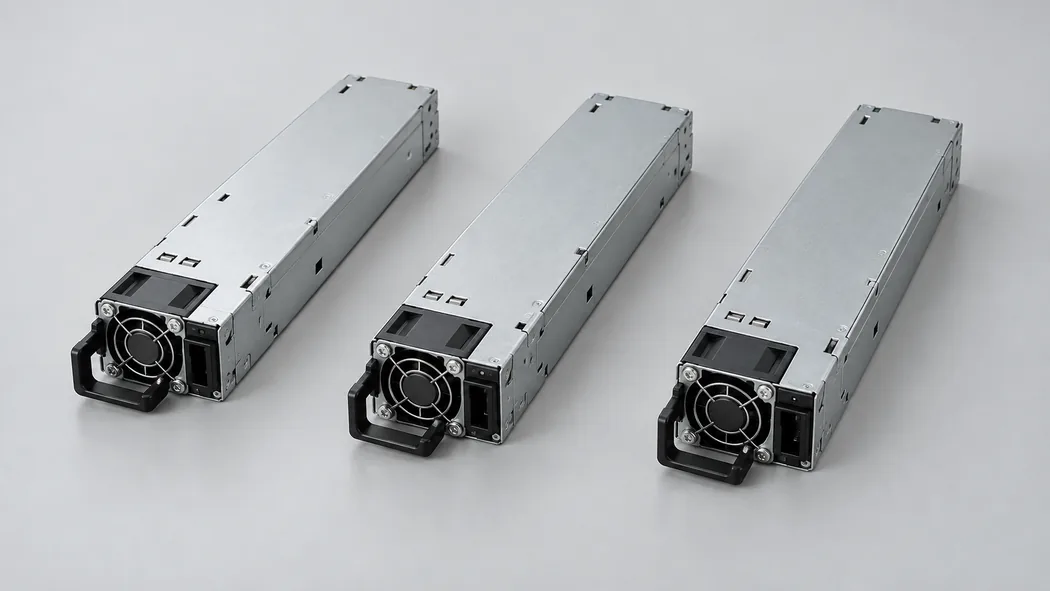
Great Wall lists the CRPSHD1600D2 at 185 × 73.5 × 40 mm with FR airflow and a 0–55°C operating interval. The dimensional envelope can rule out an obviously incompatible bay and helps describe the spare in inventory. It cannot confirm guide-rail geometry, connector keying, contact positions, handle clearance, extraction travel, or power-management signaling. The same applies when comparing the 1,600 W HD unit with neighboring HD capacities or other 185 mm CRPS modules.
Airflow direction is particularly easy to overlook because it may not be visible in a stock description. The listing says FR, but the abbreviation should be checked against the actual module drawing and the host’s intake-to-exhaust scheme. A server designed around a specific flow direction may create a local hot spot with a reverse-flow replacement even if both modules occupy the same bay. The 55°C upper operating temperature is also not a promise that the 132 A tier remains available at 55°C. The public row gives no current-versus-temperature derating curve.
Management behavior is similarly unspecified in the public table. Some hosts use presence detection, status signals, telemetry, or firmware rules to identify approved modules. This CRPSHD1600D2 listing does not state the protocol or command set. It would be inaccurate to infer PMBus support, a particular telemetry map, or compatibility with a server controller from the CRPS form factor alone. For a replacement program, the host vendor’s approved-parts list and the manufacturer’s interface drawing are stronger evidence than a matching shell size.
CCC is the certification stated in the public manufacturer row. Platinum and MEI Class A are also listed attributes, but they should be repeated as published categories rather than expanded into unverified approvals or numerical efficiency claims. If a deployment requires a particular national approval or a formal efficiency report, obtain the exact certificate and test documentation for the model and revision to be installed.
Where the 1,600 W tier is a useful boundary
A sensible use for CRPSHD1600D2 is a defined class of 12 V servers or storage nodes whose documented maximum load stays within the current tier available at their feed. That description is narrower than “any server under 1,600 W,” and it is operationally more useful. It ties the spare to a set of hosts, an input condition, and a load profile. A fleet operator can then distinguish nodes that remain below the 75 A figure from those that require 82 A or 132 A, without pretending the public listing explains when each tier applies.
The 1,300 W and 2,000 W HD family entries provide neighboring capacities in the same published input-voltage family. They can frame a design trade-off, but neither is an automatic substitute. A host with a sustained 1,300 W 12 V load may fall within the 1,600 W model’s highest listed current arithmetic, yet its burst behavior, inlet condition, temperature, and host approval can alter the answer. If those conditions place the usable tier at 82 A, the nominal 984 W arithmetic limit is below the sustained load; if the 132 A tier applies, the continuous comparison is different. The missing tier map is therefore a decisive document, not a minor footnote.
That is the practical boundary of the public information. CRPSHD1600D2 is clearly a 1,600 W-class, 12 V module with AC and high-voltage DC input ranges in a compact listed envelope. The published 75 A, 82 A, and 132 A figures identify materially different output regions. Before assigning one SKU across a mixed fleet, obtain the model-specific tier conditions and host approval, then map each server’s sustained and transient 12 V demand to them. This preserves the benefit of a common spare where it is real and exposes the nodes that need another rating or an explicitly approved configuration.