“Master” and “slave” do not identify one universal server power-supply mode. In one design, a leading converter sends a current-share reference that other active converters follow. Separately, an Intel M50CYP cold-redundancy support note uses “Master” when discussing the active PSU while the other is in cold standby; that platform-specific usage describes a host operating policy, not the TI current-share control role. Some share controllers even let the leading role move between modules automatically. Those arrangements have different normal current readings and different responses when a module fails. A server owner should interpret the words through the specific host, PSU and power-distribution documentation, rather than assume that “slave” means either powerless backup or half of an active pair.
One label, three different electrical questions
The first question is whether both supplies are converting power at the same time. A current-sharing arrangement may have two active outputs joined through a distribution assembly. A priority or hot-spare arrangement may let one PSU carry most of the present demand while a second remains ready to wake. The second question is who sets any shared control signal. A dedicated leading module can provide a reference that other modules follow; an automatic controller can select whichever module presently meets its leadership criterion. Neither question is answered by the number of PSU handles visible at the rear of a server.
The third question is what happens after the leading source disappears. A subordinate current-share controller may be able to assume control, may revert to a separately defined mode, or may require another supervisory function. A standby PSU may start supplying the load under the host’s power policy. Those outcomes depend on different circuitry and timing. The phrase “master/slave” by itself is not a failover specification.
It also helps to distinguish the PSU’s local control role from the server’s management policy. A board-level controller may be described as a leader because its share signal is highest. The management interface may separately name a “primary PSU” because the server has chosen one input for energy-saving operation. The primary input does not have to be the fixed source of a hardware current-share signal. If a document uses both descriptions, read their definitions rather than merge them into a single hierarchy.
| Use of the role names | Normal power flow | Question after a loss |
|---|---|---|
| Dedicated current-share leader and follower | Both approved modules may feed one bus; the leader supplies a control reference | Can the follower maintain regulation and take the required load when that leader is lost? |
| Automatically selected share leader | Both modules may feed the bus; leadership is a temporary control state | Does the remaining controller become the valid reference without upsetting the bus? |
| Preferred active PSU and standby PSU | The preferred module may carry most demand at suitable load | How quickly and under what conditions does the standby module become active? |
This is a map of possible meanings, not a claim that a particular Powernexu or third-party PSU supports all three. Some systems use different terminology altogether. The actual operating mode must come from the approved server and PSU assembly.
In current sharing, leadership is a control signal—not a bigger PSU
Parallel regulated supplies do not naturally divide output current equally. Slight differences in voltage setting, connector resistance and distribution impedance can bias one branch. A supported current-share circuit senses each module’s contribution and adjusts its control behavior to bring the branches into an acceptable distribution. “Master” may name the controller that provides the reference; “slave” may name a controller adjusting its own output to follow it. It does not mean the follower has a lower wattage rating or that the leader owns the entire DC load.
Texas Instruments describes an automatic load-share controller in which the module with the highest current-sense signal drives the share bus and other controllers adjust their outputs toward that reference. This is an example of a control mechanism, not proof that an arbitrary server PSU uses that device. The distinction matters because a share bus is an internal command path. AC-input presence, output current, BMC-reported PSU status and current-share leadership are separate observations.
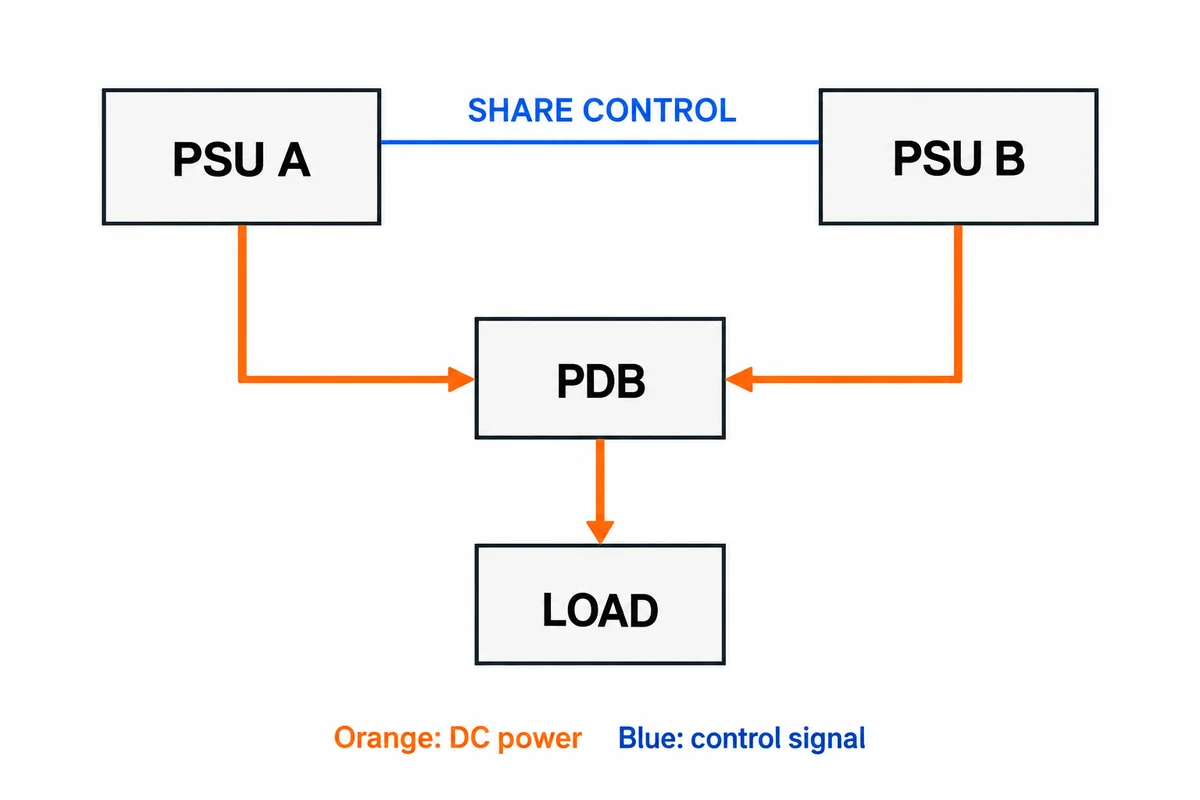
In a dedicated-leader design, one designated unit provides a reference to the followers. The arrangement can coordinate current under normal load, but loss of the designated leader raises a specific fault question: what reference remains and how does the DC bus behave while the group recovers? An automatic-leader design attempts to avoid that fixed-role dependency by allowing another controller to become the reference. That capability still requires a sound implementation. It does not make the whole server immune to a failed common distribution board, a shorted share signal or insufficient surviving capacity.
A role name is especially easy to misuse when two otherwise similar cartridges have different firmware or control revisions. Their mechanical fit does not prove that their share signaling is interoperable. The server vendor’s supported module pairing, PDB routing and control specification are more informative than the labels printed on two modules. For the underlying reasons that parallel PSU currents diverge, see the separate server PSU current-sharing explanation; the issue here is what a particular “master/slave” designation does and does not promise.
Automatic leadership is a moving state
In a controller that elects the leading branch from current information, a module can be leader at one operating point and follower at another. The role can change when load, input condition, output setting or branch impedance changes. A service log that calls PSU A “master” in one sample and PSU B “master” later is not automatically evidence of hardware replacement or an unstable server. One must know how the controller elects the role and whether changes are expected in the observed mode.
The term “automatic” should not be confused with a software administrator choosing a preferred input. The control loop can establish the reference electrically without a permanent chassis slot assignment. A server’s management interface may nevertheless prefer one AC feed for a separate power-saving policy. These two decisions occur at different layers: one controls current distribution among active outputs, while the other decides which supplies should be active under the present workload. A system can expose only one layer, both layers, or neither to the user.
Leadership transfer must be considered with fault isolation. If a failed module remains connected to the output bus, a healthy controller becoming the new share reference may not be enough to preserve voltage. The distribution assembly and PSU output protection must prevent the failed path from dragging down the common load. Likewise, a functioning share loop cannot raise the capacity of the sole survivor beyond its approved rating under the installed input and cooling conditions. The leader can change; the electrical limits do not.
An engineering sketch should therefore draw three paths separately: AC or DC input to each PSU, each PSU’s power output to the PDB and load, and any control or telemetry path between modules and host. Arrows that combine all three into one line conceal the very distinction that the terminology is meant to clarify. For a multi-module platform, the same drawing also reveals whether a shared connector, fuse or copper path remains a common failure point even though the controllers can exchange roles.
A preferred PSU and a standby PSU are about operating policy
On platforms with a documented hot-spare feature, a host may designate one supply as primary and let another sleep at light load. Dell documents that behavior for the PowerEdge R7625; Intel separately documents active and cold-standby operation for the M50CYP family. The motive can be conversion efficiency: the active converter operates at a different point on its efficiency curve than two lightly loaded converters would. In that policy, large differences in observed input power or output current can be normal. The standby source is not necessarily defective because its telemetry is low. It is present for a supported transition when the load rises or the active source disappears.
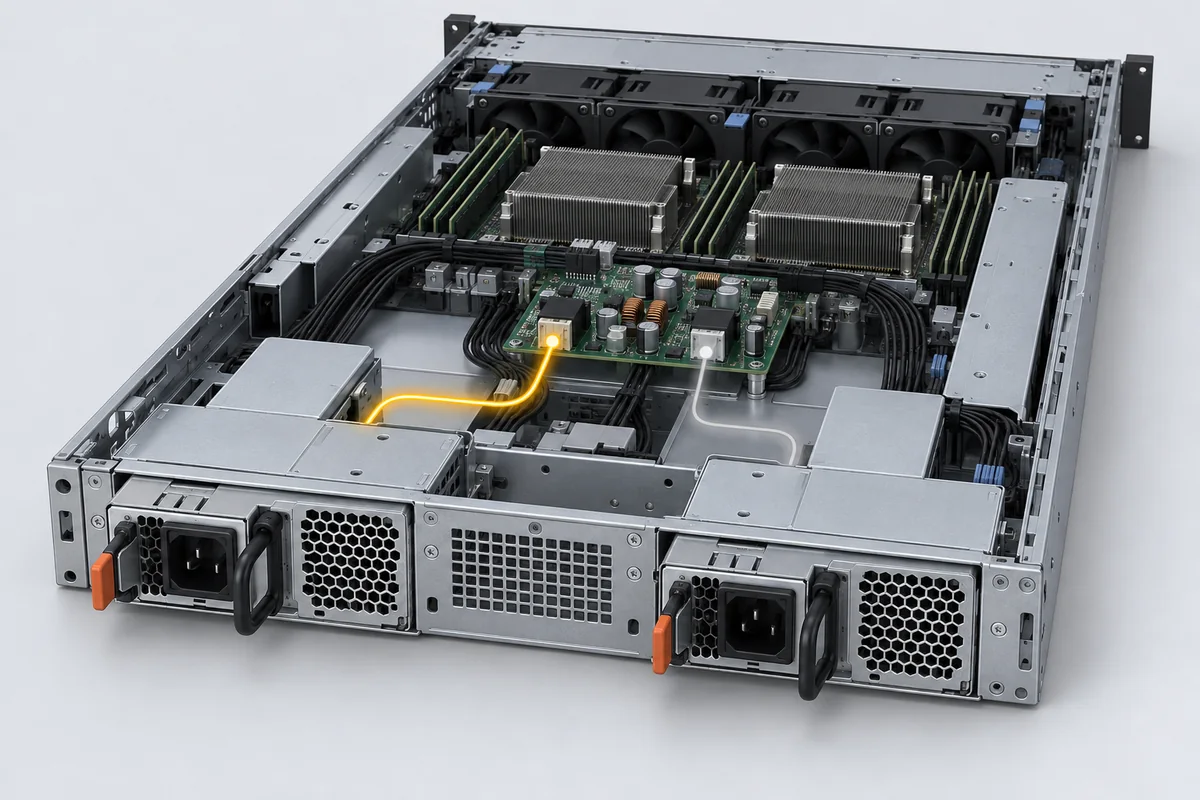
Intel’s M50CYP support note uses “Master” in a cold-redundancy question, but that wording does not establish a master/slave current-share circuit or a universal naming convention. When both supplies become active at higher load, the server may switch to a current-sharing mode, or it may use a different approved arrangement. The management setting that chooses a preferred PSU may have no power to select the leader of an analog share bus. The safe interpretation is the one documented for the exact server platform, not a general rule inferred from the word “primary.”
The transition has an energy boundary. During a primary-input loss, the still-powered standby path must become capable of carrying the allowed load before bus voltage falls outside the host’s tolerance. Output capacitance, wake behavior, isolation, input availability and host power policy all influence that event. A server may remain powered but reduce performance under a documented power cap; another may be specified to maintain full operation. “Redundant” should be read against the load and the host’s promised behavior, not treated as a synonym for uninterrupted full-power performance in every configuration.
What a missing module tells the control system
Removal of a hot-plug cartridge, loss of its AC input, failure of its output stage and loss of a share-control signal are not identical events. A healthy cartridge can lose its input yet remain physically seated and communicating for a time. Another can be powered at its input but unable to contribute DC current. A server BMC may report these conditions through different status fields, and the control loop may respond differently to each. If the concern is a real outage, identify the failed boundary before interpreting a master/slave label in the event log.
Consider a host in which both PSU modules are active and a current-share controller elects the higher-current branch as leader. If one input disappears, the remaining module must carry the permitted load while the failed path is isolated; leadership may simply move with the operating current. Now consider a host in a light-load hot-spare policy. One PSU was intentionally near sleep before the fault. Its necessary action is to wake and take the load. Both can be described with role language, but the electrical sequence and the useful evidence are different. These are hypothetical architectures, not statements about a named Powernexu product.
Read the role in its own layer
For a specification or troubleshooting record, the useful statement is not “PSU A is master and PSU B is slave.” It is a description of the mode: which supplies are converting, whether their outputs are paralleled, what the share-control signal represents, whether leadership is fixed or elected, and what the host does after a source is lost. These facts may be split among the PSU manual, PDB documentation and server management guide. A connector pin named SHARE confirms the presence of a signal on that interface, but does not reveal its scaling, permitted module combinations or failover behavior without the corresponding specification.
Likewise, one low current reading cannot prove standby operation. It can reflect a supported energy-saving policy, normal light-load share tolerance, an inhibited output, a measurement boundary, a poor contact or a fault. Compare the reading with the host’s reported operating mode and with what the exact PSU pairing is expected to do at that load. Do not “correct” an apparent slave by increasing its voltage adjustment or moving a sense connection in a production server. Such changes can defeat the control loop and the warranty-supported configuration.
The word “master” is therefore best treated as a clue to a control relationship, not a component rating or a guarantee of availability. In an active share loop, ask which module defines the reference and whether another can assume it. In a primary/standby policy, ask when the quieter PSU must wake and which load it can carry. If the documentation never defines the role, use the explicit electrical and failure-state descriptions instead. Those descriptions determine what the server can actually survive.