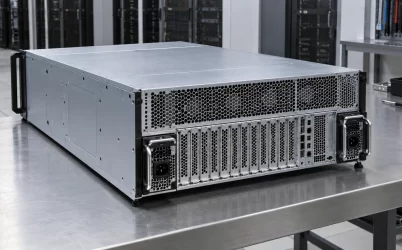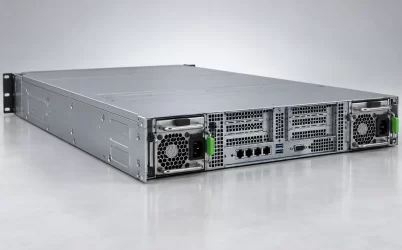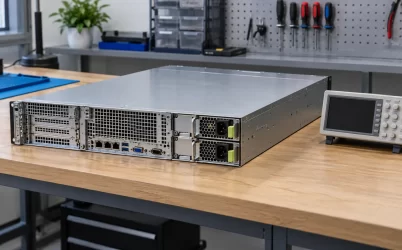
A cold redundant power supply keeps a spare conversion path available without asking every installed module to deliver output power all the time. In a supported server, one or more primary PSUs carry the load while a secondary module remains in a reduced-power state; the controller brings reserve capacity online when load rises or an active path fails. The word “cold” describes that operating policy, not a disconnected spare on a shelf. Whether the transition is fast enough, which faults it covers, and whether it saves energy are properties of the particular server, PSU family, firmware, and power-distribution architecture.
The reserve module is present, powered, and under control
The spare usually needs an available AC input, some control and housekeeping power, and communication with the host. Its main converter may be idle or disabled, but the platform still has to know that the module is present and able to respond. A disconnected cord or an incompatible PSU cannot become useful simply because software calls it a reserve.
By contrast, in a load-balanced redundant mode, compatible modules contribute output power during normal operation. Each may carry a share of the server load through the approved combining path. Cold redundancy changes the distribution of normal output work: fewer converters do most of it, while enough installed capacity remains to cover the specified failure. It does not automatically change the server’s peak permitted load, the number of supported module failures, or the capacity of a branch circuit.
Terminology differs among vendors. Some call the behavior high-efficiency mode, hot spare, or cold redundancy, and those labels do not guarantee identical transitions. Dell’s current PowerEdge explanation, for example, distinguishes its M-CRPS cold-redundancy feature from an older hot-spare implementation. Treat the host’s own mode description as the authority for the exact states and alarms, rather than inferring behavior from a familiar name.
Why concentrating the load may change conversion loss
AC-to-DC efficiency varies with output load. Running two converters at a light fraction of their ratings can yield a different combined loss than operating one converter at a higher fraction while the other waits. A supported cold mode exploits that difference where the PSU efficiency curves and server power policy make it worthwhile. The standby module still consumes some input power, and the active module may run warmer or closer to its rating. Therefore, an efficiency improvement is conditional rather than inherent in the word “cold.”
Consider an illustrative server drawing 600 W of DC power at a steady workload. Suppose, only for the sake of comparing operating points, that two active modules would each deliver 300 W at 89% efficiency. Their combined AC input would be approximately 674 W. If a single active module delivered the 600 W at 93% efficiency, it would take about 645 W, before adding the waiting module’s input consumption. The arithmetic suggests a possible saving of less than 29 W, not a measured product result. Different efficiency curves, standby draw, fan speeds, input voltage, or workload changes could narrow or reverse it.
That is why a label such as Platinum or Titanium does not resolve the mode choice by itself. Certification values are obtained at defined test points, whereas a real server changes load through idle, boot, application bursts, and management events. Compare total AC input for the entire server under the operating modes it actually supports. Measuring only the active PSU’s output, or ignoring the secondary PSU’s input draw, can make the apparent saving too large.
Concentrating conversion loss in one chassis corner can change local inlet and exhaust temperatures. The active PSU fan and neighboring system fans may respond differently than they do with both modules sharing power. A quieter or cooler server cannot be assumed from the electrical efficiency calculation.
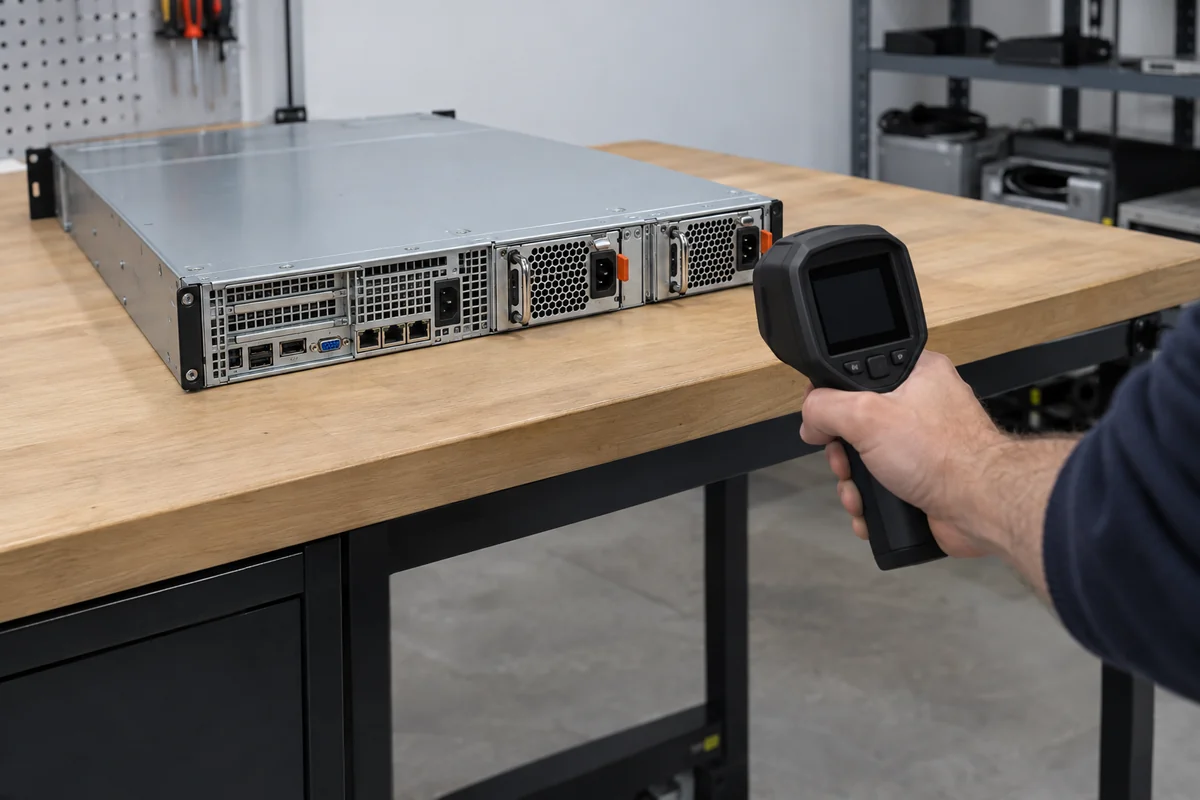
Load growth can wake the secondary before any failure
Cold redundancy must respond to two different events. The obvious one is failure of an active module or its input. The less obvious one is demand increasing beyond what the active set should carry alone. A server may therefore move its secondary PSU into active operation during boot, a sudden accelerator workload, storage spin-up, or a sustained high-load period even though nothing has failed. The change can be normal operation, not evidence of a fault.
The control threshold and hysteresis are implementation-specific. If a platform moves between states too frequently near a threshold, the repeated switching may impose undesirable thermal, acoustic, or electrical transitions. A well-defined policy avoids needless oscillation, but no universal switch point can be inferred from the module’s wattage label. Management screens may describe a module as standby, idle, enabled, or not supplying output; interpreting that status requires the server documentation and the current demand.
At high enough load, both modules may be needed to supply the system, so a configuration physically containing two PSUs might no longer retain one-module redundancy. This is a capacity issue, not an efficiency-setting defect. The host may refuse cold mode, leave it automatically, limit performance, or warn that redundant capacity is unavailable. Operators should distinguish “secondary converter is idle while one module can carry the load” from “both modules must run because the load exceeds one module’s supported output.” Both can show two installed, powered units, yet only the former may preserve the intended reserve.
A fault transfer is not the same as an efficiency transition
When demand rises normally, the controller can detect the trend and activate more capacity according to its power policy. A sudden input or converter failure gives it much less time. Output capacitors, control timing, current-sharing behavior, reverse-current blocking, and the server’s tolerance for bus deviation all influence whether the load rides through. The reserve must be ready to assume the required current without turning a single PSU fault into a common-bus collapse.
The electrical path matters as much as the software state. A power-distribution board or integrated isolation stage combines module outputs and prevents a failed source from drawing damaging reverse current. A standby PSU that powers up successfully on a bench may still fail to preserve a server if the host connector, PDB, firmware, or protection sequence is incompatible. Neither an extra module nor an efficiency setting substitutes for an approved system architecture.
Some transitions start upstream. If the active PSU’s AC feed disappears, the server may wake the module on a separate feed. If both PSUs share the same branch or rack PDU, that failure boundary disappears. Cold redundancy therefore cannot be used as evidence of A/B feed independence. The spare’s power cord must remain connected to an appropriate supply, and each surviving upstream path must be able to accept the transferred input demand.
The supported transition can differ by fault. An orderly standby command, loss of AC input, internal shutdown, and shorted output are not electrically equivalent. A platform may handle one cleanly while another triggers protection or host throttling. The redundancy claim should name the event the server is designed to survive.
Normal A/B readings can become intentionally unequal
Two cords on two metered rack PDUs do not necessarily draw equal power when the server runs in cold mode. A preferred primary PSU may take most of the AC input, while its reserve on the other feed draws only standby power. An operator expecting a 50/50 split could misdiagnose the low reading as a disconnected module. Conversely, an unexpectedly equal split might indicate that the server has moved out of cold mode because demand increased or the selected policy changed.
At rack scale, these preferences accumulate. If many servers choose side A as primary, side A may carry a disproportionate normal load even though side B retains the ability to accept it after a failure. The branch, PDU, and UPS feeding side B still need capacity for the transferred state. A low standby reading on B is not unused capacity available for unrelated equipment without considering simultaneous transfers. Conversely, alternation of preferred sides across servers is useful only where the actual platform supports that policy and the upstream design preserves both failure paths.
Use the right measurements for the question. Per-PSU telemetry may reveal which converter is active, but rack-PDU readings show the load seen by each facility feed. Total server AC input shows whether the efficiency policy changes electricity use. Those values need not match at a single instant because they describe different boundaries and can be sampled at different rates. A transition trace is more informative than one screenshot of a standby state.
Mode support belongs to the complete server platform
A PSU can be physically capable of low-power standby yet not support a particular host’s cold-redundancy mode. The server must recognize the installed module family, expose the policy, manage converter enable states, report alarms, and allow the standby unit to assume load. The paired modules may need matching output ratings, efficiency grades, firmware, airflow direction, or approved spare numbers depending on the host. These are platform-specific requirements, not universal rules attached to the words “redundant PSU.”

Mixed generations deserve caution. A replacement supply with a matching shape and output voltage might boot the server but remove access to an efficiency policy or redundant operating state. Conversely, the same PSU family may expose different management behavior in different hosts or firmware releases. Read the supported-parts list and power-mode documentation for the exact server, and treat the mode offered in its management interface as an observed platform feature, not proof that every fault condition has been tested for a new PSU combination.
Where the system permits choosing between load-balanced and cold modes, the comparison should include output capacity at the deployed AC voltage, the load range over which the mode is allowed, standby consumption, management visibility, and the response to the loss of each active path. Those are the variables that determine whether the efficiency benefit has operational value. An unsupported generic module is not a safe shortcut, even if a marketing description advertises “cold redundant” operation.
What a working transition looks like in the server
The clearest way to understand an installed system is to observe its state sequence at an ordinary load, at a higher supported load, and after a defined source loss. In the ordinary state, identify which PSU supplies DC output and which remains ready. Raise the application load within the host’s supported envelope and note whether the reserve becomes active before the primary reaches its allowed limit. Return to the lower load and see whether the mode settles rather than repeatedly toggling.
A controlled loss of one input or module, when the server manufacturer supports that procedure, should reveal whether the other path carries the intended workload and whether an alarm identifies the degraded condition. The observation needs both electrical and workload context: output-bus continuity, host resets or throttling, module status, AC feed current, and thermal response can tell different parts of the story. Do not remove a module from a non-hot-swap assembly or stage an intentional fault outside the documented service method simply to demonstrate redundancy.
Restoring the input does not always put the system immediately back into its original cold state. It may share load during recovery, wait for a timer, require a policy confirmation, or retain an alarm until it is cleared. Those differences are exactly why “cold” should be read as an operating mode rather than a generic PSU hardware class. In a supported implementation, the useful result is a normal low-loss state with a reserve that is visibly ready and a failure response the server is explicitly designed to survive. If the reserve is disconnected, unsupported, or too small at the actual input and temperature, the name of the mode offers no protection.