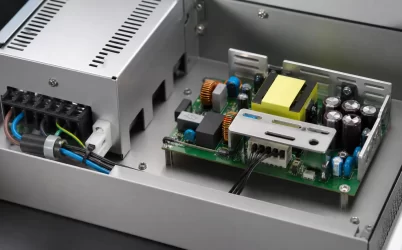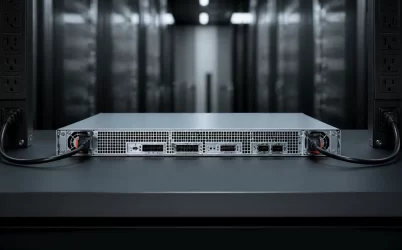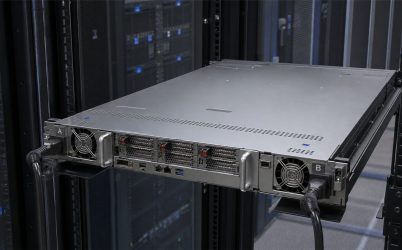
A hot swap server power supply can be removed and replaced while the server remains energized, provided the platform has a healthy redundant power path with enough capacity. Hot swap is not the same as redundancy: the connector, inrush control, ORing or reverse-current blocking, current sharing, management logic, and service procedure make live replacement possible, while additional capacity keeps the load powered. Before removing a module, operators must confirm the remaining PSU and upstream feed can carry the full server load.
Quick Answer
A safe hot-swap PSU replacement requires a platform-qualified module, an active redundant PSU on a healthy feed, sufficient failure-state capacity, correct fault isolation, and a documented service sequence. Check BMC and PSU indicators, identify the failed module, verify A/B feed status, remove the correct cord when required, wait for the prescribed discharge interval, and insert the replacement fully. Afterward, confirm power-good, current sharing, telemetry, alarms, and redundancy restoration.
What Happens During a Hot Swap
When a powered module is inserted, its uncharged input and output capacitance can demand a large current. Without controlled connection, that inrush can pull down a live bus, stress contacts, or trip upstream protection. A hot-swap design controls the energy transfer and sequences contacts or signals so protective and management functions establish the intended state.
During removal, the departing PSU must stop sourcing current and prevent reverse current from the live bus. The remaining module or modules take the load without allowing the bus to fall outside the downstream converters’ acceptable range. The BMC should detect the state change and report it without blocking the electrical transition.
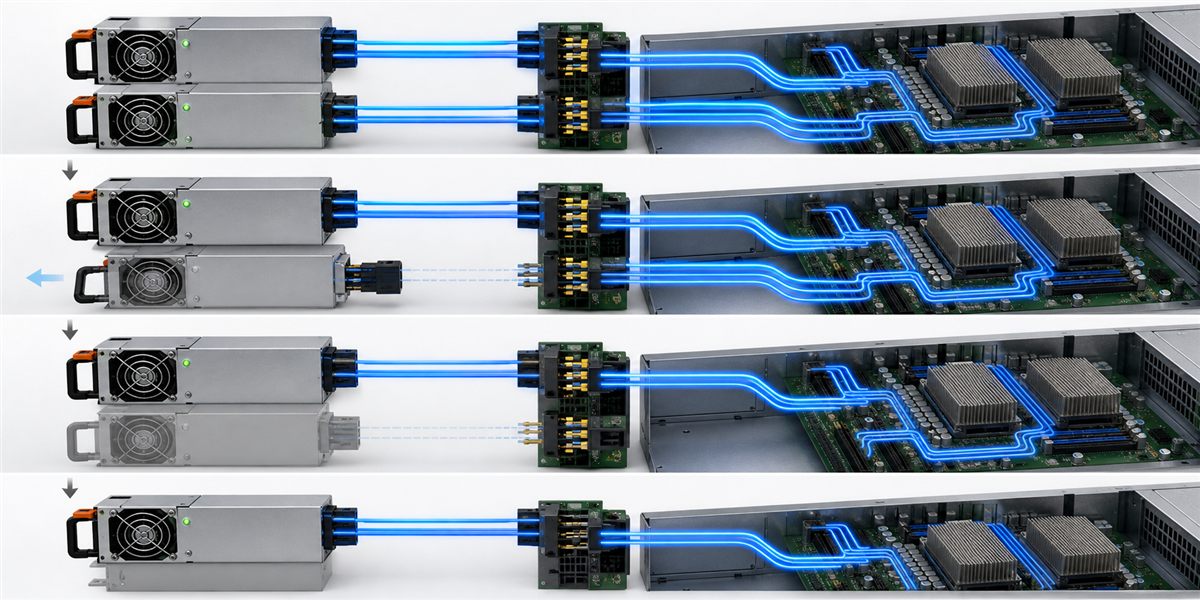
Redundancy Determines Whether Service Is Non-Disruptive
Assume a server’s maximum sustained DC load is 1,350 W and each of two PSUs is qualified to provide 1,600 W at the deployed input voltage and inlet temperature. In normal 1+1 load sharing, each may provide about 675 W. After one PSU is removed, the remaining unit must provide the full 1,350 W. The nameplate margin is 250 W, but transient and thermal testing must still confirm stability.
If the server load were 1,700 W, the same pair could share the load during normal operation but would not provide 1+1 redundancy because one 1,600 W module cannot carry the full demand. Calling the modules “hot-swappable” would not change that capacity limit.
The Electrical Functions Behind Hot Swap
| Function | Plain-English role | Failure risk if incorrect |
|---|---|---|
| Inrush control | Limits the current used to charge an inserted module or bus | Bus dip, connector damage, or protection trip |
| ORing / reverse blocking | Prevents a failed or removed supply from sinking current | Live bus discharges into the faulty path |
| Current sharing | Balances load among active modules | One PSU overheats or reaches current limit early |
| Presence and power-good | Tells the platform when a module is installed and stable | Incorrect alarms or unsafe sequencing |
| PMBus telemetry | Reports identity, load, temperature, and faults | Poor diagnosis or incorrect service decision |
| Staggered contacts | Establishes ground, power, and signals in a controlled order | Arcing, signal corruption, or uncontrolled connection |
A Safe Replacement Procedure
- Confirm the server is designed for hot PSU replacement and identify an approved replacement part.
- Check the BMC, module indicators, and rack PDU data to identify the affected PSU and feed.
- Verify the remaining PSU or PSUs are healthy and can carry the current server load.
- Reduce workload first if the platform is operating above its redundant capacity.
- Follow the manufacturer’s cord-removal, latch, discharge-wait, and module-removal sequence.
- Inspect the module, cage, and connector for heat discoloration, debris, or physical damage.
- Insert the replacement straight and fully; avoid forcing an incompatible module.
- Reconnect power as specified and confirm power-good, current sharing, telemetry, and cleared alarms.
A PSU that can be physically removed while powered is not automatically safe to remove at the present server load. Confirm redundancy capacity immediately before service.
Qualification Tests for Platform Designers
Bench testing should monitor the DC bus, individual module current, input current, control signals, and BMC events during insertion and removal. Test at light load, typical load, maximum sustained load, and relevant transient workloads. Repeat with each AC feed removed, with modules in each slot, and at worst-case input and thermal conditions.
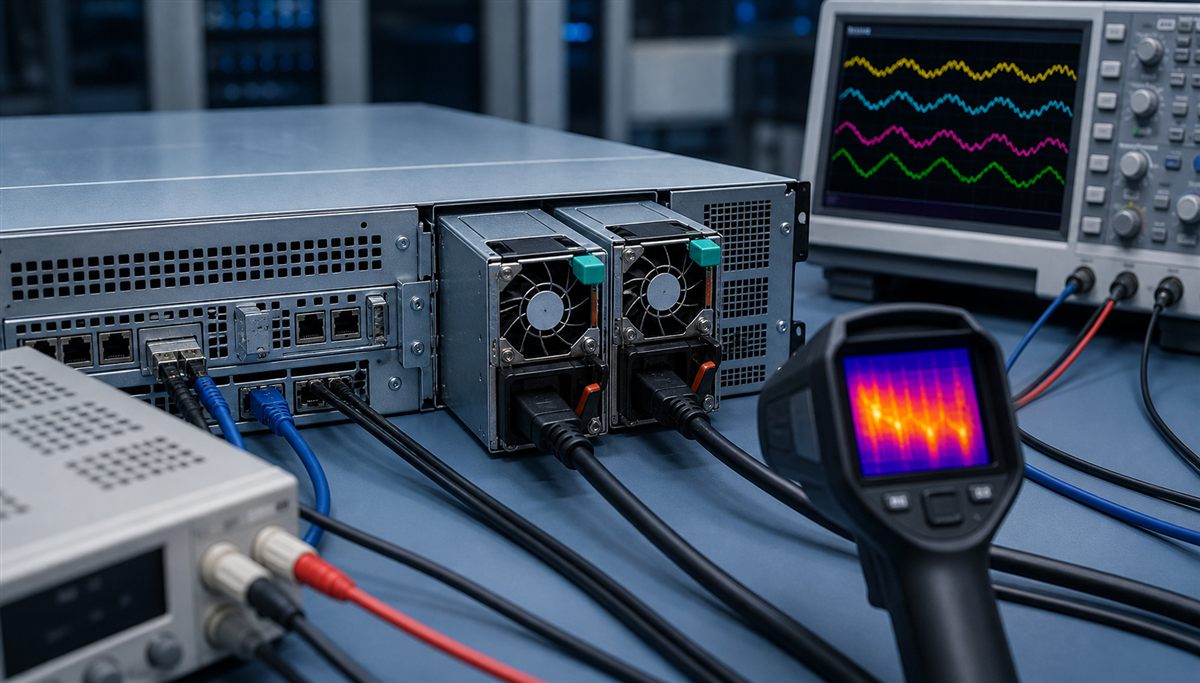
Thermal inspection is important because current transfers to the remaining module immediately. Connector temperature, PSU exhaust temperature, fan response, and nearby component temperatures should remain within the platform’s qualified limits. Fault tests should also verify that a shorted or internally failed module isolates rather than pulling down the shared bus.
Common Service Errors
- Removing the healthy module because labels or management inventory are unclear.
- Assuming two connected PSUs provide redundancy when one feed is already unavailable.
- Replacing a module with the same wattage but different connector, airflow, firmware, or signal behavior.
- Ignoring a server load that exceeds the capacity of the single remaining PSU.
- Leaving mixed firmware or unmatched modules without platform approval.
- Failing to verify that the replacement actually restored current sharing and redundancy.
Frequently Asked Questions
Can a single-PSU server use a hot-swap module?
The module may support live insertion or removal electrically, but removing the only active PSU normally stops the server because there is no redundant source.
Can any PSU with the same dimensions be inserted?
No. Dimensions do not confirm connector, voltage, signaling, current-sharing, management, thermal, or firmware compatibility.
Should the workload be reduced before replacement?
Reduce it when the remaining power path cannot support the present load with the required margin or when the platform’s service procedure requires it.
For a broader redundancy design discussion, see CRPS redundant power supply integration and qualification. A successful hot swap ends only after the platform reports healthy sharing and restored redundancy.