A production record is still in memory when incoming power disappears. The controller needs to preserve the result, but the available time starts shrinking before firmware necessarily knows anything has happened. For an OEM specifying a power supply for industrial electronics, the useful requirement is a defined interval between an actionable power-loss warning and the earliest loss of operating conditions anywhere in the save path. That interval must cover the work needed to make the record persistent.
This is a controlled-shutdown problem. Continued machine operation is a different requirement. The discussion below follows a hypothetical controller saving one production record, with no assumed product timing or storage guarantee. Its purpose is to connect the power supply’s behavior to a specific recoverable data outcome.
Define the record that must survive
Start with the information the machine needs after restart. A completed production record might contain a batch identifier, sequence number, measured result, disposition, and integrity information. Saving a partial combination can be worse than losing the latest result: a new measurement paired with an old batch identifier could appear plausible while describing an event that never occurred.
The required outcome should distinguish preservation of the last completed record from preservation of every activity in progress. These have different workloads. A controller can prepare a compact record during normal operation and commit it after a warning, or attempt to reconstruct a larger state during shutdown. The latter approach introduces more execution time and more dependencies just when available energy is limited.
A successful software call needs an explicit meaning. Data may have reached an application buffer, an operating-system cache, a storage controller, or persistent media. Those are different completion boundaries. Where the platform provides a documented synchronization or persistence operation, its scope and completion semantics belong in the design. A generic write acknowledgement should not be promoted into a durability guarantee.
Storage documentation must also address what an interrupted operation can affect. The pending record may be at risk, but shared metadata or previously stored information may have their own exposure. Neither a nonvolatile memory label nor an industrial storage designation establishes atomic updates for an arbitrary record. Record layout, update size, controller behavior, and recovery software determine what the application can safely conclude.
This distinction changes the supply requirement. If the application requires the newest record to survive, power must remain usable until its documented persistence boundary is reached. If losing the unfinished record is acceptable, a suitable recovery design may instead retain the previous complete record. State that permitted loss explicitly; otherwise hardware and firmware teams can design for different outcomes while using the same phrase, save data.
Keep the complete save path powered
The save path includes every powered participant needed to finish the transaction. For local storage, that may include the processor, memory holding the pending record, storage device, local regulators, and any interface circuitry between them. The first participant to leave its supported operating condition sets the deadline, even if the upstream supply still produces substantial voltage.
A network save adds separately powered participants. A controller sending its final record to an external storage appliance may depend on an Ethernet switch and the receiving appliance, as well as its own electronics. Backing up the controller alone does not establish that the remote transaction can finish. The receiving application’s acknowledgement must also mean what the preservation requirement needs it to mean.
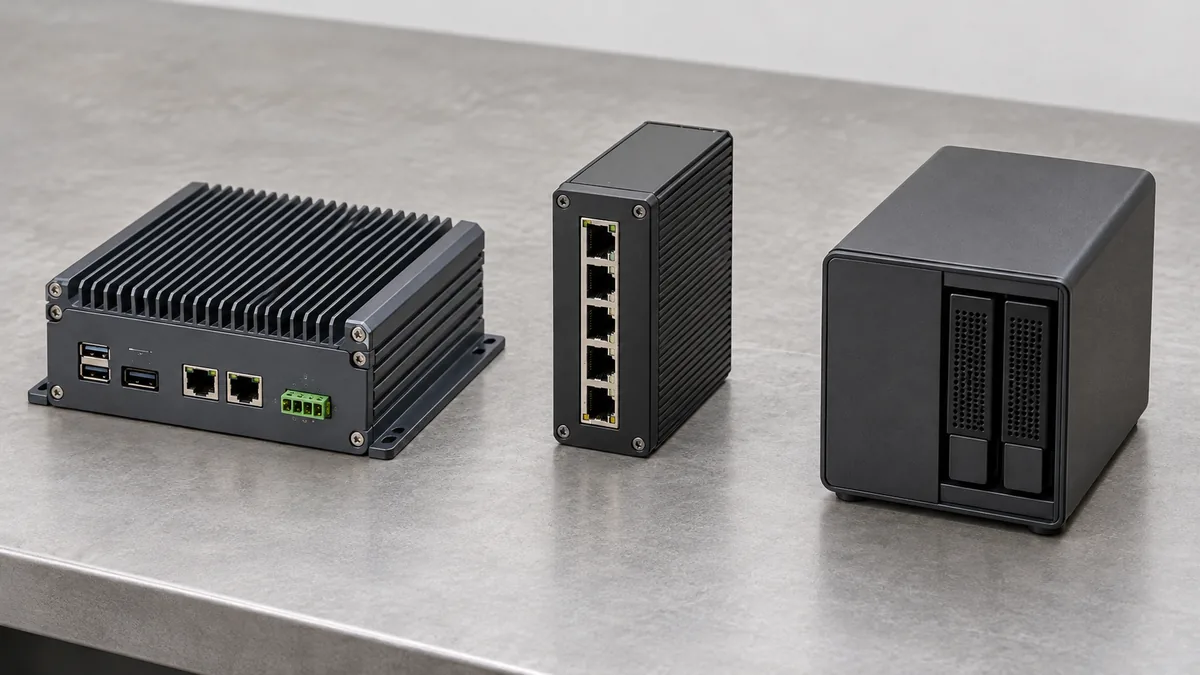
Map these dependencies by function before choosing which branches receive stored energy. A local persistent record can remove the immediate need for network availability, with transfer postponed until restart. That architecture changes the recovery workflow and creates a local storage obligation. It can nevertheless be simpler than extending the shutdown power budget across several remote devices.
Loads unrelated to saving deserve separate treatment. A display or cooling accessory might be unnecessary for a short transaction, while a required storage controller cannot be shed. Removing selected demand can extend available operation, but the transition must preserve the save path. A firmware instruction to turn off an accessory contributes nothing until the relevant hardware actually reduces consumption.
Use the electrical requirements of each participating device, including its downstream conversion stages. A processor rail can become unusable before the cabinet bus reaches a familiar nominal threshold. Conversely, some devices may tolerate a declining upstream voltage through their own regulation. The applicable operating and reset limits establish the boundary; an indicator remaining illuminated does not. Broader input, mounting, and environmental prerequisites remain covered by Powernexu’s industrial power supply selection guidance.
Put warning, execution, and power expiry on one clock
Choose a common reference event, such as the defined loss of input power at the supply terminals. Then distinguish when the monitoring circuit recognizes that condition, when firmware receives an actionable notification, when saving begins, and when persistence is established. Comparing durations measured from different starting events can make an inadequate design appear to have spare time.
An input-loss signal, an output-voltage status signal, and a buffer alarm can describe different events. Their thresholds, propagation delays, interface circuits, and receiving logic need applicable documentation. A signal intended to report that output has already become unacceptable may arrive too late to initiate a save. Earlier warning is useful only if it reliably precedes the required operating deadline.
Published hold-up information is relevant background, but it does not establish that firmware receives the whole interval. The SL Power industrial applications guide discusses stored-energy support during input interruptions and the equipment designer’s need to determine whether shutdown is acceptable. Its general discussion supplies no warning latency, storage completion time, or complete-system deadline for this hypothetical controller.
Consider the following invented timing allocations, all measured from the same input-loss event. Assume that each duration is a conservative bound for its stated stage, that the stages occur sequentially, and that the complete save path remains operational until 18 milliseconds. These are illustrative engineering inputs, not measurements or manufacturer specifications.
| Event or stage | Hypothetical allocation | Elapsed time |
|---|---|---|
| Actionable warning reaches firmware | 6 milliseconds after input loss | 6 milliseconds |
| Dispatch and record preparation | 3 milliseconds | 9 milliseconds |
| Operation establishing persistence | 11 milliseconds | 20 milliseconds |
| Earliest required operating condition expires | 18 milliseconds after input loss | 18 milliseconds |
The warning leaves 18 minus 6, or 12 milliseconds, of usable operation. The remaining work requires 3 plus 11, or 14 milliseconds. The transaction misses the assumed deadline by 2 milliseconds. Comparing an 18-millisecond power interval with an 11-millisecond storage operation would conceal both warning latency and preparation work.
A positive difference would still need an uncertainty allowance appropriate to the evidence. Scheduling delays, storage variation, signal timing, and measurement uncertainty can consume the apparent surplus. Do not derive a universal margin from this example. A typical write duration cannot establish a worst-case bound, and adding a nominal percentage cannot turn an unbounded operation into a bounded one.
Recover time through the constraint that consumes it
Earlier notification changes the beginning of the available window. In the hypothetical example, receiving the warning at 2 milliseconds instead of 6 would leave 16 milliseconds before the same deadline. The assumed 14-millisecond operation would then finish at 16 milliseconds, leaving 2 milliseconds. That improvement requires a supported detection mechanism; it cannot be obtained by renaming a late status signal.
Reducing shutdown work changes the other side of the comparison. Preparing an immutable record during normal production can shorten the work remaining after notification. Avoid placing routine log rotation, unrelated diagnostics, or optional reporting ahead of the essential commit. Their removal should follow an application requirement, rather than an assumption that every shutdown task has equal value.
The longest permitted operation matters more than a convenient demonstration. A small write can encounter housekeeping, cache flushing, metadata updates, or other activity depending on the storage stack. Obtain the relevant device and software behavior before assigning a completion bound. Where no defensible bound exists, changing the storage method or preserving records incrementally may be more useful than repeatedly increasing the energy estimate.
Additional stored energy changes the operating deadline when the selected architecture supports the complete protected load. A buffer or DC UPS needs applicable discharge capability, takeover behavior, charge readiness, and operating-condition evidence. Its nominal capacity is not itself a shutdown duration. Energy delivered through conversion and distribution must keep every required participant within its supported limits.
In the example, extending the common-reference deadline from 18 to 25 milliseconds would create a 19-millisecond post-warning window. The assumed 14-millisecond workload would leave 5 milliseconds. This arithmetic describes a requirement for further engineering; it identifies no suitable buffer. The load during saving, storage condition, conversion losses, temperature, and repeated-interruption policy still determine whether actual hardware can provide that interval.
Recharge creates an important operational consequence. After one event, the controller may restart before the energy store is ready to support another save. The design can delay production readiness, restrict data-generating activity, or provide another supported strategy. Reporting energy-store readiness is useful only when the machine’s behavior responds to it. A successful first shutdown does not establish readiness for an immediate second interruption.
After restart, distinguish committed data from unfinished work
Recovery gives the timing requirement its practical meaning. The restarted application should be able to distinguish a valid completed record from an incomplete update. One possible application design uses separate record slots, sequence information, integrity checks, and an explicit commit indication. This is a conceptual pattern, not a guarantee for a particular storage technology; its update ordering and atomicity must match documented behavior.
For that pattern, the application prepares the next record in an inactive slot while retaining the previous committed record. It establishes persistence through the supported storage mechanism before making the new record authoritative. Restart logic then examines the available records according to the defined validity rules. A commit indication written too early can falsely certify unfinished data.

An integrity check can help identify damaged or incomplete content, but it does not independently prove freshness, persistence, or correct association with a production event. Sequence information and application state have separate roles. Recovery must also define what happens when neither candidate is acceptable, rather than silently manufacturing a plausible default result.
Power returning during the save creates another state to handle. Firmware may need to finish the transaction already in progress before accepting another production event. Cancelling the save immediately because the input recovered can leave ambiguous application state. The restart and resumption policy should also prevent the same completed event from being counted twice when local records are later transferred elsewhere.
Evidence for this outcome combines timing observations with recovered data. Interruptions before preparation, during writing, near commit, and after completion exercise different transaction states. Representative worst permitted workload and energy-store readiness conditions belong in that assessment. Seeing the controller reboot successfully answers a smaller question than finding the expected committed record with its identifiers and integrity intact.
The deliverable is a conditional preservation statement: which record survives, what unfinished work may be lost, when notification arrives, and how long the complete save path remains usable. A suitable industrial power arrangement supplies that interval under its documented conditions. Firmware and storage behavior determine whether the interval ends with a recoverable record.