Imagine a hypothetical machine whose power-supply temperature appears unchanged during a quiet production interval. The next batch starts, output demand increases, and the recorded temperature resumes climbing. Ending observation during that pause would describe an intermediate condition. For industrial power supply thermal requirements, the useful stopping question is whether the monitored temperatures have settled under the specified operating duty, including its recurring changes.
There is no universal soak duration established by the evidence used here. This discussion addresses loaded thermal observation in an installed enclosure, rather than unpowered chamber conditioning. It develops an engineering method for distinguishing continuing drift, temporary plateaus, and repeatable cyclic behavior. An applicable manufacturer procedure or governing assessment requirement takes precedence over the proposed method.
Establish which operating history the observation represents
Elapsed time becomes meaningful after the operating condition is defined. Identify the exact supply, installed arrangement, input condition, output demand, cooling controls, and surrounding temperature represented by the run. For machinery with changing demand, include the production sequence and permitted pauses. A record labeled full load can conceal interruptions that materially change the heating history.
Keep the installation assumptions separate from the question of duration. The selected temperature references and applicable limits should already come from the manufacturer’s documentation and the equipment assessment. Powernexu’s discussion of thermal requirements inside a control cabinet explains those foundational relationships. Here, the task is determining whether observation continued long enough to characterize the chosen condition.
Record the initial condition because it affects the route toward the eventual temperature pattern. A cold enclosure and an enclosure returning from previous production can produce different early traces under the same subsequent load. Neither starting condition is automatically preferable. Use the preparation required by the assessment, and retain enough history to explain the measured warmup.
For machines with several permitted recipes, keep recipe identity in the record. A repeatable low-demand batch does not establish completion for a later recipe with a different heating pattern. Where recipes can follow one another, include the required transition history rather than assessing each only from a cold start.
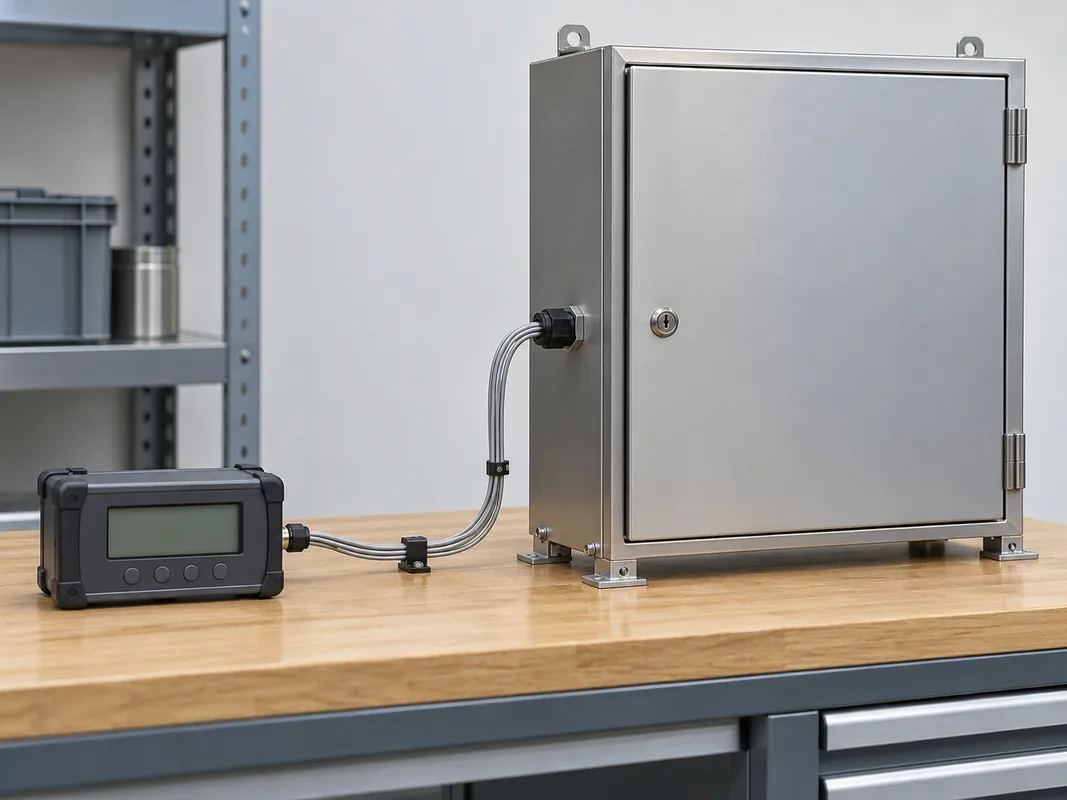
Keep the cabinet in its intended operating state while the recorder runs. Route observation leads through a suitable provision so reading the instruments does not require repeatedly opening the door. Opening the enclosure can change air exchange and disturb the temperature history. The measurement installation should preserve the cooling arrangement being assessed, including relevant covers and filters.
Start the observation clock at an identifiable event, such as establishment of the specified operating condition. Preserve earlier acquisition as preparation history where available. If the source setting, production sequence, cooling configuration, or surrounding temperature changes materially, mark that event explicitly. A long total acquisition can contain only a short interval relevant to the claimed condition.
Several temperatures may be necessary to interpret completion. The manufacturer’s defined reference determines the rating comparison; additional accessible locations can reveal slower behavior elsewhere. Choose these observations for a stated purpose. An arbitrary collection of surface readings cannot establish the temperature of inaccessible internal components, and additional sensors do not create new manufacturer acceptance limits.
A quiet interval can hide a slower thermal rise
Different parts of the installed assembly exchange heat through different paths. Local air can respond relatively quickly while a mounting structure or enclosure continues warming. Consequently, a steady local-air reading does not establish that every relevant measured location has settled. Examine the temperature history at each location needed to support the intended conclusion.
XP Power’s technical article on harsh environments describes conducting heat from power components through a baseplate to an external heatsink. Its numerical examples concern its documented arrangements and are not adopted here. The physical distinction is useful: air, mounting surfaces, and heat-rejection structures occupy different positions along the installed heat path. Their temperature histories need not flatten together.
For a sustained operating condition, examine whether the later record still shows directional change. Compare adjacent observation windows under comparable demand and environmental conditions. A progressively rising temperature deserves continued investigation even when the most recent short interval looks nearly horizontal. Selecting a window after noticing a favorable plateau can make the stopping rule depend on the desired answer.
Define the proposed stability criterion before relying on it. The criterion needs an observation-window length, a permissible change or trend, the monitored locations, and treatment of disturbances. Its numerical settings must follow the applicable procedure or an engineering justification tied to measurement capability and the conclusion required. No general slope threshold is assigned here.
A small late change does not bound the remaining rise by itself. A slowly warming assembly may retain considerable distance from its eventual condition. Extending observation provides evidence about that behavior; extrapolation requires a justified thermal model and suitable data. Fitting a convenient curve to a short record cannot establish the unobserved endpoint of an installed cabinet.
Also inspect events that interrupt the rise. A production pause, thermostat action, or temporary reduction in surrounding temperature can create a plateau without thermal settling under the original condition. Associate the trace with operating events before interpreting its shape. Where a sustained condition is required, a cooling interruption and subsequent reheating remain part of the history rather than proof of completion.
Repeating production calls for a repeating temperature pattern
A cyclic machine may never produce a flat temperature trace during normal production. Heating during an active interval and cooling during a pause can persist after the initial warmup has passed. For that duty, the useful question is whether successive comparable cycles reproduce a bounded temperature pattern without a continuing shift in their underlying level.
Compare the same phase of successive cycles. Relate each temperature peak, trough, and intermediate reading to an identifiable machine event. Comparing the end of one active interval with the middle of the next pause confuses ordinary cycling with drift. Keep the cycle timing alongside the temperature channels so the comparison can be reconstructed from the record.
Temperature peaks may occur after the electrical demand peak. Heat must move from its source to the observed location, and stored heat can continue arriving after demand falls. Preserve the complete cycle when searching for the maximum. A reading taken precisely when an actuator stops may miss a later surface-temperature maximum without indicating any recorder fault.
Repeatability requires more than similar peaks. Successive peaks can appear unchanged while troughs rise, or one monitored location can settle while another continues drifting. Examine the cycle envelope and its phase relationship at the relevant locations. The required extent of observation depends on the applicable procedure and the variability of the actual duty; no universal cycle count is proposed.
Cycle averages alone can conceal this behavior. Two cycles can have similar average temperatures while one reaches a higher maximum or spends longer near an applicable limit. Conversely, a slightly different peak may reflect a longer active interval rather than continuing warmup. Retain the event timing and the temperature extrema instead of reducing the entire run to one average.
Where production includes batches, replenishment pauses, or cooling-control cycles, the repeating unit may be longer than one machine operation. Observe enough of that larger sequence to support the stated interpretation. If the sequence changes unpredictably, a claim of periodic settling may be inappropriate. Report the actual bounded operating history instead of inventing a representative cycle.
Determine what an apparently unchanged reading can resolve
A displayed temperature that repeats the same number can conceal changes smaller than its displayed increment. Instrument resolution, sensor response, acquisition interval, and processing affect what the record reveals. A stability statement should describe the capability of the observation chain, rather than treating unchanged digits as evidence of zero temperature change.
Choose acquisition timing to preserve the behavior of interest. Sparse readings may miss cyclic maxima, while long averaging can flatten excursions and obscure their timing. Faster acquisition does not remove a sensor’s physical response limitation. The combination of sensor installation and recording method must suit the expected thermal behavior, particularly when interpreting short active intervals.
Sensor attachment can itself create ambiguity. A surface sensor with changing contact may show apparent movement unrelated to the underlying surface temperature. A local-air probe touching nearby metal measures a different thermal relationship. Record the intended measurement arrangement and investigate discontinuities before accepting them as evidence of settling. Qualified personnel should establish any access near hazardous electrical parts.
Distinguish absolute temperature uncertainty from the ability to detect change on one channel. A stable calibration offset can affect comparison with a temperature limit without producing apparent drift. Noise, changing contact, or sensor drift can affect interpretation over time. These contributions need appropriate treatment; applying one undifferentiated uncertainty number to every question can obscure the limitation.
Likewise, subtracting local-air temperature from a surface reading can help investigate changing surroundings, but the difference answers a separate question. A nearly constant temperature rise above local air can coexist with increasing absolute temperature. If the applicable requirement limits absolute temperature, the difference cannot replace that comparison. Preserve both records when both are needed.
When the suspected change is too small for the installed method to resolve, state that limitation. Longer observation may reveal a trend, but duration cannot repair poor contact, missing samples, or unsuitable processing. Improve the specific observation where necessary. Reporting no resolved change is more accurate than claiming that the assembly reached an exact equilibrium.
A completed observation supports a bounded thermal result
Thermal settling and acceptable operation are separate findings. A repeatable temperature pattern can exceed an applicable limit. A temperature below the limit during continuing warmup can leave sustained operation unresolved. Record both the completion basis and the limit comparison so neither favorable finding is used as a substitute for the other.
The completion record can remain compact. Identify the applicable requirement, monitored locations, operating sequence, initial preparation, relevant acquisition settings, and the interval used to assess settling. State why observation ended, including any remaining directional change or unresolved variation. Retain the underlying temperature and operating records so the interpretation does not depend on a screenshot chosen afterward.
If observation ends because available laboratory time expires, describe the result as time-bounded. Report the maximum observed temperature and whether the later record was still rising under the stated condition. That evidence can guide further work, but it does not establish the eventual maximum. An incomplete observation is not automatically a failed converter; its sustained thermal conclusion remains open.
Early termination may also be appropriate when an applicable stopping condition is reached, including a limit exceedance or required protective intervention. Follow the approved assessment procedure rather than continuing simply to obtain a flatter trace. Preserve the temperature and operating history leading to termination. That endpoint explains the result without implying that normal settling was demonstrated.
A completed run covers its recorded conditions. Different input, load timing, initial state, cooling behavior, or installation can require separate evidence. For cyclic operation, retain the permitted sequence behind the repeatable envelope. For sustained operation, retain the condition supporting the observed plateau. Completion means the observation supports its stated thermal conclusion; broader operating permission comes from the applicable requirements and supporting evidence.