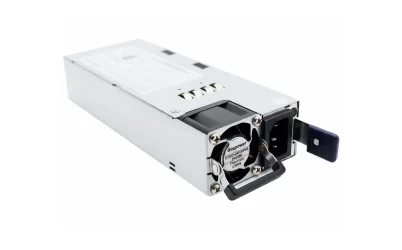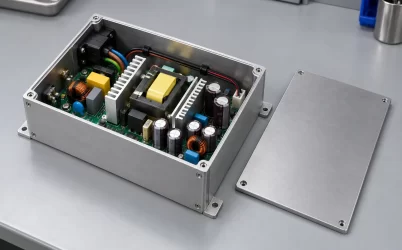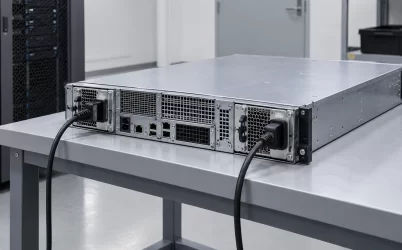
A server power supply is not necessarily fully off when the server appears to be off. If its AC cord remains connected and the source is live, the PSU may keep an auxiliary or standby output available for the baseboard management controller (BMC), power-button logic, and other platform functions. Its main output can be disabled at the same time. Conversely, a server that is running may place one of two redundant modules into a low-output state without disconnecting that module from AC. “Always on” therefore has no useful yes-or-no answer until the question names the input, the standby rail, the main output, or the server itself. The exact behavior belongs to the server and PSU design, not to a universal LED color or fan sound.
Follow four separate meanings of “on”
The first meaning is simply that power reaches the PSU inlet. A cord plugged into an energized rack PDU can leave the PSU’s input circuitry connected to AC even when the front-panel power indicator says the host is off. That observation says nothing by itself about whether the PSU is delivering full output. It also does not establish that the input is safe to handle: a powered inlet and internal stored energy remain electrical hazards. Facility supply, a rack PDU switch, a branch breaker, and the removable cord are different upstream boundaries.
The second meaning is an auxiliary output. Many server designs keep a small standby domain alive while the main processor, memory, and drives are not operating. The BMC may remain reachable on a management network, monitor a power button, or hold a setting for what to do after AC returns. This standby function consumes energy, though its amount varies with the platform and enabled devices. It is not evidence that the server’s full computational load or all downstream rails are energized.
The third meaning is the PSU’s main DC output. The server controls when that output is requested and recognized as ready. In a modular system, the power distribution board or another host-side assembly may also control how main and auxiliary power reach the motherboard. A main-output-off condition does not require the AC inlet to be dead. Equally, seeing a PSU present in management inventory does not prove that it is currently supplying main DC current.
The fourth meaning is the host operating state. A machine can be shut down to a soft-off state while its BMC and some wake circuitry still have power. Another machine may be placed into a sleep or maintenance state with a different set of active loads. It is the host’s documented state, not the colloquial phrase “server off,” that defines which internal domains remain active. An Intel Server System R1000WF integration and service guide, for example, explicitly states that its BMC remains on standby power when the server enters the DC-off/S5 state. That is a concrete platform example, not a claim that every server uses the same timing or rail arrangement.
Why an off server can still answer a management request
Remote power-on is possible only if something remains capable of receiving and interpreting the request. In a managed server that is shut down but still connected to AC, the BMC can be that powered component. Its management network interface, clock or state memory, and the circuitry that initiates the main-power sequence may continue operating from a standby domain. The host CPUs do not have to be running for a management controller to report that the chassis is off or accept a supported power-on command.
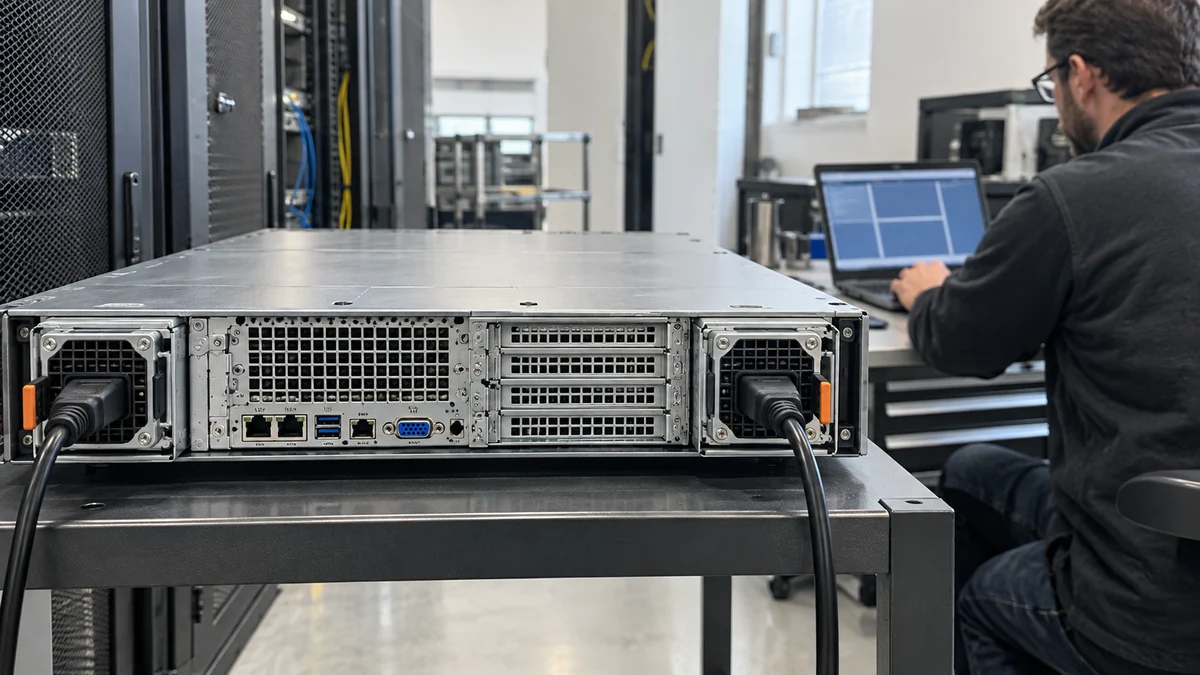
This separation explains an otherwise confusing observation: the rack outlet shows a small nonzero draw, the management interface responds, but the operating system is unavailable and the main fans are stopped. Those facts can coexist without a fault. They also do not prove that every network port or every USB socket remains powered. Platforms differ in which auxiliary functions are retained, and administrators can sometimes change wake, out-of-band management, or deep-power-saving behavior through supported settings.
What happens between AC arriving and the host booting
When AC becomes available at the inlet, an appropriately designed PSU and host establish their permitted auxiliary state before the main server load is necessarily enabled. The BMC or other platform controller can initialize, read policy, and decide whether the host should start. A configured “stay off after power returns” policy can therefore leave AC present and management active without starting CPUs or drives. A different supported policy may request host power-on after a delay. Neither policy means the PSU was unpowered during the interim.
When the host requests a start, the main output and downstream conversion stages must enter their allowed ranges in an order the platform supports. Control and power-good signals tell the host when it may proceed; the mere presence of AC cannot replace that sequence. The PSU module, mating board, and motherboard can divide these functions differently among product families. A fixed, cabled supply and a hot-swap module may implement the same broad operating states through quite different physical interfaces. For this reason, no universal pin-level sequence should be inferred from the word “server PSU.”
A standby rail is not the same as a standby PSU
The word “standby” describes two related but distinct things. A standby or auxiliary rail powers selected low-demand circuits while the host’s main output is off. A standby module in a redundant server is one of several PSU modules installed while the server is running; a supported high-efficiency or cold-redundancy policy may ask another module to carry most of the load. The reserve module can remain connected, identified, and ready without delivering the same main-output current as the active module. The host is on in the second case and off in the first.
Not every pair of redundant modules has a preferred primary. Some platforms share output current during normal operation. Others support a primary/secondary or hot-spare policy that concentrates the load and wakes reserve capacity when demand or a failure requires it. A module in such a reserve state may still need auxiliary power for recognition and control. This is why “PSU 2 is off” can be an imprecise description: its main conversion contribution may be low or absent while its AC connection and supervisory functions remain present. The platform’s power policy and telemetry, rather than the slot number, establish the meaning.
Why lights, fans, and warm metal are incomplete evidence
PSU indicators can represent AC presence, standby availability, main output, fault state, or another vendor-defined condition. A blinking green light on one documented server may mean AC is present and only the standby output is active; a different platform may use the same color or rhythm differently. Read the indicator table for the exact server and PSU revision. The absence of light can also reflect a failed indicator or a condition outside the table, so it should not be treated as a certified absence-of-voltage test.
A stationary fan is similarly ambiguous. A low-power standby state may not demand meaningful PSU cooling, and some fan controllers stop or slow a fan under certain conditions. Other platforms run a fan while the main host is off, perhaps because management, temperature, or a host-specific policy requires it. Fan motion confirms movement, not which DC rails are available. For a running redundant host, one module’s fan behavior can differ from another’s because load sharing or a reserve mode is asymmetric.
Residual warmth is even less decisive. Heat stored in components and metal can persist after an output stops; a small standby load can also produce fresh loss while the chassis appears off. Neither feeling warmth nor hearing silence is a reliable way to identify the electrical boundary. If the concern is wasted standby power, use an appropriate external input meter or supported platform telemetry. If the concern is service safety, follow the documented isolation and verification process rather than observing the grille.
How much electricity does an apparently off server use?
There is no single standby-watt value for server PSUs. AC power at the inlet includes the energy used by auxiliary conversion, BMC and network management, any powered expansion or wake circuitry, plus conversion losses at that low operating point. It may change with firmware settings and attached devices. A PSU’s full output rating is not the off-state consumption, and an 80 PLUS efficiency tier measured at defined active-load points does not directly state what an entire server draws in soft-off.
To answer the energy question for a particular installation, measure the AC input of the whole server at a defined state, then record whether both redundant PSU cords are connected and what the BMC and wake settings are. A rack PDU reading from only one cord may miss the other module’s input; adding two readings is appropriate only when they cover the same interval and represent the complete host. If the meter reports apparent power as VA as well as real power in W, do not treat the values as interchangeable energy-consumption figures. Repeat the observation after the state has settled rather than capturing only the moment of shutdown.
Annual energy follows from measured real power and time, not the PSU nameplate. As an illustration only, a measured 5 W average standby draw maintained for 8,760 hours would consume 43.8 kWh in a year. That calculation does not claim any Powernexu product or typical server draws 5 W; it demonstrates why the measurement boundary and the duration matter. In a fleet, management features retained during shutdown and the frequency of that state can affect the total. Turning off a required BMC service merely to reduce a measured number can carry an operational cost that belongs in the comparison.
A separately metered active host can also have low input on one cord for reasons unrelated to shutdown. Cold-redundancy policy, unequal current sharing, or a meter interval can make one supply look almost inactive while the server remains busy. Always pair a watt reading with the host’s operating state and the source of the measurement. “PSU always on” is too imprecise to be a useful energy-performance claim.
What “off” must mean before a service action
Software shutdown is an operating-system and host-power action. A front-panel button may request a supported transition to soft-off. Neither action guarantees that the PSU input, auxiliary output, or management board is de-energized. A remote management interface may intentionally stay online so an administrator can restart the machine. That behavior is a feature, but it makes the phrase “the server is off” unsuitable as an electrical safety instruction.
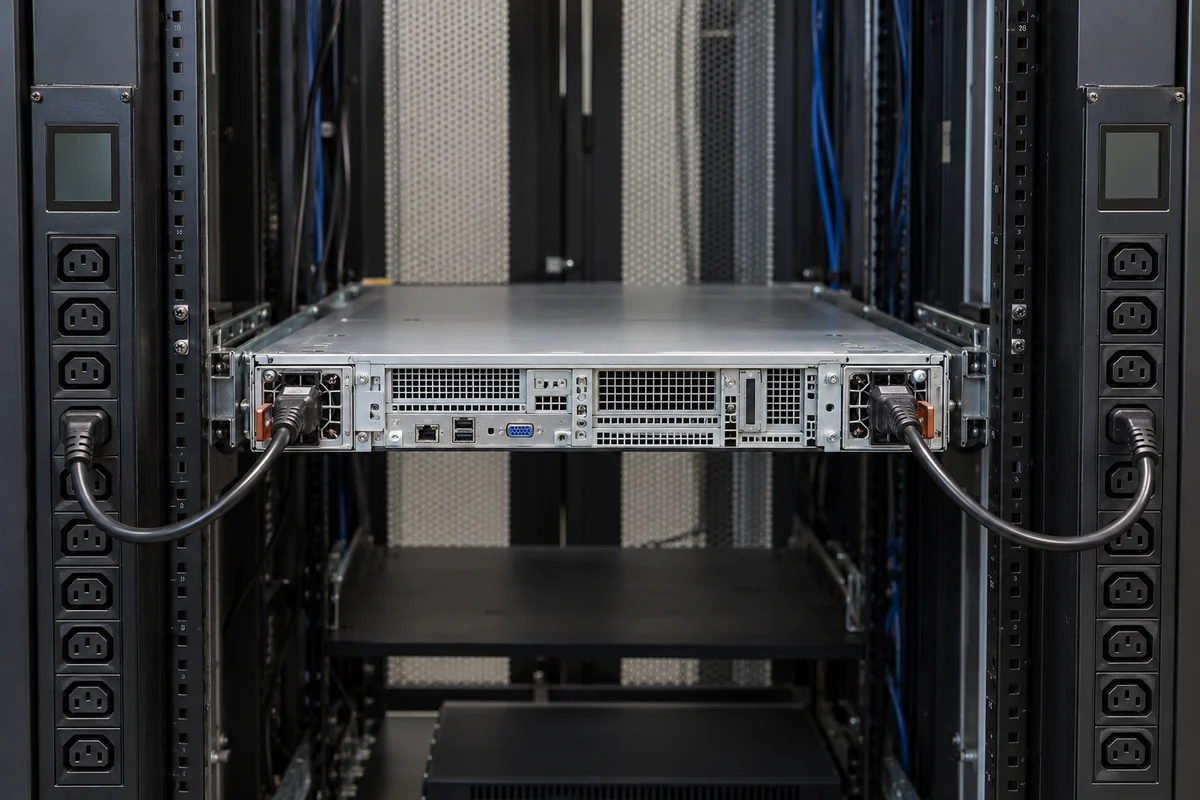
Disconnecting one cord from a dual-PSU server is also not necessarily a complete isolation step. Another feed may keep the host and its power distribution energized, and some platform-specific service tasks require additional precautions even after all external inputs are removed. Only authorized personnel should perform electrical service using the exact manufacturer’s procedure and site isolation rules. The distinction here is conceptual, not a suggested live-work sequence: identify whether the task needs the workload stopped, the main rails disabled, or all energy sources safely isolated. Those are different outcomes.
For routine observation, there is no need to open a supply or probe its connector. The host’s documented power state, management status, PSU LEDs interpreted through the correct manual, and external input-meter readings usually answer the ordinary “is it still on?” question. If those observations disagree, treat the disagreement as a platform-specific diagnostic matter rather than assuming a hidden universal rail behavior.
A server PSU can therefore be connected to live AC and supplying standby power while the server is shut down, yet not be delivering its main operating output. It can also be a ready but lightly loaded second module while the server is fully running. It is truly disconnected from its external source only when that source has been isolated as required by the platform and site procedure. Naming those three conditions is more informative than calling any of them simply “always on.”