A server PSU that appears to start and then stops has not necessarily failed. During the first seconds of a server power-on request, AC input, standby power, main DC outputs, power-good signaling, downstream voltage regulators, and host control move through different states. A brief fan spin or momentary light says little about which stage withdrew power. The useful distinction is whether the PSU protected itself, the server stopped requesting its main output, or the incoming source disappeared. Each can leave a server dark before it reaches stable operation, but they call for different responses.
The moment of shutdown identifies the question
First decide what “starts” means. Does the PSU show input present when its cord is connected, even though the host stays off? Does a fan move only after the front-panel power request? Do the main fans and drives begin to spin before everything stops? Does the host remain reachable through its management controller afterward? These are observations of different parts of the startup sequence, not interchangeable descriptions of a failed power supply.
A PSU may have a live input and an auxiliary output while the main server loads are disabled. A host power-on request then changes the state of the conversion system and the load it sees. If the machine drops back to a quiet standby condition, the main output may have been removed, but standby power could remain available. If even management disappears at the same instant, investigate whether input or standby was lost rather than assuming a normal host shutdown. On some platforms management remains available through faults that remove main power; on others the observable behavior differs. An exact service guide is needed before interpreting one LED or beep pattern.
Capture the timing without repeatedly forcing a failing server through startup. A single attempt that fails at the same point differs from an autonomous sequence that tries again every few seconds. The latter is a repeating protection or control pattern and can place additional stress on the system. This article concerns the first aborted attempt before stable operation, not a server that later crashes under workload or a PSU that makes an occasional click during normal state changes.
Standby can be healthy while the main output never stays on
The existence of standby power is easy to misread. A management port may respond and a power-button light may illuminate while the high-current output path needed by the processors has not yet been established. The PSU is not necessarily delivering the server’s normal operating power. Conversely, losing a management connection does not prove the PSU main stage failed: network and controller faults can hide a still-powered chassis.
In a platform that uses host control to enable the PSU’s main output, the controller’s request is a separate event from AC arriving at the inlet. Once the request is made, the output must rise and stay within the applicable limits long enough for the host to advance its own startup. The host may expect a power-good indication and then enable downstream regulators in a defined order. Those signals, timeouts, and connector assignments are platform-specific. A generic connector drawing found online is not a safe way to infer them on a proprietary hot-plug module.
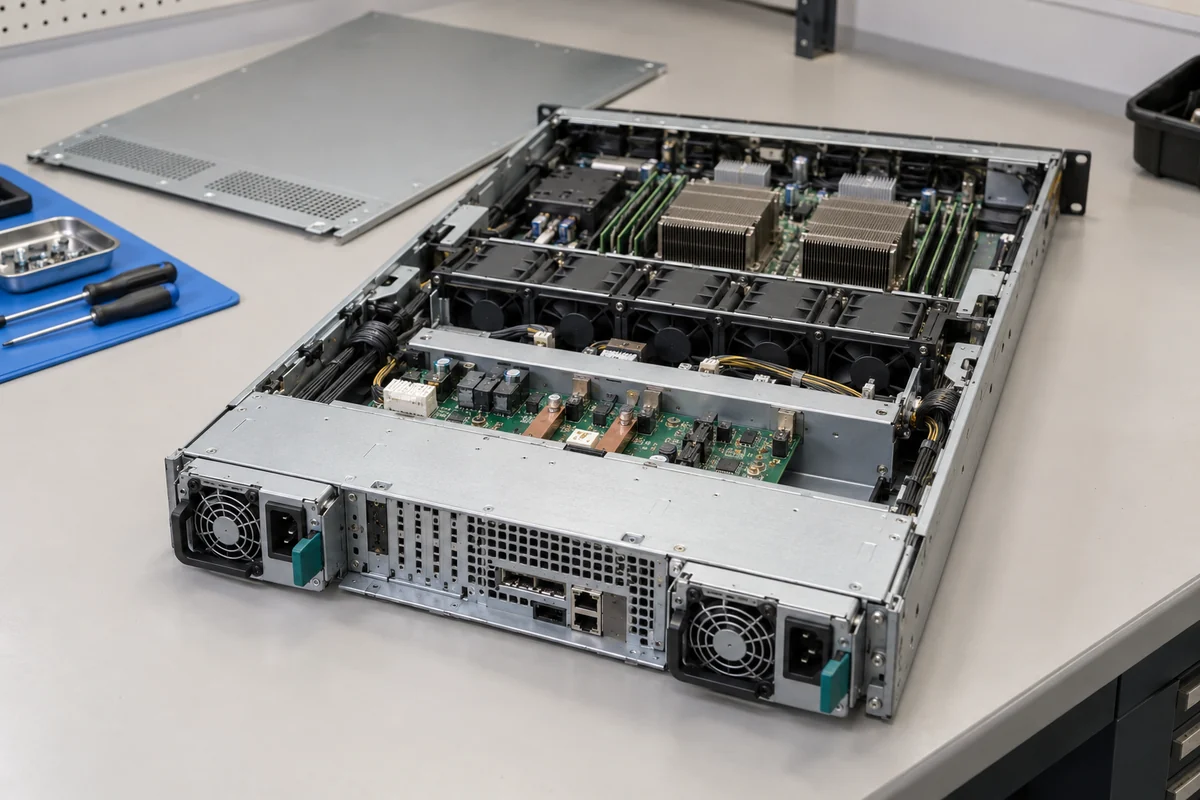
An Intel server-board technical specification illustrates why the distinction matters: for that board family, it distinguishes a power-good dropout after DC power was established from a power-good assertion timeout, and also lists a voltage-regulator sequence timeout. Those entries describe different places in the startup chain. They do not provide universal event codes for other servers, but they show why “the PSU came on, then went off” cannot identify the defective component by itself.
Three distinct reasons the main power can disappear
A PSU protection event is one possibility. A shorted downstream rail, excessive startup current, an incompatible load condition, or an internal converter fault can cause an output to be removed. The module may then latch off or retry according to its design. The symptom at the rack is often the same as a server that intentionally deasserts the PSU enable signal. Without a supported status indication or comparison, it is unsafe to label the PSU bad simply because its fan stopped.
The host can also end the attempt. A server may decide not to maintain main power after a hardware inventory, regulator, fan, temperature, or platform-policy fault. A brief output rise followed by a host-commanded return to standby is not evidence that the converter could not support the load. Server management may identify the decision more precisely than the PSU indicator. Here again the exact platform matters: an event called “power fault” may refer to a control timeout, a lost DC-good condition, or a broader power-unit status, not one universal circuit failure.
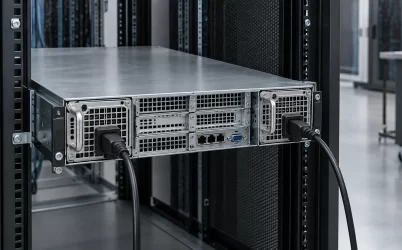
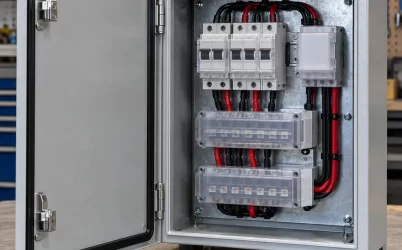
The third family is upstream. A loose input cord, disabled rack outlet, UPS transfer, unstable source, or an input condition outside the module’s supported range can interrupt conversion as startup load rises. One of two redundant PSU cords may still be connected, obscuring the absence of the other feed. Input-present indicators and PDU records can separate a source event from an internal output event, provided their timestamps and scope are interpreted carefully. A PDU showing power available before the attempt does not prove that voltage remained valid throughout it.
These causes can interact: lost input can trigger a host shutdown, and a downstream fault can make a healthy PSU enforce its limit. Name the first abnormal state supported by evidence, not the last visible part to stop moving.
Startup load is not the same as the later workload
A capacity problem can appear before an operating system is loaded. Fans accelerate, storage devices start, CPUs and memory regulators initialize, and optional cards enter powered states. These activities need not peak simultaneously, but their sequence can briefly ask more of a particular rail or output path than an idle measurement suggests. A module that supports the eventual steady state may still face a startup condition that the host configuration or power distribution was not designed to sustain. That does not mean every start-stop incident is “not enough watts.”
Rated output belongs to a documented input range and temperature condition. Some server supplies reduce available output at lower AC voltage; a redundant chassis can also depend on how many healthy modules the host has recognized. A 1+1 server should not be assumed to double usable protected capacity simply because two modules are installed. If one input is absent or one module is rejected as incompatible, the startup attempt may occur with less available capacity than the operator expected. The relevant question is the power available to this host in its actual startup state, not the sum of two nameplates.
One should also distinguish output-current protection from host power budgeting. A converter may remove output when its hardware protection threshold is reached. Separately, management firmware may prevent a server from completing startup because the installed PSU population cannot support a configured set of components. Both can follow a recent processor, accelerator, drive, or fan change, yet the repair routes differ. A larger arbitrary module is not necessarily accepted by the bay, PDB, firmware, airflow system, or management policy. A supported module and configuration matrix matter more than matching a wattage label.
Where evidence points to a startup-load boundary, record the exact hardware population and supported PSU configuration that produced the failure. That is more useful than repeating a low-load bench reading. It can reveal whether the change was a new card, a missing power cable, a module removed for service, a switch to low-line AC, or a thermal state inherited from a warm restart. Do not infer a transient’s magnitude from how long a fan happened to spin.
Use the event order to separate a failed source from a failed start
The strongest nonintrusive evidence is a short event timeline assembled from the server and its input source. Note when AC was applied, when the power-on request was issued, whether the BMC stayed online, what the PSU and system logs reported, and whether the rack PDU or UPS recorded a coincident input disturbance. Then identify which event plausibly happened first. A “PSU lost input” message followed by a power-unit alarm tells a different story from a power-good timeout while the rack source remains present.
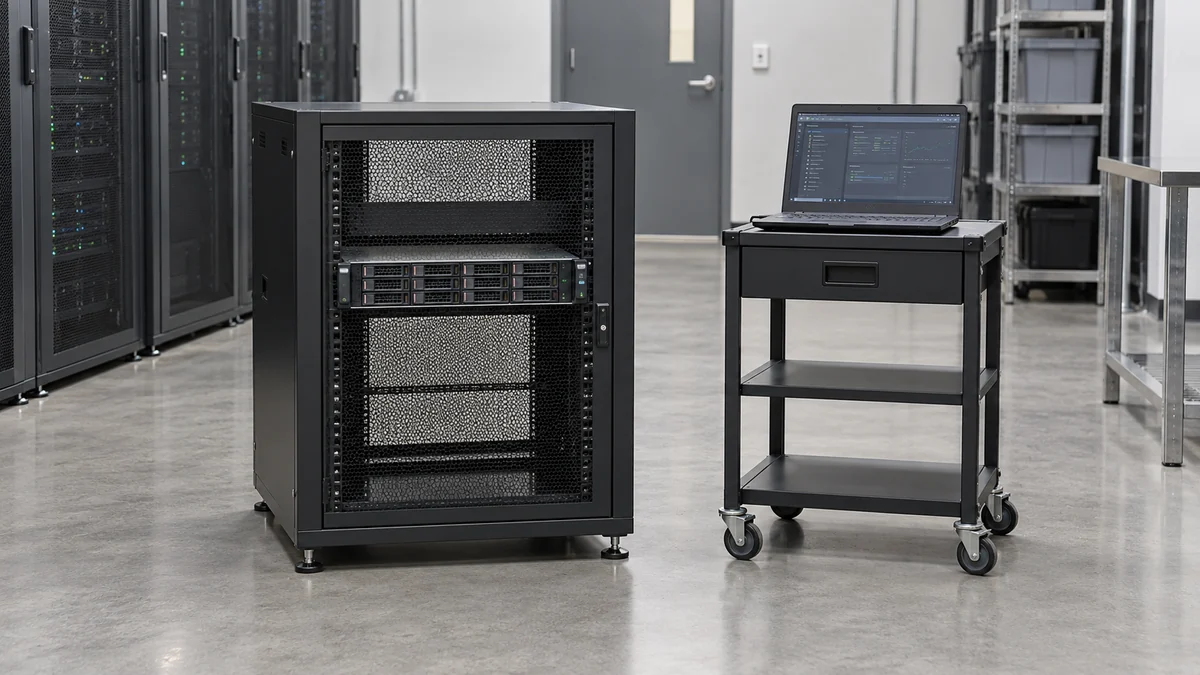
Do not demand millisecond agreement among unrelated clocks. Server event logs, UPS records, and PDU telemetry may sample at different intervals, buffer events, or use clocks that are not perfectly synchronized. An input record and a host log a second apart can still be related; two records with identical timestamps do not establish cause. The useful evidence is a consistent order and an understood measurement boundary. Where neither is available, describe the cause as unresolved rather than converting correlation into proof.
Logs can be silent when the failure occurs before a controller has initialized or when standby power itself drops. That silence changes the investigation but does not identify the PSU. An intact rack source and a documented absence of standby indication, for example, narrow the power path differently from a reachable BMC that reports a regulator sequence failure. The first case still includes cord, inlet, module and internal distribution possibilities; the second points farther into the host’s startup controls. Neither permits a universal LED translation.
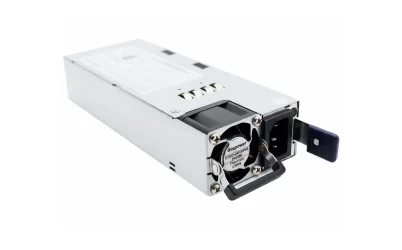
If a supported replacement comparison is available under the manufacturer’s service procedure, it can separate a fault that follows one removable module from a condition that stays with a bay or system. Preserve the pre-change logs and the exact part identity. A mismatched spare, damaged mating connector or different rated input condition can make a swap seem decisive when it is not. The goal is to isolate the failing stage, not to keep cycling a suspect power path until it happens to boot once.
What the brief start does not prove
A spinning PSU fan proves only that the fan moved. It does not establish that main DC output reached regulation, that power-good was accepted by the host, or that every downstream rail stayed up. A lit LED may indicate AC input, standby availability, active output, warning, or firmware activity depending on the model. A flash pattern should be interpreted only against its service documentation. An unchanged AC power reading at a rack outlet may also conceal a short event between meter samples.
Likewise, an apparently normal standalone PSU does not clear the installed system. Its load, enable behavior, mating interface, cooling and control policy may be different outside the chassis. Testing a proprietary module through unknown contacts or an improvised adapter can damage equipment and expose a person to hazardous energy. Do not open the PSU cover or probe energized internal points to settle this question. Follow the host manufacturer’s supported diagnostic and service path, with qualified personnel for any controlled electrical measurements.
A server that actually stays up and later hangs is a different incident. Its workload, thermals, software and memory may be relevant in ways that a first-second abort does not establish. A repeated autonomous click-and-retry pattern is also different from one aborted request; it needs attention to the module’s retry and protection behavior. Keeping these symptom boundaries separate prevents the start-stop question from turning into a generic list of every server fault.
The working answer is therefore conditional but specific: a server PSU can appear to start and then stop because the input falls away, its output protection removes main power, or the host withdraws the request after a startup-stage fault or policy decision. The moment standby, main output, power-good and management events diverge is what distinguishes these explanations. Until that boundary is known, replacing the PSU is a hypothesis, not a diagnosis.