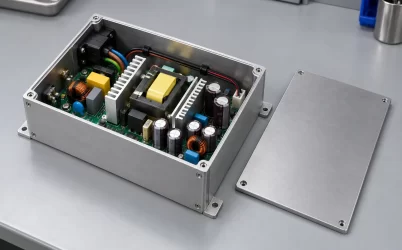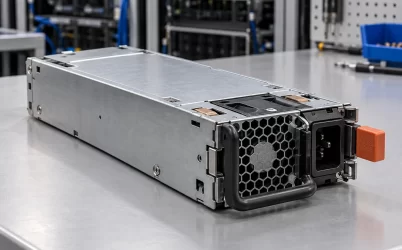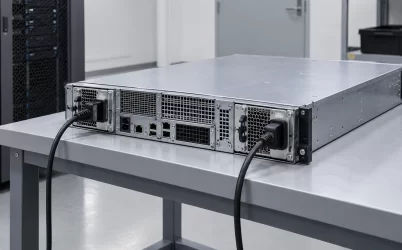
G1302-2400WNA is listed by Gospower in its T185 Titanium CRPS family as a 2,400 W server power module. For a buyer replacing a failed unit or designing a 12 V server shelf, the central issue is whether the exact WNA revision matches the host’s power bay and operating conditions. Gospower gives 185 × 73.5 × 40 mm in the T185 highlights on its exact-model page. Powernexu lists hot-pluggability, 90–264 V input and 12 V / 200 A output; the latter electrical entries remain unverified against a controlled G1302-2400WNA datasheet. Gospower’s family page instead describes a nominal +12.2 V output and does not expose a readable suffix-specific rating table. Treat those public entries as a useful identity and screening description, then obtain the controlled datasheet and host approval before ordering a substitute.
Read the G1302 number as a family, and WNA as the order boundary
The exact suffix matters here. Gospower’s official CRPS catalog lists G1302-2000WNA, G1302-2200WNA, G1302-2400WNA and G1302-2600WNA as separate T185 products. The common family number suggests a shared platform, but it does not establish that the four modules have identical input limits, fans, connector coding, control firmware or host approvals. Even a superficially similar 2,400 W unit from a different Gospower family could have a longer body. A replacement request should reproduce the full identifier from the installed nameplate, including any revision or customer code after it.
Gospower’s G1302-2400WNA page presents T185 series highlights: a 185 mm Titanium CRPS platform, +12.2 Vdc output, built-in ORing fault isolation, PMBus 1.2 family support and fan reversal. The page uses shared series text rather than a revision-controlled suffix-specific datasheet. Its published “up to 96.3%” efficiency statement describes the series; it is not an independently verified efficiency point for this exact 2,400 W suffix. The page’s product-specification table is an image rather than a readable controlled datasheet. That limitation prevents a reliable statement about the WNA unit’s input-dependent power, standby output, efficiency curve or pin assignments from the family text alone.
The Powernexu G1302-2400WNA record lists 2,400 W maximum output, 185 × 73.5 × 40 mm dimensions, 90–264 V input and a 12 V output rated up to 200 A. Its headline positions the module for enterprise networking equipment, but that application phrase is not an approval for a particular switch, storage server or network appliance. The product record gives no input-frequency range, low-line power curve, standby-rail current or temperature derating. Those blanks should stay blank in a purchase specification until a revision-controlled document resolves them.
The 12 V versus 12.2 V descriptions require care. A catalog can round a rail name to its nominal architecture while a manufacturer gives a more precise set point or series description. That is one plausible explanation, not a verified reconciliation for this suffix. At 12 V, 200 A has a voltage-times-current product of 2,400 W; at 12.2 V, the same current would be 2,440 W. Neither arithmetic result proves an allowable continuous operating point because the exact voltage regulation, current limit and combined-output rule are not public. Use the actual WNA datasheet when setting rail tolerances or fuse ratings.
The 185 mm bay is a mechanical interface, not a fit guarantee
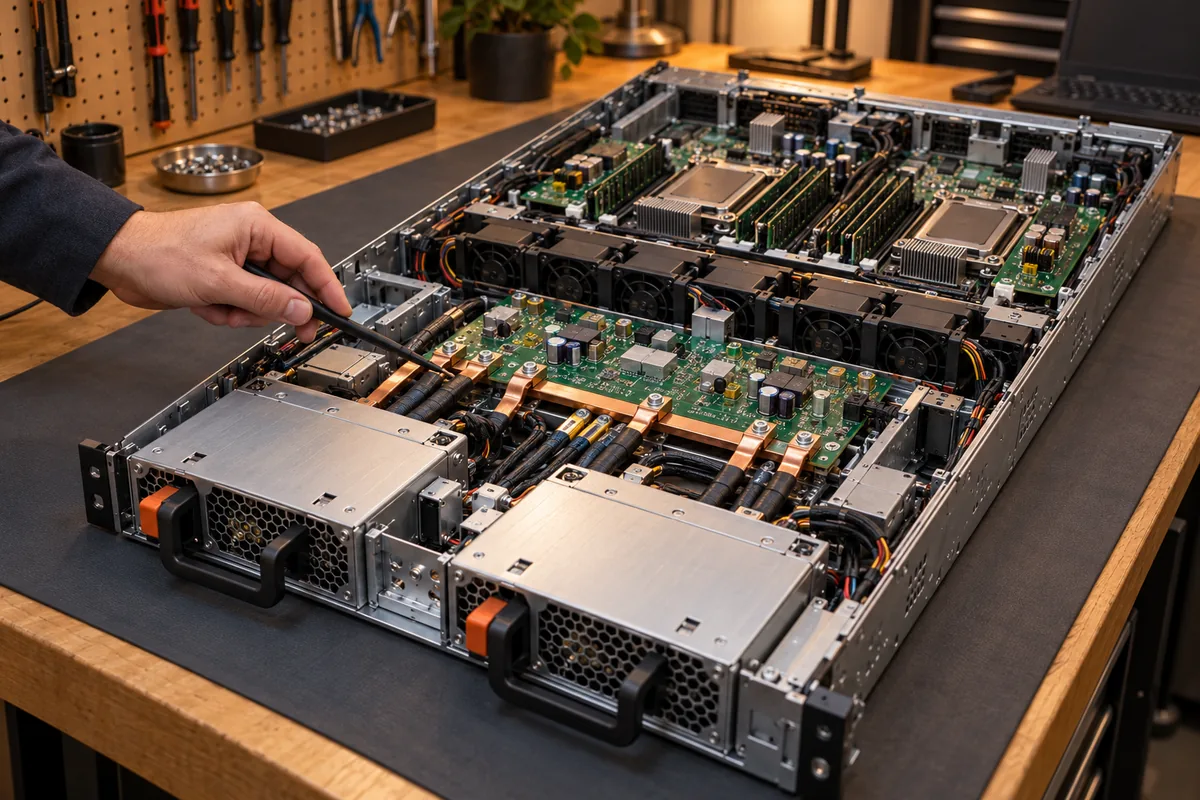
Gospower’s T185 designation refers to a 185 mm body length, and its page also gives 73.5 mm width and 40 mm height in the series highlights. Those measurements can eliminate a visibly wrong module, particularly against a longer CRPS platform, but they cannot establish service interchangeability. A real power bay also has guide rails, latch engagement, a rear electrical mating plane, an AC inlet location, insertion stops and an extraction path. The position of each relative to the chassis matters at least as much as the outer rectangle.
A chassis originally built for a 185 mm module may still reject a unit whose keying or connector contacts differ. Conversely, a module may slide into the bay and touch the backplane while assigning a control or sense signal differently. Neither situation is resolved by matching the wattage or the three published dimensions. The safe comparison is between the installed module’s label and mechanical drawing, the candidate WNA revision, and the host’s approved replacement list. If the host maker names an approved assembly number rather than the bare Gospower model, cross-reference both part numbers before procurement.
Hot-pluggable in a catalog describes a design intention; it does not by itself authorize every live-service procedure. The host must support insertion and removal under its defined load, and the other power path must retain sufficient capacity. The backplane contact sequence, fault isolation, control signaling and service instructions belong to the host/module combination. A technician should use the server’s service procedure, including any required confirmation that the remaining module and feed are healthy, instead of treating the “hot pluggable” field as a standalone safety instruction.
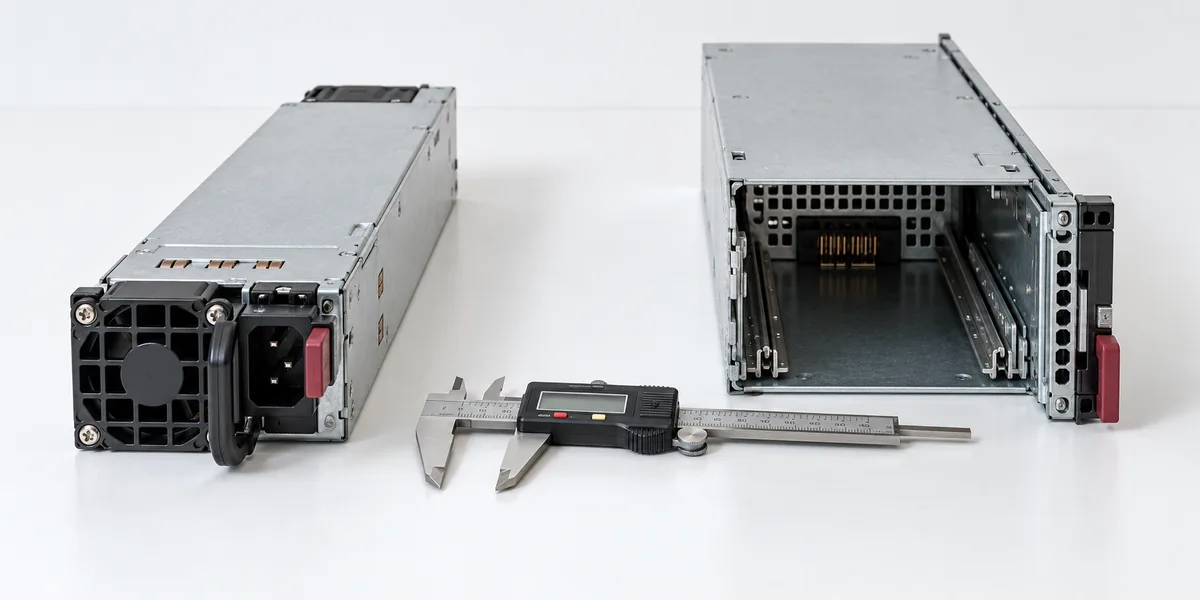
The illustration keeps the complete power module and bay in view while showing the mechanical landmarks that a simple L × W × H line omits. It is a conceptual comparison, not a drawing of the G1302-2400WNA connector or latch. An actual installation drawing should define the mating reference plane and the permitted insertion orientation.
Separate the 2,400 W label from low-line availability
The public Powernexu entry states a 90–264 V input span but does not say that 2,400 W is available at every voltage in that span. Many high-power AC supplies condition their full output on a higher input range because lower AC voltage requires greater input current for the same delivered power. This is a general converter constraint, not evidence of a specific G1302 derating threshold. The exact WNA data must identify the input voltage, frequency, ambient temperature and airflow conditions under which full rating applies.
Suppose an existing server takes 1,700 W from its 12 V bus at a defined peak workload and must continue operating with one supply removed. A nominal 2,400 W replacement appears to have ample headroom, but that conclusion is valid only if a single installed WNA module can deliver at least the required load on the surviving AC feed under the site’s conditions. If the second feed is a lower-voltage branch and the module has an unpublished low-line derating, the headline rating alone cannot support the redundancy claim. The example load is hypothetical; it is not a measured application of this product.
For a nonredundant use, input behavior still matters. A supply drawing 2,400 W of DC output needs more than 2,400 W from AC because conversion has losses. The family statement that efficiency can reach 96.3% cannot be inserted as a guaranteed operating efficiency for the WNA module, especially without the load and input conditions. The branch circuit, cord, inlet and upstream distribution equipment should be checked against the module’s specified maximum input current, not an estimate obtained by dividing its output label by an attractive family-level efficiency figure.
The 12 V path includes a board, contacts and downstream converters
The Powernexu listing’s 12 V / 200 A line describes a very high-current output path. At that level, the backplane’s contacts and copper distribution are part of the usable system rating. Their allowed current, temperature rise and fault behavior cannot be inferred from the supply label. The host may distribute the nominal 12 V bus directly to some loads and convert it locally for processors, memory, storage and management circuits. Those downstream converters have their own transient response and protection behavior; a PSU’s steady-state current entry does not establish the load step that the entire system can tolerate.
Gospower highlights built-in ORing in the T185 family. In a redundant arrangement, ORing can isolate a faulted module from a shared DC bus, but the public family description does not reveal the exact WNA circuit, reverse-current limits or system-level failure coverage. A power distribution board may add further protection or combine outputs, depending on the host design. If a field replacement is being considered, ask whether the approved WNA revision is qualified with the actual PDB, firmware and companion supply. Mixing a new module with an older sibling can introduce current-sharing or communication questions even where both carry the same nominal voltage.
The power-path drawing distinguishes conversion in the removable CRPS from distribution by the host board and point-of-load conversion. It deliberately avoids a fabricated pin map. That separation helps locate the document needed for each claim: the PSU datasheet for module output and signals, the PDB drawing for contact and branch ratings, and the host documentation for supported loads and service behavior.
What the Titanium and management claims actually support
The T185 family is described by Gospower as 80 PLUS Titanium CRPS. That family classification is useful for understanding the intended efficiency tier, but it is not a substitute for an exact model certificate, measured efficiency curve or data-center energy calculation. Facility cost depends on the operating load distribution, inlet conditions and system cooling as well as converter efficiency. A module running far below its intended operating point can have a different loss fraction from a module near its rated load. The family-level “up to” figure cannot settle either case.
Likewise, Gospower’s PMBus 1.2 family statement establishes a management-interface direction, not a complete command map for G1302-2400WNA. A host BMC may expect particular addresses, manufacturer identifiers, telemetry scaling, warning thresholds and firmware behavior. A replacement can provide electrical power while leaving monitoring or fault reporting incomplete. That matters in fleets where operations staff rely on remote status to detect a degraded 1+1 pair before the next failure. Ask for the supported command set and host firmware compatibility when management behavior is part of the purchase requirement.
The highlighted fan-reversal capability should be interpreted with similar precision. It suggests that the family can support different airflow arrangements, but it does not identify which airflow direction is shipped in a given WNA order code or whether the host supports a reversed fan unit. The actual airflow must match the chassis pressure path. A mechanically fitting module with the wrong airflow orientation could recycle hot exhaust or oppose the designed flow through neighboring hardware. An approved part number, label and fan-direction marking are better evidence than a general series brochure.
Use the exact WNA revision to settle replacement or new-build questions
For replacement, start with the installed unit’s full label and the host’s approved spare list. Match the G1302-2400WNA suffix, revision, customer code if present, airflow direction and approved firmware. Then confirm the mechanical drawing and PDB interface. A listing that says “185 mm, 2,400 W” is insufficient if the server maker specifies a different keyed module or a particular management firmware. If the original unit is unavailable, request a written cross-reference that identifies the host assembly and the proposed substitute by full part number.
For a new build, the missing documents are just as concrete: suffix-specific input and derating curves, main and standby rail limits, output-voltage tolerance, connector pin map, inrush and hold-up behavior, thermal operating envelope, airflow option, PMBus implementation and approval evidence required by the project. These are not claims that the WNA lacks those functions. They are fields that cannot be safely derived from the two public summaries. The design team can then allocate board contacts, feeder current, thermal space and monitoring behavior against actual revision-controlled data.
G1302-2400WNA is therefore best understood publicly as a 2,400 W-class, 185 mm T185 CRPS candidate for a 12 V server architecture. The Powernexu page provides the 12 V / 200 A catalog line; Gospower’s exact-model page carries the +12.2 V T185 series description without a readable suffix-specific electrical rating table. The unresolved difference is small in nominal voltage but consequential in documentation: it illustrates why a family page and a reseller table should not be fused into an imaginary precision specification. Once the exact module, host and input conditions are documented together, the product can be assessed for the intended power bay and workload without guesswork.