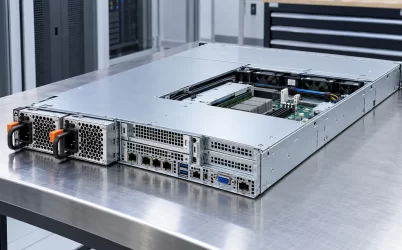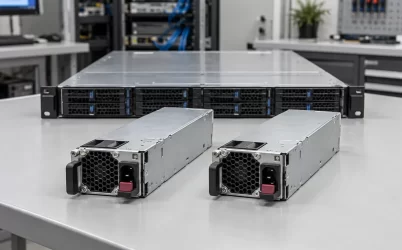
“How many amps is a 1200W server PSU?” has at least three different answers. At a supported 1200W output on a 12V rail, simple DC arithmetic gives 100A. The AC input current is not 100A: it depends on the supply voltage, delivered load, efficiency, and power factor. The current printed on the PSU’s input label is normally a rated or maximum input value under stated conditions, not the amperage the server draws continuously. For a rack cord, PDU outlet, or branch-circuit decision, use the exact module’s documented input-current rating and the applicable installation requirements rather than converting the headline wattage with one division.
Start at the side of the PSU you mean
A server power module has a high-voltage AC input and one or more low-voltage DC outputs. Both sides carry current in amperes, but those currents are not interchangeable. At the output, power is approximately DC voltage multiplied by DC current for a steady load. A hypothetical module delivering 1200W solely on a regulated 12V main rail would deliver about 100A on that rail. A real module may have standby output, nonideal operating conditions, and documented limits that require its own output table. The 100A calculation is a reference point, not a promised output specification for every “1200W” model.
At the input, the module draws alternating current. Real AC power depends on root-mean-square voltage, root-mean-square current, and power factor for the operating point. The converter also loses some energy as heat, so AC real power exceeds delivered DC output. Confusing the two sides can produce a dramatic wiring error: a server’s 12V distribution may need to carry high DC current even while the external AC cord carries current in the single-digit or low-teens ampere range, depending on its supply and load.
The output current also does not tell you how many amperes flow through every motherboard connector. A backplane or power distribution board splits the module’s output among its branches. Individual connectors, copper, cables, and protection devices have their own limits. Where the server has two supplies, current sharing can change each module’s contribution. The arithmetic of total 12V demand should therefore be separated from the rating of any one downstream path.
The AC current calculation needs two extra terms
For a single-phase AC input, a useful estimate is input current approximately equal to DC output power divided by input voltage, efficiency, and power factor. Express efficiency and power factor as fractions rather than percentages. If a hypothetical PSU delivers 1200W DC at 230V AC, operates at 90% efficiency, and has a power factor of 0.98 at that point, its estimated input current is 1200 ÷ (230 × 0.90 × 0.98), or about 5.9A RMS. This is illustrative arithmetic, not a rating for an actual server PSU.
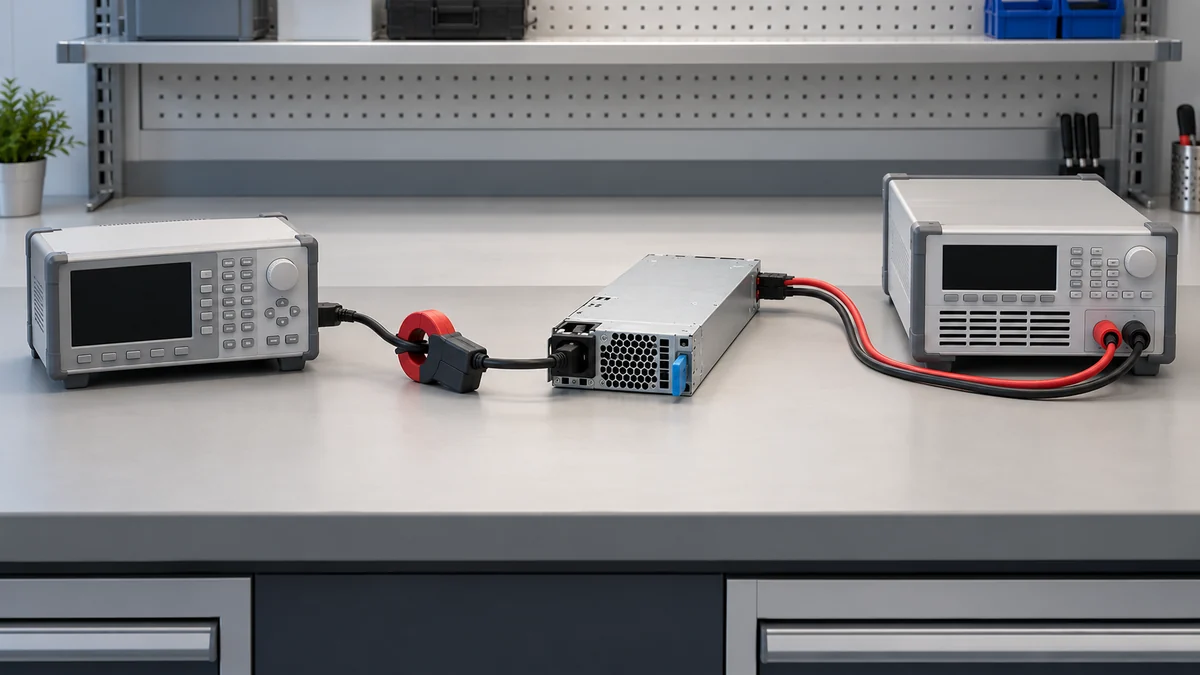
At 120V with the same hypothetical output, efficiency, and power factor, the result is about 11.3A RMS. That comparison shows why lower AC voltage usually implies higher current for the same delivered DC power. It does not prove that a given module supports 1200W output at 120V. Some 1200W-class modules reduce their available DC output on lower-voltage input, and the actual efficiency and power factor need not remain identical. Before using the low-voltage number, establish that the specified output is available at that input.
Why include power factor? A simple 1200W ÷ 230V calculation yields about 5.2A, but that would treat the output rating as if it were input real power and implicitly assume lossless conversion and unity power factor. Neither is a safe universal assumption. Power factor describes the relationship between AC real power and apparent power at the input. It should not be confused with efficiency, which relates DC output power to AC real power. A manufacturer’s rated input current is often the more appropriate planning figure because it covers the actual design’s stated operating envelope rather than a guessed typical point.
For a partially loaded server, replace the 1200W numerator with its actual DC load if that quantity is reliably known, and use efficiency and power factor at that load and line voltage. An installed 1200W-rated module feeding 450W DC does not necessarily draw its full-rated input current. Conversely, a cable should not be sized from one measured idle current when the same server may start, run a demanding workload, or enter a different redundancy state. Operating estimates and equipment ratings answer different questions.
The label’s input amperage is not a power meter
A PSU label or datasheet commonly lists input voltage and rated AC current. That current is intended to describe equipment requirements under specified conditions; it is not a live measurement. It may be stated as a range, a maximum, or separate figures for different input ranges. Look for qualifying notes about output derating, frequency, input type, and operating temperature. A broad input-voltage range printed on a product listing does not establish full 1200W DC output throughout that range.

The difference is visible in a real, model-specific source. A Supermicro 1200W-class PSU quick specification lists a higher input-current range at low-line AC than at high-line AC, while also listing 1000W maximum output at its low-line range and 1200W at high-line. Its DC-output table distinguishes the corresponding main-rail current limits. These figures describe that particular product only; they are not a standard table for every 1200W PSU. They illustrate why one label can contain several correct ampere values with different meanings.
Read those tables in the same direction the electricity flows. First identify the deployed line voltage and the module’s allowed input. Then identify the corresponding maximum DC output and rail current. Finally read the rated AC input current and any input-connector requirement. If the installed server is redundant, repeat this against the surviving module’s operating condition. A specification that shows 1200W only at high line should not be converted to a hypothetical 120V current as though that output were approved at low line.
Do not use inrush current as if it were the continuous input current either. Inrush is a short event associated with energizing input circuitry; its magnitude, duration, and timing differ from steady RMS current. It can matter for PDU or protection coordination, especially when many servers restart together, but it should be evaluated from the module and system specifications. A running current estimate cannot predict it reliably.
Why two 1200W modules do not imply twice the wall current
A redundant server may contain two 1200W-labeled supplies for continuity rather than to deliver a combined 2400W of usable server power. Under a documented 1+1 arrangement, one healthy module must carry the protected load after the other becomes unavailable. During normal operation, the host may share load between the pair, hold one in a lower-power mode, or use another approved policy. The AC input currents of the two cords reflect those operating states, not simply the two nameplate ratings added together.

Suppose, only as an example, a server needs 800W DC and two identical PSUs share that demand equally. Each might deliver roughly 400W DC, but its AC current requires the actual efficiency, power factor, and input voltage at 400W. If one unit stops contributing, the survivor may move toward the full 800W DC requirement. For a cord or PDU outlet feeding either bay, plan for the approved fault state rather than assuming permanent half-load. For the rack feed, consider how the site distributes the two cords and whether one feed can carry the intended surviving load.
Two BMC current readings may differ without proving that one module is defective. Sharing accuracy, sensor resolution, sampling times, and control mode can all affect the displayed split. A module’s input current is also not its output current. When the goal is to investigate an imbalance, compare like quantities measured at the same boundary and operating interval. The question “how many amps?” must specify whether it refers to each AC cord, total rack AC input, one module’s DC output, or a distribution-board branch.
There is an additional trap with mixed input sources. If one PSU receives 120V and the other 230V, equal DC contribution would not imply equal AC amperes because voltage and conversion behavior differ. Such mixed-feed operation should be considered only if the server and PSU pair explicitly support it. The numerical fact that one cord reads more amperes cannot by itself identify a failing feed or module.
Turning amperes into a rack connection
When planning a PDU outlet, cord, UPS output, or branch circuit, separate four numbers: the PSU’s documented maximum continuous input current under the installed voltage, the expected operating current, its inrush behavior, and the total load on the shared upstream equipment. Each has a different purpose. The expected value helps estimate utilization and losses; the rated value and applicable electrical requirements control equipment selection; inrush informs protective-device coordination; the aggregate determines whether the rack or upstream source is overloaded.
A rack with many servers needs more than “number of PSUs × nameplate watts ÷ voltage.” Redundant systems may normally split load, but a feed-failure scenario can move demand to the surviving side. Simultaneous startup may create short input surges. Other rack equipment shares the PDU and branch. Use the real electrical topology and the appropriate documented ratings; have a qualified electrical professional apply the governing installation rules. Do not convert an illustrative current estimate into a claim that a specific outlet or breaker is sufficient.
Connector shape is not an ampere certificate. A PSU inlet, power cord, rack PDU receptacle, and upstream branch must be compatible with the supply and individually rated for their intended service. The PSU’s input-current table helps identify a candidate cord and outlet class, but local wiring, equipment approvals, temperature, grouping, and site policy still matter. The server manufacturer’s supported configuration may also specify cords or power-distribution hardware that a generic plug match would miss.
For the DC side, examine the PDB and connector ratings rather than exporting the AC cord calculation into the chassis. A 12V bus carrying 100A creates substantial distribution and thermal demands even though the AC input current may be far lower. A voltage drop across a high-current contact can create local heat; branch protection and copper design must be appropriate for that DC path. These are host-design considerations, not reasons to assume that every 1200W PSU exposes one single 100A connector.
Which amp figure belongs in the request?
If the request concerns a module’s ability to power the server, ask for its available DC output current at the required rail and input condition. If it concerns a cord or PDU, ask for the module’s rated AC input current at the deployed voltage and for the host’s approved redundancy mode. If it concerns electricity consumption, measure real AC input over representative workloads rather than treating the rated current as an all-day draw. If it concerns startup trips, use the specified inrush characteristics and an appropriate electrical review.
The concise numerical answer is that 1200W at a hypothetical 12V DC output equals 100A DC. On the AC side, there is no single universal ampere answer: an illustrative full-output calculation gives roughly 5.9A at 230V or 11.3A at 120V under explicitly assumed 90% efficiency and 0.98 power factor, but the 120V operating point may not be supported by the exact PSU. The correct purchasing and rack-planning value is the current and conditional output rating published for that module, its input source, and the server’s operating state. That is why two seemingly contradictory ampere numbers on a 1200W server supply can both be accurate.