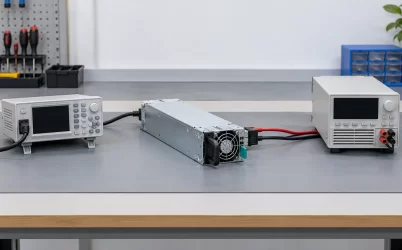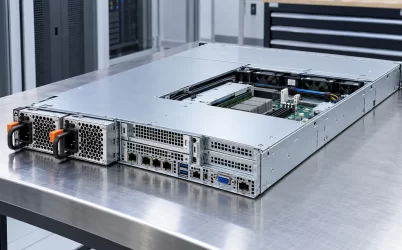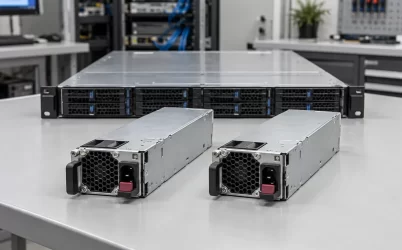
There is no single “server PSU standard” that proves a power module is safe, efficient, mechanically interchangeable, and compatible with a particular server. Different documents govern different questions. A CRPS or M-CRPS interface specification concerns a module and its mating system. Safety requirements address hazards in the equipment’s intended use. EMC rules concern electromagnetic emissions and immunity where applicable. 80 PLUS records PSU conversion-efficiency performance under a program’s test method, while ENERGY STAR and some regulations evaluate eligible server products more broadly. A useful comparison starts by asking which claim each document can establish—and what it cannot.
A form-factor specification is an interface contract, not approval for every host
Server power modules are often described using terms such as CRPS, M-CRPS, Flex ATX, or 1U. These labels can narrow the family of equipment under discussion, but they do not all describe the same thing. A rack unit describes chassis height, whereas a removable module’s envelope, guide rails, latch, connector, airflow orientation, electrical outputs, control signals, and backplane relationship are separate details. Two products advertised for 1U servers may not mate with the same bay.
The Open Compute Project publishes M-CRPS material in its server specification collection. It is an example of an interface specification that designers can use to establish a documented common module and host relationship. It is not a universal statement that any power supply called “CRPS” works in any server. Revision, optional features, mechanical variants, electrical ratings, firmware expectations, and host approval still matter. A third-party module that resembles a qualified unit from the rear may differ at the blind-mate contacts or control interface.
Think of interchangeability as a two-sided claim: the exact PSU revision must meet an exact host assembly’s requirements, and the host must support that module. A standards reference can explain the common interface vocabulary; a server’s approved parts list, dimensional drawing, and integration documentation close the remaining gap. This is why a purchasing listing that merely says “standard CRPS” is insufficient evidence for a replacement order.
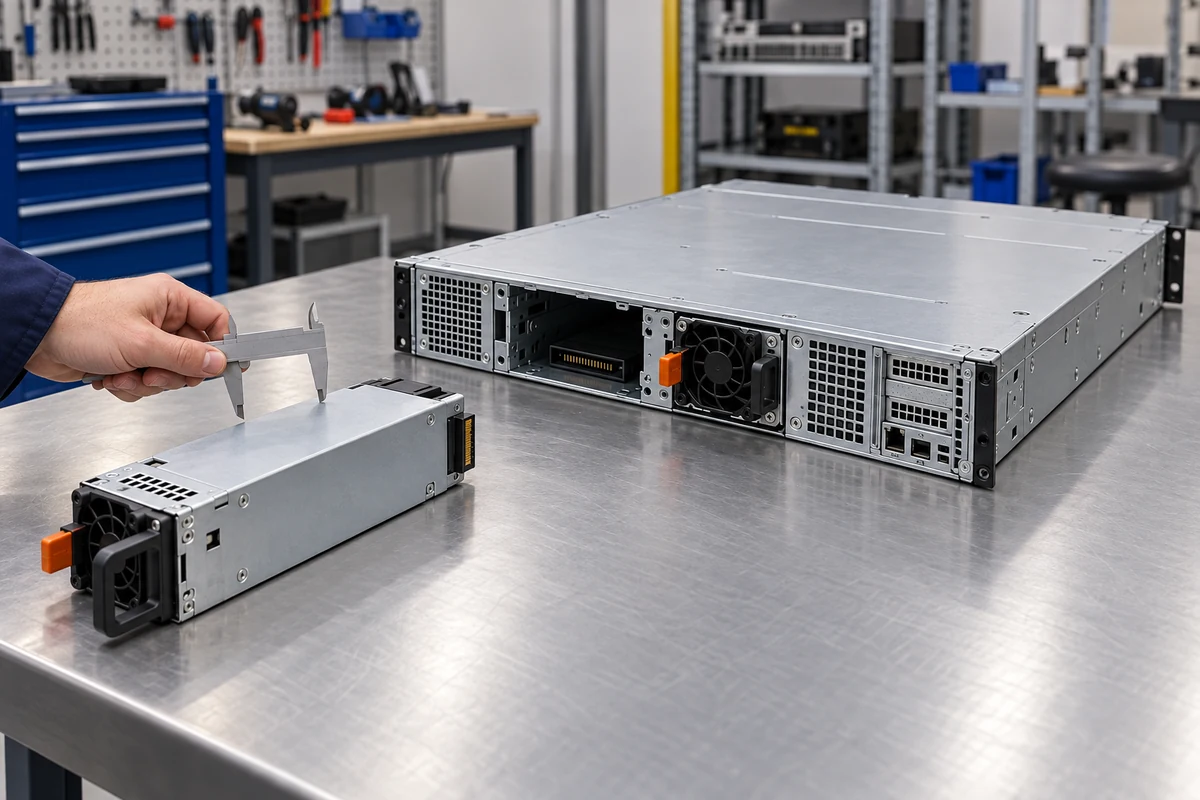
A useful physical example is insertion depth. A module can match the height and approximate width of a bay yet have a longer body, different handle projection, or a connector position that reaches the backplane incorrectly. Likewise, a correct electrical output voltage does not prove airflow direction, current-sharing behavior, standby power, or presence signaling. The mechanical standard reduces ambiguity, but it does not remove the need to identify the precise interface version and host configuration.
Safety evidence answers a different question
Safety standards and approvals address hazards such as accessible energy, electric shock, fire, and thermal risks under defined conditions. IEC 62368-1 and its national or regional adoptions are common references for audio/video and information/communication technology equipment, including much server-related hardware. A datasheet’s reference to a standard, however, is not automatically the same as a current certificate for the exact part number and market. Confirm the covered model, edition or adoption, certification body where applicable, and any installation conditions attached to the evidence.
Open-frame supplies illustrate the boundary especially clearly. A power board may have its own component-level approvals and still require the final equipment manufacturer to provide an enclosure, accessible-part protection, grounding, spacing, cooling, and final-system evaluation. A removable enclosed server PSU similarly operates as part of a chassis with cords, backplane, accessible openings, and service procedure. Product evidence and system evidence are related, but neither should be silently substituted for the other.
Marks also differ in legal function. A certification mark, declaration, and product listing are not interchangeable words, and the required route depends on the destination market and exact product category. Avoid claiming that one mark alone establishes worldwide compliance. For procurement, ask for the relevant document number and the model variants it covers rather than accepting a row of unqualified logos. If the server is sold into multiple regions, the manufacturer’s regulatory team should map the evidence to each intended market.
Safety approval does not prove efficiency, server compatibility, or resilience after one PSU fails. A supply may satisfy safety requirements as a component yet be unsuitable for a specific host’s output connector, cooling pattern, or management expectations. Keeping those claims separate prevents a legitimate certificate from being used to support an unrelated engineering conclusion.
EMC compliance belongs to both the module and the assembled server
Switch-mode power conversion produces conducted and radiated electrical noise. Relevant electromagnetic-compatibility requirements vary by market, installation class, and product. A PSU may be tested as a component under stated conditions, but the server’s cable harness, grounding, enclosure seams, PDB layout, processor load transients, and rack cabling can alter the assembled product’s emissions or immunity. The final server therefore needs its own applicable EMC assessment rather than inheriting an unconditional pass from one module.
For an integrator, the important question is not simply “does the PSU say EMC compliant?” It is what configuration was tested and what the PSU supplier requires for filtering, grounding, shield termination, or enclosure integration. Substituting a module with a different switching design can change conducted noise on the DC bus or AC input even when rated wattage and dimensions match. That does not mean every substitution fails EMC; it means a component claim cannot settle the complete-system question without evidence.
EMC and electrical safety sometimes share installation details, such as protective-earth bonding, but their test purposes differ. A low-noise module is not automatically safe, and a safe module is not automatically quiet enough in the final equipment. This matters especially in dense servers, where high-current busbars, management wiring, fans, and high-speed interfaces are close together. Preserve each standard’s scope when comparing supplier documents.
The evidence may also name an installation class or test setup that differs from the buyer’s finished rack. A laboratory fixture with short cables and a controlled enclosure cannot represent every host assembly. Ask whether the supplier’s report is a component characterization, a pre-compliance investigation, or a formal evaluation of the finished model. Each can be useful, but each supports a different claim. A system integrator should carry forward the conditions that made the original result valid.
Efficiency badges, server labels, and regulation are not synonyms
80 PLUS is a PSU efficiency certification program. A named efficiency tier applies to a tested product in a specified program category and test condition; it is not a promise of identical efficiency at every load, line voltage, ambient temperature, or host operating mode. Before comparing two modules, identify the exact certified model and the program category rather than assuming that a Platinum or Titanium word on a sales page transfers to another revision. A certification result also says nothing by itself about pinout, safety approval, or platform compatibility.
ENERGY STAR computer-server criteria are broader than one PSU badge. The official ENERGY STAR computer-server specification page publishes the applicable program documents, including requirements that address power-supply performance within an eligible server. The program also covers server-level power management and measurement. A PSU with an 80 PLUS result is not automatically an ENERGY STAR-certified server; the finished server must meet the relevant program eligibility and test requirements.
Jurisdictional rules add another layer. For example, European ecodesign requirements for servers and online data storage can set efficiency, power-factor, and product-information obligations within their defined scope and exemptions. A manufacturer’s compliance statement should identify the exact regulation and product configuration. A voluntary badge may help communicate performance, but it is not a legal substitute for an applicable market requirement. Equally, a regulation’s product scope should not be generalized to equipment it excludes or to every input architecture.
Use efficiency evidence to answer an efficiency question. If a server normally operates at a small fraction of PSU rating or uses a redundant pair that shares load, the relevant operating point may differ from a headline test point. A certified tier narrows an efficiency comparison, while a model-specific curve or measurement better estimates loss under the installed voltage and load. Neither resolves whether the module can survive a PSU failure at the deployed site.
Control protocols specify communication, not the whole power path
A managed PSU may expose SMBus or PMBus communication to a server’s baseboard management controller. PMBus supplies a power-management command vocabulary built on SMBus conventions, which in turn relate to I²C signaling. These are management-interface standards or specifications, not proof of the module’s high-current output rating. The same server can continue receiving DC power while the BMC loses telemetry because the physical power contacts and low-current management path are distinct.
Even a claim of PMBus support requires detail. The command set can include optional or manufacturer-specific behavior, and the host may expect a particular address, inventory identity, data format, or fault flag. A standard protocol name should prompt a model-specific interface check, not an assumption that any BMC will recognize any compliant-looking unit. Management visibility, output regulation, current sharing, and electrical fault isolation are different functions with different evidence.
In a dual-PSU server, the power distribution board can be a critical part of this relationship. It may combine outputs with isolation, distribute standby and main power, route control signals, and connect the management bus. A standardized removable module cannot compensate for a mismatched PDB or firmware. When a replacement supply powers a host but appears as “unknown” to the BMC, the observation narrows the management issue; it does not prove that all other interface requirements were met.
How to read a claim that says “standards compliant”
Request the actual document or program behind each claim. “CRPS compliant” should point to a named interface generation or controlled drawing and a supported host assembly. “Safety approved” should identify the applicable standard, national adoption, certificate or declaration, model coverage, and installation conditions. “EMC compliant” should identify the applicable test and configuration. “Platinum” or another efficiency tier should trace to the exact certified model and program category. “PMBus supported” should identify the host-required behavior, not merely the existence of clock and data contacts.
One hypothetical comparison makes the difference concrete. Suppose two module offers both describe a 1600W-class CRPS PSU. Offer A has a matching mechanical drawing and host approval but no verified efficiency record for the quoted variant. Offer B has a strong efficiency certificate but a different connector revision and no approval for the target server. The first may still need efficiency evidence; the second may be excellent in another platform yet unusable here. No single standard label ranks the offers across all dimensions.
The value of this layered reading is practical. It keeps a supplier from answering a mechanical question with an efficiency badge or a safety question with a product photograph. It also helps an engineer identify where evidence is missing without implying the whole design is defective. Some applications require additional market- or system-specific standards; others do not need every program mentioned above. The correct set follows the product, destination market, installation, and buyer’s actual claim.
“Server PSU standards” is therefore a map, not one stamp. Interface documents describe what must mate; safety and EMC evidence address hazards and interference; efficiency programs measure conversion under defined conditions; server programs and regulations apply to eligible systems or markets; management protocols define data exchange. A PSU becomes a sound candidate only when the standards evidence relevant to its intended use is matched with the exact model and server configuration. The categories remain separate even when a product legitimately satisfies several of them.