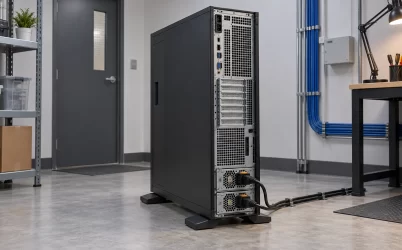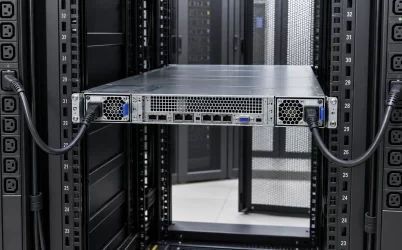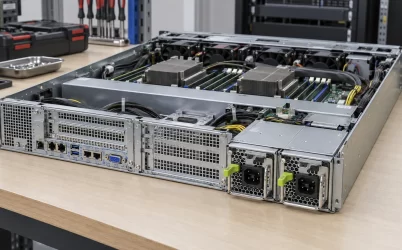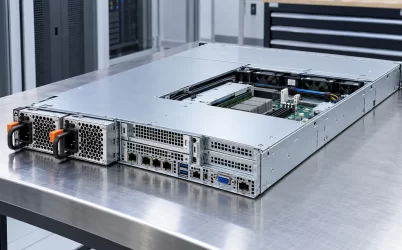
A 277V server power supply is built to accept a nominal 277 V AC input when the exact server platform, PSU model, cord, rack PDU, and facility distribution all support that arrangement. It is not a conventional 200–240 V-only PSU connected to a higher-voltage outlet. In a common North American 480Y/277 V distribution system, 277 V is the line-to-neutral voltage available from a 480 V three-phase source. Delivering that voltage directly to compatible server PSUs can remove a distribution step that would otherwise supply a lower-voltage rack, but it also changes equipment compatibility and the electrical design of the entire path. The reason to consider it is a specific facility architecture—not the assumption that higher voltage always makes a server itself more efficient.
Where the 277 V at a server rack comes from
In a 480Y/277 V system, the three-phase line-to-line voltage is nominally 480 V, while each phase to neutral is nominally 277 V. A rack arrangement intended for 277 V server input distributes the appropriate line-to-neutral supply to each compatible PSU through equipment rated for that service. This is not a proposal to connect a server between two 480 V phases. The distinction matters because “480 V available in the building” does not alone establish what any particular rack outlet supplies or whether neutral is present in the intended arrangement.
Dell’s technical note on 277 V AC and high-voltage DC power supplies describes a 480 V three-phase installation using line-to-neutral distribution to provide 277 V single-phase input to compatible server PSUs. It frames the potential benefit as avoiding a transformer stage used to supply traditional lower-voltage IT distribution. That is a system-level opportunity, not a universal efficiency percentage or proof that any Powernexu module works in a Dell host. The electrical and product decisions remain tied to the exact site and equipment.
A 277 V rack needs more than a matching voltage number on a diagram. The upstream source, switchgear, branch protection, rack PDU, outlet, cord, inlet, and PSU must all be specified for the intended voltage and current. Facility electrical design belongs to qualified personnel and applicable codes. At the server level, the buyer should ask for the exact supported input range and host option, then align it with the documented rack outlet and cord assembly. Adapters or convenient-looking connector matches cannot make an unsupported PSU suitable for a higher-voltage feed.
The rack PDU may receive three-phase power even though each PSU receives single-phase power at its outlet. Distribution design then determines how loads are assigned among phases and how the neutral and protection system are implemented. A server purchaser need not redesign that infrastructure, but should not specify “277 V three-phase PSU” when the host actually expects one supported single-phase input per module. Recording the voltage at the PSU inlet avoids ambiguity between the building service, PDU input, PDU outlet, and converter input. It also makes a cross-vendor equipment comparison possible without assuming the same physical distribution behind every 277 V claim.
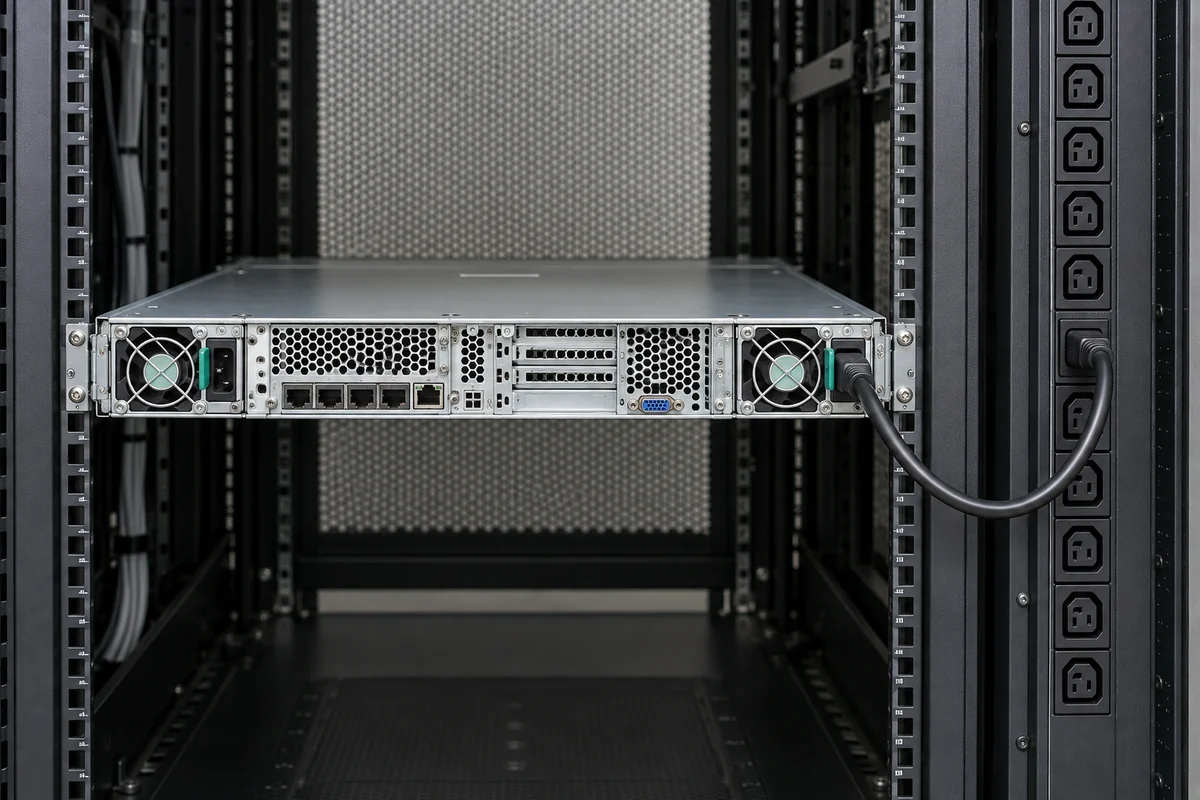
Why a 200–240 V server PSU is not a 277 V PSU
The nameplate input range is a boundary, not a suggestion. A PSU specified only for 200–240 V AC should not be treated as acceptable on a nominal 277 V source, even if it appears to boot briefly or shares a mechanical module family with a high-voltage variant. Components, insulation, surge handling, control behavior, certification, and the host’s approved configuration may differ. The relevant question is whether the exact part number and revision expressly support the site’s input, including normal variation and any documented conditions.

Some wide-input products list an AC range that includes nominal 277 V; others are designed for a narrower high-line range, and still others accept both high-voltage AC and a stated DC input range. Those are model-level properties. A broad range printed on a product page is a useful screen, but it does not by itself prove the module is approved for a particular server cage or that its full rated output is available at every point in the range. Check the exact output-versus-input rating table, the host’s option list, and the chosen cord and inlet.
Input compatibility must not be confused with output architecture. A 277 V AC-capable module may deliver 12 V, 48 V, 54 V, or another regulated output depending on its design. A 48 V DC server bus does not imply a 48 V DC facility feed, just as a 277 V AC rack feed does not imply a 277 V output inside the server. Keep source voltage, PSU output bus, and downstream point-of-load conversion as separate fields in a design record. Conflating them can lead to selecting a physically similar but electrically incompatible power subsystem.
Likewise, a high-voltage DC claim is not automatically interchangeable with 277 V AC. A mixed-mode PSU may explicitly support both, but AC and DC inputs involve different source characteristics, switching, protection, connectors, and installation rules. Dell describes particular mixed-mode products in its own portfolio; that does not establish that a generic 277 V AC module will accept DC or that its DC rating equals its AC rating. Use the manufacturer’s exact AC and DC ranges and conditions rather than reasoning from voltage magnitude alone.
The distribution benefit sits upstream of the server
One attraction of 277 V input is the possibility of delivering power to servers from a 480Y/277 V infrastructure without first stepping the voltage down to a conventional 208 V or 240 V rack system. Removing a conversion stage can remove that stage’s losses and equipment, depending on the facility design. Higher distribution voltage can also mean lower current for comparable real power, which may reduce resistive loss in a given conductor path. Neither point says that every installed 277 V PSU has higher conversion efficiency than every 208 V PSU. Component-level efficiency and distribution-level efficiency are separate comparisons.
For an illustrative single-phase calculation, a 1,000 W real-power load at power factor 0.98 would correspond to about 3.68 A at 277 V and about 4.91 A at 208 V, ignoring other details. These are calculated examples, not branch-circuit sizing recommendations or measurements of a real PSU. The ratio shows why higher voltage can lower current at similar power and power factor. A final distribution design must account for actual load, power factor, protective devices, conductor ratings, temperature, code requirements, and the site’s topology.
Resistive wiring loss follows current squared times resistance. Lower current may reduce loss in an otherwise comparable path, but the magnitude of site savings cannot be inferred from that formula alone. Conductor lengths, transformer arrangement, PDU architecture, load balance, and operating hours matter. If a proposed 277 V migration also replaces old UPS or distribution hardware, attribute savings to the actual changes rather than crediting the PSU input voltage for all of them. Conversely, if additional conversion or isolation hardware is needed at the rack, include its loss and cost.
The server still consumes the DC power demanded by its processors, accelerators, memory, drives, and fans. Feeding a compatible PSU at 277 V does not make a workload use less computational energy by itself. Its AC input may differ because the PSU conversion efficiency changes with source voltage and load, but that difference must come from a model-specific report or measurement. The strongest business case compares whole distribution alternatives at the same IT load and availability requirement, not just voltage labels.
Rack hardware and A/B feeds can become the limiting details
A 277 V-capable PSU must meet a rack PDU and cord system that supports the same input. The physical mating shape of a connector is not enough; its marked electrical rating, approved cordset, retention method, and upstream outlet arrangement matter. A facility may already own substantial inventories of 208 V or 240 V PDUs and cords. A new rack design can plan compatible parts from the start, whereas a mixed-voltage retrofit creates a significant operational risk if technicians can mistake one outlet type for another. Clear identification and controlled procurement are practical requirements, not cosmetic extras.
For a redundant server, trace both PSU inputs. If the architecture promises operation after one feed is lost, the remaining feed must support the full permitted server load through its PDU, outlet, cord, and PSU. Two 277 V inputs on the same upstream failure domain protect against a module failure but not that common source failure. A/B distribution at 277 V has the same conceptual failure-domain question as lower-voltage power; only the equipment and source characteristics change. Do not confuse two cords with two independent facility paths.
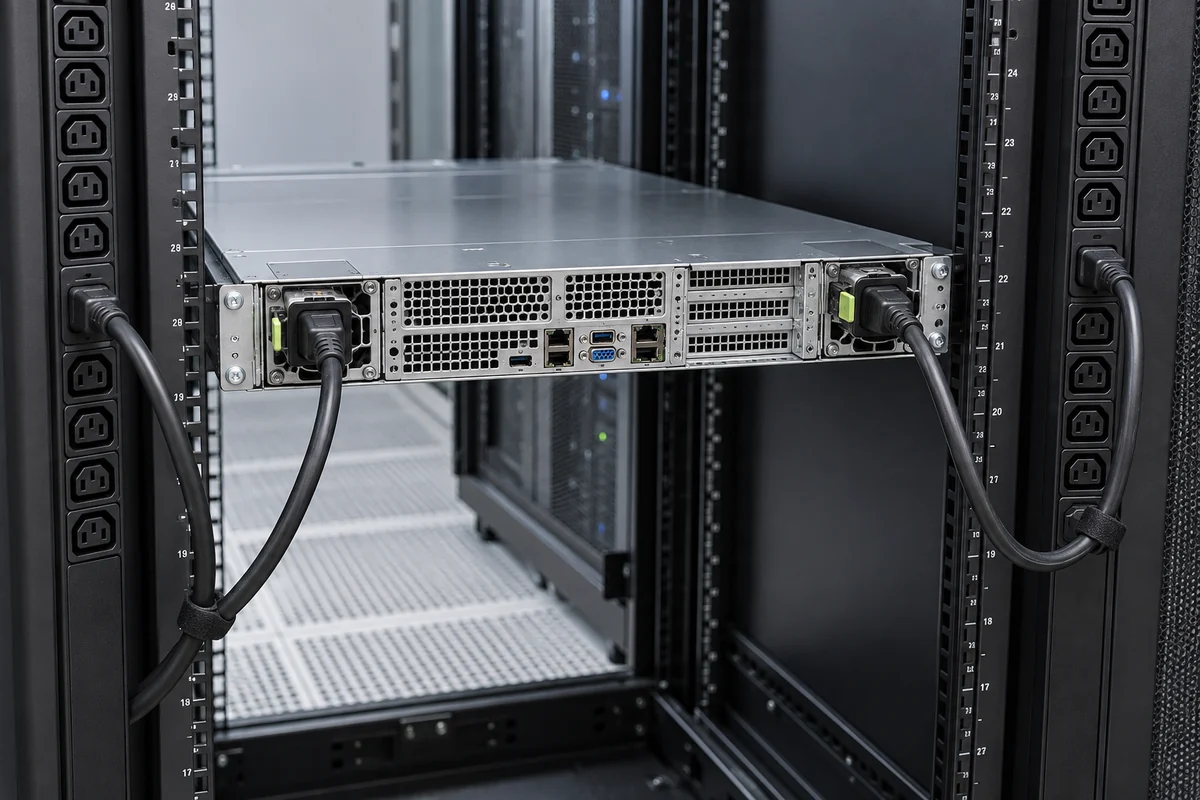
Input current during normal balanced operation is not necessarily the maximum current either surviving path must carry. When one module is removed or loses input, the survivor may take the full load. Use the host’s approved power policy and the module’s published input conditions to evaluate that state. A nominally higher voltage can reduce current relative to a lower-voltage distribution option, but it does not excuse underspecified branch protection or an incompatible connector. The resulting rack plan should be reviewed as an electrical installation, not estimated from PSU output watts alone.
Mixed fleets complicate deployment. A rack might contain older servers that accept only conventional high-line AC, newer units with 277 V options, and networking equipment with different input ranges. The rack voltage decision can therefore be constrained by the least flexible load. Segregating equipment into compatible racks or using separately engineered distribution may be safer than relying on technicians to remember which cord belongs to which device. The capital and service implications belong in the same comparison as the potential reduction in conversion stages.
When a 277 V option is worth pursuing
The option is most coherent when a facility already has, or is intentionally designing around, 480Y/277 V infrastructure and has servers explicitly qualified for the corresponding input. It is less persuasive when only a small subset of hosts support it, the rack hardware would need extensive replacement, or a lower-voltage transformer stage remains necessary for most loads. Those are not universal verdicts. They identify which architecture produces a real simplification at a particular site.
For a procurement request, name the server model and approved 277 V PSU option, rated output at the deployed input, cord and inlet, rack PDU input/output arrangement, A/B source topology, and the operating mode after one module or feed is lost. Ask for model-specific efficiency data at 277 V if the economic case relies on PSU conversion savings. Ask the facility designer for a comparison of distribution losses and equipment that the proposed topology actually removes. This prevents a nominal voltage change from being sold as an unqualified energy saving.
The operational boundary is simple: a server should be connected to 277 V only when every element from the facility source through the PSU is designed and approved for that service. Where that boundary is satisfied, 277 V can be a useful route from 480Y/277 V distribution to a high-density server rack. Where it is not, an ordinary 208–240 V architecture remains a valid engineering choice. The decisive difference lies in the complete power path and its verified equipment—not in the attractiveness of a higher number on the supply label.