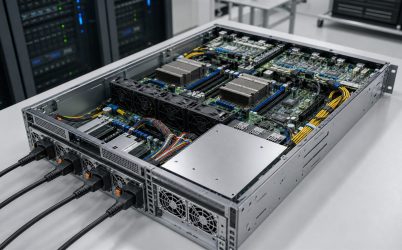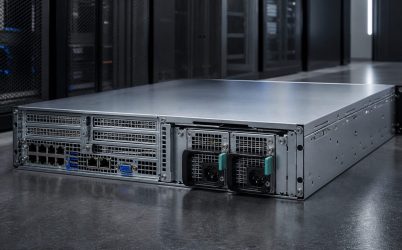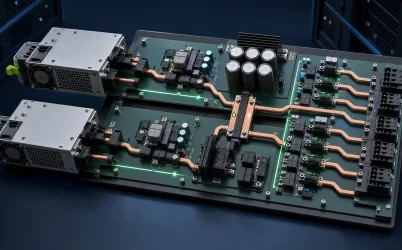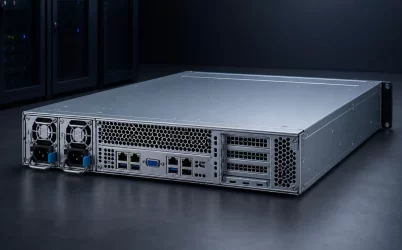
A 495W dual hot-plug redundant server power supply is a low-power 1+1 option for supported servers whose entire degraded-state demand can be carried by one 495W module. The pair should not be treated as 990W of protected output: during a module failure or live replacement, one supply must support the server by itself. This class is most coherent for bounded CPU, storage, networking, and edge configurations; it is usually the wrong starting point for dense accelerator systems or an expanding bill of materials. The server’s approved PSU list, input conditions, module identity, and worst credible single-module load determine whether it fits.
The 495W number describes a narrow capacity lane
The phrase appears frequently in server configuration and replacement searches, especially for established enterprise platforms. It is a rating, redundancy mode, and service characteristic compressed into one line. It is not a universal form factor or interchangeability standard. Dell’s PowerEdge R640 service documentation, for example, lists 495W among several supported AC PSU options and explicitly warns that supplies from earlier server generations are not supported merely because their power rating matches. Its R620 documentation likewise describes two identical 495W modules operating as 1+1 redundancy, with both modules supplying power in normal operation. These are platform facts, not permission to generalize Dell mechanics or firmware behavior to another server.
The unusually useful feature of this rating is its lower ceiling. A server that genuinely fits below it can avoid installing a much larger module solely because higher wattages dominate current catalogs. That benefit is conditional: the lower rating must remain sufficient after a fan fault response, drive spin-up, memory expansion, PCIe activity, and loss of one power module. A 495W label therefore marks a capacity lane, not a workload recommendation by itself.
Read the pair as four different electrical states
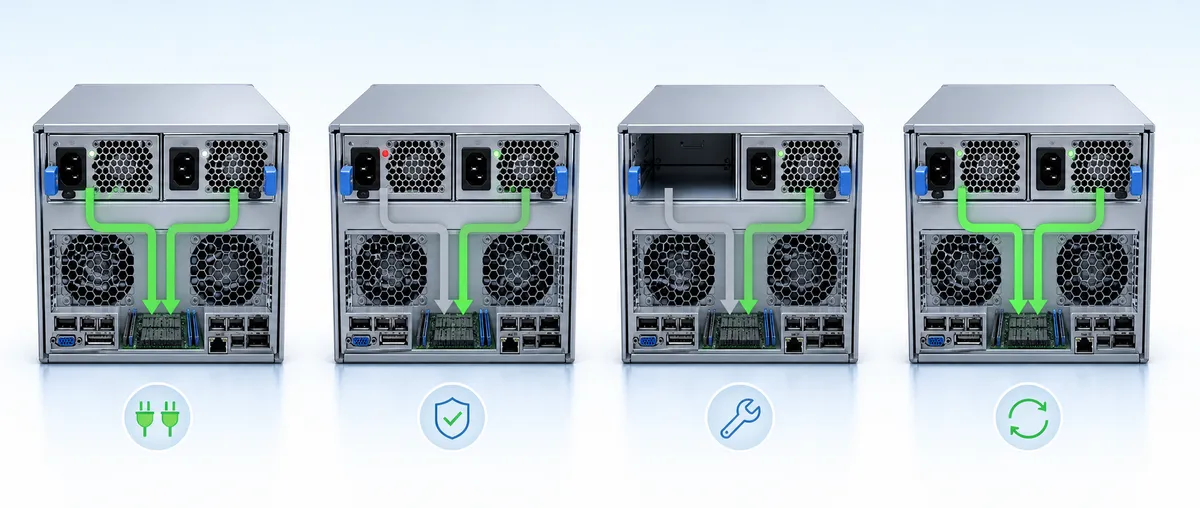
Normal operation is the easiest state. Both supported modules are present, healthy, and usually share the load under the host’s control. The design promise is tested in the other three states: one module stops contributing, a technician removes it, and a replacement is inserted and recognized. The common DC bus must stay inside the loads’ acceptable range throughout those transitions.
| Operating state | What carries the server | 495W-specific question |
|---|---|---|
| Both modules healthy | Two modules may share demand | Is telemetry balanced and redundancy reported? |
| One module unavailable | One remaining module | Does the complete peak envelope remain below its supported output? |
| Failed unit removed | One module plus the host DC bus | Are cooling and workload limits still acceptable? |
| Replacement inserted | Survivor until the new path is accepted | Can inrush and discovery occur without disturbing the bus? |
This state view prevents a common purchasing error. Two modules may divide a 430W running load comfortably in steady operation, yet 430W may leave too little room for the platform’s transient demand, rating conditions, or degraded cooling when one module is absent. Conversely, a stable 240W enterprise node can have a credible margin without needing a 750W or 1100W class. The correct input to the decision is measured or platform-qualified demand by state, not the sum of the two nameplates.
The low-power envelope has recognizable application limits
A 495W redundant pair is most plausible where configuration growth is controlled. Examples include a single- or modest dual-socket CPU server without high-power accelerators, a storage or backup node with a known drive population, an edge appliance with a short list of PCIe cards, or an infrastructure server whose processor power limits are deliberately managed. These are examples of design territory rather than assurances about any named server.
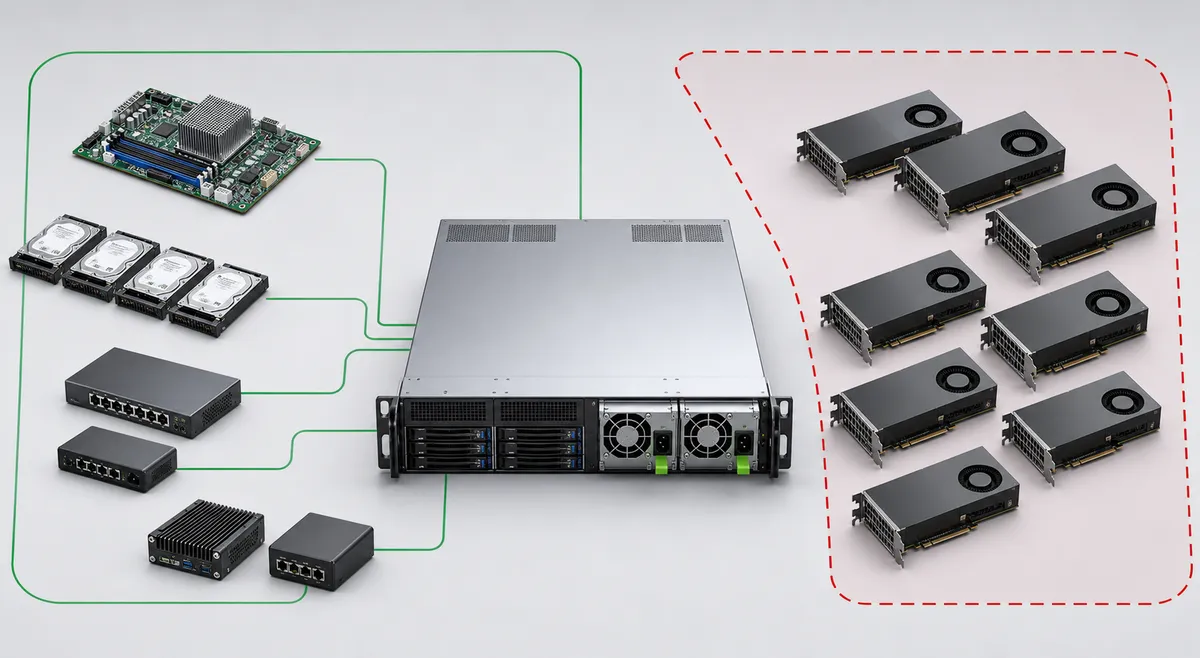
Dense GPU compute changes the problem. Several accelerator cards can create both a much higher average demand and faster excursions, while concentrated connector and board paths add local constraints. The existing Powernexu article on the 750W redundant power class addresses the next capacity zone; the 1600W architecture discussion covers a substantially denser electrical and thermal territory. Moving upward is justified by the actual supported configuration, not by a reflexive preference for the largest rating.
Configuration drift is especially important at 495W. Adding drives, memory, a high-speed network adapter, or a second CPU may be individually modest, but their concurrent worst-case demand can consume the reserve intended for a module-loss interval. Procurement records should therefore bind the PSU choice to a configuration class. If the server is later repurposed, its protected capacity needs to be reassessed.
Hot-plug changes the bus while the server remains alive
Hot-plug means a supported module can be removed and inserted while the system remains powered, under the platform’s specified procedure. It does not mean any physically similar module can be pushed into a live bay. Connector sequencing, output isolation, inrush control, precharge behavior, presence detection, and controller timing have to work as a coordinated interface.
During removal, the departing module must stop feeding the shared bus without accepting reverse current from the survivor. During insertion, the incoming module’s uncharged capacitance cannot be allowed to pull the bus down. Only after its output and control state are acceptable should it join the power path and begin sharing. Dell’s R450 service instructions illustrate the platform dependence: they require same-type, same-output modules for redundant systems and note a recognition interval after hot insertion. That precise interval belongs to that documented platform; another host may use different firmware and timing.
The lower 495W rating reduces the absolute energy scale compared with multi-kilowatt modules, but it does not relax interface correctness. A brief bus disturbance can reset logic long before a thermal limit is reached. Service staff should confirm that redundancy is healthy before pulling a module, preserve independent input paths where the design requires them, and wait for the host to report restored redundancy after insertion.
Low wattage makes failure-state cooling unusually visible
Server PSU fans are often part of the chassis airflow strategy. Removing one module can create an open recirculation path unless the bay, latch, or blanking arrangement controls it. The surviving supply may also increase its own airflow as its load rises. In a lower-power server, that transition may still fit comfortably, but the margin cannot be inferred from wattage alone because inlet temperature, altitude, fan policy, dust loading, and chassis impedance influence available output and component temperature.
This creates a useful distinction from the 2000W class. High-power designs are dominated by concentrated current and dynamic heat removal; at 495W, the engineering risk is more often an overlooked boundary: a lightly loaded system is expanded, an input source changes, a bay is left open, or a low-noise fan policy is retained during a fault. The supply selected for a quiet normal state must still belong to a platform configuration that handles the abnormal state.
Compatibility is an identity chain, not a metal outline
A replacement decision should start with the server’s service tag or exact platform, then the approved option list, PSU type, manufacturer and platform part numbers, rated output under the intended input, mechanical keying, connector, airflow direction, and firmware expectations. Dell’s official 495W replacement listing names a defined set of compatible PowerEdge systems; that kind of platform list is stronger evidence than a marketplace title saying only “495W redundant PSU.”
Two supplies installed in the same redundant pair generally need to meet the host’s matching rules. Same nominal wattage does not prove matching efficiency class, generation, airflow, output behavior, or management implementation. The blind-mate connector may look familiar while signal assignments or identification data differ. Treat a mismatch warning as loss of a verified redundancy state, not merely a cosmetic alert.
Digital power management adds visibility but does not create compatibility. PMBus identifies its current power-management specification, and its official application-profile library includes profiles for server AC-DC supplies and hot-swap controllers. A host may use standardized commands, manufacturer-specific extensions, or a different management design. Buyers should ask what the named server supports rather than assuming that “PMBus-capable” modules can substitute for one another.
When 495W is the disciplined choice
The strongest case for a 495W dual hot-plug redundant server power supply is a stable, approved configuration with a measured or documented degraded-state envelope comfortably inside one module’s supported capacity. That can be a more disciplined design than installing oversized supplies in every low-utilization node. It preserves live service and potentially keeps the normal operating point in a useful part of the module’s load curve, subject to model-specific efficiency data.
The weakest case is a server selected before its workload, expansion plan, and input environment are settled. If accelerators may be added, CPU limits may rise, drive count is uncertain, or one module cannot support the highest permitted configuration, the 495W class has reached its architectural boundary. A higher supported option then buys a defined fault-state envelope rather than an abstract wattage advantage.
For deployment, keep the evidence compact: exact server and configuration, approved PSU identifiers, matching rules, independent-feed arrangement if used, worst credible one-module demand, relevant input and environmental conditions, and the management indication that confirms redundancy. If those facts remain stable, a low-power redundant pair can do precisely what it should—carry a bounded server through a module failure and live replacement without pretending to be a platform for every future load.