A platinum server power supply is usually a server PSU certified to an 80 PLUS Platinum efficiency tier under defined test conditions. The official 80 PLUS program description identifies 80 PLUS as a performance specification and certification program for internal PSUs, with separate application and voltage categories. The label is useful evidence of conversion efficiency, but it is not a universal compatibility mark, a redundancy rating, or a promise that every deployed load will operate at the badge’s best test point. For a buyer or platform engineer, the practical task is to connect the certified model, input class, load range, chassis interface, and redundancy policy to the server that will actually use it. That reading separates a defensible Platinum purchase from a badge-only comparison.
Begin with the certificate, not the marketplace title
Search results for “platinum server power supply” are dominated by product listings, replacement modules, and server-option pages. Those pages often compress several different facts into one short title: output wattage, a server family, hot-plug construction, and an efficiency tier. The first screening question is therefore whether the exact PSU model appears in the official 80 PLUS Platinum certified-PSU database or an official manufacturer document. The database separates non-redundant server applications from redundant data-center categories, so a seller’s description can help discovery but does not establish the tested model identity or category.
Model suffixes matter because two units with similar housings or headline wattage may use different electrical designs, input ranges, firmware, airflow directions, or host interfaces. The certification record also has a scope. It represents a particular unit tested under a defined program and voltage category; it does not transfer automatically to a look-alike replacement. Procurement records should preserve the complete part number and the server manufacturer’s supported-option reference, not merely “1200 W Platinum PSU.”
The word Platinum describes measured conversion behavior at specified load points. It does not certify the server’s connector, blind-mate geometry, PMBus behavior, fan-control integration, hot-swap sequencing, safety approvals, or ability to share current with another module. Each of those remains a separate compatibility question. This distinction is especially important in used and refurbished markets, where an inexpensive server module may be electrically excellent yet unsuitable for the intended chassis.
Translate the tier into the server’s operating point
Efficiency is output power divided by input power. The difference becomes conversion loss, much of which ultimately appears as heat that the PSU and facility cooling system must remove. For the official 230 V Internal redundant category, the 80 PLUS rating chart lists Platinum thresholds at defined 20%, 50%, and 100% rated-load points rather than one universal percentage. Platinum certification therefore indicates that the tested unit cleared the applicable thresholds; it does not mean one fixed efficiency percentage applies from idle to full output. The deployed result follows the model-specific efficiency curve, input voltage, temperature, fan demand, and actual load.
This is where the Platinum topic differs from a general discussion of server PSU efficiency across a fleet. A Platinum purchasing review begins with a named certificate and asks whether the certified operating region matches the server. A fleet-energy analysis starts with measured load distribution and compares conversion loss across time. The two analyses can support each other, but they answer different questions.
Consider a hypothetical server delivering 720 W of DC power. At an assumed 92% conversion efficiency, its PSU input would be about 783 W and conversion loss about 63 W. At an assumed 94%, input would be about 766 W and loss about 46 W. The approximate 17 W difference is not a claim about any product; it simply shows why a few efficiency points can matter when multiplied by many nodes and operating hours. Actual estimates must use published or measured data for the exact PSU at the relevant input and load.
Redundancy can move both modules away from their favorable region
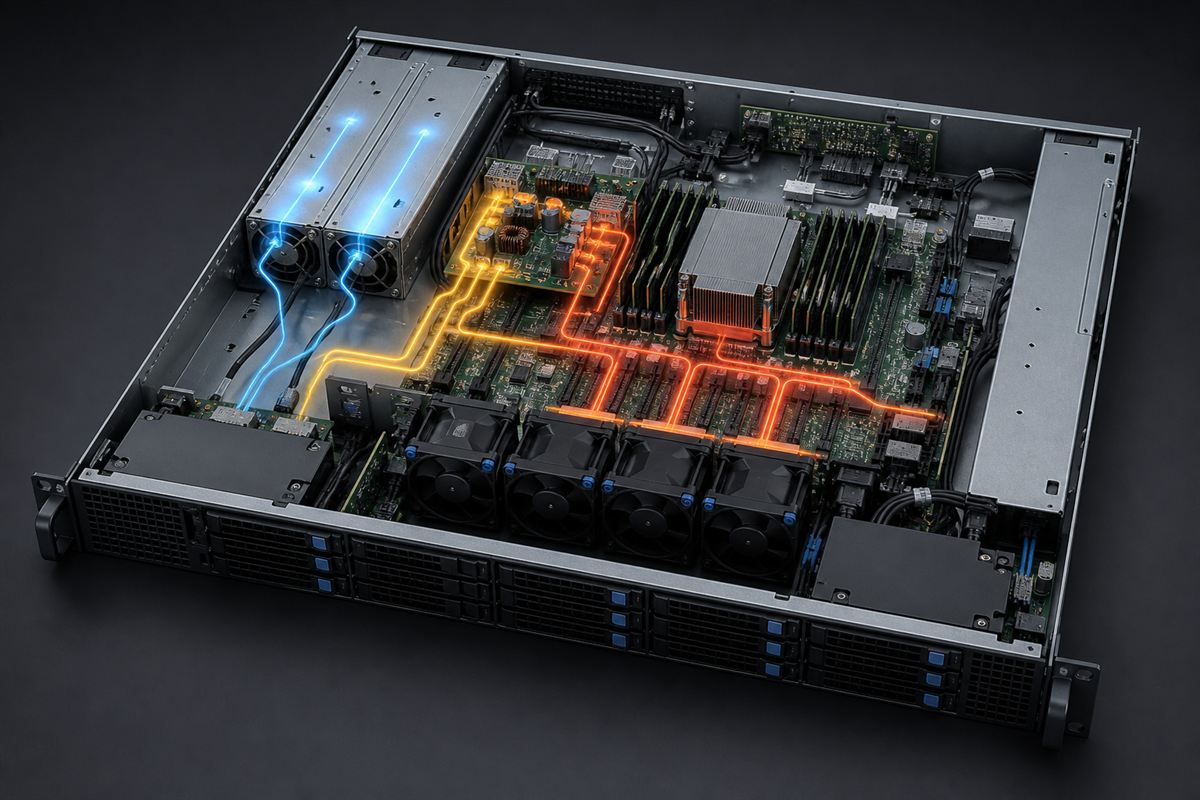
A dual-PSU server may split load between two active modules, keep one module in reserve, or change behavior according to platform policy. If a 600 W server shares evenly, each module may carry roughly 300 W, subject to the platform’s current-sharing controls and auxiliary loads. That can place each unit at a different point on its curve than a single active module carrying most of the load. The energy comparison must therefore describe the redundancy mode rather than assuming the same outcome for every dual-PSU server.
Efficiency mode can consolidate load onto one supply during normal operation and wake or rebalance the second when needed, but availability policy, platform support, and transient response determine whether that mode is appropriate. An operator may reasonably accept a small conversion-loss penalty to maintain both power paths active and preserve a preferred fault response. Platinum status does not choose that policy.
Surviving capacity is a separate limit. In a 1+1 arrangement, the remaining approved module must support the server through a module or feed loss under the applicable input, ambient, and airflow conditions. Adding two nameplate ratings does not create twice the fault-tolerant capacity. The server documentation, power configurator, and workload controls define what can continue during the single-module interval.
High-line input may change what the badge delivers in practice
Data-center power distribution often gives a server PSU a different input environment from a small office or lab. A model may support a broad AC range yet have conditional output capability, efficiency, or cord requirements across that range. Buyers should distinguish “the module powers on” from “the module provides its full documented output and certified behavior.” Manufacturer power matrices and certification records are the appropriate sources for that distinction.
Higher AC voltage can reduce input current for the same real power, which may lower conductor losses upstream, but it does not erase branch-circuit, connector, rack-PDU, or regulatory constraints. Facility voltage should be treated as part of the deployment design, not as a free efficiency upgrade. If a module offers different capacity at low line and high line, the worst intended source condition belongs in the capacity review.
Power factor is also distinct from conversion efficiency. A PSU can draw real power efficiently while presenting a different relationship between real and apparent power. The official 80 PLUS category chart reports power-factor criteria separately from efficiency, and the ENERGY STAR Computer Servers test method likewise defines controlled AC test conditions rather than treating the wall source as irrelevant. Rack loading and upstream distribution planning need the actual input-current and apparent-power behavior of the deployed equipment, rather than an inference from the Platinum name alone.

A replacement must match the host, not just the metal shell
Server PSUs are often mechanically compact and visually similar. A complete replacement check includes the approved part number, mechanical envelope, keying, insertion depth, latch and handle, blind-mate connector, output bus, standby behavior, control signals, management communication, airflow direction, and firmware expectations. Exact requirements are platform-specific; an industry form factor can narrow the search without guaranteeing interchangeability.
Mixing different wattage or efficiency variants in one server may be unsupported even when both appear in the same product family. Current sharing, fan behavior, fault reporting, and firmware policy can depend on a matched pair. The host manual or official option matrix should settle the question. A Platinum unit that triggers a management warning or cannot share correctly is not an upgrade.
The same caution applies to breakout-board uses outside the original server. A server PSU can be repurposed only when its connector, enable logic, cooling, current distribution, protective functions, and enclosure are engineered for the new application. A marketplace cable bundle does not establish safe conductor loading or fault coordination. For production infrastructure, a supported server or power-shelf integration is the more auditable path.
Thermal value depends on where the saved watts go
Lower conversion loss can reduce heat inside a narrow PSU tunnel, potentially easing component and fan stress. The system effect, however, depends on airflow impedance, inlet temperature, fan controls, and total server power. A dense accelerator server can still demand substantial airflow even with an efficient PSU because CPUs, GPUs, memory, and voltage regulators dominate its heat load.
Power density introduces another trade-off. Two supplies can share a tier while using different mechanical volumes, fan sizes, acoustics, and airflow paths. A very compact module may need higher air velocity to remove its remaining loss. In a 1U server, rear-panel blockage and fan interaction may matter more than they do in a spacious chassis. The approved platform design accounts for these relationships; an isolated efficiency badge does not.
For comparison, record PSU inlet temperature and server fan behavior at representative workloads if operational data is available. Do not interpret a lower rack input reading as PSU improvement unless workload, redundancy state, fan controls, and measurement boundary are comparable. The useful metric is not the badge alone, but how the certified module affects the node’s input power and thermal budget under the same service condition.
Build the purchase record around evidence that survives handoff
A clear procurement line identifies the server platform, approved PSU option, full model and part number, rated output under the intended input, efficiency certification record, redundancy mode, airflow direction, connector or cord requirement, and required regional approvals. It also states whether new, manufacturer-authorized replacement, or refurbished supply is acceptable and what traceability accompanies it.
That record prevents three common substitutions: a consumer Platinum PSU offered for a server chassis, an unsupported server module offered because the wattage matches, and a visually similar unit whose certification belongs to another suffix. It also gives operations a reliable spare-pool definition. If the server is expected to remain online during service, the approved hot-plug procedure and surviving-load limit belong with the spare strategy.
A platinum server power supply is most valuable when its evidence chain remains intact from certificate to chassis. The tier can support lower conversion loss, but the purchase earns that benefit only when the exact certified unit operates in a favorable load and input region, remains supported by the host, and preserves the intended fault behavior. That is a narrower claim than “Platinum is always better,” and a much more useful basis for specifying real server power.