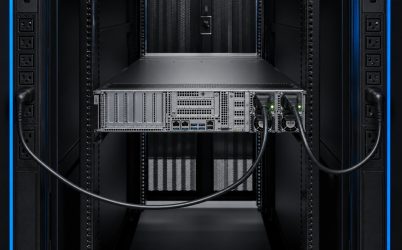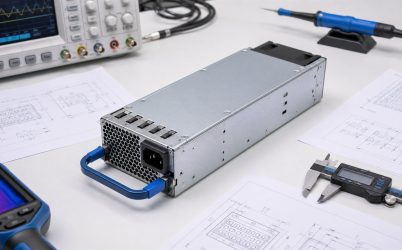
An 80 Plus Platinum server power supply has passed defined efficiency targets under a specific 80 PLUS test category and input condition. For a server buyer, that rating is useful but narrow: it describes AC-to-DC conversion efficiency at prescribed load points, not mechanical compatibility, redundancy, transient performance, acoustics, firmware support, or service life. A responsible selection therefore starts by confirming the exact certified model and test category, then places that efficiency evidence inside the server’s real load profile, input voltage, cooling design, and 1+1 operating strategy.
Quick answer: use Platinum as verified efficiency evidence, not a compatibility label
Check the official certificate for the exact model, input category, and measured load points. Estimate how often the server operates near those points, including the lower per-module load created by redundant current sharing. Convert the efficiency difference into input energy and heat over the expected duty cycle. Separately verify form factor, connector, pinout, PDB, standby rail, control signals, PMBus behavior, airflow, derating, and surviving-module capacity. Platinum can reduce conversion loss and cooling demand, but only a system-level review shows whether a particular PSU is suitable and whether its economic benefit is meaningful.
What the 80 PLUS result actually establishes
80 PLUS certification compares measured conversion efficiency with thresholds associated with a named tier. Platinum is one of those tiers. The program has categories associated with different input-voltage and equipment contexts, so threshold values should always be read from the applicable official table and report. A number remembered from a desktop PSU chart may not be the correct criterion for an internal redundant server supply operating from a different input condition.
The certificate should match the model being purchased. Similar housing, family name, wattage, or vendor does not prove that a variant is covered by the same test. Procurement documentation should retain the certificate reference and model identity. If a vendor changes hardware revision, firmware, fan, or major power-stage components, obtain confirmation that the offered configuration remains represented by the evidence being cited.
Efficiency is a curve, while the badge summarizes points
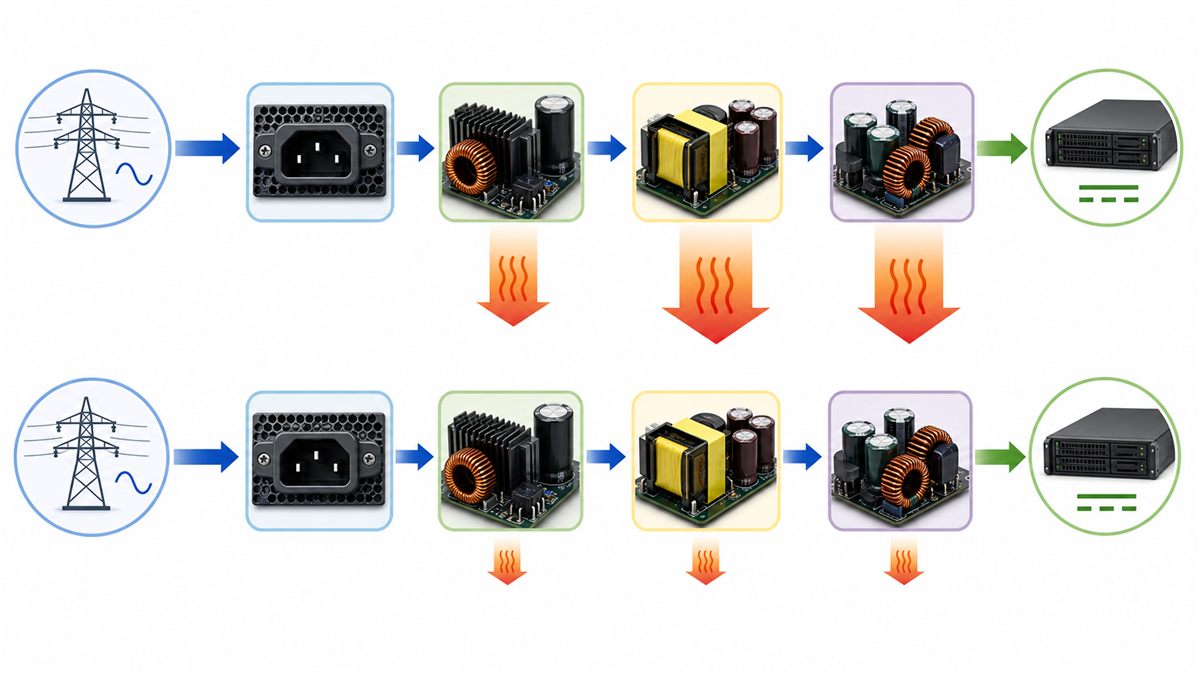
A power supply does not operate at one efficiency across its entire range. Fixed losses can dominate at light load, switching and magnetic losses change with operating point, and conduction losses grow with current. Input voltage and cooling conditions may also influence results. The tier gives useful standardized points, but an energy model benefits from a full efficiency curve for the exact unit at the intended input.
Server workload is equally important. An enterprise application may spend much of the day at moderate utilization and rise during scheduled processing. A storage node can have different idle, rebuild, and peak states. A GPU server may show faster, larger power transitions. Gather measured or estimated time in representative DC-output bins. The relevant question is not “What is the maximum efficiency?” but “How much input energy is used across the actual operating distribution?”
Calculate conversion loss across operating intervals
For a given interval, estimated AC input power equals DC output power divided by efficiency expressed as a decimal. Conversion loss is the difference between input and output. For example, if a hypothetical server requires 800 W of DC output and the PSU efficiency at that condition is 0.94, input is about 851 W and conversion loss is about 51 W. This is an illustrative calculation, not a claim for a particular model.
Repeat the calculation for each meaningful load bin and multiply by the hours spent there. For a redundant system, use the efficiency of each module at its share of load, not the efficiency at total server load. Then compare candidate totals. Include cooling implications only with an explicit assumption about facility cooling performance; electrical loss becomes heat, but the additional facility energy needed to remove it depends on the data center.
Redundancy can move modules into a lower load region
In an active-current-sharing 1+1 arrangement, two supplies may each carry roughly half of the total output. A 900 W server load would therefore place each module near 450 W, subject to sharing tolerance and auxiliary consumption. If one module is removed, the survivor approaches the full 900 W. Both points matter: the normal state influences annual energy, while the degraded state determines capacity and temperature limits.
Some platforms use efficiency-oriented power management that changes how modules share or enter standby states. Such behavior must be supported by the PSU, PDB, and system firmware. It can improve efficiency at low server load, but it changes fault response and the operating hours accumulated by each module. Do not assume that any pair of Platinum units supports this strategy merely because both can deliver the required voltage.
Lower conversion loss reduces a local heat source
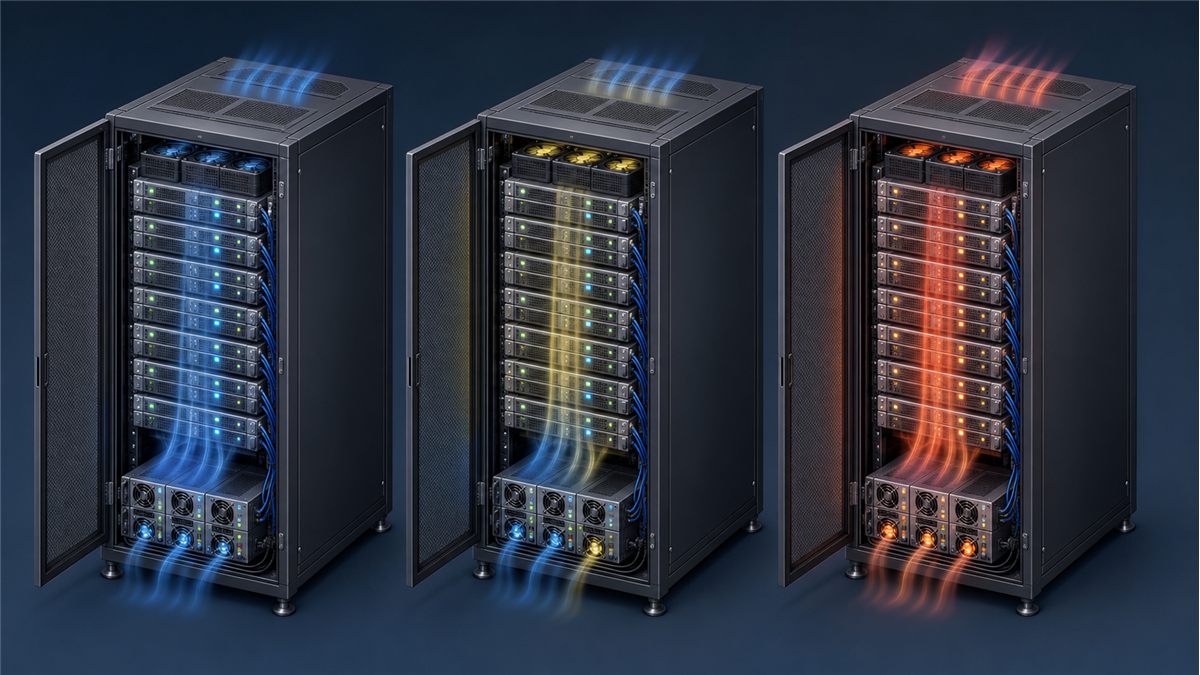
Every watt not delivered as DC output becomes heat in the power conversion path. Reducing that loss can lower PSU exhaust temperature, fan requirement, or rack cooling load. The amount is condition-dependent. A small efficiency difference at high continuous load may be operationally valuable across thousands of servers, while a larger percentage-point difference during a rarely used state may have little effect.
Thermal benefit should not be converted directly into a reliability claim without evidence. Component temperature depends on internal topology, heat sinks, airflow resistance, fan control, inlet temperature, and component placement. Two equally certified units can have different acoustic and temperature behavior. Review thermal derating and fan specifications, then measure representative units in the production chassis if acoustics or temperature margin is important.
Input voltage affects deployment and comparison
Data centers may distribute different AC voltages depending on region and rack design. Higher input voltage can reduce input current for the same power and may improve conversion efficiency in some designs, but the exact relationship is model-specific. Confirm that the PSU’s rated input range matches both normal and abnormal facility conditions. Also verify the inlet, cord, PDU receptacle, branch rating, and regulatory requirements.
High-power modules may provide their full output only above a stated input voltage. At lower input, output can be derated. This matters for international deployments and lab testing from ordinary receptacles. Capacity planning for redundant operation must use the rating available at the actual input, not the largest wattage printed for another input condition.
Platinum does not guarantee CRPS interchangeability
Server PSUs that share a similar external shape can differ in length, latch geometry, connector keying, output rail, pin assignment, standby output, current-share method, PMBus implementation, airflow direction, and firmware identity. A module may fit partially yet fail to seat, or it may power the main rail while producing management faults. The exact mechanical drawing, connector definition, and host compatibility list are authoritative.
- Confirm chassis envelope, insertion depth, handle clearance, and airflow direction.
- Verify the mating connector and every power, return, sense, and control contact.
- Check standby power, enable, power-good, present, and fault behavior.
- Review current sharing, output isolation, inrush, and hot-swap sequencing.
- Validate PMBus commands, addressing, telemetry scaling, and BMC acceptance.
The standard CRPS power supply compatibility guide provides a deeper system-level checklist. Certification tier should be recorded alongside these requirements, not used in place of them.
Reliability requires evidence beyond efficiency
Efficiency can reduce heat, and lower heat can be beneficial, but an 80 PLUS tier is not a reliability certification. Reliability assessment may include component quality, electrical and thermal design margins, fan strategy, protection behavior, manufacturing controls, warranty, service data, and qualification results. Relevant safety, EMC, environmental, and application-specific approvals should be verified independently.
Protection labels also need detail. Overvoltage, overcurrent, short-circuit, and overtemperature protection may use different thresholds, response times, and recovery modes. In a redundant system, a faulted module must not collapse the shared bus. The PDB’s ORing or isolation design and the PSU’s output behavior work together; neither should be evaluated alone.
When the Platinum premium is economically sensible
Compare total cost over the intended service period. Inputs include purchase price, measured or modeled energy consumption, operating hours, electricity tariff, utilization profile, cooling overhead, expected replacement cycle, and any operational value from reduced heat or noise. Use ranges for uncertain factors. A sensitivity analysis can show whether the decision remains favorable when load or electricity price changes.
Platinum often deserves strong consideration for continuously operating server fleets, higher rack utilization, warm environments, or sites where energy and cooling costs are significant. A lower tier may still be rational for lightly used development systems or short deployments when its full compatibility and performance are established. The certificate does not make the financial decision by itself.
A validation plan before fleet deployment
- Verify the offered unit against its certificate, datasheet, drawing, and revision information.
- Confirm mechanical insertion, connector engagement, airflow, cable, and PDB compatibility.
- Test startup at input extremes and representative cold and warm conditions.
- Exercise idle, typical, sustained maximum, and fast workload transitions.
- Measure input power, DC output, power factor where relevant, and thermal behavior.
- Remove each redundant module at permitted load and observe rail stability and alarms.
- Verify telemetry, event logs, fault isolation, reinsertion, and return to current sharing.
Results should be compared with the platform’s acceptance limits, not with a generic expectation. For facility-level implications, Powernexu’s data center server power supply planning article discusses feed architecture, thermal load, and redundancy in a broader context.
Common questions about Platinum server PSUs
Does Platinum mean the PSU is always more efficient than Gold?
The tier requires higher standardized targets in its applicable category, but actual curves can cross outside or between test points, and different units may be tested under different categories or inputs. Compare certified results and manufacturer curves at the intended operating conditions.
Does Platinum reduce the wattage a server needs?
It does not reduce the DC power demanded by processors, memory, drives, or accelerators. It can reduce the additional AC input needed to supply that DC output, thereby reducing conversion loss.
Can a Platinum PSU replace any lower-tier server PSU?
No. Efficiency tier does not establish physical or electrical compatibility. Replacement requires confirmation of form factor, output, connector, pinout, signals, management, cooling, input, redundancy, and host approval.
Should a redundant pair be sized at twice the server load?
Not necessarily. In a 1+1 design, each module normally needs enough usable capacity to support the permitted load after the other is lost. The correct rating also accounts for transient demand, derating, input condition, and platform rules. Simply doubling one number does not define the architecture.