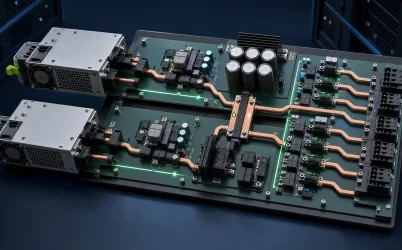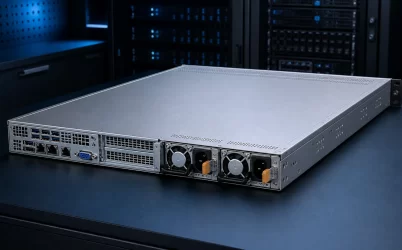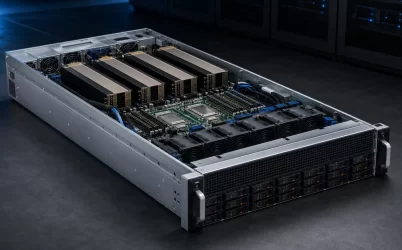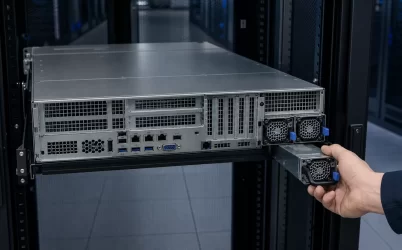
A 550W dual hot-plug redundant server power supply is best understood as a continuity architecture with a deliberately modest capacity ceiling. In a typical 1+1 arrangement, two 550W modules are installed, but the server is normally designed to remain within the output capability of one module after the other is removed or fails. The pair therefore does not automatically create 1,100W of redundant usable power. This class fits compact enterprise, storage, edge, and industrial servers whose measured worst-case load—including transient and environmental allowances—stays inside one module’s supported operating envelope.
Why 550W is a deployment envelope, not a sum
The 550W label describes rated output under the input-voltage, temperature, airflow, and other conditions stated for a particular module. It does not disclose how much a complete host can safely consume, and it should not be generalized across unrelated PSU models. A platform designer begins with the host’s supported PSU option and then maps the server’s operating states against that exact option.
For a conventional 1+1 pair, the decisive state is one healthy module carrying the complete server. If the host can reach 430W of sustained DC load, for example, the remaining difference to 550W is not simply spare capacity available for arbitrary upgrades. Fan acceleration after a fault, short workload steps, component tolerances, input derating, and the PSU’s documented thermal limits can consume part of it. This example illustrates the reasoning; it is not a rating recommendation for a specific platform.
That creates a clear distinction from the nearby 495W dual hot-plug redundant supply analysis. The extra 55W may accommodate a modest CPU bin change, more drives, or a larger transient allowance in some verified designs, but it does not change the architecture. Nor does it make a 550W module appropriate for accelerator-heavy servers that need a much larger single-module survival envelope.
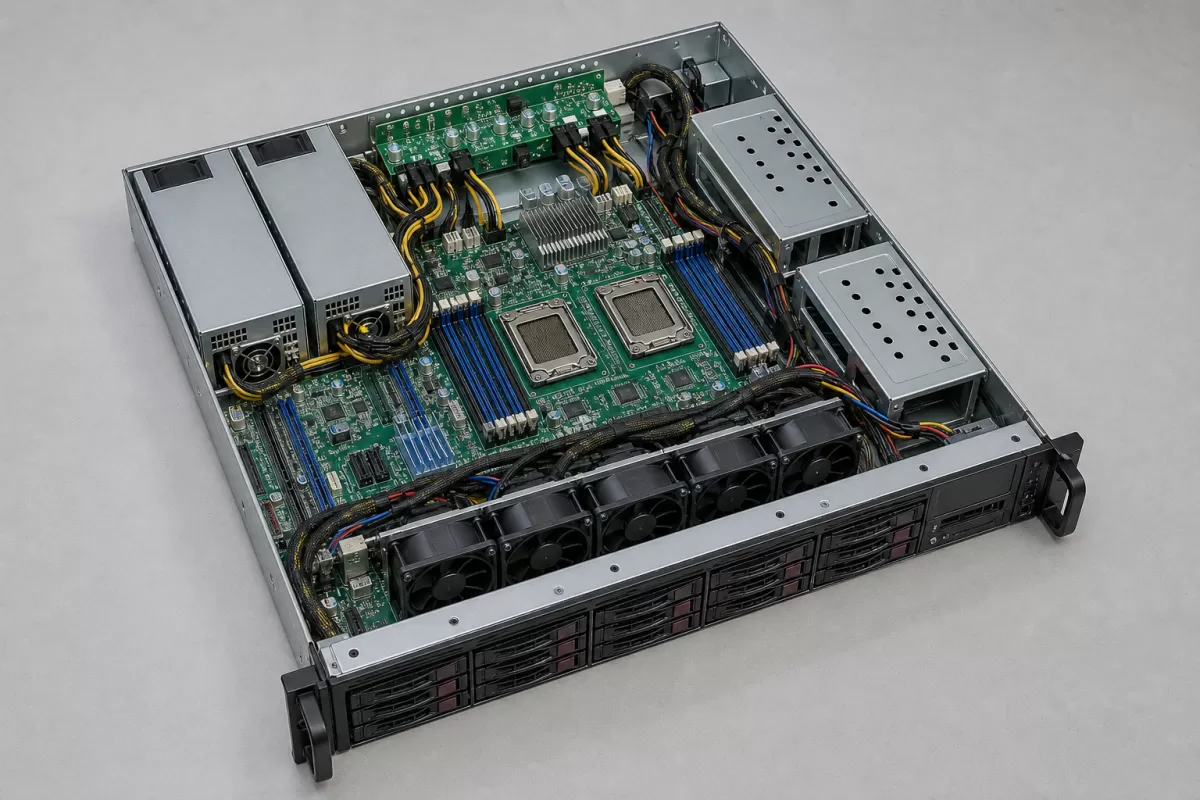
The two-module pair moves through distinct power states
A useful specification describes the pair as a state machine. With both modules online, they may share load or one may operate in a standby policy, depending on the supported platform. After loss of an AC feed or module, the survivor assumes the host load. During service, one module is physically absent. On insertion, its input, standby functions, control signals, and main output must connect in the intended sequence before it participates in supplying current.
| Pair state | Electrical question | Operational consequence |
|---|---|---|
| Both modules healthy | Are outputs sharing as the platform expects, or is one intentionally in standby? | Telemetry should distinguish policy from a weak or disconnected module. |
| One input feed lost | Can the other feed and module carry the complete host at the actual input condition? | A dual-module chassis is not feed-redundant when both cords terminate in one failure domain. |
| One module faulted or removed | Does isolation prevent the failed or open bay from pulling down the common bus? | The host continues only if surviving capacity and cooling remain adequate. |
| Replacement inserted | Are inrush, contact sequencing, and current takeover controlled? | A mechanically insertable module is not necessarily electrically interchangeable. |
The Open Compute Project’s M-CRPS specification provides a concrete example of how a redundant specification treats failover as an output-voltage event rather than a marketing label: its defined 1+1 standby behavior includes a requirement for the standby unit to support the load following active-unit failure under stated test conditions. The engineering implication is broader than that particular document—continuity must be demonstrated at the shared bus, with a declared test setup, rather than inferred from the number of installed modules.
Hot-plug is an electrical transition under load
Hot-plug capability means an intended module can be removed and inserted while the supported server remains energized. Safe behavior depends on the entire chain: mating contacts, pre-charge or inrush control, output ORing or isolation, the PDB, firmware, and the surviving module. A release handle by itself proves none of these functions.
During removal, main-output contacts must separate without allowing the departing unit to disturb the common bus beyond the host’s permitted limits. The remaining module then carries the load and may change fan speed or temperature. During insertion, the incoming unit presents capacitance to the source. Uncontrolled charging can pull down the bus, damage contacts, or trip protection. Properly designed sequencing lets control and presence functions establish the module’s state before its main output joins the bus.
The OCP Platform Infrastructure Connectivity specification explicitly warns against high current in partial-mate conditions and discusses hot-plug requirements at defined power interfaces. That evidence translates into a practical purchasing boundary: a replacement must be approved for the host’s connector, PDB, sequencing, and control implementation. Similar dimensions and the same nominal wattage are insufficient evidence.
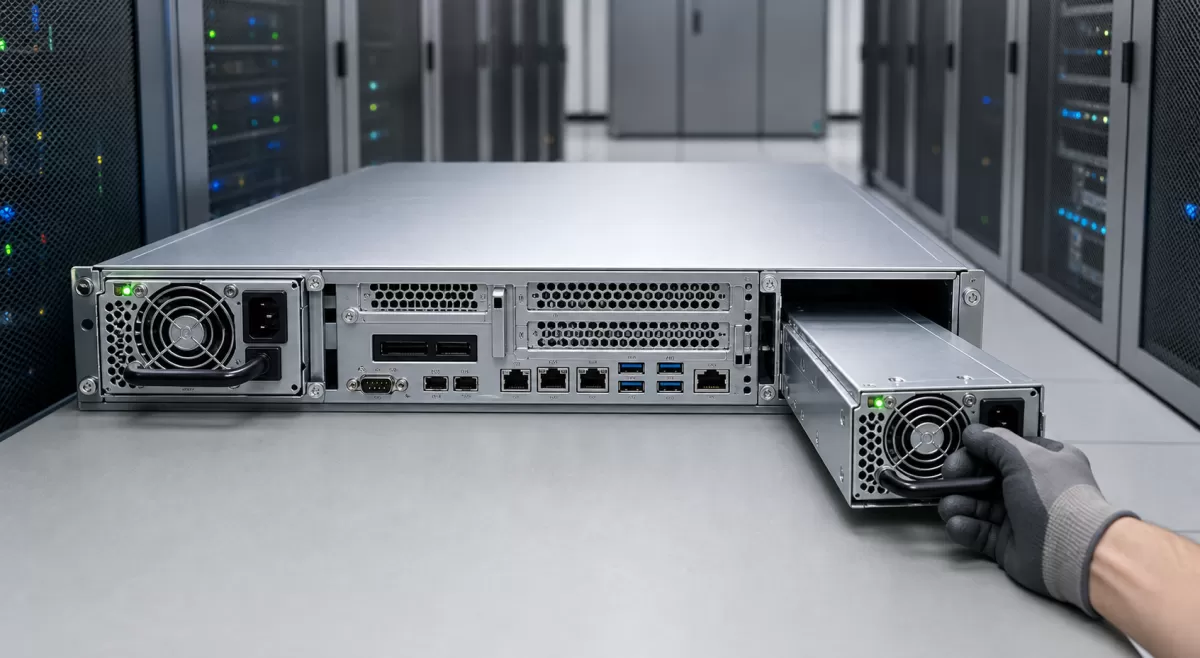
Dual power modules do not automatically create two failure domains
Redundancy is weakened when both module inputs share the same upstream breaker, PDU, receptacle group, or cable path. If continuity through an input-path fault is required, the two power cords need appropriately independent A and B sources within the facility’s approved electrical design. The server documentation must also permit the planned input configuration.
Inside the chassis, the PDB becomes another boundary. It combines isolated outputs, distributes current to the motherboard and drives, carries management signals, and may contain current-sense or protection functions. Because both modules commonly converge there, the PDB and downstream copper remain shared components. A dual hot-plug pair protects against specified module and feed events; it should not be described as eliminating every single point of failure.
Current sharing matters when both units are active. Large imbalance can leave one module closer to a limit even though total server power appears modest. Conversely, an intentional cold-redundancy or standby policy can make a low reading on one unit normal. The BMC needs the correct platform logic to distinguish those cases. The PMBus specification archive documents the standardized command framework used by many power components, but supported commands, scaling, addresses, and fault responses remain product- and platform-specific.
The modest rating makes cooling behavior easy to overlook
A lower-power server can still lose thermal margin after one PSU is removed. The extracted module may have provided part of the rear exhaust path; an open bay can recirculate air or reduce pressure unless the chassis and service procedure account for it. The surviving module also converts the entire PSU load and may increase its fan speed. These changes occur precisely when the system is expected to remain available.
The 550W class is therefore attractive where it matches a compact load, not because it is thermally trivial. Drive-heavy storage nodes can combine moderate steady consumption with spin-up or rebuild events. Edge servers may encounter restricted inlet temperature control. Industrial computing installations can expose filters and fans to contamination. Each host needs its own temperature, altitude, and airflow limits; no universal derating percentage should be invented.
Efficiency information should likewise be tied to evidence. The 80 PLUS program certifies submitted PSU configurations at defined load points and input conditions. A badge can help compare conversion efficiency, but it does not establish hot-plug compatibility, redundancy, acoustic behavior, or efficiency at every server operating point. In a lightly loaded 1+1 pair, the per-module load may also differ from the server’s total-load percentage.
Where a 550W redundant pair is a disciplined fit
This capacity class is most credible in a host that was designed and qualified for it: a general-purpose server with a restrained CPU configuration, a storage or network appliance, an edge node, or an industrial server without high-power accelerators. The relevant inventory includes processors, memory, fans, storage devices, PCIe cards, motherboard conversion losses, and any powered peripherals. Rated component maxima should not be added blindly, but workload averages should not be treated as worst-case demand either.
Workload timing changes the interpretation of that inventory. A storage rebuild, CPU boost interval, fan response, and peripheral startup may overlap even if each event is brief. The PSU and host documentation determines which excursions are permitted and for how long. Logging only minute-scale averages can hide the event that actually challenges the bus, while summing unrelated nameplate maxima can produce an unusably conservative result. Select evidence at a time resolution appropriate to the platform’s dynamic behavior.
GPU-rich and high-density compute configurations usually belong to a different design discussion because rapid load movement, connector-zone loading, and large failure-state demand can dominate. For those systems, Powernexu’s GPU server power-supply architecture article addresses the accelerator power path rather than stretching the 550W envelope beyond its natural territory.
A precise request for quotation should identify the server manufacturer and model, approved PSU part number or compatibility evidence, AC or DC input and facility range, required redundancy policy, power-cord and inlet needs, PDB and connector identity, management expectations, and environmental limits. That information prevents a common error: treating “550W dual hot-plug” as if it were a universal physical format.
The useful headroom is measured in the failed state
The decisive number is not two modules multiplied by 550W. It is the supported output of one module at the real input and environmental condition, minus the server’s credible worst-case demand during the interval in which that module stands alone. If that interval cannot cover workload steps, cooling changes, and the planned component set without violating host limits, the design needs a different platform configuration or a higher supported power class. When the interval is comfortably supported, a 550W pair offers a focused benefit: serviceable module and input-path continuity without installing a power class that the modest server cannot use effectively.