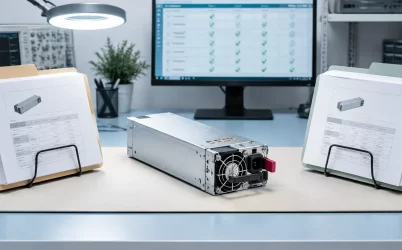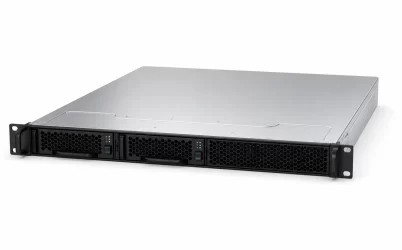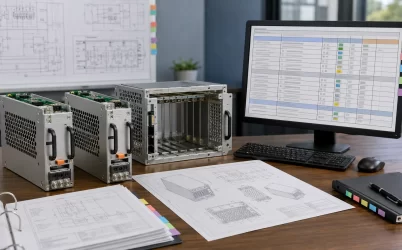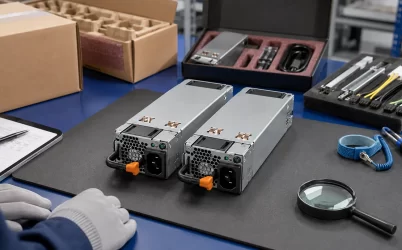
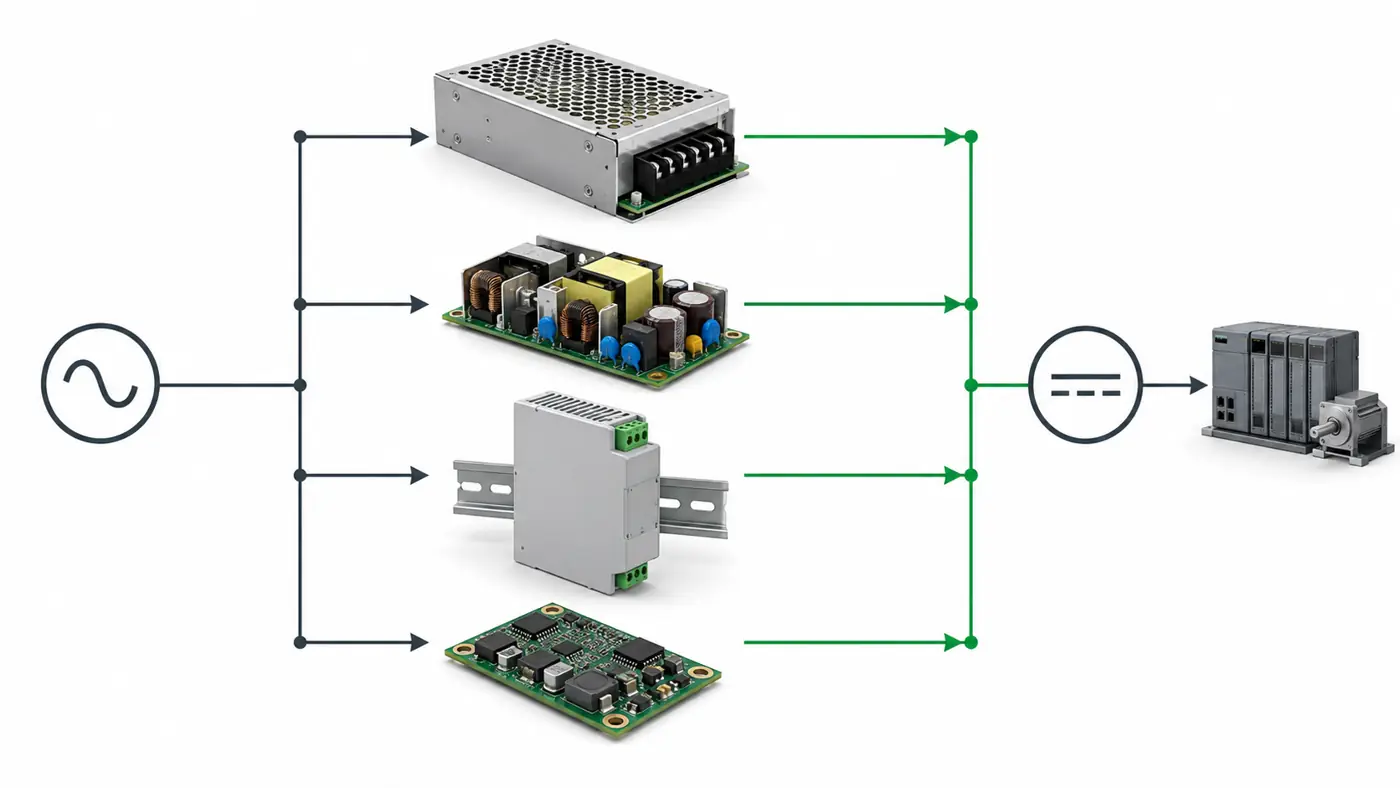
An industrial AC-DC power supply module is not one standardized product class. Supplier results may describe a self-contained converter, an exposed open-frame assembly, an encapsulated board-mounted unit, or one plug-in element of a configurable power system. Before comparing wattage, output voltage, availability, or price, identify the physical object being supplied and the functions left outside it. A useful shortlist begins with an explicit statement such as: one complete AC-DC converter with its enclosure and input/output terminations, or one output module requiring a separately purchased chassis and AC front end. If that sentence cannot be completed from the quotation and model documentation, the offers are not yet comparable.
This distinction prevents a common purchasing error: treating products with similar electrical headlines as substitutes even though they occupy different installation, cooling, safety, and commercial boundaries. The word module is a search aid, not sufficient evidence of what arrives, where AC conversion occurs, or what additional hardware the equipment integrator must provide.
The noun after AC-DC changes the purchase
Industrial power manufacturers use product-family terminology according to their own portfolios. Consequently, the same search phrase can lead to several legitimate architectures. A listing may emphasize the converter itself, its installation format, or the modularity of a larger system. None of those uses creates a universal definition.
| Commercial description | Possible supplied object | Questions still unresolved |
|---|---|---|
| AC-DC power module | A board-mounted, encapsulated, baseplate-cooled, or otherwise integrated converter | Whether it includes input protection, terminations, cooling hardware, mechanical protection, or an installation enclosure |
| Open-frame AC-DC module | An exposed converter PCB or assembly intended for installation inside host equipment | Mounting clearances, required airflow, wiring protection, accessibility, grounding, and final-equipment safety responsibilities |
| Enclosed industrial power module | A converter inside a metal or polymer enclosure, potentially with terminals, connectors, or a mounting feature | Whether the enclosure is touch-safe for the intended installation, how it is cooled, and which external protection or EMC components remain necessary |
| Configurable or modular PSU | A chassis, AC input unit, control element, or plug-in output module belonging to a larger power system | Which chassis and modules are included, where AC-DC conversion occurs, and whether the quoted element can operate independently |
The last category is particularly important because a module in a configurable system may not be a standalone AC-DC converter. It might receive an internal DC bus from a separate front end, provide one selectable output, or depend on a chassis for cooling, control, protection, and physical connections. Advanced Energy, for example, lists industrial configurable modular power supplies as a distinct product category. This establishes the architecture as a real commercial category, but exact functions and specifications still have to be taken from the documentation for the proposed system and modules.
Classify candidates on two independent axes
A clean comparison separates physical packaging from the module’s role in the conversion system. Combining those two questions into one label is what makes search results appear more interchangeable than they are.
Axis one: what package enters the machine?
Record whether the candidate is an encapsulated PCB-mounted component, an open-frame board, an enclosed chassis-mounted supply, a DIN-rail assembly, a plug-in module, or a complete modular chassis. The package determines how the item mounts, how technicians access it, whether live parts remain exposed, where conductors terminate, and how heat reaches the surrounding air or mounting surface.
Package names still require drawings. Two products described as enclosed modules can use different mounting planes, terminal orientations, service clearances, and airflow paths. Likewise, two open-frame boards can assign very different responsibilities to the host enclosure. Use the exact mechanical drawing and installation instructions rather than inferring fit from a category photograph.
Axis two: what conversion function does it perform?
Trace the energy path through the candidate. A complete AC-DC converter accepts the specified AC source and provides the required regulated DC output. A front-end module may convert AC to an intermediate bus that feeds other stages. An output module in a configurable system may regulate that internal bus into the load voltage but have no direct AC input. A controller, backplane, or chassis accessory may be essential to operation without performing the conversion implied by the search term.
For each result, identify the upstream source presented to the item, the downstream output it controls, and every mandatory assembly between those points. This exposes offers that share a voltage and power class but cannot serve the same function. A standalone enclosed converter and a plug-in output module may both advertise the required DC output; only the former can be evaluated as an independent AC-DC supply unless the latter’s compatible chassis and front end are included.
Compare operating conditions only after categories are normalized
Compare ratings only after candidates represent the same supplied object and conversion role. Keep each exact model’s output attached to its documented input, load, temperature, airflow, orientation, altitude, and derating conditions.
- Source and output: Record input range and frequency, load-terminal voltage, continuous and short-duration current, ripple, and required control interfaces.
- Machine states: Check startup, normal load, peak demand, shutdown, restart, and reverse-energy conditions. Larger nominal wattage does not prove startup compatibility.
- Protection and cooling: Verify thresholds, response and recovery behavior, and the thermal assumptions behind the rating.
For multiple outputs, preserve individual and combined limits. Candidates documented under materially different conditions should remain separate alternatives rather than being normalized by headline wattage.
Integration responsibilities belong in the comparison
Different module architectures transfer different engineering tasks to the equipment builder. Those tasks carry cost, enclosure space, compliance implications, and schedule risk even when they do not appear on the PSU quotation.
| Boundary | Evidence to obtain for the exact candidate | Potential integrator responsibility |
|---|---|---|
| AC connection | Terminal or connector definition, grounding method, input protection requirements, and installation instructions | Fusing, disconnects, conductor protection, strain relief, touch protection, and source wiring |
| DC connection | Output terminals, mating components, current limits, sense or control interfaces, and cable requirements | Harness design, voltage-drop control, branch protection, return routing, and connector cooling |
| Mechanical installation | Dimensions, mounting points, keep-out zones, mass, orientation, and service access | Brackets, standoffs, structural support, extraction clearance, and protection against conductive debris |
| Cooling | Documented airflow, fan, baseplate, heatsink, or convection conditions | System fans, ducts, thermal interfaces, inlet management, and derating within the host enclosure |
| Safety and EMC | Exact approvals, conditions of acceptability, emissions or immunity evidence, and referenced configuration | Final-equipment evaluation, bonding, spacing, filters, shielding, wiring layout, and installation controls |
| Configurable system | Compatible chassis, front end, output modules, controller, blanking parts, and supported population rules | System configuration, module population, spare strategy, and control or alarm integration |
An open-frame assembly commonly leaves more of the physical protection and cooling solution to the host equipment than an enclosed supply. That does not make it inferior; it can reduce volume and support a tightly integrated machine design. It does mean its catalog price cannot be compared fairly with an enclosed product until the additional mounting, guarding, airflow, wiring, and final-equipment work are visible.
Conversely, a configurable modular system may include capabilities that would otherwise require separate engineering, such as a shared chassis, coordinated cooling, multiple outputs, or serviceable plug-in elements. Those capabilities are useful only when the quotation identifies the complete required configuration. Pricing one output module while omitting its chassis, front end, controller, or mandatory accessories understates the purchase boundary.
Build a category-normalized commercial shortlist
A comparison sheet should preserve differences rather than award points for the largest feature count. Give every candidate one row and require each field to reference the exact manufacturer model, variant, and applicable document revision.
| Normalization field | Entry required | Why it matters |
|---|---|---|
| Orderable identity | Manufacturer, exact model, suffix, revision where controlled, and distributor ordering code if applicable | Prevents specifications from one variant being assigned to another |
| Supplied object | Converter, board, enclosed unit, plug-in module, chassis, kit, or complete configured system | Makes quotation scope and integration ownership explicit |
| Conversion path | Input presented to the supplied object and regulated output delivered by it | Separates standalone AC-DC products from internal modules and accessories |
| Included hardware | Mating connectors, terminals, fans, chassis, controller, modules, covers, and mounting parts actually included | Exposes incomplete or differently bundled offers |
| Documented envelope | Input, output, load state, temperature, airflow, orientation, altitude, and derating conditions relevant to the application | Keeps ratings attached to their operating coordinates |
| Interface evidence | Drawings, connector definitions, control descriptions, and installation instructions | Shows whether integration can proceed without guessing |
| Approval scope | Exact marks or reports claimed for the quoted model and the conditions under which they apply | Prevents category-level compliance language from being treated as final-equipment approval |
| Commercial state | Lifecycle status, availability basis, lead time, minimum order constraints, warranty terms, and substitution policy | Distinguishes an orderable production option from a technically interesting listing |
Use explicit statuses for missing information. A field can be documented, not applicable, awaiting supplier clarification, or unresolved and disqualifying. A blank should not be interpreted as compliance. This method also prevents a distributor summary from outranking the manufacturer’s model documentation when the two differ in detail.
Category normalization does not force unlike architectures into artificial equivalence. It reveals where the cost boundary moves. An open-frame converter may shift expense into the machine enclosure and thermal design. An enclosed unit may consume more panel space but simplify guarding and installation. A configurable system may carry a higher initial assembly scope while supporting multiple rails or replaceable modules. The preferred architecture follows the equipment requirement and ownership model, not the shortest product title.
Availability can change the architecture choice
Commercial investigation should extend beyond whether a distributor shows stock on the day of the search. Establish whether the exact variant is a standard production item, configured to order, subject to a module-population rule, or sold only with additional hardware. Ask whether accessories and mating components share the same availability horizon as the converter.
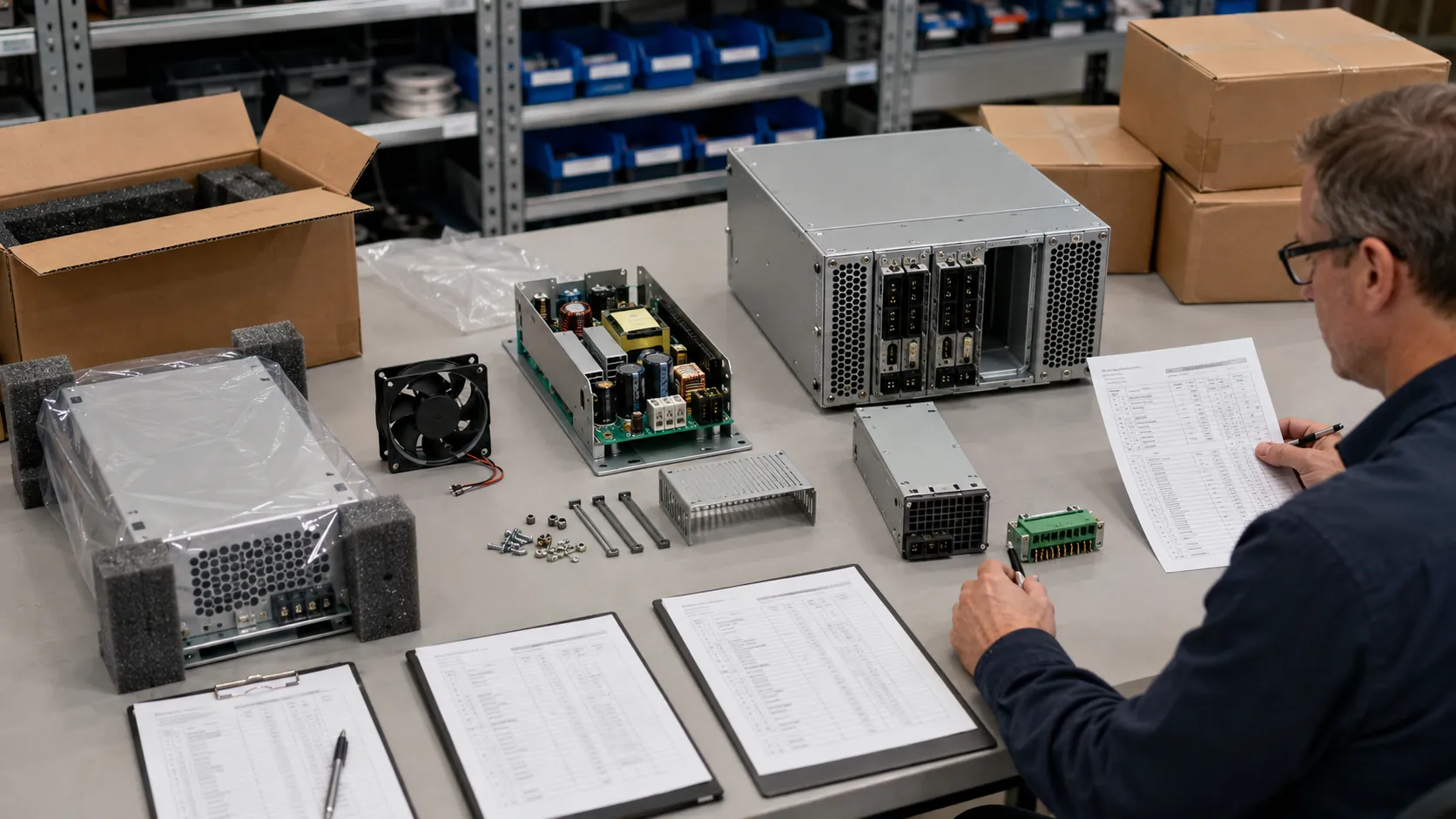
Replacement planning also differs by architecture. A self-contained module may be stocked as one spare identity. An open-frame supply may require the controlled board revision plus mounting and wiring records. A configurable system can require separate spare identities for the chassis, front end, fan or controller assemblies, and output modules. If the supplier may substitute a nominally equivalent model, the acceptable electrical, mechanical, thermal, approval, and interface boundaries should be written into the order rather than inferred after delivery.
Price should therefore be compared at a consistent deployment boundary. Include mandatory chassis hardware, cooling provisions, mating connectors, configuration work, compliance-related integration, and the minimum spare package required by the service plan. This is not a generic total-cost exercise; it is the correction needed when the word module causes one quotation to include a complete converter and another to include only one element of a larger system.
Send each architecture to the right next document
After the mixed search results have been separated, each surviving category needs a different depth of review. A self-contained industrial converter should proceed into the broader industrial power-supply evidence framework, where the machine environment, operating states, compliance boundary, and supplier evidence can be evaluated for the exact model.
If the candidate is a configurable shelf or module intended to operate as rack equipment, use the industrial rackmount power-supply architecture process to define the chassis, source, distribution, cooling, service, and supplied assembly. Adjustable outputs and multiple-output open-frame products require their own model-specific analysis because trim range, rail interaction, and combined limits cannot be resolved by the general module label.
The category-screening stage is complete when each candidate has a stable noun, a named conversion role, an explicit bill of supplied hardware, documented rating conditions, assigned integration responsibilities, and a credible availability state. At that point, specifications and prices refer to comparable objects—or the worksheet clearly shows why two architectures should remain separate alternatives. That is the useful outcome of an industrial AC-DC power supply module search: not a longer catalog list, but a shortlist in which every model has a defined physical and commercial boundary.