A search for a 1U server power supply with Platinum efficiency does not return one interchangeable product category. The results can include fixed multi-output supplies, removable redundant modules, CRPS front ends, and complete redundant assemblies. Determine which architecture the server requires before comparing wattage, price, or efficiency claims. Then retain only exact models in that architecture and verify their Platinum evidence, host support, mechanical fit, interfaces, input conditions, cooling direction, and supplied hardware. This order prevents an efficient but structurally incompatible PSU from reaching the purchasing shortlist.
Quick answer: choose the power architecture before the efficiency class
Begin with the server’s existing or intended power path. A fixed supply connects differently from a removable module that mates with a power distribution board (PDB), while a CRPS front end still requires a compatible cage, interface, distribution path, and host design. If the project lacks those supporting parts, it may need a complete assembly rather than a module. Apply the Platinum requirement only after this architecture screen. Platinum describes bounded efficiency evidence; it does not establish that a PSU fits the server, mates with its PDB, supports the required outputs, or provides redundant capacity.
Why the search results divide into different architecture lanes
The reviewed manufacturer results illustrate why a direct product ranking would be misleading. Supermicro identifies the PWS-350-1H as a 350W 1U multi-output power supply and the PWS-407P-1R as a 400W 1U redundant power supply. Meanwhile, Advanced Energy presents the CSU800AP series within its CRPS front-end portfolio. These descriptions identify different starting architectures; they do not establish that the products are interchangeable or that every result satisfies a Platinum requirement.
The wattage figures also cannot normalize the results. A lower-rated fixed supply may provide several host-specific output rails through a cable harness. A removable front-end module may instead deliver a principal bus through a blind-mate interface, leaving downstream conversion and distribution to the server. A redundant product description may refer to one removable module, a pair, or a wider assembly. Until those boundaries are known, the numbers do not describe equivalent jobs.
| Reviewed result | Provisional architecture lane | What the result does not establish by itself |
|---|---|---|
| Supermicro PWS-350-1H | Fixed or host-integrated multi-output supply | Platinum status, suitability for another 1U host, connector equivalence, or redundant operation |
| Supermicro PWS-407P-1R | Redundant-power product requiring exact scope review | Whether an offer includes one module or all supporting hardware, surviving capacity, or compatibility with an unidentified PDB |
| Advanced Energy CSU800AP series | CRPS/front-end candidate family | Exact orderable model, host support, complete assembly contents, or the efficiency classification applicable to a quoted unit |
This is a routing table, not a performance ranking. Each result should continue only in the lane that matches the server architecture. A category mismatch is sufficient reason to remove a candidate even when its price, wattage, or advertised efficiency appears attractive.
Follow the server power path to one of four purchase routes
The most useful starting evidence is the installed server or the proposed chassis design. Trace the path from the PSU inlet to the motherboard, processors, accelerators, drives, fans, and management circuits. The location of conversion, combining, standby power, and output distribution reveals which commercial object is needed.
Route 1: a fixed multi-output PSU
Use the fixed-supply route when the PSU is mounted inside the server and its output harness directly serves several host loads or motherboard connectors. The server may expect multiple regulated outputs, dedicated standby power, control conductors, and a particular cable map. In this architecture, the PSU and harness are often closely tied to the chassis and motherboard design.
A similarly sized front-end module is not an automatic substitute. Even if it provides enough total power, it may expose one principal DC bus rather than the downstream rails and cable terminations required by the host. Replacing the fixed supply with a different architecture would transfer conversion, distribution, protection, and mechanical responsibilities to new hardware. That is a server redesign, not a normal PSU substitution.
Route 2: one removable module for an existing redundant platform
Choose the module route when the target server already contains a supported cage, PDB, mating interface, and management policy. The required purchase may then be an exact replacement module or a documented supersession rather than a complete power subsystem.
One module is useful only inside the assembly that supports it. Its card edge or blind-mate connector must align mechanically and electrically with the installed PDB. The host must recognize the model and any permitted mixed-module configuration. Airflow direction, latch geometry, insertion depth, firmware policy, and current-sharing behavior can matter even when two modules have similar external dimensions.
If redundancy is required, define the workload that must remain powered after the permitted module or source loss. Two module labels must not be added together and treated as protected output unless the platform documentation expressly defines that operating mode. In a typical 1+1 use case, the relevant limit is associated with the supported surviving path, including applicable input and thermal conditions.
Route 3: a CRPS or front-end module for new integration
The CRPS route is appropriate when the system is being designed around a compatible front-end module ecosystem rather than replacing a fixed multi-output PSU. This architecture can support high-density, removable server power, but the module is only one part of the power path. The integrator still needs a mechanically and electrically matching receptacle or PDB, suitable current paths, downstream distribution, control and management handling, cooling, and fault isolation.
CRPS terminology narrows the product family without proving universal interchangeability. Exact revisions can differ in mechanical envelope, contact implementation, output capability, control features, airflow, and documented operating conditions. A series page can identify candidates, but the exact model record and applicable interface documentation must govern the design.
Route 4: a complete redundant power assembly
Use the complete-assembly route when the project does not already own a compatible cage, PDB, output harness, and module population. The quotation should then identify the included modules, mechanical housing, distribution hardware, output connections, management provisions, mounting parts, and any components explicitly excluded.
This route is often clearer for a new server integration because it prevents hidden responsibilities from being split between unrelated suppliers. It may also be appropriate when an existing proprietary assembly is unavailable and the host is being deliberately redesigned. The assembly still requires server-level review, but the commercial line item corresponds more closely to the subsystem being installed.
“1U” must be attached to the correct mechanical boundary
A 1U server and a “1U power supply” are not equivalent specifications. Rack height does not define PSU width, depth, mounting points, connector datum, handle, latch, cable exits, airflow direction, or extraction clearance.
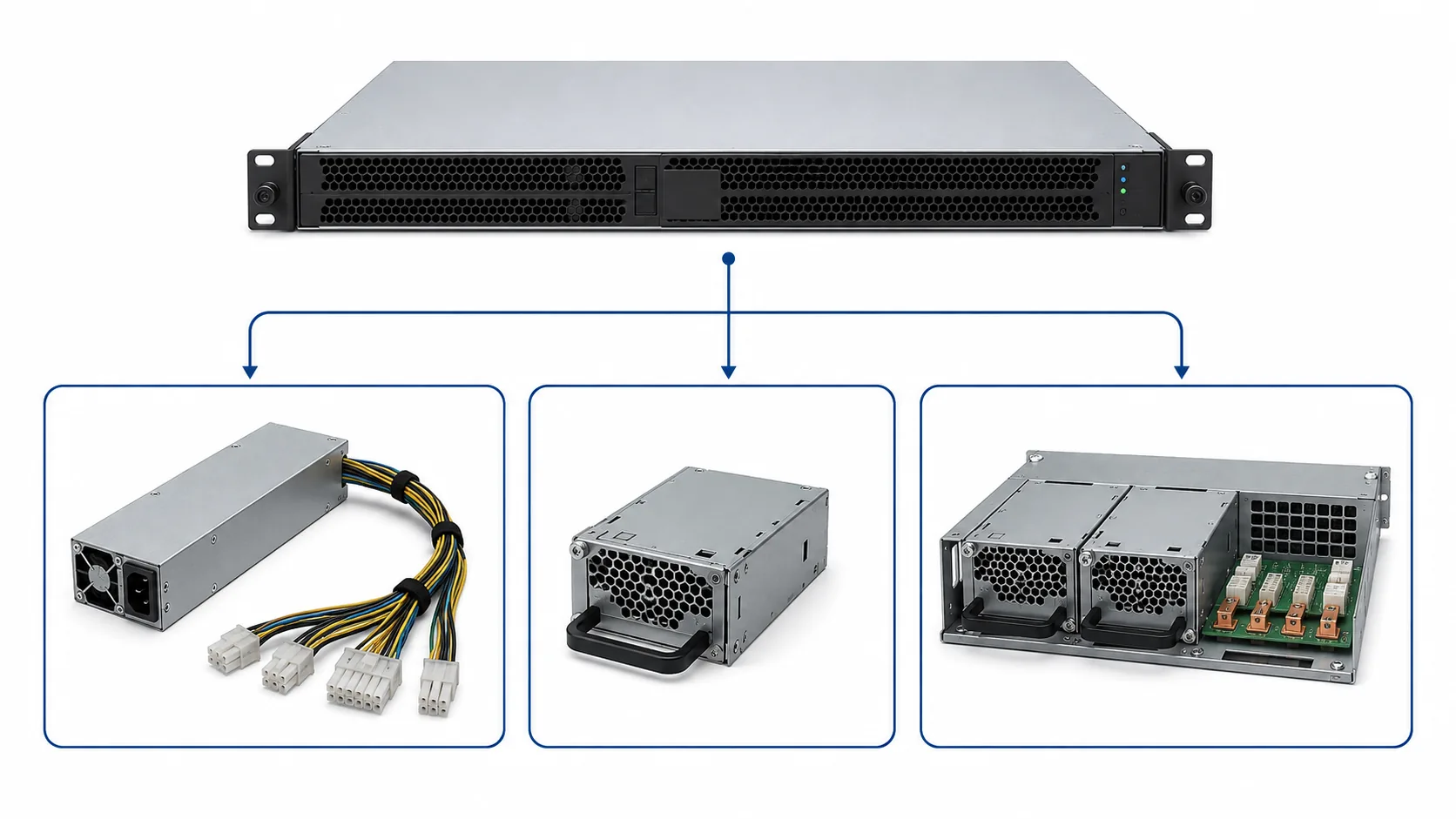
Review the boundary that matches the selected lane: the body, mounts, harness exits, and ventilation for a fixed supply; the bay, rails, latch, insertion stop, PDB datum, and removal path for a removable module; or the complete cage-to-PDB relationship for CRPS integration. A module that inserts can still fail because its airflow opposes the host or the installed rack blocks service removal.
After architecture screening, compare the exact candidate and host with a model-specific mechanical fit drawing covering both installed and service envelopes. Chassis height or three enclosure dimensions alone cannot prove fit.
Apply the Platinum gate only to surviving exact models
Platinum should be treated as an exact-model efficiency requirement, not as a synonym for premium, redundant, or server-compatible. Marketplace wording, a family-level description, or a search snippet does not establish that the quoted manufacturer model and revision carry the required classification. The supplied search results also show that some titles do not explicitly make a Platinum claim.
After architecture screening, record the exact manufacturer, model, revision where relevant, and the efficiency scheme intended by the requirement. If Platinum means an 80 PLUS classification, obtain the applicable record for that exact product identity and retain its documented test scope and conditions. A candidate with unstated status should remain unresolved rather than being promoted from visual similarity, related-family evidence, or seller wording.
That evidence answers only the efficiency question. It does not prove host support, output topology, redundant capacity, input suitability, or thermal integration. Readers preparing a formal efficiency-specific quotation can use the separate Platinum PSU claim-verification framework after the architecture route has produced exact-model candidates.
This sequence also avoids wasting effort. There is little value in auditing the efficiency record of a fixed multi-output PSU when the server requires a removable CRPS module, or verifying a module when the purchasing requirement is actually for a complete two-module assembly. Architecture eliminates false candidates before detailed evidence collection begins.
Build the shortlist around unresolved system boundaries
An architecture-matched shortlist should show both confirmed facts and open conditions. Blank fields are dangerous because purchasing may interpret them as unimportant or implicitly satisfied. Mark each field as documented, not applicable to this architecture, or unresolved.
- Exact identity: manufacturer, orderable model, revision policy, and any documented supersession.
- Architecture lane: fixed multi-output supply, removable redundant module, CRPS/front end, or complete assembly.
- Supply scope: module quantity, cage, PDB, harnesses, mounting hardware, and accessories included in the offer.
- Host relationship: target server or chassis, supported bay or assembly, and the authority establishing that relationship.
- Power interface: input type, main and standby output roles, mating assembly, downstream distribution owner, and control boundary.
- Operating conditions: applicable source, output rating conditions, airflow direction, inlet-temperature constraints, and any documented derating.
- Redundancy statement: required module population, supported mode, failure being covered, and capacity available through the surviving path.
- Platinum evidence: exact-model record, applicable scheme, documented conditions, and any identity discrepancy still awaiting resolution.
The interface field should name both sides of every connection. “Standard server connector” is not adequate because it can refer to the AC inlet, a blind-mate module-to-PDB interface, or downstream motherboard and accelerator connectors. The server PSU interface-mapping method can be used when those boundaries remain ambiguous.
Supply scope deserves equal attention. A seller may quote one removable PSU when the project needs two modules and a distribution assembly. Conversely, a maintenance team may need only an approved spare and should not compare its price with a complete subsystem. Architecture routing keeps these commercially different offers from competing in the same column.
Use architecture mismatches as elimination evidence
A shortlist becomes stronger when it records why a result was removed. “Not selected” is less useful than “fixed multi-output architecture; target host requires a removable module mating with the installed PDB.” The latter disposition can be reviewed, repeated, and defended without claiming the rejected PSU is poor quality.
Other defensible outcomes include “CRPS family candidate, but exact module and host interface remain unidentified,” “module-only offer cannot satisfy the requested complete-assembly scope,” or “architecture matches, but Platinum evidence is absent for the quoted identity.” These statements separate category errors from missing documents and genuine technical conflicts.
This treatment is especially important when the candidates have different wattages. A higher wattage cannot rescue an architecture mismatch, and a lower wattage should not be rejected until the actual host load, degraded operating state, and rating conditions are understood. Capacity comparison becomes meaningful only among candidates that perform the same conversion and distribution role.
An orderable result fits in one architecture sentence
The final requirement should be expressible without relying on the broad search phrase: “Supply one exact supported fixed multi-output PSU for the named 1U server,” “supply one approved replacement module for the installed redundant assembly,” or “supply a complete two-module power assembly with its specified cage, PDB, and output hardware.” The sentence should then attach the exact model, applicable Platinum evidence, host relationship, input and cooling conditions, required surviving capacity, and included hardware.
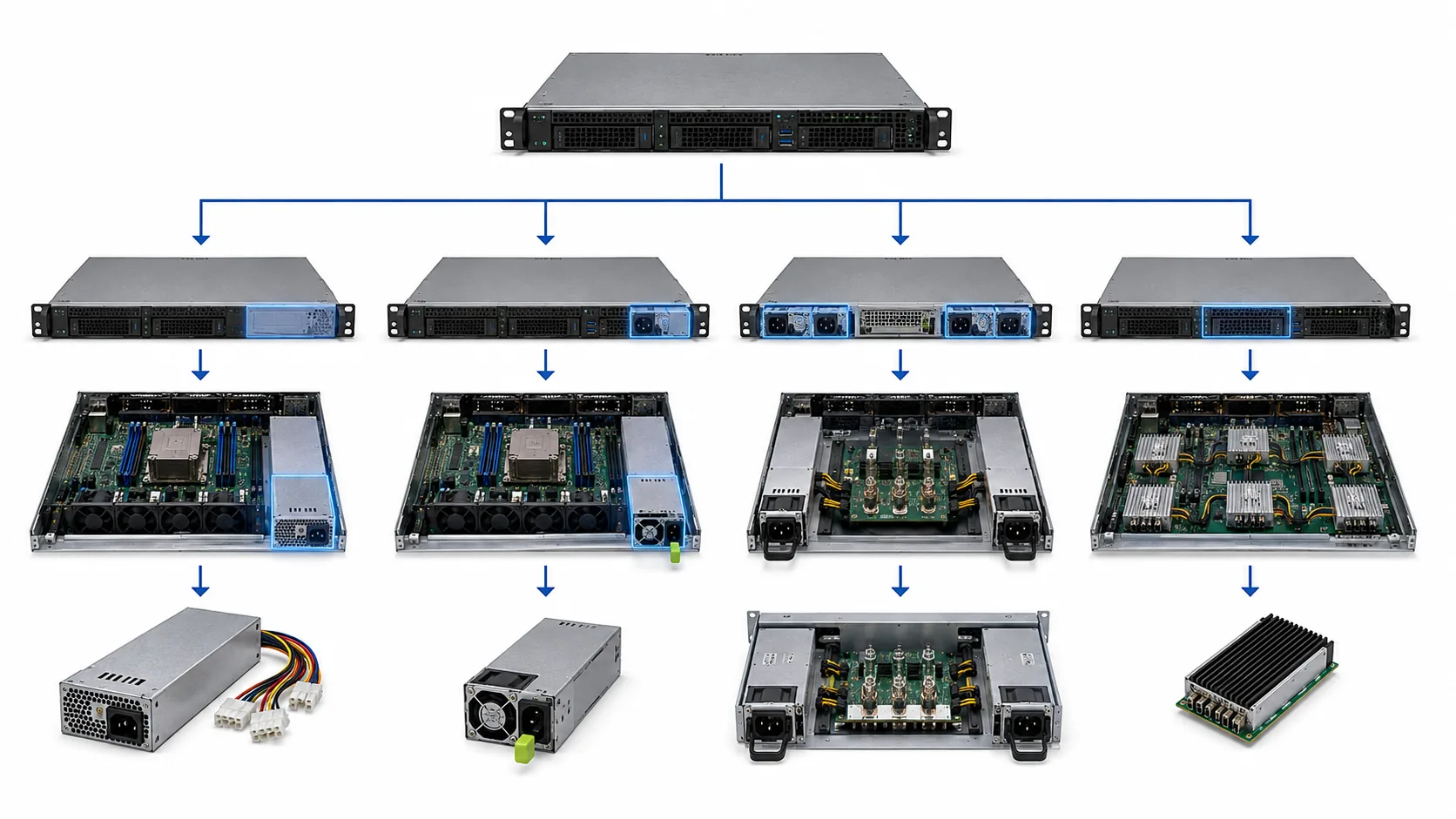
If that sentence cannot yet be written, the search has not produced comparable products. Keep the candidates in separate architecture lanes until the server’s power path establishes which object belongs in the order. A 1U Platinum server power supply becomes a useful purchasing description only after “1U,” “Platinum,” and “power supply” all refer to the same exact hardware, host boundary, and scope of supply.