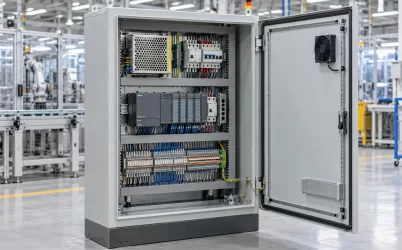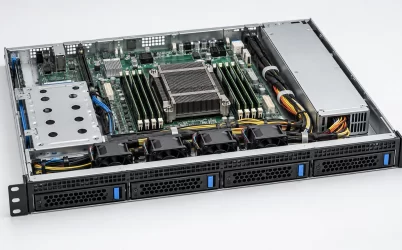
A listing for a “1U 700W hot swap redundant power supply” is not enough to identify a replacement part. In some servers, 700W names the output available from either of two removable modules; another listing may describe the complete redundant assembly, including its cage or distribution hardware. A related 700W/750W description can even reflect different input-voltage conditions for the same platform. Before ordering, identify the server or chassis, the installed module part and revision, the mating bay, and the output rating at the rack’s actual AC voltage. Hot swap describes removal while the host remains powered under specified conditions; it does not promise that an arbitrary 1U module will fit or that both ratings apply on every feed.
The label may describe a module or the redundant assembly
“Redundant” describes a system relationship, not a shape visible on one removable supply. A typical 1+1 arrangement has two independently removable converter modules feeding a common power path through a compatible cage, backplane, or power distribution board. When both operate, they may share load. If either is removed or fails, the remaining module has to support the host’s continuing demand within its own operating limits. Two 700W modules therefore do not automatically give a 1,400W redundant load rating. That sum would describe possible installed converter capacity under some conditions, not the load that survives the loss of one module.
Manufacturer naming shows why the distinction matters. One Supermicro 1U system specification describes a 700W/750W redundant supply and lists two removable PSU modules. Its published low-line and high-line output figures differ. Those are facts about that specific system, not a dimension, wiring convention, or power rating shared by every product advertised with this keyword. A seller may list the removable module alone, a chassis containing two modules, or an assembly that includes the mating hardware. The listing title can be identical while the delivered scope is not.
Start with the installed hardware rather than the headline. Photograph the existing module label and the server identification plate; record the exact spare-part designation, revision, and any manufacturer-approved alternate. Check whether a purchase includes one module, a matched pair, a cage, the distribution board, mounting parts, or only a bare converter. A physically similar module from the same manufacturer is still not a validated replacement unless the host documentation or supplier confirms that specific pairing.
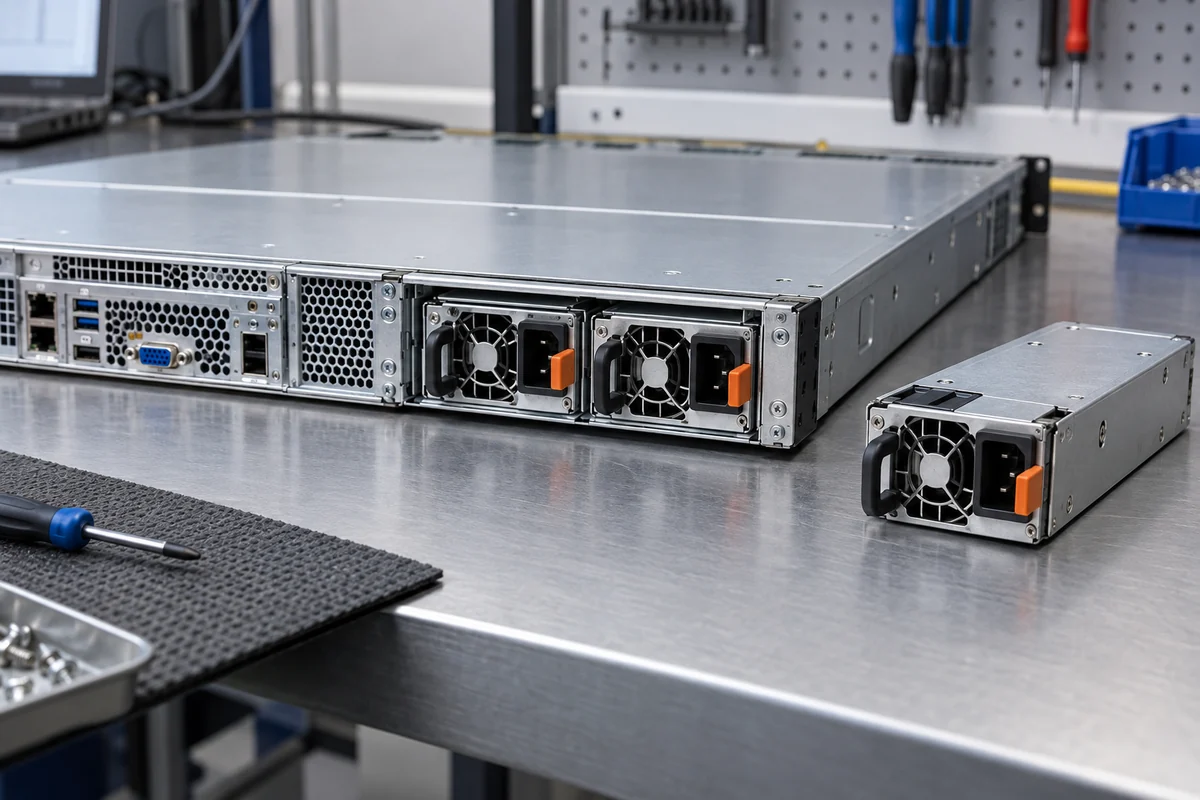
Why a 700W unit may also be advertised as 750W
A dual wattage listing often signals an input-dependent output rating. The particular Supermicro system cited above publishes a lower output for its lower AC input range and a higher output for its higher range. It is easy to mistake the larger number for a universal continuous rating when the rack is actually supplied from a lower-voltage circuit. Conversely, a different product might carry one continuous rating across its entire specified input range. Neither behavior can be inferred from the phrase “700W/750W.” The manufacturer’s table for the exact module and revision must settle it.
Read the conditions attached to each output figure: AC input range, frequency where specified, output rail, cooling arrangement, operating temperature, and any current limit or derating note. A wattage value without its conditions cannot answer whether a replacement will carry the host after one module is withdrawn. The module’s AC connector and broad input range are not substitutes for an output-versus-input rating. A unit can accept a voltage while delivering less power at it.
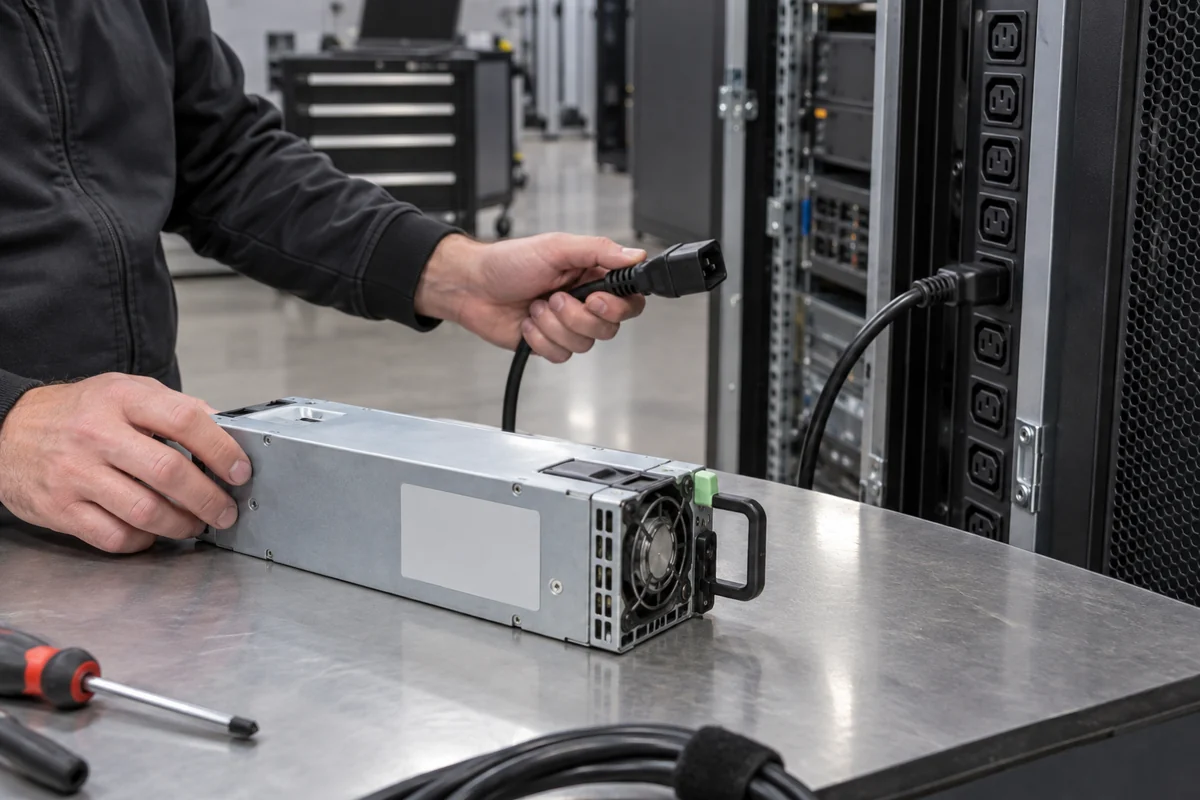
Consider a clearly hypothetical server drawing 620W of DC power at a heavy but valid workload. If its exact module is documented to deliver 700W at the rack’s AC voltage, one healthy module appears to have 80W of nameplate headroom before any temperature or transient constraints are considered. If a different candidate is documented for only 600W at that same voltage, the same workload exceeds its stated output after a failure, even though the product might advertise a higher figure at another input voltage. This arithmetic is a screening step, not a claim about either real product. The server’s actual measured or specified load, the module documentation, and the host’s supported configuration determine whether the margin is usable.
On a dual-feed rack, perform the comparison against each feed’s actual voltage and allowable input path, not an assumed facility nominal. The two PSU positions may be powered from different PDUs or phases. A surviving module on one feed still needs sufficient DC output under that feed’s conditions. Also distinguish DC output from AC input: the module draws more AC power than it delivers as DC because conversion has losses. An outlet, cord, PDU branch, or UPS sized from the DC wattage alone can therefore become the limiting element. There is no need to invent a generic current figure; use the exact input-current specification and the rack’s circuit design.
The bay and backplane decide whether the module is a replacement
Height alone is a poor mechanical test. “1U” describes the rack-height envelope of the host, not a universal PSU cartridge. Replacement modules vary in width, depth, insertion keying, latch geometry, handle position, airflow direction, and mating connector. A cartridge may slide most of the way into a bay yet fail to seat electrically, obstruct the adjacent unit, or leave a cooling gap. Do not try to solve that mismatch by force or by modifying the latch.
The electrical interface is equally specific. A server PSU generally mates to a host-defined connector or distribution assembly that routes high-current output, control, fault indication, and sometimes management signals. An apparently matching output voltage does not establish compatible pin allocation, startup behavior, current sharing, or alert reporting. Even when two cartridges share a shell, the host may support only certain module revisions or firmware combinations. Cross-references from an authorized parts list are more useful than resemblance in a marketplace photograph.
A good replacement record therefore connects three identities: the server or chassis model, its PSU bay or backplane assembly, and the exact converter module. If the original part is unavailable, request a documented successor or approved alternate tied to that host, not merely a “700W 1U” substitute. A seller should clarify whether the alternate can coexist temporarily with the installed unit during service and whether a matched pair is required for the intended redundancy mode. The answer may differ across server generations even when the individual module ratings look alike.
The condition of the mating bay deserves attention when a replacement fails immediately. Bent contacts, a damaged latch, contamination, or a backplane fault can make a known-compatible module appear defective. Compare the behavior of the two positions using the host’s approved diagnostic procedure; do not assume that a second failed insertion proves a second bad spare. If a module works in one position but the other position repeatedly reports absent or faulty hardware, the bay-side path becomes a stronger suspect. Live troubleshooting of high-energy connections should remain within the manufacturer’s service procedure and the site’s electrical safety practices.
For a new integration project rather than a spare purchase, the question changes. The engineer can select a compatible pair of modules together with a cage and PDB, then design the host around their published interface. That broader architecture is covered separately in Powernexu’s discussion of 1U dual redundant server power integration. A field replacement has less freedom: the host interface is already fixed, so the original system documentation controls the part choice.
Hot swap is a supported operating state, not a handling shortcut
Hot swap means a qualified module can be removed and installed while the server stays on, provided the system supports that action and the surviving path can carry the load. It does not mean removing both units, ignoring warning indicators, or assuming every bay is safe under every workload. Before touching a live chassis, identify which module has failed, confirm that the other is present and healthy, and check the host’s service procedure. The failed cartridge, power cord, latch, and fan direction should be identified unambiguously so the healthy path is not interrupted by mistake.
When one converter is removed, the remaining module supplies the load that the pair previously shared. The common output path and host capacitors support the transition, while the control scheme prevents a missing or failed source from dragging down the bus. Exactly how this occurs is host-specific; the words “hot swap” on a seller’s listing do not describe the timing or fault behavior of an unknown backplane. If a server already reports a power fault or operates near the single-module limit, planned maintenance may be safer than an improvised live exchange.
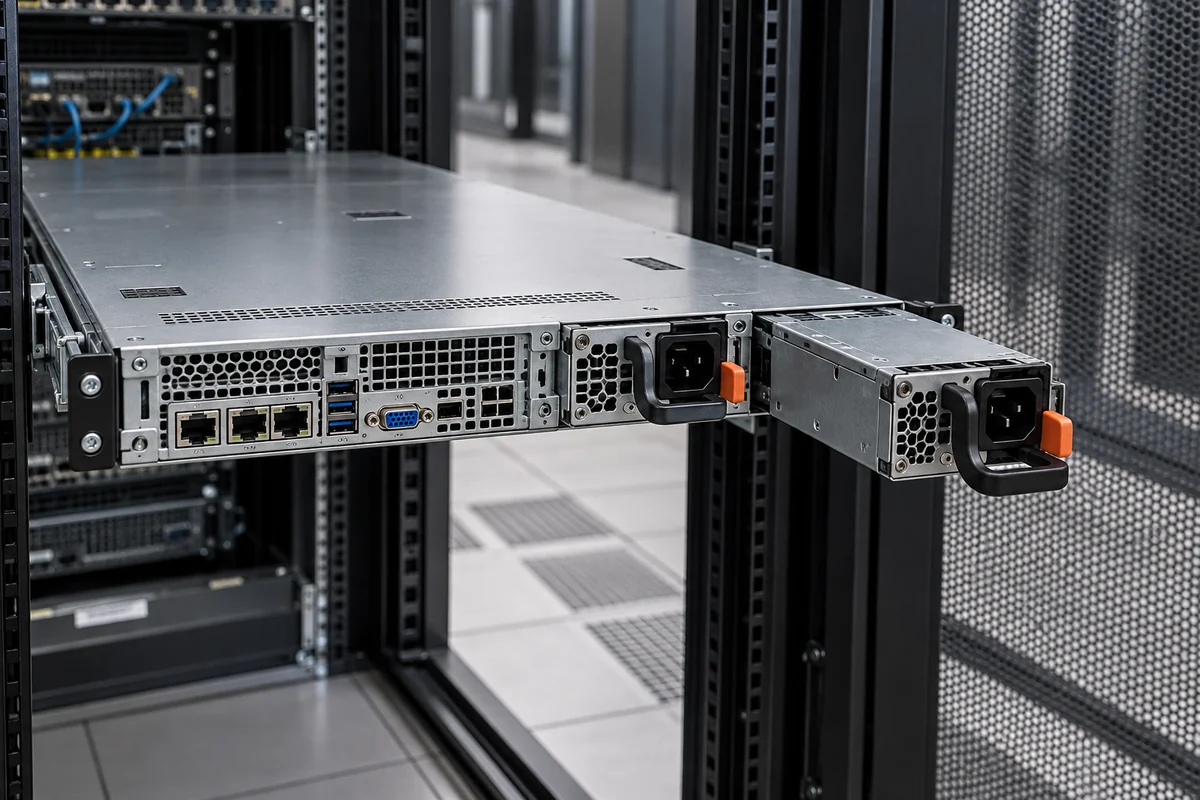
Airflow can also change during service. In a compact 1U enclosure, a PSU bay is part of the physical air path. A missing module, an incompatible fan direction, or a bay left open can alter cooling around the remaining supply and nearby components. Use the host’s blanking and service instructions rather than treating the empty opening as harmless. This matters especially when the surviving converter is carrying more current than it did before removal and may produce more heat.
After insertion, confirm that the latch is fully engaged and the management interface reports the new module in the expected position. Observe status through the host’s supported indicators or management software; a fan spinning or an LED lighting is not by itself proof that the module is sharing load or that redundancy has returned. If the host reports a mismatch, check the approved-part record and module revision before repeating the swap. Repeated insertion will not correct an incompatible cartridge or backplane.
A successful swap also has a distinct before-and-after state. Before service, the server may be operating without redundancy because one module is failed or absent. After service, both modules should be recognized and the host’s power-health indication should return to its supported redundant state. Preserve the event log around the exchange when troubleshooting; it can distinguish an existing bay fault from a problem that began at insertion. Do not interpret an unchanged “power on” state as the whole outcome: the point of the spare is to restore fault tolerance, not merely keep the server running for the next few minutes.
What an actual spare order needs to specify
For a replacement inquiry, the decisive information is concrete: server or chassis identification, installed PSU part and revision, bay or backplane part where available, site input voltage, required quantity, and whether the order is for one cartridge or a full redundant set. State whether the server must remain online during replacement. If the installed pair is mixed already, include both module labels and the host’s current power-health report. This is not a generic purchasing form; it resolves the ambiguities hidden by the short search phrase.
Ask the supplier to return the exact shipped part number and its documented compatibility with the named host. Confirm the rated output at the site’s input voltage, the included hardware, and whether the replacement may be mixed with the unit that remains in service. For surplus equipment, condition and revision can matter as much as a nominal wattage match. The photos should show the complete module, connector end, latch, label, and fan opening, not only a cropped faceplate. The buyer can then compare the offered unit with the official host parts list and the actual hardware before scheduling a maintenance window.
A new build may justify a different conversation about output architecture, management, and PDB design. But when the search is for a 1U 700W hot-swap redundant power supply to keep an existing server running, the safest answer is narrower: identify the exact removable unit that the host supports, confirm its capacity under the rack’s input conditions, and order the scope that the service task actually needs. That closes the gap between a plausible marketplace description and a replacement that will seat, power the host, and restore its intended redundancy.