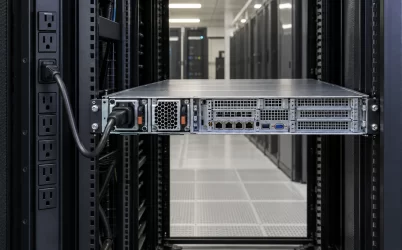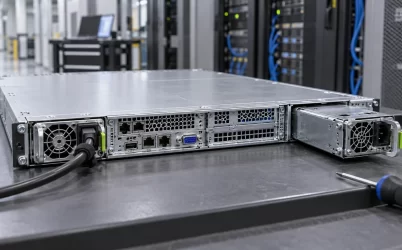
Do not assume a 1600W server PSU will supply 1600W from a nominal 110V outlet. The exact module may reject low-line AC entirely, operate there at a reduced DC output, or support a stated high output under specific conditions. Even where full output is documented, the AC current can be too high for the available cord, PDU outlet, or branch circuit. A usable answer therefore needs two separate facts: the module’s output rating at the site’s actual input range and the rack path’s permitted input current. For a redundant host, each surviving feed must also carry the required failure-state load.
“110V” is often conversational shorthand for a low-line AC environment rather than a guarantee that the PSU receives exactly 110.0V. The facility, PDU, cord, and rack loading determine the voltage at its inlet. Many server specifications group low-line operation as a range such as 100–127V, but the boundaries and output limits belong to the specific model. The purchase question is not simply whether its inlet plug fits. It is whether the server can boot, run the required workload, and meet its redundancy promise on that source.
Three materially different meanings of a 1600W label
A high-line-only module may carry a 1600W nameplate yet specify AC input only around 200–240V. On a 110V rack, that module is unsupported; an adapter or different cord does not convert the source into an approved operating condition. A second type accepts low-line input but delivers substantially less DC power there. A third type may document full or near-full output at a lower input, typically with significant AC current. The label “1600W” alone cannot distinguish these designs.
A real manufacturer example makes the range of outcomes concrete. The Supermicro PWS-1K68A-1R quick specification lists 800W maximum output at 100–140V AC and 1600W at 200–240V AC. Those numbers describe that particular PSU, not a general 50% derating rule. Other 1600W-class server supplies may use different voltage bands, output limits, connectors, or host restrictions. The same family may also have variants with distinct airflow or management behavior. Read the full part number and revision before borrowing a rating from a search result.
Look for a table that pairs input voltage with maximum continuous DC output. A broad “100–240V input” line merely says the unit can operate over that source range; it does not prove that 1600W is available throughout. If the low-line maximum is missing from a seller page, request the original technical sheet. Check whether its figure applies to the installed module, the entire PSU assembly, a short peak, or an approved server configuration. Standby and main-rail limits may need to be considered together.
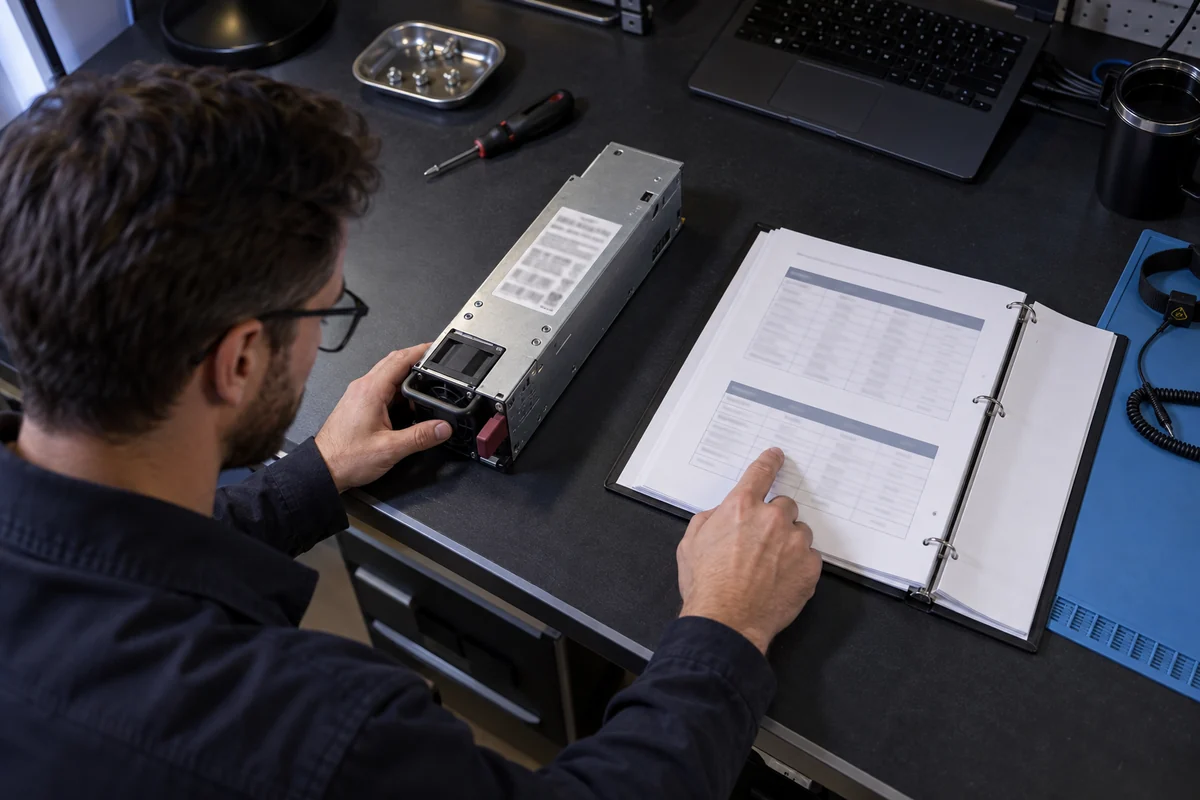
Some platform manuals identify PSU options that cannot be used at low line even though another option in the same chassis can. That makes the host’s approved-parts document as important as the module datasheet. A technically capable supply may still fail to seat, signal presence, share current, or satisfy the baseboard management controller in a specific server. Treat a marketplace statement such as “fits 1600W server” as an invitation to identify the actual supported part, not as a compatibility certificate.
The 110V branch can become the limiting component
To see why full low-line output is demanding, consider an intentionally hypothetical calculation. If a PSU delivered 1600W DC at 94% efficiency and 0.98 power factor while its inlet sat at 110V, its approximate single-phase input current would be 1600 ÷ (0.94 × 0.98 × 110), or about 15.8A. The assumed efficiency and power factor are illustrative, not specifications for any named unit. At a lower inlet voltage, current for a similar delivered load would rise. The actual maximum input current must come from the manufacturer’s documentation.
This estimate already exceeds the nominal current printed on a 15A outlet or branch, before considering another device on the same path. It is not a circuit-sizing instruction: permitted continuous loading, wiring, protective devices, and receptacle selection depend on the local code and installation. Its purpose is to show why a server advertised for 1600W on low line cannot be selected without also reviewing the AC infrastructure. A 20A circuit does not automatically make a 15A connector, PDU outlet, or cord suitable for the corresponding current.
Trace the entire path from the PSU inlet back through the cord, rack PDU outlet, internal PDU bank where applicable, PDU feed, and branch circuit. Read each component’s actual rating and installation conditions. A rack PDU can have an aggregate input limit and smaller outlet or bank limits; a large total nameplate does not make every receptacle equivalent. If the server is moved to a different rack or temporary PDU during recovery, repeat the check with that destination’s source and connector arrangement.

Include other loads sharing the feed. A rack may contain switches, storage shelves, management appliances, and several servers whose normal input current is modest but can rise together during a busy workload. Monitoring at a PDU input gives valuable operating evidence, yet it does not by itself define a PSU’s maximum or the required failure-state branch load. Use metered trends alongside the equipment ratings and the planned growth of the rack.
Be precise about where a current value was measured. A BMC-reported “system power” figure may be an estimate of DC load, while a rack PDU reports AC-side measurements at its outlets or input. A PDU aggregate can conceal an overloaded internal bank. If a team compares these numbers without identifying their measurement points, it may mistake conversion losses for unaccounted server load or miss the circuit that actually carries the current. Record the source, timestamp, workload, and PSU configuration beside each reading.
What changes when one redundant PSU or feed disappears?
Two 1600W modules can split a server’s ordinary load while both are healthy. In a genuine 1+1 design, one remaining module must support the required server state after its partner is removed or fails. If a particular module is documented for only 800W at low line, two healthy modules might support a configuration that cannot continue at the same performance on one module. The host might cap processors, disable an option, alarm, or shut down; only the platform documentation and qualification establish its response.
Suppose, as an example, that a server requires 1100W DC during the workload the operator promises to preserve. Two modules with 800W low-line output could plausibly share that demand in normal operation, subject to platform support, but one 800W module cannot supply the full 1100W after a failure. Calling the pair “2 × 1600W redundant” would hide the low-line condition that matters. If the service requirement instead permits a documented power cap to bring the failure-state demand below one module’s supported output, record the resulting performance and verify that the cap engages in time.
A second calculation belongs on the AC side. When one PSU or A/B source path is lost, surviving modules may draw more input current through the remaining cord and PDU. Several servers can transfer load to the same branch at once. The branch design must consider that correlated transfer, not merely multiply one server’s average metered current. This is especially material on a low-line rack already near a current limit. The PSU’s internal redundancy policy cannot raise the capacity of an upstream outlet.
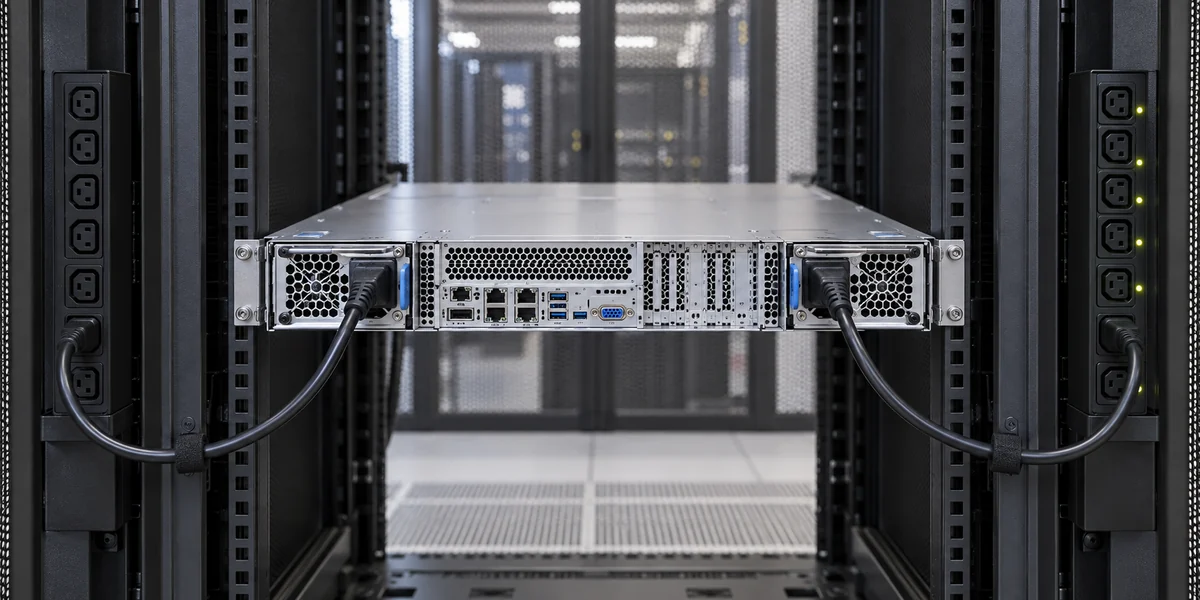
Source separation must be real. Two PSU cords connected to separate outlets of one PDU may survive a module failure but not that PDU’s failure. Even two PDUs can share an upstream branch or maintenance domain. Draw the actual A/B routes and define which event the installation is intended to tolerate. Then examine the surviving route’s current and the remaining PSU’s DC output at the source voltage it will actually see.
When high-line power is the better engineering path
If the only approved 1600W PSU for a host requires high-line input, the viable facility choice may be an appropriate 208V, 230V, or 240V rack source rather than a different plug on the 110V branch. The exact supported range depends on the module and region. A qualified high-line distribution path can also reduce input current for the same delivered real power, although its cords, PDU, and protection must still be selected from their own ratings.
Changing rack voltage is a facility project, not a software setting on the server. The rack PDU input, receptacles, server cords, UPS or distribution equipment, branch identification, and operational procedures must agree. Where multiple PSU options are available, another approved module with a lower power level may fit the existing low-line rack if the actual server demand and redundancy target fit its capacity. This is a different choice from assuming that a high-line 1600W option has somehow become a 1600W low-line supply.
Sites sometimes have low-line staging benches but high-line production racks. A server that qualifies in production can then be impossible to start or test on the bench with its installed PSU option. Conversely, a low-line-capable module may boot on a bench at a reduced output that is inadequate for full production configuration. Preserve source voltage and PSU option together in build, spare, and recovery records so an emergency replacement does not silently change the power envelope.
Powernexu lists the G1136-1600WNA CRPS module with a broad AC input range. That product page identifies a possible 1600W-class candidate but does not, by itself, establish full 1600W output at 110V in a particular host. Obtain an input-dependent output table and the server’s approved-module evidence before assigning it a low-line capacity. The same caution applies to other products advertised with a broad input range.
A practical answer for an existing 110V rack
First identify the exact server, installed PSU part number, hardware revision, and supported PSU options. Then read the candidate’s minimum input voltage, low-line continuous output, maximum AC input current, inlet and cord requirements, thermal conditions, and host compatibility. Compare the supported low-line output with the server’s required sustained and short-duration states. For 1+1 service, make that comparison against one surviving module, not the sum of two labels.
Next compare the documented input current and the rack’s measured operating profile with the cord, PDU outlet, PDU bank, and branch ratings. Account for a failed A/B feed and any other loads that would transfer to the surviving path. Involve the facility designer for code-compliant circuit decisions. If either the DC-side capacity or AC-side path fails, a verified high-line source, an approved different PSU, or a supported server power policy may resolve the issue. Each option changes a different constraint and should be evaluated on its own evidence.
The server PSU input-voltage reference explains voltage matching across the rack more broadly. For this 1600W question, the decisive documents are narrower: the exact module’s low-line output table and the rack path’s current ratings. The Supermicro PWS-1K68A-1R specification shows how large the gap between low-line and high-line output can be for one real module. It is evidence for the need to read a model-specific table, not a prediction for a different PSU.
A 1600W server PSU may run on 110V, but “run” can mean anything from a supported reduced-output state to full rated service; some models will not accept that input at all. The answer is complete only when the exact source, output rating, host behavior, and AC current path are known. Those facts also reveal whether the server can keep running after the one failure its redundancy design is supposed to survive.