A 1200W server PSU may accept a nominal 120V AC source without delivering 1200W DC at that voltage. The answer depends on the exact module’s input-dependent output rating. Some 1200W-class supplies deliver their full rating at high-line input but a lower rating around 100–127V; others are documented differently. Read the output-power table for the precise part number and revision before matching a server to a 120V rack. Then check the surviving module’s capacity if the server uses redundant PSUs, and size the cord, PDU, and branch for the documented AC input current.
The phrase “1200W 120V server PSU” can refer to three different numbers: a nominal AC supply voltage, a PSU’s maximum DC output, and the AC power drawn from the outlet. They are not interchangeable. A 1200W output rating does not mean the server continuously consumes 1200W, and a 120V outlet does not establish that a module can provide its high-line nameplate output. The practical question is whether the exact powered configuration remains inside the module’s 120V operating envelope during normal service and after a power-path failure.
The output rating may change between low-line and high-line input
Server PSU documentation commonly separates accepted AC input from available DC output. A universal-input label may say that the module operates across a broad AC range. A second table may assign different maximum output levels to low-line and high-line operation. Read both. “Accepts 120V” establishes an operating input; it does not by itself establish a 1200W output at that input.
Actual manufacturer documents illustrate why a single class label is insufficient. A Cisco 1200W AC PSU specification lists 1100W maximum output at 100–120V AC and 1200W at 208–230V AC. Other 1200W-labeled equipment has a larger low-line reduction. These are examples of distinct products, not a derating rule that can be transferred to an unrelated PSU. The exact model may also have restrictions tied to temperature, airflow, altitude, or platform configuration. Where a product listing omits the conditional rating, obtain the manufacturer’s datasheet or approved host documentation rather than treating the headline wattage as universal.
The most useful document is usually the module’s own input and output specification, read alongside the host’s supported-PSU list. Look for the precise part number, revision, supported input-voltage range, output-power table, maximum AC input current, inlet type, and any note about AC input or thermal derating. Similar models within a family can differ. A “1200W” search result or a photograph of a matching handle is not enough to transfer a low-line output figure from one variant to another.
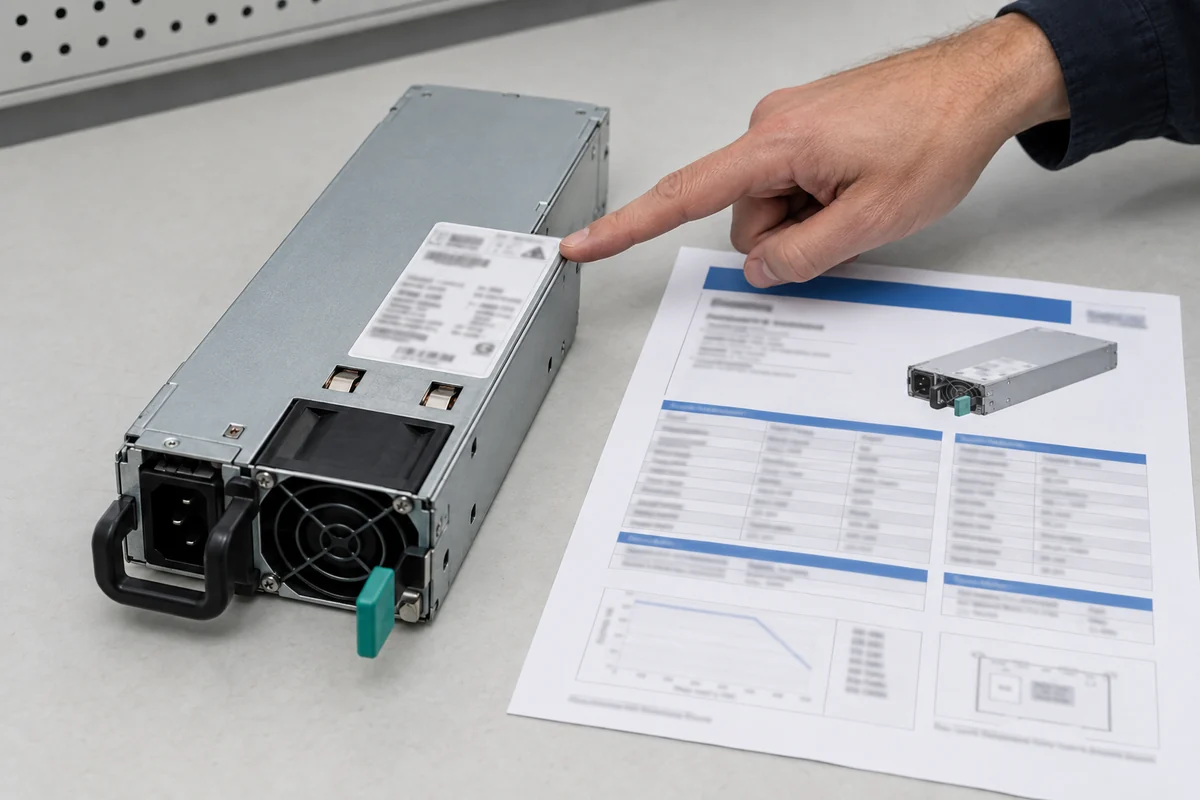
Check whether the rating describes continuous output or a short peak. A peak allowance does not replace sustained capability. If the documentation distinguishes the main rail from standby output, read how the overall limit applies to their combination. Do not add independently listed rail maxima unless the specification permits simultaneous use.
Map the 120V limit to the server’s real operating states
Once the low-line rating is known, compare it with the server’s power demand under the states it must support. Inventory the installed CPUs, accelerators, drives, memory, network cards, fans, and expansion devices. A chassis power calculator or manufacturer configuration guide is more useful than summing component marketing ratings because it can account for supported combinations and power policies. Measured inlet power adds evidence about a deployed machine, but a short period of ordinary load does not establish its maximum supported demand.
Separate normal production, workload peaks, restart, and reduced-cooling conditions. A storage server may draw differently while many drives spin up. A compute node may approach its sustained power limit when processors, accelerators, and fans are busy together. Firmware power caps can constrain demand, but the cap matters only if it is supported for that hardware, survives updates and recovery, and leaves the workload acceptable. The PSU’s low-line output must be evaluated against the state the service promise actually includes, not against an idle dashboard reading.
A hypothetical example shows the consequence without assigning a rating to a real product. Suppose a particular 1200W-class PSU is documented for 900W DC at 120V, and a configured server requires 850W DC under its supported heavy-load state. That leaves 50W between demand and the documented ceiling before any applicable environmental reduction. If the same server’s required state rises to 950W, its configuration no longer fits that PSU’s stated low-line envelope even though the label still says 1200W. The remedy could be a different supported PSU, a qualified high-line source, or a supported reduction in the server’s power demand; none can be chosen from the wattage label alone.
Input voltage at the PSU can also vary from the nominal outlet figure. Long cords, loaded circuits, and local supply variation affect the voltage presented at the inlet. Compare the site’s actual range with the manufacturer’s range and output bands. If a rating changes at an input threshold, a rack operating close to that boundary deserves particular attention. Do not assume that “120V” is a precise measurement at every instant or at every connector in the path.
Redundant modules make the surviving-state rating decisive
Two 1200W-class PSUs do not necessarily give a redundant server 2400W of protected capacity. In a 1+1 arrangement, both modules can share the normal load while either one must be capable of supporting the required server state after the other fails or is removed. At 120V, the surviving module’s documented low-line output is the relevant capacity. If the platform uses a different redundancy mode or limits performance after a failure, follow the host documentation for that exact mode rather than applying a generic 1+1 assumption.
Consider another hypothetical pair of modules each documented to deliver 900W at the deployed 120V source. A server that needs 1000W DC at full performance may run while both modules are healthy, yet it cannot claim full-performance 1+1 continuity on that documented rating alone. One module might overload, the host might impose a power cap, or the server might shut down; the actual response depends on the approved platform design. A workload that needs only 750W in its required failure state could fit within one 900W module, subject to the remaining thermal, input, and distribution limits. The point is to define the promised service state first, then compare it with one surviving low-line module.
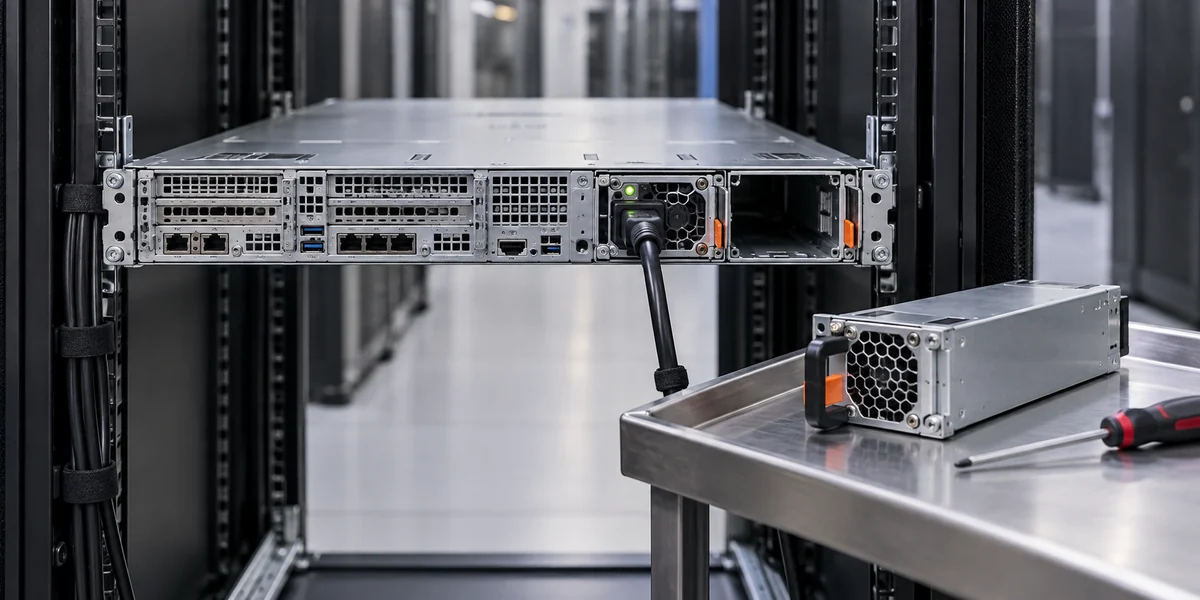
A/B rack feeds add a second boundary. Separate power cords protect against the loss of a feed only if the PSU configuration and upstream rack distribution support that behavior. If one PDU fails, the surviving cord and PSU input can take a greater share of the system’s AC current. Confirm that each cord, PDU outlet, PDU bank, and upstream branch can carry its failure-state load. Two inlet connectors are not proof of two independent sources, and two independent sources do not improve the DC output rating of a single surviving module.
For a specific 1200W CRPS candidate, Powernexu lists the G1136-1200WNA product with a broad AC input range. That page is a starting point for product identification, not proof of its full output at 120V in a particular server. Request the input-dependent power table and host compatibility evidence for the offered revision before assigning it a 120V redundancy capacity.
The AC side needs its own current budget
DC output watts and AC branch current describe opposite sides of the conversion process. The input must supply the useful DC load plus conversion losses. Current is also affected by voltage and power factor. For a rough single-phase illustration, a PSU supplying 900W DC at an assumed 90% efficiency would draw about 1000W of real AC power. At an assumed power factor of 0.98 and exactly 120V, the corresponding current is about 8.5A. These are explicitly hypothetical operating assumptions, not the input specification of any Powernexu or third-party module.
That estimate does not size a branch circuit or cord. Manufacturer maximum input current may reflect operating points that differ from the illustrative load, and local electrical rules determine how circuits and continuous loads are designed. Start with the PSU label and technical documentation, then account for all other equipment on the PDU and the current that shifts when one feed disappears. An electrician or facility designer should apply the applicable code and the actual PDU installation instructions. The server integrator should provide the qualified machine configuration and source behavior rather than guessing the electrical design from DC watts.
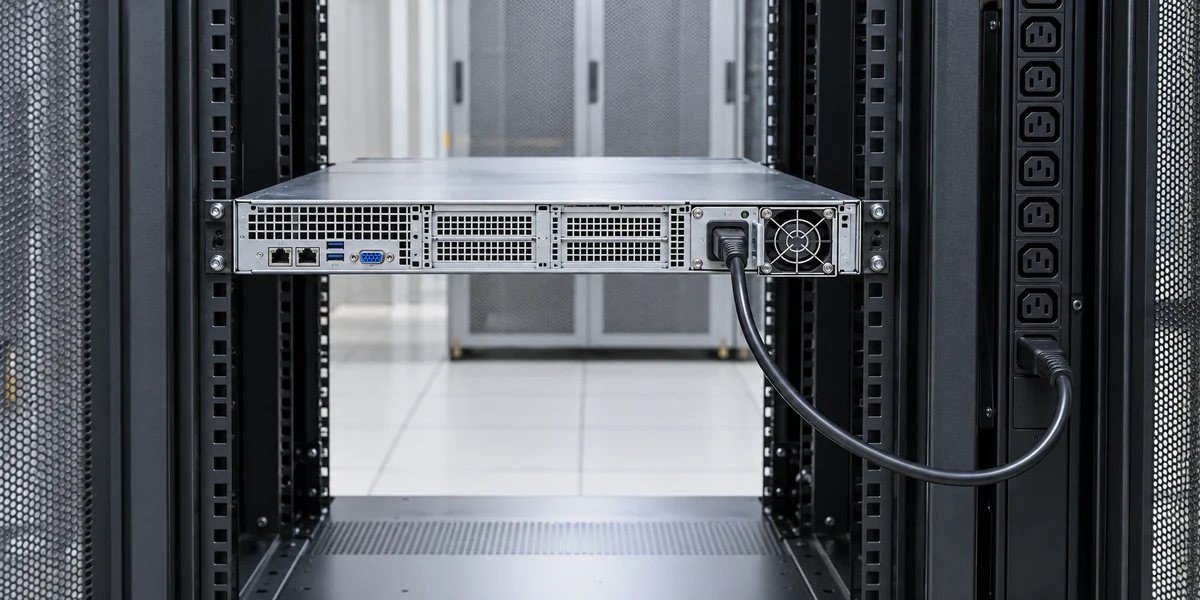
Input current normally rises for a given output as input voltage falls, even when the PSU remains inside its supported range. This is one reason a module can have a stricter output limit on low line. The resulting heat and fan demand are handled by the supply’s thermal design, and the allowable rating may depend on inlet temperature and chassis airflow. A server mounted in a constrained cabinet should be evaluated using the PSU inlet conditions that actually exist there, not merely the room thermostat setting.
Starting and restoration differ from steady-state operation. Simultaneously energizing servers can produce a short input demand unlike running current. A switched PDU may stage startup if supported and configured. Review documented inrush guidance when coordinating rack protection. Current can move again when a failed A/B source returns and modules resume sharing.
Which evidence should a 120V replacement quote carry?
A replacement purchase can fail even when the vendor supplies a real 1200W PSU. The receiving server may accept only approved module identities, a particular mechanical key, connector, PDB interface, airflow direction, or firmware combination. For the 120V question, the quote should identify the exact offered part and revision and provide its low-line output rating. If the vendor presents a high-line-only 1200W figure, that does not settle a low-line replacement request.
Photographs can compare the casing, handle, inlet, and label, but cannot establish electrical or management compatibility. Obtain the host’s approved options or a documented integration result. Confirm the output rail, standby behavior, control signals, current sharing, fault isolation, and management interface as applicable. A PSU that cannot mate with the host’s PDB is not a usable spare.
Ask the supplier to state the actual site source, including the expected voltage range and connector arrangement, in the quote. If the offered module is rated for less DC output at that source, place that figure beside the server’s supported heavy-load and surviving-module demand. The gap becomes visible before the spare reaches the rack. For the broader task of matching rack voltage to a PSU input, Powernexu’s server input-voltage article explains the facility-to-inlet path; the present question is narrower because it asks whether a 1200W-class module retains enough output on a 120V source.
One authoritative example can support the distinction without turning another manufacturer’s rating into a universal rule. The Cisco server specification explicitly lists different maximum outputs for 100–120V and 208–230V input on its 1200W AC PSU. Read any candidate’s corresponding table with the same care. A supplier’s “1200W compatible” wording should be interpreted in light of the actual input and output conditions, not as a substitute for them.
Make the rack decision from the low-line operating envelope
A 120V deployment is viable when the exact PSU accepts the site’s input range, its documented output at that range covers every required server state, and its electrical connection can support the corresponding AC load. In a redundant host, repeat the check with only the permitted surviving module and source path. If the evidence supports less than 1200W at 120V, use that lower figure in the server and rack design even though the model belongs to a 1200W class.
There is no general conversion factor from a 1200W nameplate to a safe 120V output. Some products have modest low-line reductions, some have larger ones, and the host can impose further conditions. The reliable answer lives in the exact module’s conditional rating and the host’s supported configuration. With those documents, a 120V source becomes an explicit engineering choice rather than a surprise discovered during a PSU failure or rack move.