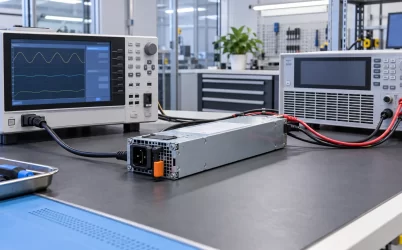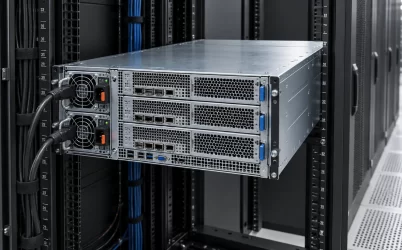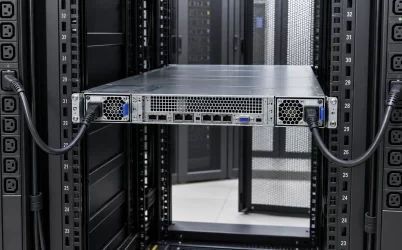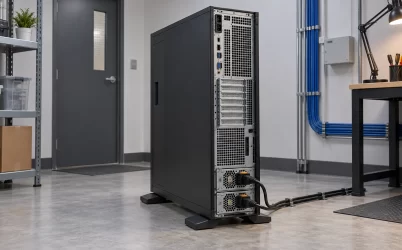
A 1200W server PSU does not continuously consume 1200 watts. The number normally describes its rated DC output capacity under the conditions specified for that model. The AC power drawn from the wall depends on how much DC power the server actually demands and how efficiently the supply converts power at that operating point. A server receiving 400 W of DC power may draw somewhat more than 400 W at its PSU input; a server approaching 1200 W of DC demand will draw more than 1200 W from AC because conversion is not lossless. With two redundant modules, the wall draw is not automatically twice either rating. These distinctions are the starting point for sizing circuits and estimating an electricity bill.
Rated output, live demand, and wall input are three different numbers
The 1200W label is a capacity ceiling for the PSU’s output under its applicable input and thermal conditions, not a request for the utility to deliver that power at all times. The server determines the instantaneous load: processors, memory, drives, accelerators, network cards, fans, and board converters draw what their operating state requires. The PSU responds within its regulation limits. A lightly loaded server will normally consume far less than the module’s nameplate output; a busy server can approach the limit if the platform permits that configuration.
Wall input is larger than delivered DC output because some input becomes heat in the converter and its supporting circuits. Use the relationship AC input power = DC output power ÷ efficiency, with efficiency expressed as a decimal for the same input voltage and load point. If the hypothetical server draws 600 W DC and the relevant PSU efficiency is 90%, AC input is about 667 W. The approximately 67 W difference is converter loss in this simplified example. It is not a measured figure for any named product. If a monitoring tool already reports AC input, dividing it by efficiency again would count the loss twice.
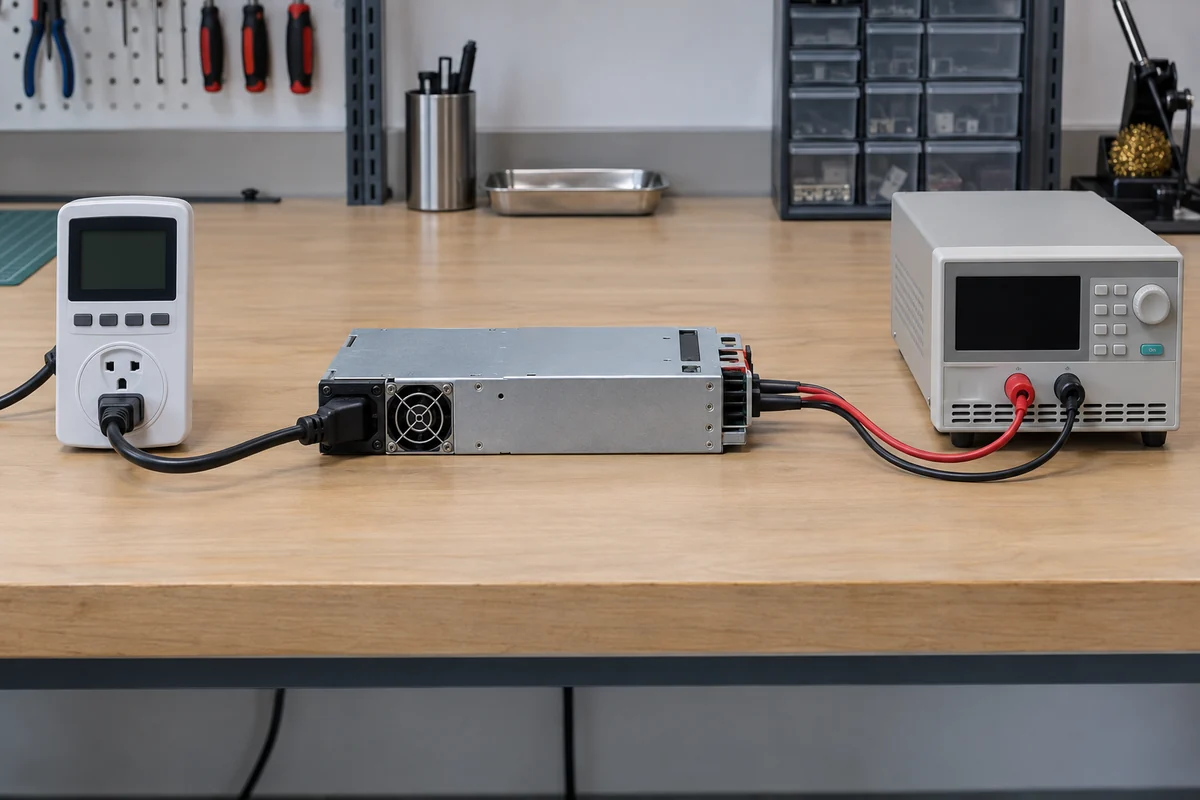
Current on the AC cord is another quantity. A circuit is not sized from watts divided by nominal volts alone without considering the supply’s specified input current, power factor, inrush, local electrical rules, circuit protection, and all other loads. For a facility planner, the PSU label and the host’s approved configuration determine available capacity, while measurements and a defensible load profile determine expected consumption. A 1200W rating cannot serve both purposes.
A worked estimate at three server operating states
Suppose a hypothetical server with one active 1200W PSU needs 180 W DC while nearly idle, 500 W DC during a common workload, and 900 W DC during a sustained intensive task. For illustration only, assume efficiency is 86%, 92%, and 93% at those respective operating points. The estimated AC inputs are about 209 W, 543 W, and 968 W. The corresponding conversion losses are approximately 29 W, 43 W, and 68 W. These assumed efficiencies are not certification thresholds or a Powernexu specification; they only show why the answer changes with the load.
Notice that the difference between 500 W DC and 543 W AC is not “unused capacity.” Unused capacity is the gap between the PSU’s supported DC output limit and the server’s actual DC demand. The 43 W is energy dissipated by conversion at the assumed operating point. The distinctions matter in a procurement discussion: a replacement can have enough output capacity yet consume more AC power than another suitable replacement at the workload that dominates operating hours.
A point estimate is still not a bill. If that server spent 16 hours per day near the assumed 209 W input and eight hours near 543 W, estimated daily PSU-input energy would be (0.209 kW × 16 h) + (0.543 kW × 8 h), or roughly 7.7 kWh. Multiplying by an electricity tariff gives an energy-cost estimate for the stated boundary. The actual server may not alternate neatly between two states, and this calculation excludes UPS, rack distribution, cooling, and other facility overhead. State that boundary before presenting a monthly cost.
For a real server, replace these example points with measurements over a representative operating period. Include low-use hours, normal production, backups or batch jobs, and periods of sustained high demand. A peak observed once during a maintenance event should not be treated as every-hour consumption; an idle snapshot should not be applied to a busy service. Separate the capacity question—can the PSU support the highest approved demand?—from the energy question—how often does the server occupy each load region?
What changes when there are two 1200W modules?
Many servers install two PSUs for availability. In a supported 1+1 configuration, either module is expected to carry the required server load after the other is lost, subject to the host’s power policy and operating limits. Two 1200W labels do not necessarily mean 2400W of protected output. During normal operation the modules may share load, or a platform may manage them in another supported mode. That operating policy affects where each module lies on its efficiency curve, so two installations with the same combined DC load can have somewhat different AC input.
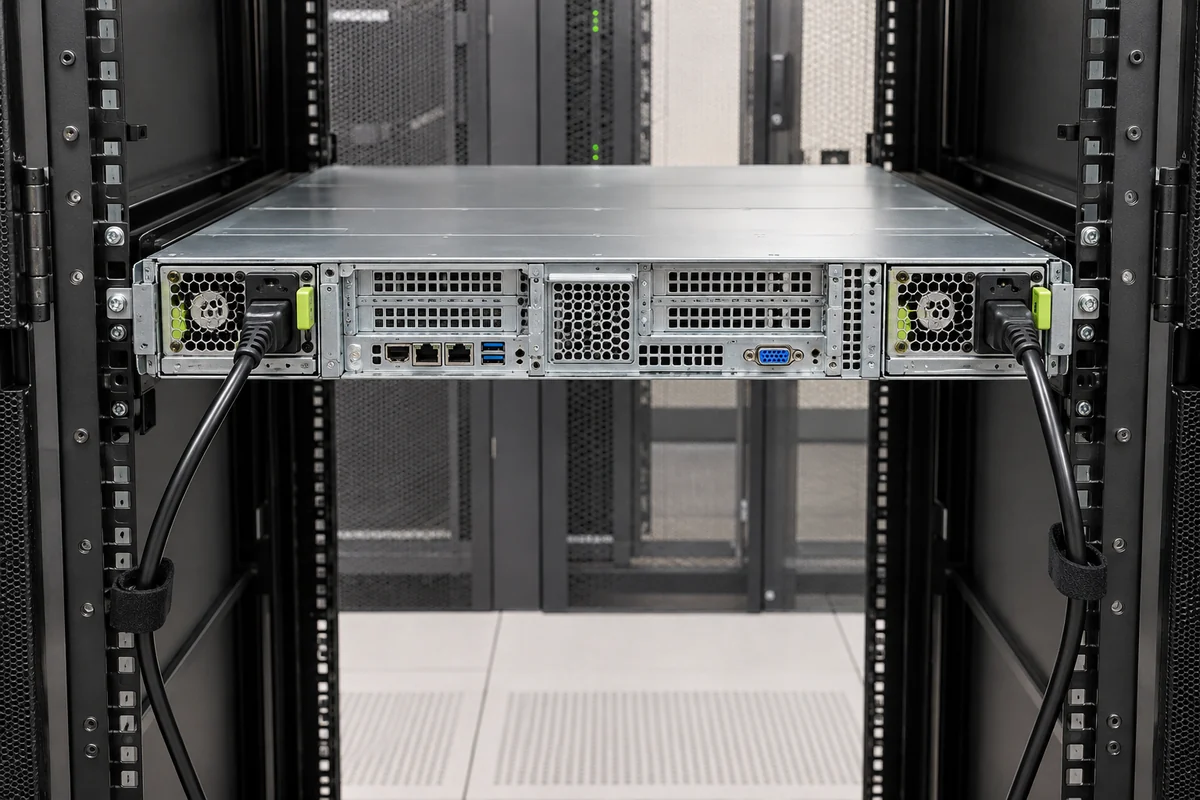
For a simple hypothetical illustration, imagine a server that needs 600 W DC and two active supplies sharing it equally. Each delivers about 300 W. If each supply is 88% efficient at that load, their combined AC input is about 682 W, not 2,400 W. If the host instead runs one supply at 600 W with the other in a lower-power standby state, the result depends on the active module’s efficiency and the second module’s standby draw. Without actual platform behavior and measured or documented curves, claiming that one mode always saves a certain percentage would be unjustified.
After one module fails, the surviving unit may move from roughly 300 W to 600 W DC in the sharing example. Its efficiency, fan power, and thermal state may change. The important reliability condition is that it can sustain the full approved load under the deployed input voltage and inlet temperature. A power-saving mode should never be inferred from module count alone, nor should an efficiency calculation obscure the system’s required survival behavior. Use the server’s management data or manufacturer documentation to learn whether it shares, parks, or otherwise manages the redundant pair.
A different arrangement might deliberately combine two modules for additional nonredundant capacity. In that case, the power budget after one module is lost is a separate question, and a 1200W label on each unit does not establish that the host supports a 2400W combined operating mode. The cage, distribution board, firmware, and branch limits control what the system permits. Energy estimation should use the actual supported mode, not an arithmetic sum of labels.
Input voltage can affect both available output and consumption
Some high-power server PSUs have different rated output at different AC input ranges. A unit marketed as 1200W might only deliver its full labeled output on a higher-voltage feed, while another model could support that output across a broader input range. Neither outcome should be assumed from the wattage alone. Read the exact model’s rating table and the host’s approved configuration for the site’s voltage. A server that works at a lower input voltage may still have less available headroom than a quote based on its high-line rating implies.
Efficiency can also vary with input voltage. Therefore, a conversion figure measured at one voltage is not an exact prediction for another site. If a report offers results at the site’s input, use those. Otherwise mark the efficiency as an assumption or measure the deployed system. Avoid an invented universal adjustment such as “subtract two percent for 120 V.” The magnitude and even the relevance of a difference depend on the model, load, and test conditions.
Voltage alone does not determine energy consumption. Raising an AC feed from 120 V to 230 V does not cause the server’s processors to demand less DC power merely because the number is higher. It may change conversion loss and input current for a particular PSU, but the server workload still drives the main power demand. The circuit and cord must be evaluated under their own ratings and applicable electrical requirements; a reduced current estimate must not be used to bypass those constraints.
Where to measure without mixing boundaries
A rack PDU meter reports power delivered from the rack distribution point to its connected equipment, subject to the meter’s location and accuracy. An intelligent server may report estimated or measured PSU input, output, or component power through its management controller. These fields are not interchangeable. Check the documentation for whether the reported value is AC input to one or both PSUs, DC output, or a host-level estimate. A value labeled simply “power” without a defined boundary is a poor basis for comparing two supplies.
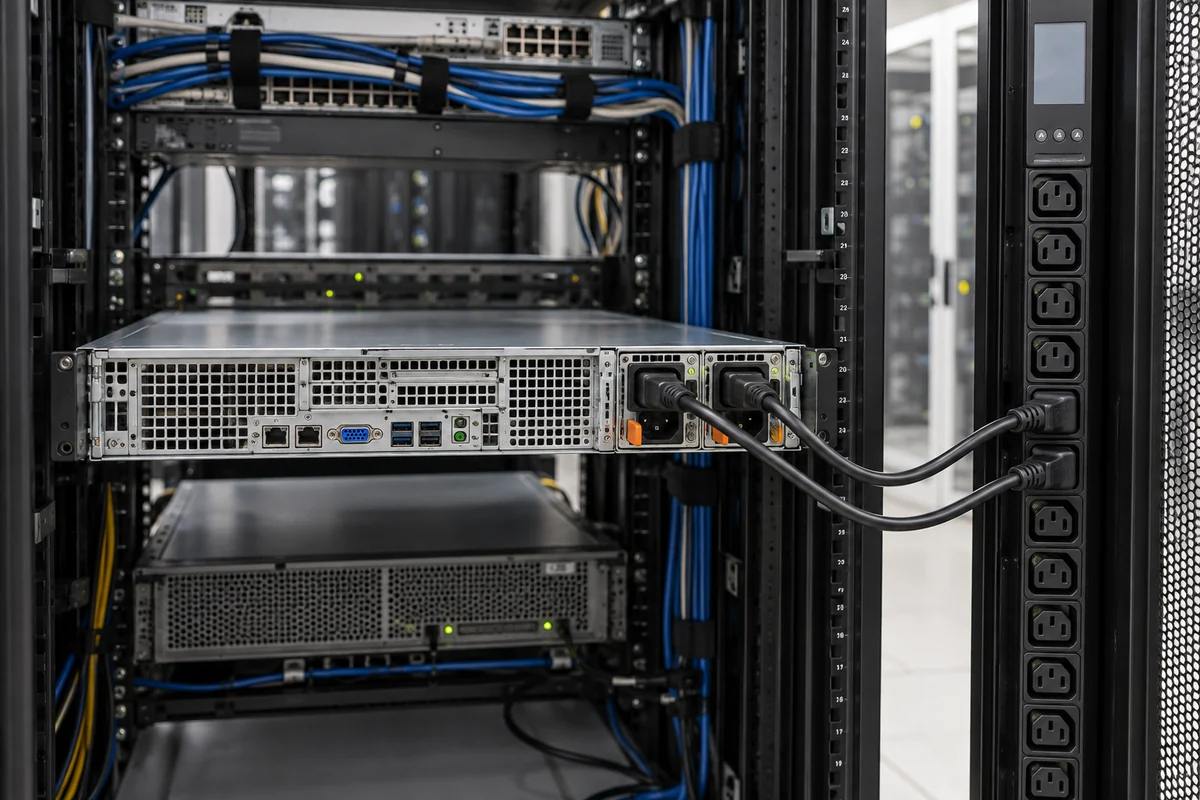
For an energy estimate, the cleanest operational measurement is an AC input reading that includes all PSUs feeding the server during a representative workload. Record the input voltage, whether one or two modules were active, and the server configuration. If the PDU also powers a switch or other devices, isolate the server outlets rather than attributing the whole rack total to one host. If only DC output telemetry is available, apply an efficiency curve appropriate to the load and input condition, and state that the result is modeled rather than directly measured.
Sampling interval matters. A one-minute average may hide a brief power peak that is important for PSU capacity or breaker coordination, while a short peak should not dominate an annual energy estimate. Collect data at a resolution suited to the question. Use platform specifications and electrical engineering review for transient and inrush decisions; use longer-term metered energy or load-distribution data for costs. A 1200W power-supply rating gives neither the waveform nor the time distribution.
Do not subtract a PSU’s displayed DC output from rack-level AC input and automatically label the difference “PSU loss” if other devices or measurement boundaries lie between them. The result may include distribution losses, standby loads, meter error, and differences in sampling time. To isolate conversion loss, compare synchronized input and output measurements for the same supply or use a controlled report that states its boundary. To forecast facility energy, keep the broader boundary and include additional layers explicitly.
When the 1200W label is useful
The nameplate remains important. It helps establish the maximum supported DC output for a particular model under stated conditions and allows a server designer to compare that limit with the host’s approved peak and failure-state demand. It can also reveal a mismatch between the supply on a parts listing and the unit a server requires. What it cannot tell a purchaser is the wattage the server draws every hour. That requires the installed hardware, workload, operating mode, input condition, and conversion behavior.
A useful plain-language answer is therefore conditional: a 1200W server PSU normally draws whatever AC power is needed to deliver the server’s current DC demand, plus the PSU’s losses. At full supported 1200W DC output it would draw more than 1200W AC; below that load it generally draws less, though the exact figure belongs to the actual efficiency point and auxiliary consumption. Two installed units do not automatically double wall power, and neither a certification badge nor a nameplate replaces measured operation. This separates the three numbers that planning often confuses—capacity, current draw, and energy over time—without treating any of them as a universal constant.