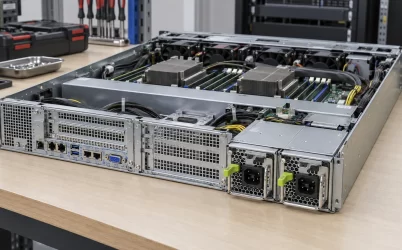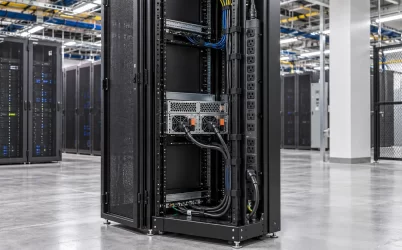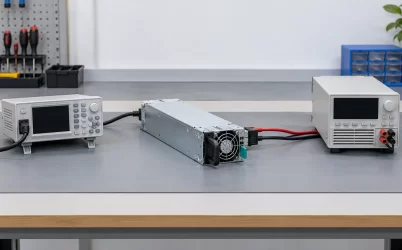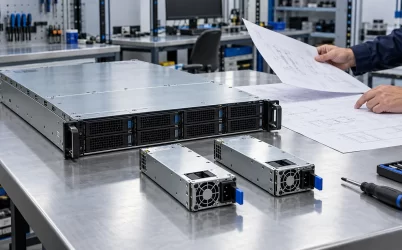
A server power supply can deliver stable DC power while its management controller reports no PSU telemetry. That apparent contradiction makes sense once the power path is separated from the I²C management path. In a managed server, the PSU may expose an I²C-compatible interface to the chassis backplane and baseboard management controller (BMC); higher-layer SMBus and PMBus conventions determine how devices exchange power-management data. The connection can reveal status, electrical measurements, and faults when the particular PSU and platform support those functions. It does not, by itself, establish that two supplies are electrically interchangeable, that every PMBus command is implemented, or that the BMC will recognize a substitute module.
The three layers hidden inside “PSU I²C”
I²C describes a two-wire serial bus with clock and data lines. It answers how a controller addresses devices and transfers bits, but it does not define what a PSU’s register means. SMBus adds defined electrical and transaction conventions for system-management devices. PMBus builds power-system commands and data formats on that foundation. The PMBus organization’s explanation of I²C, SMBus, and PMBus explicitly distinguishes a physical bus from a complete power-management protocol. This distinction matters when a module is advertised simply as “I²C capable.” That phrase alone says little about command coverage or host compatibility.
A typical path runs from the BMC or another management controller, across the motherboard or cable harness, through a power distribution board or backplane, to the PSU’s management contacts. The actual routing varies by chassis. Some designs place a switch, multiplexer, isolation device, or management controller between the BMC and supply; others expose separate buses for each bay. Nothing about the visible AC inlet or DC output connector proves how this route is wired.
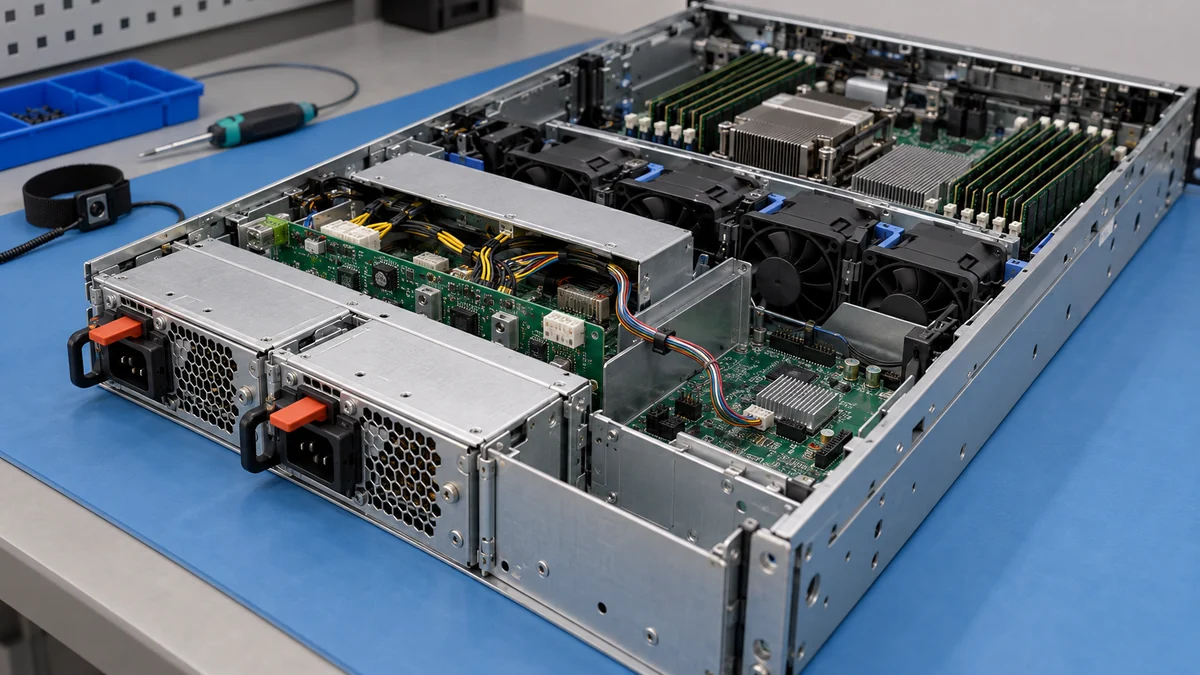
At the operating-system level, an administrator may see summarized power readings through a BMC web interface or management API. Those readings are not a direct electrical property of the I²C wires. They depend on the PSU providing the measurement, successful bus transactions, firmware decoding, and the BMC publishing the result. A missing GUI field may therefore be a firmware or inventory-mapping limitation rather than a failed power converter.
What the management link can tell a server
Implemented commands may let the host identify a module, read output voltage or current, inspect input power, review temperatures, or observe status and warning flags. Support is model-specific: a PMBus label does not promise every optional quantity or command. Some values are measured internally, others are calculated or estimated, and their resolution and update behavior depend on the design. A rack-level energy meter, branch-circuit monitor, BMC reading, and individual PSU telemetry can legitimately show different numbers because they measure different boundaries or sample at different times.
For a redundant chassis, separate per-module readings can expose an imbalance that a single combined server-power number conceals. Yet telemetry should not be mistaken for the current-sharing control loop. A supply pair can exchange or implement sharing control by another path, and the management bus may merely observe the outcome. Equally, one missing PSU reading does not prove that the module stopped contributing DC power. Electrical status, fault indications, and the actual load state need to be considered independently.
The management interface can support operating policy as well as monitoring, but only where the specific PSU, chassis, and firmware define that behavior. A writable command is not a license to change output voltage, power limits, or fan behavior on an arbitrary module. Unrecognized or unsupported commands should be treated as interface limitations, not invitations to experiment on a production server. In a replacement project, the useful question is which commands the platform actually expects from that exact supply family.
The backplane is part of the conversation
Blind-mate contacts make a hot-plug server module easy to replace mechanically, but their small management pins must still reach the correct controller. A compatible-looking module can line up with the power blades while its clock, data, presence, address-selection, or auxiliary-control contacts differ. The chassis may then energize the bus yet fail to enumerate the PSU, or the firmware may reject an identifier that does not match its supported inventory. A mechanical fit is therefore not a management-interface match.
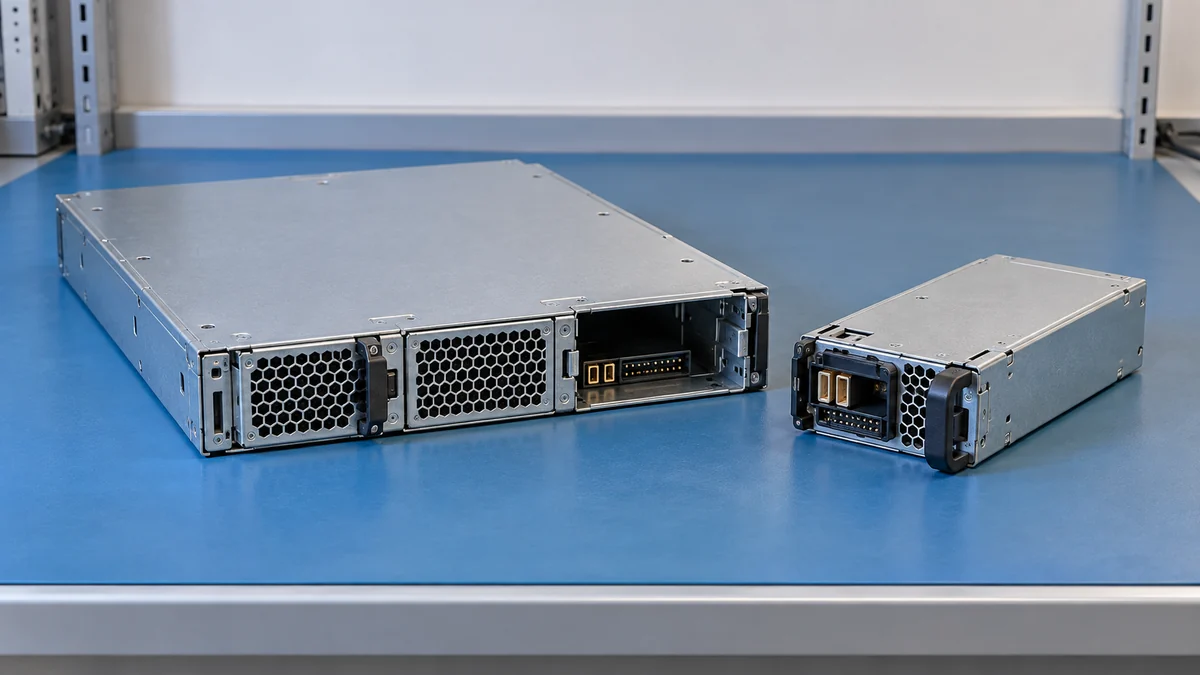
The distribution board may connect two PSU bays to a shared management bus or route them through separate branches. In a shared arrangement, both devices need distinct usable addresses, and a fault on one branch can interfere with communications elsewhere unless the board isolates it. In a switched arrangement, the BMC must select the intended bay before addressing it. Address assignment can be fixed in a module, affected by a backplane signal, or handled through another platform-specific method. It should never be inferred from a generic pinout found for a different PSU family.
Standby power is another practical dependency. The BMC often needs to see the PSU while the main server rails are off, but whether the management interface remains active in that state is design-specific. Trace the management supply and presence path through the exact chassis before interpreting “not detected with the server off” as a defect. Conversely, a PSU that responds while standby is present has not thereby demonstrated that its main conversion stage, load capability, or fault isolation works.
Physical routing also affects service. The management contacts may mate at a different point in the insertion sequence from high-current contacts. A momentary loss of telemetry during module insertion or withdrawal may be normal for a supported hot-swap design, while loss of the remaining module’s telemetry may reveal a shared-bus disturbance. The distinction is visible only when per-bay management and electrical state are interpreted together.
Why a healthy PSU can appear missing
Begin with the symptom, not the assumption that the module has failed. If the server stays powered and the PSU’s independent indicators show a normal state, missing BMC data points first toward the management route. If the PSU is also absent electrically, the input, backplane connection, enable logic, and power path require attention before software interpretation. Avoid treating either observation as a complete diagnosis.
At the bus level, common causes include the wrong address or bay mapping, a disconnected management contact, missing pull-up or standby supply, incompatible logic levels, a clock or data line held low, excessive bus loading, or a firmware command that the module does not support. The correct test depends on access and service documentation. An oscilloscope or logic analyzer can distinguish an idle bus, attempted address transaction, acknowledgment, and malformed exchange; the BMC event log can show whether discovery or a later command failed. Such work belongs to qualified personnel using the manufacturer’s safe-service procedure.
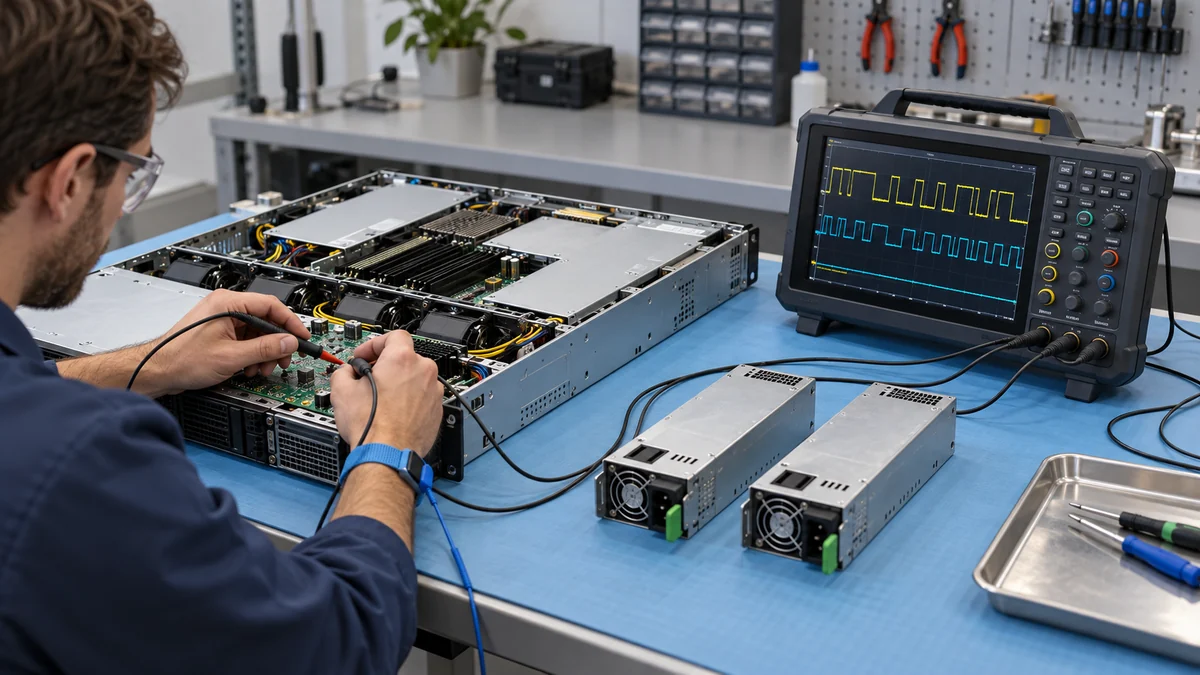
A more subtle problem is valid communication with misleading interpretation. The BMC may recognize a PSU identity but not decode a particular telemetry format. One module may report a field that the other does not, or firmware may apply an unexpected scaling rule. Compare the raw supported readings and platform documentation before describing the result as a real voltage, current, or temperature anomaly. A plausible number in a dashboard is not proof that its source and unit were interpreted correctly.
Intermittent disappearance calls for a different line of inquiry than permanent absence. If it coincides with hot-plug activity, fan-speed changes, or a particular bay, inspect the mechanical management connection and disturbance on the shared bus. If it appears after a firmware update or module substitution, examine identity handling and command support. If both bays lose telemetry simultaneously, a common backplane segment or BMC-side route becomes more plausible than two independent PSU sensor failures. These are diagnostic priorities, not model-specific failure claims.
Monitoring data is useful only at the right boundary
A PSU’s reported input and output quantities can help operations teams spot trends, but the readings describe the module’s measurement boundary. They do not automatically equal power at the wall, rack PDU, motherboard socket, or CPU package. Consider an illustrative two-module server: each module may report a different input-power value because the pair shares load imperfectly and conversion losses differ. Adding those reported values estimates the modules’ combined AC demand only if both readings represent comparable inputs, are current, and are available. It still does not include losses upstream of those measurements.
Alerting also requires understanding status semantics. A warning bit may indicate a threshold condition while the PSU continues operating; a fault may indicate a latched protection event or a current condition, depending on the command and implementation. The BMC may debounce events or translate them into its own severity classes. A runbook should name the raw event, host presentation, and physical response separately. Otherwise a transient communication fault can be escalated as an electrical outage, or a serious output loss can be dismissed because the interface still answers.
Poll rate is not a substitute for physical measurement bandwidth. I²C/SMBus management is suitable for inventory and supervisory telemetry, not for resolving every rapid server load excursion. When a design problem involves transient droop, output ripple, or failover timing, use the measurement method specified for that electrical phenomenon. The bus remains valuable for the accompanying status history, but a smooth dashboard curve should not be mistaken for a high-speed waveform.
Replacing a module without losing manageability
A replacement specification should identify the exact PSU family and supported platform, not merely the output rating and connector shape. Record the module’s verified management protocol and command set, bay-address behavior, supported inventory identifiers, firmware dependencies, and how the chassis presents faults. Also check the electrical and mechanical criteria separately: input range, output behavior, cooling direction, extraction geometry, blind-mate interface, and surviving capacity in redundant operation. The I²C path is one dimension of compatibility, not a shortcut around the others.
For a new server integration, ask the platform supplier for a management interface description tied to the particular module and backplane revision. The information should show which controller talks to each bay, how addresses are established, what happens when a module is removed, which PMBus commands and data formats are supported, and how faults reach the BMC. A public PMBus specification helps interpret the protocol vocabulary; it cannot replace the product-specific interface definition.
In a supported redundant system, the practical acceptance observation is twofold: the host should continue to receive the DC power required by the configured load, and the BMC should identify the surviving and removed modules correctly. Those outcomes are related but distinct. A server that remains powered with an “unknown PSU” warning has an observability or compatibility issue even if the electrical service was uninterrupted. A dashboard that shows both modules present does not prove surviving power capacity. Treat power continuity and management visibility as separate results.
This is the central meaning of “server power supply I²C”: a management pathway that lets a platform recognize and observe a supply, usually through SMBus/PMBus conventions, while the PSU’s actual energy delivery follows separate high-current connections. Its value is greatest when the module, backplane, BMC firmware, and monitoring software agree on the same interface. If any one of those pieces differs, a supply can look physically correct yet remain invisible or misleading to the server’s management system.