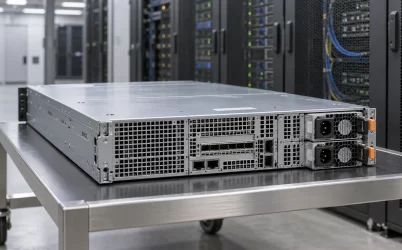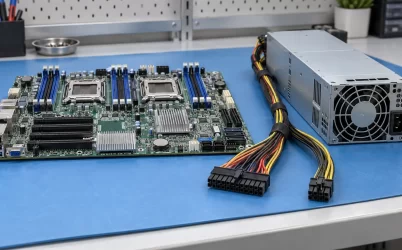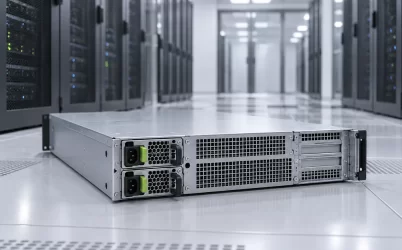
A fanless server power supply has no fan inside the PSU itself. That does not necessarily mean the server is silent or that the supply can operate without moving air. The heat from conversion still has to cross a thermal path into an enclosure, heatsink, chassis surface or host-provided airflow. For a compact rack server, the decisive question is therefore not just “Is the PSU fanless?” but “Which part of the system removes the PSU’s heat at the required output?”
Search results for this phrase mix passive desktop supplies, compact DC-DC boards, industrial modules and server components. Those products do not share one mechanical or cooling model. A passive ATX supply fitted into a roomy workstation may use a large ventilated enclosure. A removable server module may have no internal fan because a chassis fan wall supplies its airflow. An open-frame DC-DC board may depend on a metal baseplate or system cold plate. Their common absence of a local fan says little about interchangeability.
Three meanings of “fanless” that should not be confused
The strictest meaning is passive operation under defined conditions: no fan in the supply and no required forced airflow over it at its documented output, ambient and orientation. Heat leaves by convection and radiation or by conduction into an approved mounting surface. This is possible when losses, thermal resistance and available surface area permit it. The word “fanless” alone does not establish what those conditions are or whether an installation reproduces them.
A second meaning is a PSU without its own fan that relies on the host. In a rack chassis, a fan wall can move air through the PSU bay and across the converter. The PSU is fanless as a component, while the server is emphatically not fanless. A supplier may accurately describe the module as fanless; an integrator must still account for the required air temperature, direction, volume or pressure at the installed module. The chassis fans, baffles and empty-bay seals become part of the PSU’s thermal design.
The third meaning is semi-passive or fan-stop operation. A supply contains a fan but switches it off over some operating range. Its fan may start as load or temperature rises. That can reduce noise under light load, but it is not a fanless PSU. In a server room, a fan-stop claim also says little about the acoustic behavior of the complete host because system fans, drives and rack airflow may dominate.
These distinctions are more useful than a single product filter. If the goal is to remove one small high-speed fan as a service item, host-cooled architecture may be suitable. If the goal is an acoustically quiet edge server, the entire cooling arrangement matters. If the goal is dust avoidance in an industrial enclosure, eliminating a PSU fan does not automatically eliminate enclosure openings or cooling needs.
Where the converter’s heat actually goes
Conversion loss is the difference between input and delivered output power at a defined operating point. Even an efficient PSU dissipates heat; the loss changes with load, input condition and design. That heat originates in semiconductors, magnetics, conductors and other parts, then travels through internal interfaces to air or a mounting structure. A fanless unit must use a sufficiently low-resistance path so those parts remain inside their documented temperature limits.
Imagine an illustrative 300 W output at an assumed 90% efficiency. Input power would be about 333 W and loss about 33 W. This is not a claim for a Powernexu model or a guarantee across loads; it simply shows that “fanless” does not mean “heatless.” The same physical enclosure that looks cool to the hand can conceal hotter internal components. Moreover, the allowable output at a high inlet or mounting temperature may be lower than the catalog headline rating.
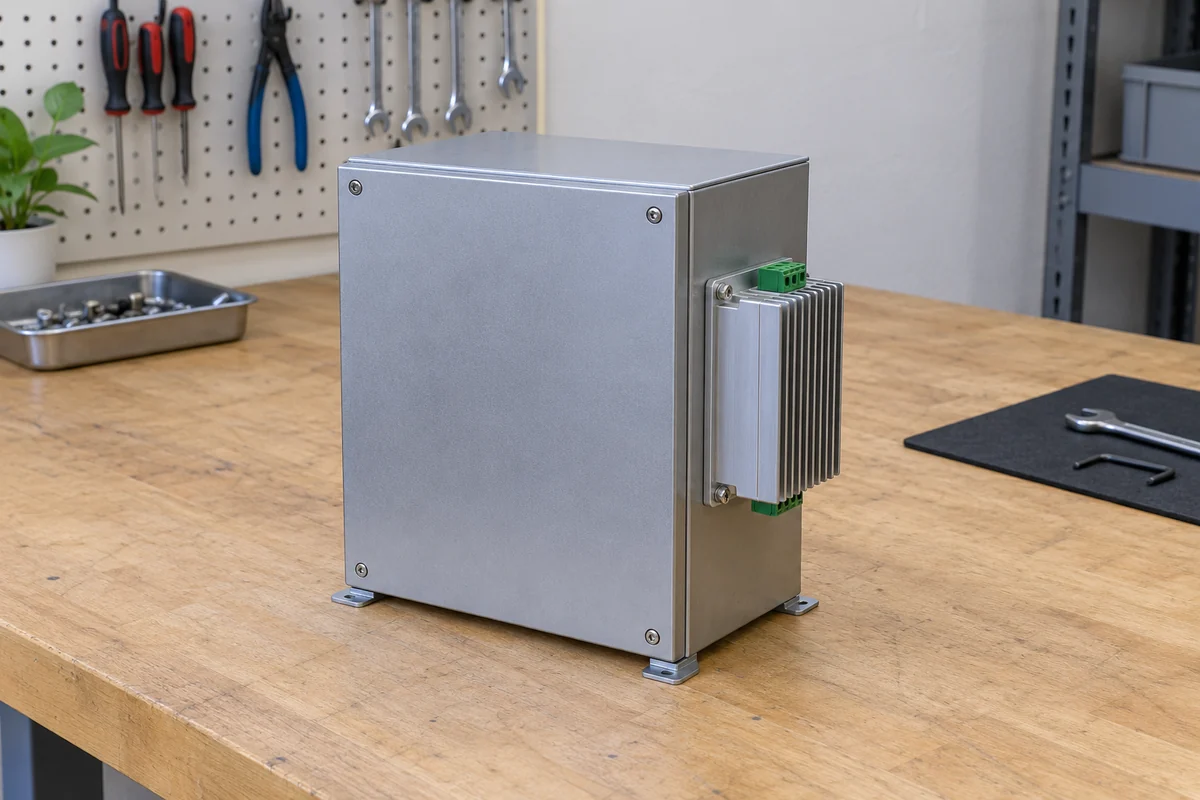
A free-standing passive supply rejects heat through its case and surrounding air. Position, spacing and orientation can therefore affect it. A conduction-cooled module transfers heat into a baseplate or chassis wall; contact pressure, interface material and the temperature of that wall now matter. A chassis-cooled module uses air delivered by the host. None of these heat paths can be assumed from an exterior photo alone. Read the manufacturer’s installation and derating conditions for the specific unit.
A wide rack can disguise a local hot spot. Air at the rack inlet may be cool while the PSU pocket behind a cable bundle sees warmer recirculated air. Conversely, a well-designed host fan wall may cool a fanless module effectively despite the absence of any visible fan at its rear face. The relevant temperature is the air or mounting surface specified for that PSU, not a convenient room reading several feet away.
Rack servers put different pressure on passive cooling
High-density rack platforms concentrate substantial output power into a narrow vertical and rear-panel envelope. A passive enclosure needs area and thermal mass, while a short hot-swap PSU prioritizes power density and removal through a bay. The resulting conflict does not make every fanless server supply impossible; it means that a claim must be understood within its platform. A host-cooled module can fit a dense server, but it still depends on forced air delivered by other fans. A truly passive assembly may be more plausible in a lower-power edge device or a chassis with generous conduction surfaces.
Module replacement adds a mechanical constraint. A removable PSU must slide through guides and blind-mate to a connector. A large external heatsink or rigid thermal attachment may prevent hot swap unless the platform is designed around it. A fanless fixed supply can use a different thermal connection, but then the service strategy changes. The installer should not infer hot-swap capability from a fanless power rating, or fanless capability from a hot-swap shape.
Power density also affects the acoustic promise. In a 1U server, removing the PSU’s small fan could reduce one noise source, yet the chassis controller may accelerate the remaining fans to compensate for added thermal load. Total sound may stay similar or even rise. An acoustic comparison has to use the same workload, ambient conditions, fan-control policy and measurement position; a component fan count alone cannot predict the result.
Some commercial results labeled “fanless server PSU” are actually desktop ATX products marketed for a workstation or small server. Connector form, standby rail, management signals, chassis fit and airflow assumptions may be different from a CRPS or proprietary server bay. The label should not turn a standard ATX supply into a supported replacement for a hot-swap server module. Start with the host’s accepted mechanical and electrical interface, then ask whether a fanless option exists within that boundary.
What happens when the server loses one cooling path
A redundant server can continue delivering electrical output after a PSU failure, but its thermal state changes. The remaining module may carry more load and produce more loss. At the same time, an empty or failed bay can change airflow. If a failed PSU’s fan was part of a shared flow path, losing it may affect more than that one module. If the module was host-cooled, a missing blanking panel can let air bypass the surviving supply. These mechanisms differ by chassis and cannot be inferred from a generic 1+1 label.
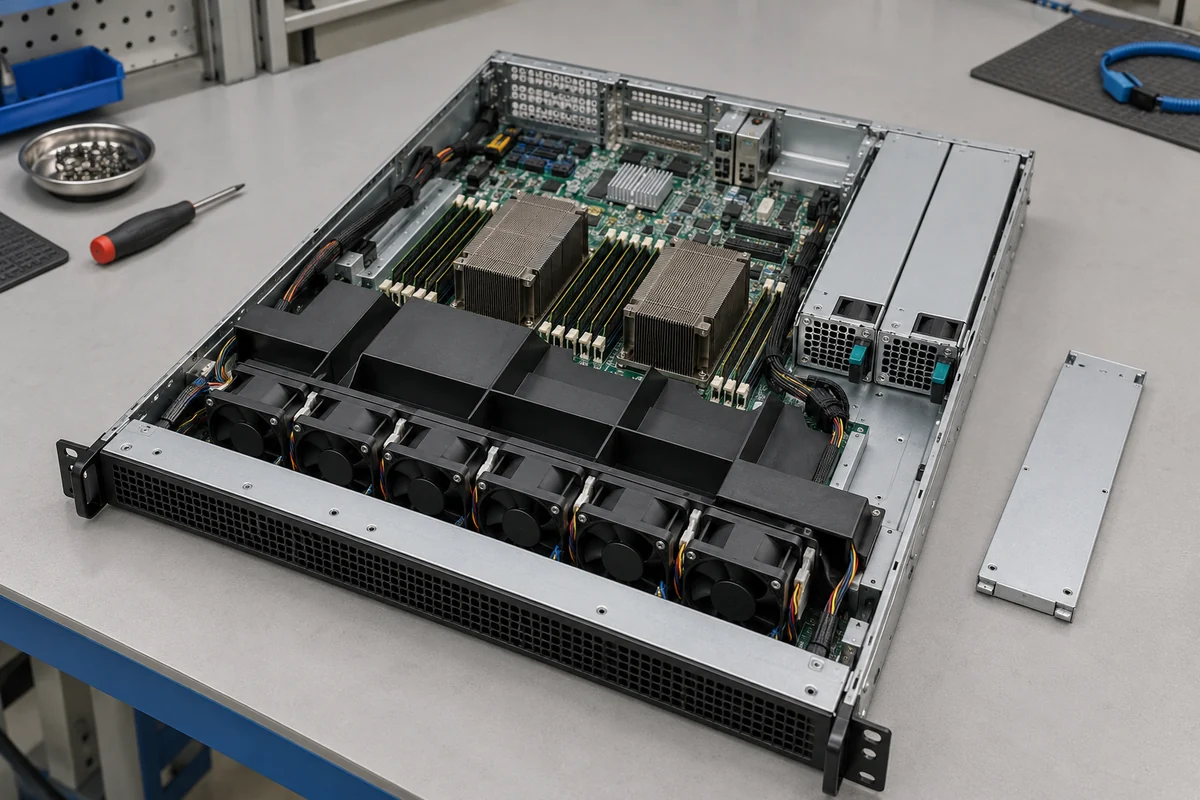
This matters especially when the fanless claim really means “no local fan; host fans provide cooling.” Those fans are a dependency of the power system. A power module can be electrically healthy while operating outside its thermal conditions after a fan-wall fault or airflow blockage. The host may respond with increased fan speed, throttling, alarms or shutdown according to its design. A correctly installed bay blank and the intended air baffle can be as relevant as the module’s nameplate.
For a truly passive server enclosure, the dependency shifts to the heat sink, chassis surface and ambient environment. Mounting a unit on a thermally insulating panel, enclosing it without the specified space, or adding adjacent hot equipment can change its operating point. The absence of fan bearings can remove one potential failure mechanism, but it does not eliminate thermal stress in capacitors, magnetics, solder joints or semiconductors. Reliability comparisons require the whole installed thermal profile.
Reading a fanless product claim without overpromising
The useful document is a model-specific datasheet or installation guide. Look for the output rating and its conditions, permitted ambient or baseplate temperature, airflow assumption, orientation, mounting surface, clearance, enclosure requirement and derating curve. If the manufacturer describes convection cooling, check whether the performance figure was measured in open air or inside an enclosure. If it describes conduction cooling, determine what temperature and contact interface the rating assumes. If it describes host airflow, identify the specified direction and any minimum cooling requirement.
Safety and system responsibility matter as well. An open-frame board with exposed circuitry cannot be treated like a finished enclosed server PSU merely because it has no fan. The final equipment must provide suitable mechanical protection, electrical spacing, grounding and cooling appropriate to its application. Conversely, a sealed enclosure may be mechanically robust but still lack a viable heat path for a high-output module. The word “fanless” does not answer either question.
A practical comparison begins with the real host. Record the bay or mounting envelope, required outputs and standby behavior, supported connectors and management signals, operating load, inlet or baseplate temperature, and service method. Then compare only products whose published conditions can be met. If the host has a strong fan wall, a PSU with no internal fan may be a sensible part of the platform. If the host must run without any fans, the heat must escape by passive air or conduction through an explicitly designed path. These are different engineering propositions.
Beware of translating a desktop “zero-RPM mode” claim into a server specification. The fan may remain stopped only at modest load or cool ambient; a server’s continuous duty and confined installation may place it outside that range. Likewise, an advertised maximum wattage may be achieved with forced air even if a lower power level is permitted by convection. The right comparison is not the top-line wattage versus a server’s typical load. It is the supported output under the actual cooling mode and temperature.
A quiet module is not necessarily a quiet system
Noise-sensitive edge deployments are a common reason to search for fanless power. A fanless PSU can help only if it removes a meaningful share of system noise without pushing extra heat into another fan-controlled zone. Where the chassis still needs forced air for processors and storage, optimizing the system fan path may have more acoustic effect than changing the PSU alone. If a server is designed around an integrated proprietary PSU, replacement with a passive supply may not be supported even when nominal wattage and voltage appear similar.
In an industrial cabinet, the appeal may instead be lower maintenance and less dust transport through the PSU. The cabinet still needs a controlled thermal route. A conduction-cooled PSU attached to a suitable chassis surface can be appropriate if the complete equipment is designed for that heat transfer. A nominally fanless open-frame board placed in a sealed hot box is a different and much weaker proposition. The installation conditions make the difference.
The answer to “Can a server power supply be fanless?” is yes, within a design that carries conversion heat away without a local fan. But that answer splits into passive, conduction-cooled and host-cooled cases. A server PSU with no internal fan can depend on chassis fans; a fan-stop PSU still has a fan; and a genuinely all-fanless server needs an adequate passive or conductive heat path for the entire machine. The exact module rating is meaningful only together with the cooling conditions that make it true.