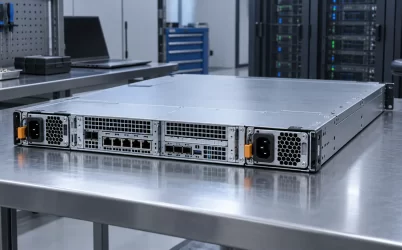
A server does not consume twice as much electricity simply because it has two power supplies. The processors, memory, drives, fans, and other loads still demand roughly the power their work requires. In a dual-PSU system, that output demand may be shared between two converters or supplied mainly by one while the other remains ready. The AC input is the server load plus conversion, fan, and standby losses, not the sum of the two nameplate wattages. Those losses can change with the operating mode, so two supplies need not draw exactly the same total AC watts as one.
A rack PDU may show two separate inlet readings; neither is the total by itself. A management controller may report output power, input power, or an estimate, depending on the platform. Compare at similar workload, input conditions, and cooling state while identifying load-sharing or hot-spare mode. Without those conditions, a claim that dual supplies “use more” or “save power” is too broad.
Two ratings describe available capacity, not a standing bill
Imagine a server with two modules each rated to deliver a specified maximum DC output. That rating is a ceiling under the applicable conditions, not a command for each module to draw its rated wattage continuously. A lightly loaded server can use a small fraction of that capacity. In a 1+1 configuration, each module may be capable of carrying the permitted server load alone; the second module supplies resilience, not a second copy of the workload.
Even “1+1” needs a platform check. Intel’s technical specification for one server family describes 1+1 redundant and 2+0 combined-power modes that depend on total draw. When draw exceeds one module’s capacity, the second can contribute output but redundancy is lost. That is a capacity distinction, not a doubling of consumption. A high-power accelerator population may need both modules; a lower workload can retain one-module survivability. Neither state can be inferred from a PSU label alone.
For energy accounting, separate DC output delivered to the hardware from AC input taken by the converters. The conversion loss becomes heat inside the server or power bay. The difference between those two quantities, plus any ancillary supply overhead, is the actual electrical penalty under that operating point. It is not equal to the unused output capacity marked on the second module. This also explains why unplugging one redundant PSU does not usually cut the server’s electricity use in half: the surviving converter now supplies most or all of the same hardware demand.
What a load-sharing pair looks like on A and B feeds
With both modules active and their inputs connected to separate A and B rack feeds, the platform may divide DC output between them. Near-equal sharing is possible, but it is not a universal 50/50 guarantee. Module tolerances, control behavior, firmware settings, input characteristics, and the particular power architecture can produce an uneven split. IBM’s hardware documentation describes approximately equal current in its normal load-sharing configuration; that observation belongs to the documented IBM equipment rather than every dual-PSU server.
A pair of rack-PDU inlet meters reports what the two AC cords draw, including each converter’s losses. To estimate this one server’s present AC input from dedicated measured outlets, add simultaneous real-power readings from both cords. If those outlets also serve other equipment, a PDU inlet total is not a server measurement. Do not add a PSU management figure to the PDU figure: they are different views of energy crossing related boundaries, and adding them double-counts some or all of the same flow.
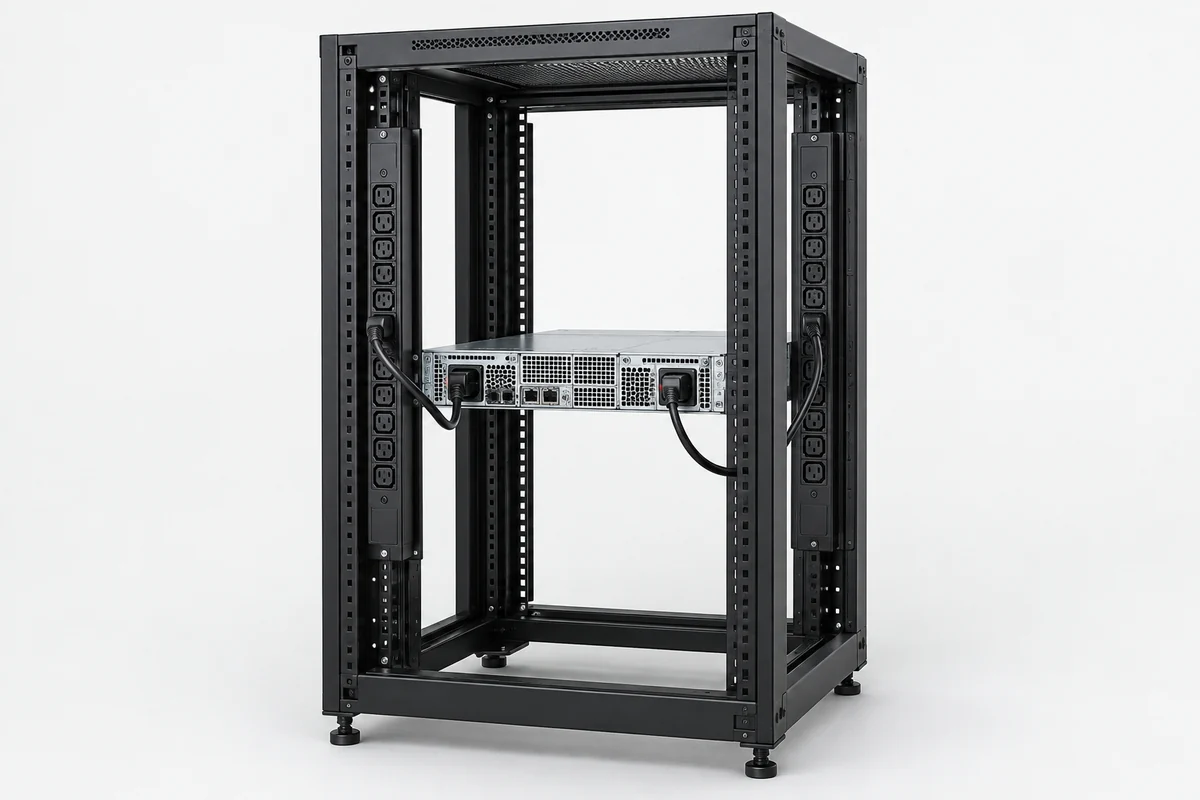
After one input feed or module is lost, its measured AC draw should fall, while the surviving input carries the continued server load if redundancy and capacity actually hold. The surviving cord’s reading can increase sharply without the server’s total useful workload doubling. Total AC input may shift somewhat because one converter now operates at a different load point, fans or control states may change, and the system may throttle or lose a component under an insufficient surviving capacity. Those are platform outcomes to observe, not a universal fixed percentage.
The power path matters as much as the arithmetic. A module failure can be tolerated without protecting against a shared upstream PDU or breaker failure. That reliability boundary is covered separately in Powernexu’s dual redundant server power supply architecture discussion. Here the point is narrower: separate feed readings tell where the existing load is entering, and the single-feed condition tells what the survivor must carry. A and B labels do not turn the server’s wattage rating into two independent energy bills.
Why the total AC watts can change when both supplies are active
PSU efficiency is not one fixed number at every output load. Two active modules serving the same server may each run at a lower fraction of their rating than one module would. Their combined conversion loss depends on the efficiency of those modules at those actual fractions, input voltage, temperature, and control state. The smaller individual losses can sum to more or less than the loss of one module at a higher load point. Nothing in the mere presence of a second PSU determines the sign of that difference.
A hypothetical calculation shows the scale without pretending to characterize a real model. Suppose the server hardware requires 600 W DC during a fixed workload. If two sharing modules each deliver 300 W at an assumed 90% efficiency, each draws about 333 W AC and the pair draws about 667 W. If one module instead delivers the whole 600 W at an assumed 92% efficiency, its input is about 652 W. The illustrative difference is roughly 15 W, not 600 W or one entire PSU rating. It would reverse if the actual efficiency curves favored the two-module operating points. Real equipment must be assessed from measured input or model-specific efficiency data, not from these assumed percentages.
At very light server load, fixed overhead can be more visible relative to useful output: control circuitry, an energized converter, and possibly a fan all consume something. At higher output, converter efficiency and cooling behavior may dominate the comparison. Two modules do not necessarily have identical thermal conditions in a chassis, and a fan curve may change when only one module is doing the work. This is why a single idle snapshot should not be extrapolated into a full annual-cost claim for a server whose utilization changes substantially through the day.
A certification tier can inform likely efficiency, but it cannot directly resolve the dual-versus-single question. It is awarded under defined test conditions and load points; the server’s actual operating point may lie elsewhere. A higher-tier pair at low utilization and a lower-tier single module at a favorable load point cannot be compared honestly by badge alone. The hardware load, input voltage, active PSU mode, and actual efficiency curves are needed before the conversion loss is known.
Hot-spare modes alter the sharing pattern
Some servers can deliberately reduce load on a redundant PSU at low demand. The active module carries most of the output while the other enters a lower-power standby state, then the platform brings it back when needed. This is a control feature, not a generic property of all dual-PSU designs. Dell’s iDRAC power-supply options documentation describes a hot-spare feature that turns redundant PSUs off according to server load and warns that this can leave A- and B-circuit readings unequal. Its behavior should not be generalized to other firmware or platforms.
A low reading on the standby feed therefore need not mean its cord is unplugged or its module is defective. Equally, the existence of a “hot spare” setting does not by itself prove a particular standby wattage or switchover behavior. Read the server’s own power-management status, firmware mode, supported PSU pairing, and event log. If the operator expects balanced A/B feed draw for a facility policy, a power-saving mode that parks one module can produce a surprising imbalance even while module redundancy remains enabled. Site feed planning and server energy optimization can pull in different directions.
Changing this mode should be an intentional platform decision rather than an improvised energy experiment on production equipment. A server might require both modules active for a larger installed configuration; another may switch modes as load changes. An apparent savings during a quiet window may disappear under sustained compute load. Compare the server’s input under representative operating states and retain the manufacturer-supported mode for the intended redundancy and capacity. Do not force a secondary module off merely to improve a meter number when one-module operation would sacrifice the availability requirement.
Make sure the two numbers describe the same boundary
“Server power” in a management dashboard may be estimated DC output, measured PSU input, average system power, or a telemetry value sampled over a specified interval. Rack PDUs usually show AC at their own metering boundary. A facility meter includes more than one server and may include distribution losses. A comparison of 600 W in one interface with 670 W in another is meaningless until the units, measurement point, and sample time are identified. It may simply be a reasonable output-versus-input distinction.
For an installed dual-cord server, simultaneous outlet-level real-power measurements are especially useful because they reveal both total AC input and the A/B split. If only PDU inlet meters are available, identify what else shares each feed before attributing the values to the server. If BMC telemetry is used, read the platform’s definition and whether it is per-PSU or system-wide. Summing two “system power” figures would count the same load twice, while reading only one PSU’s input would omit the other in an active-active state.
A before-and-after test is weak if processor load, drive activity, inlet temperature, or fan speed changed. Use a controlled workload or comparable windows, and report both PSU modes. Simultaneous A and B traces reveal a hot-spare transition: one feed can fall while the other rises, with total input changing much less. The useful result is the sum and its context, not whichever cord reading is lower.
What changes when one module disappears
Loss of a module makes the distinction between consumption and capacity immediately visible. The surviving PSU may now deliver approximately the output previously supplied by both, provided it has the necessary capacity at the actual input voltage and temperature. Its AC inlet draw rises accordingly, while the failed side falls away. If that remaining output capacity is insufficient, the server may throttle, shed load, or shut down according to its design. A falling total input at that point is not an energy-efficiency improvement; it may be lost compute work.
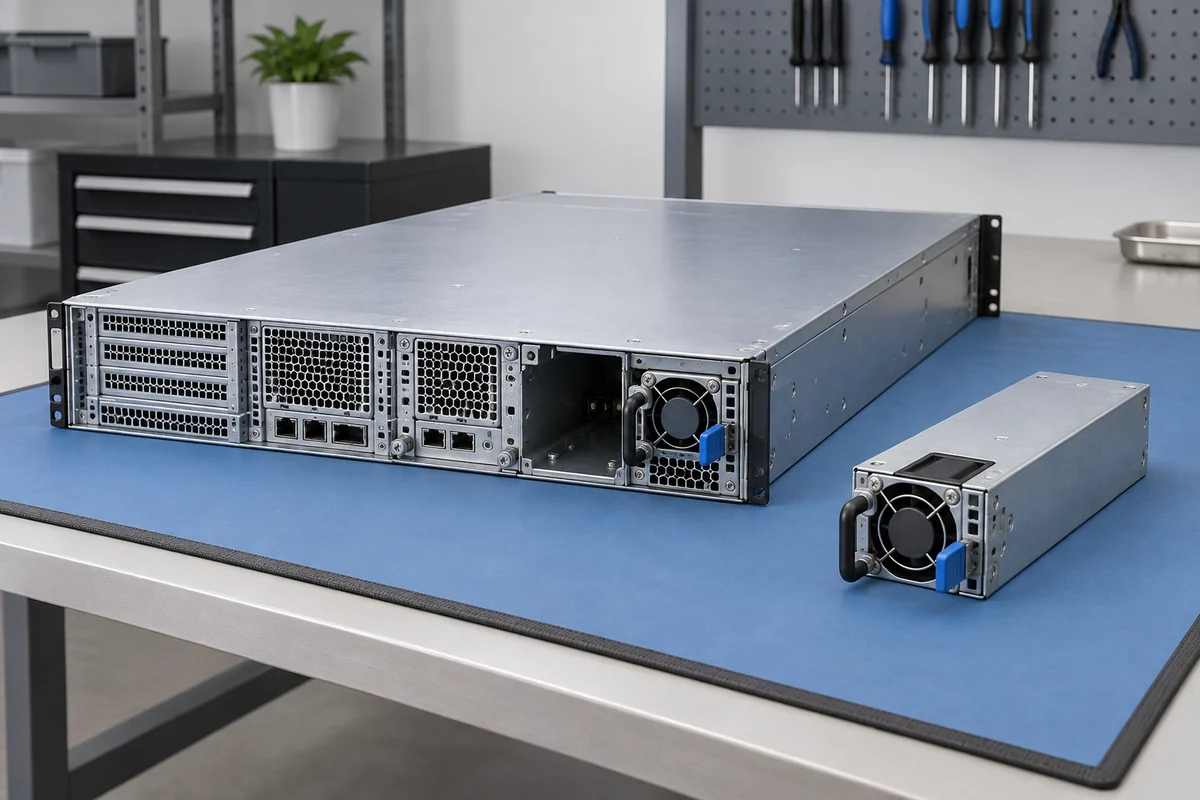
In a properly supported 1+1 state, the two installed ratings are not added to produce the amount of protected server load. In a 2+0 state, both may be needed for the installed workload, and a single-module loss is no longer a redundant operating event. Intel’s documented automatic distinction for its R2000WF family illustrates this exact risk; other platforms must be checked on their own terms. This capacity fact matters to energy interpretation because measurements taken while a server is throttling cannot be compared as though it maintained the same workload.
For a site trying to reduce electricity use, the defensible answer is to measure total AC input across both cords during representative work, identify the server’s active PSU policy, and compare configurations at equal useful output. Two supplies generally do not double consumption. They can add or reduce conversion overhead relative to another operating mode, depending on the actual efficiency curves and management behavior. The unused module rating remains reserved capability; it is not a continuous load on the meter.