A 2U server case does not define a power-supply form factor. Some 2U cases accept an ATX/PS2-style supply, while others are built around a smaller Flex ATX unit or a removable CRPS assembly. The answer to “which power supply fits?” starts with the exact case model and its configured PSU bay, not with the rack height or the wattage printed on a converter. Identify the supported format, the mounting hardware included with that case, and the space left for its cables and airflow. Only then is an electrical rating useful. A nominally suitable PSU can still be impossible to mount or connect in a particular 2U chassis.
“2U” describes the enclosure height, not its PSU socket
Rack units constrain the outside height of the case. They do not prescribe the shape of the rear PSU opening, the location of mounting holes, the direction of airflow, or the connection between a power module and the system board. That is why searching for a “2U power supply” without a chassis model returns several physically different answers. A desktop-style supply bolted into a rear opening and a blind-mate cartridge inserted into a redundant cage may both power 2U servers, yet neither replaces the other without the corresponding case hardware.
Start with the chassis maker’s PSU support line and exact configuration identifier. Look for a named form factor, maximum supply depth where specified, included power hardware, and any optional cage. Photographs can reveal a rear opening, but not the electrical mating interface or the contents of a kit. A listed PSU “option” does not mean every case ships with it.
Published case specifications illustrate the distinction. Fantec SG-220 datasheet describes a 2U case supplied without a PSU and intended for an ATX PC power supply. Rosewill specifies a PS2 (ATX) supply for its RSV-Z2600U and explicitly states a maximum PSU length of 150 mm. Chenbro’s RM24100 family presents single Flex ATX and 1+1 CRPS power configurations as different options. Those are three case-specific examples, not a claim that every ATX, Flex ATX, or CRPS unit fits every chassis using the same category name.
| Published case example | PSU support stated by the maker | What the shopper still needs to resolve |
|---|---|---|
| Fantec SG-220 | ATX PC power supply; case supplied without one | Physical and electrical fit of the particular ATX unit and the rest of the build |
| Rosewill RSV-Z2600U | PS2 (ATX) supply, with a 150 mm maximum PSU length | Depth, cable exit, and interference in the chosen component layout |
| Chenbro RM24100 family | Single Flex ATX or 1+1 CRPS power options, depending on configuration | Which option, cage, distribution hardware, and mating parts are actually ordered |
This is not an interchange list. Chenbro’s official chassis listing shows configuration-dependent power options, not approval for an arbitrary CRPS cartridge. The exact option code and supported accessories matter.
ATX support still leaves a depth problem
An ATX or PS2 designation narrows the search, but it does not erase the rest of the 2U geometry. In a shallow case, the PSU body can occupy space that a drive cage, motherboard edge, fan carrier, or cable bundle would otherwise use. The Rosewill example is unusually clear because its published PSU-length limit is part of the case specification. A longer ATX supply is not made compatible by having the right screw pattern and output rating. Even below a stated length limit, a modular cable plug may need room beyond the metal body before the wires can turn safely.
Trace the output leads to the board and storage hardware. Limited space behind the supply may favor fixed leads over bulky modular plugs. An expansion-heavy build can put a cable bundle in a fan inlet even when the PSU body meets a published depth limit. That limit is not a promise that every cable combination clears nearby components.
The ATX unit’s own fan arrangement must also suit the case. A PSU that normally draws air through a large face needs an unobstructed intake at that face; its exhaust should not be trapped against an interior panel. The rack’s front-to-rear cooling convention does not automatically tell you how an ATX PSU mounted inside a particular case breathes. Inspect the case’s ventilation openings and the proposed supply’s intake and exhaust surfaces together. In a 2U enclosure, turning a supply to solve screw alignment can put its fan against metal, so the approved mounting orientation matters.
For a physical fit study, the useful drawing is the complete rear bay and nearby internal volume, not an isolated PSU silhouette. Include the mounting plane, PSU body, cable exit, adjacent drive or board, and nearest fan. Outside case depth can mislead because panels, brackets, connectors, and cable bends consume space. A supported-PSU list applies to the cited case revision, not every supply sharing the ATX label.
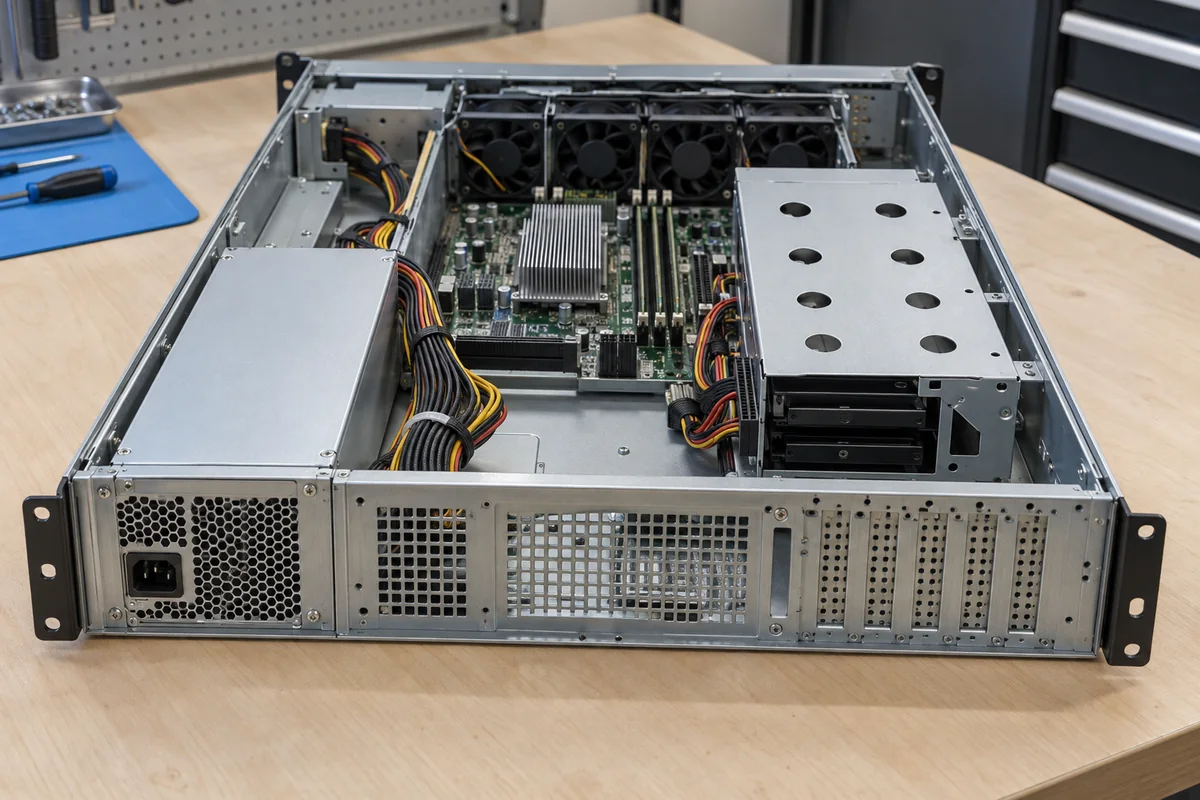
A Flex ATX position is not a scaled-down ATX hole
Flex ATX supplies can make a compact 2U layout possible when the chassis is designed for them, but an ATX-to-Flex substitution is not simply a smaller box in a larger space. The rear cutout, fastening points, power-cord position, airflow direction, and output cable arrangement are part of the case design. A loose Flex ATX unit in an ATX bay may have nowhere to secure its rear face; an ATX unit cannot occupy a narrow Flex ATX channel because it has more power on its label. Brackets or case-specific conversion hardware must be confirmed rather than presumed.
Chenbro’s alternative power configurations refer to different assemblies. A reseller listing only the chassis family name has not identified its rear panel or included power hardware. The family name does not authorize a format switch without matching parts, especially when the case and supply are bought separately.
Flex ATX can also shift where the wiring and airflow burden lands. A long narrow supply may fit beside a board where an ATX block would not, but its cable outlet still needs a route to the load without pressing on an inlet or access cover. The case maker’s mechanical description and the selected PSU’s dimensional drawing answer different questions: the first identifies the permitted location; the second shows whether the actual unit and its leads occupy that location cleanly. Neither document by itself establishes that their electrical connectors suit the intended board.
CRPS needs the cage and power-distribution path
In a CRPS-configured case, the removable converter is only the visible end of an assembly. The module normally slides into a guided bay and mates with an internal connection. The cage, connector, power-distribution board or backplane, downstream harnesses, and control wiring belong to the chassis power architecture. Buying two cartridges for a case configured only for one fixed supply does not create redundancy. Conversely, a chassis advertised with a CRPS option may require a particular cage and distribution kit before any cartridge can be installed.
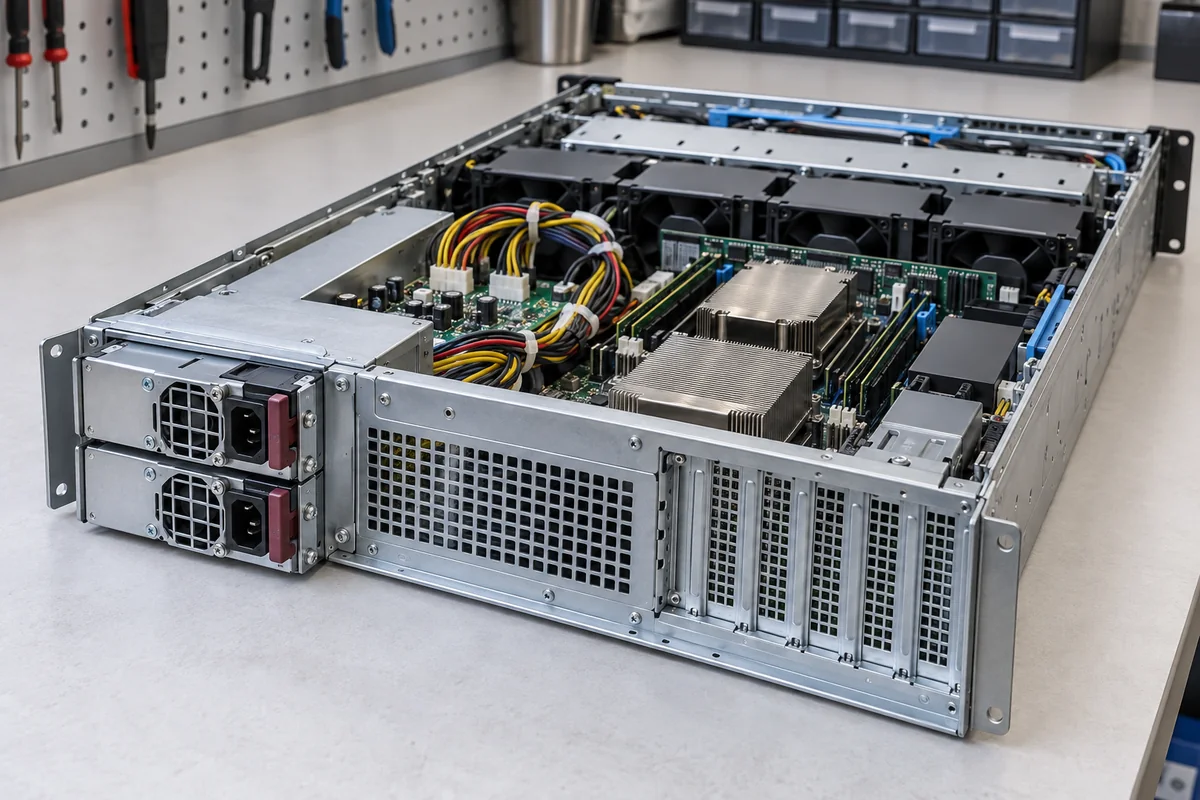
“1+1” describes a redundant arrangement, not permission to add both label ratings when sizing the protected load. One surviving module may need to carry the machine after its partner is lost. That electrical question follows identification of a real dual-module bay; it cannot correct an incompatible mechanical interface.
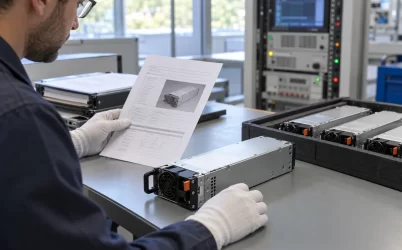
Blind-mate connections are especially unsuited to visual guessing. Similar-looking removable PSU cartridges can differ in envelope, guide rails, latching, connector location, signal arrangement, and the system’s management expectations. A seller’s description of a cartridge as “CRPS” is not an approval for the Chenbro example or another particular chassis. Find the case manufacturer’s supported module or assembly information, then compare the proposed PSU against that support. Do not assume that a Powernexu module, or any other branded module, is interchangeable merely because its wattage and general shape appear plausible.
If the cage or PDB is missing from a used chassis, replacement CRPS modules alone may be unusable. Obtain photos or a bill of materials identifying the rear assembly, not merely the case exterior. Where multiple options exist, the configured part number matters more than the family name.
The case option determines what “power supply included” means
“With power supply,” “power supply optional,” and “supports redundant PSU” describe potentially different shipments. One may include a mounted converter; another may provide only an opening; a third may advertise a separately sold cage and modules. Missing the distinction can leave an integrator without a rear panel, PDB, harness, AC inlet, or mounting kit.
For a bare case, ask what occupies the PSU bay in the item actually offered. An ATX rear opening and depth limit answer part of that question. A modular CRPS case calls for cage and supported-module information. Do not transfer a power option from one Chenbro variant to another; the seller’s stock number and delivered hardware should match the manufacturer’s configuration.
There is a second boundary between the case and the computer. A PSU may mount properly while its output harness does not provide the board, storage backplane, or expansion hardware with the connectors they require. Conversely, a harness with apparently suitable plugs can belong to a unit that will not mount or cool correctly. Keep those questions separate: the chassis determines the mounting and airflow envelope; the load hardware determines the required electrical outputs and mating connectors. This separation helps prevent an attractive but unusable purchase from being justified by one matching detail.
Use the fitted format to size the electrical supply
Once the case’s supported architecture is clear, estimate the intended system load and compare it with the specific supply’s output capabilities. CPU, memory, drives, fans, add-in cards, and any accelerator hardware contribute to the load; their rail distribution and transient behavior matter as well as their aggregate power. The goal is not to select the largest printed wattage that can be found in the nominal form factor. A physically suitable unit still needs appropriate outputs, protections, cooling conditions, and input support for the deployment.
For example, an electrically capable ATX supply can still collide with a drive cage. In a different hypothetical case, a fitted 1+1 CRPS assembly can be mechanically sound while one surviving module is insufficient for the load. The first is a mounting failure; the second is a capacity failure. Neither is resolved by the phrase “compatible 2U PSU.”
Input conditions can affect which module rating is available, and a case’s cooling arrangement can limit sustained output in the installed system. Use the selected PSU’s actual documentation for those conditions. A claim that an unspecified 2U case supports a particular wattage would be unreliable; two cases of the same height can have different power openings, cooling hardware, and accessory paths. If the proposed build is unusually dense, the 2U server power-supply layout discussion covers internal space and airflow as a broader system design question. It does not replace the case-specific bay information needed here.
What to do when the case listing is incomplete
An incomplete listing is common with second-hand server cases and configurable industrial enclosures. The productive response is to identify the missing piece of compatibility evidence, not to infer a form factor from the 2U height. A rear photo can distinguish a rectangular fixed-PSU opening from a cartridge cage, but it may not identify the exact cage or board behind the panel. The manufacturer’s model and option code, installation manual, supported PSU assembly, and photographs of the delivered rear hardware together provide a much firmer basis than a marketplace title.
If the case is in hand, inspect it before ordering a converter. A fixed opening needs its bracket and fasteners; a removable bay needs its guide and intact mating assembly. The AC entry and fan path should suit the intended orientation. Do not probe a live backplane to identify a part. If documentation omits the assembly or supported supply, obtain the exact kit information from the chassis seller or maker.