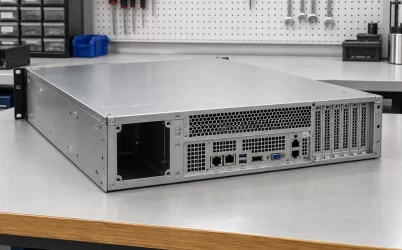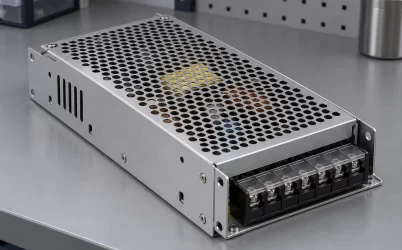
A redundant server power supply can be quiet at its usual workload and noticeably louder after one module stops carrying power. “Quiet” is therefore a property of the installed server in a defined operating state, not a reliable adjective for a loose PSU cartridge. Two healthy modules may share the load; a supported efficiency mode may place one in standby; and a fault may push the entire load onto the survivor. Those states change converter heat, fan behavior, and sometimes chassis cooling. For an office rack or edge cabinet, compare sound with both supplies healthy and with one unavailable, while preserving the host’s approved power and thermal settings. No general dB rating can substitute for that state-specific evidence.
Two installed modules do not make one acoustic condition
In an active 1+1 arrangement, both power modules may deliver output during normal service. Each then handles some fraction of the server’s DC demand, subject to the platform’s current-sharing policy. Two fans are present, but each converter may dissipate less heat than a sole converter carrying the full load. It is not technically sound to assume that the pair will be twice as loud as one module, nor that splitting the load will always be quieter. Fan control, idle losses, fan size, airflow resistance, and tonal character can defeat either shortcut.
At low server utilization, two running PSU fans may contribute a steady rear-of-rack sound even when neither module is hot. At higher utilization, sharing may prevent one module’s fan from reaching a louder speed range. The point where that balance changes belongs to the exact PSU and chassis design. A datasheet that states one acoustic figure without its loading and inlet temperature does not reveal how a pair behaves across the server’s workday.
Listen beyond the PSU grille as well. A rack server may have a separate fan wall, drive noise, and airflow turbulence at the rear perforations. A listener standing beside a server may attribute a rising tone to a PSU simply because the rear bays are easy to locate. The quieter module option, if one exists and the host supports it, will not cure a fan-wall problem. The separate discussion of noise sources in a 1U server explores that attribution problem; the question here is what changes when the power system moves between redundant states.
A standby PSU can be electrically idle without being acoustically absent
Some server platforms offer a high-efficiency or cold-redundancy mode that concentrates output on one module while another remains ready to contribute. This can shift the active converter closer to a favorable efficiency region and reduce losses in the secondary path. It does not mean the standby cartridge is disconnected, that its fan is guaranteed to stop, or that the system has abandoned redundancy. The exact standby behavior is controlled by the host and module combination.
For example, The HPE Modular Common Redundant Power Supplies QuickSpecs describes HPE ProLiant power domains with identical M-CRPS modules in which a high-efficiency mode designates primary and secondary supplies. Its documentation treats this as a platform setting, not a universal feature of every CRPS module. A server may periodically run a standby fan or change its fan policy to check hardware and maintain cooling. The audible result can be a low continuous sound, intermittent pulsing, or little change from load-balanced operation. Those possibilities should not be turned into a general claim about a product family without host-specific documentation.
A quieter idle mode also has a cost in acoustic predictability. The active module bears more conversion load; an increase in computing demand can bring the secondary online before a failure, changing the sound even though both modules are healthy. A room that must remain quiet during brief load bursts needs more than an idle recording. It needs the operating range in which the standby mode remains active, and a realistic understanding of how the transition sounds in the installed rack. The electrical behavior of that mode is covered separately in the article on cold redundant power supplies; acoustic behavior is an additional system-level question.
The survivor can become the loudest normal part of a fault
When one module fails, loses its input, or is removed, the surviving path may need to deliver the server’s full permitted load. Its conversion losses and internal temperatures can rise, so its fan may accelerate. That response is protective, not necessarily a defect in a supposedly quiet PSU. The precise change depends on load, inlet air, fan-control design, and whether the server reduces performance under the fault policy. If the full workload is not supported by one module, a power cap or shutdown can change the acoustic pattern again; neither outcome should be inferred from the nominal pair of wattage labels.
The missing cartridge can also alter airflow. In a chassis designed around two occupied bays, an empty opening may become a bypass route unless the manufacturer provides an appropriate blank or service procedure. A failed module left in place can present a different restriction from a fully removed module. The server’s main fans may react to temperatures or fan faults independently of the PSU fan. An apparent “loud PSU after failure” may therefore consist of a faster surviving PSU fan, faster chassis fans, or both.
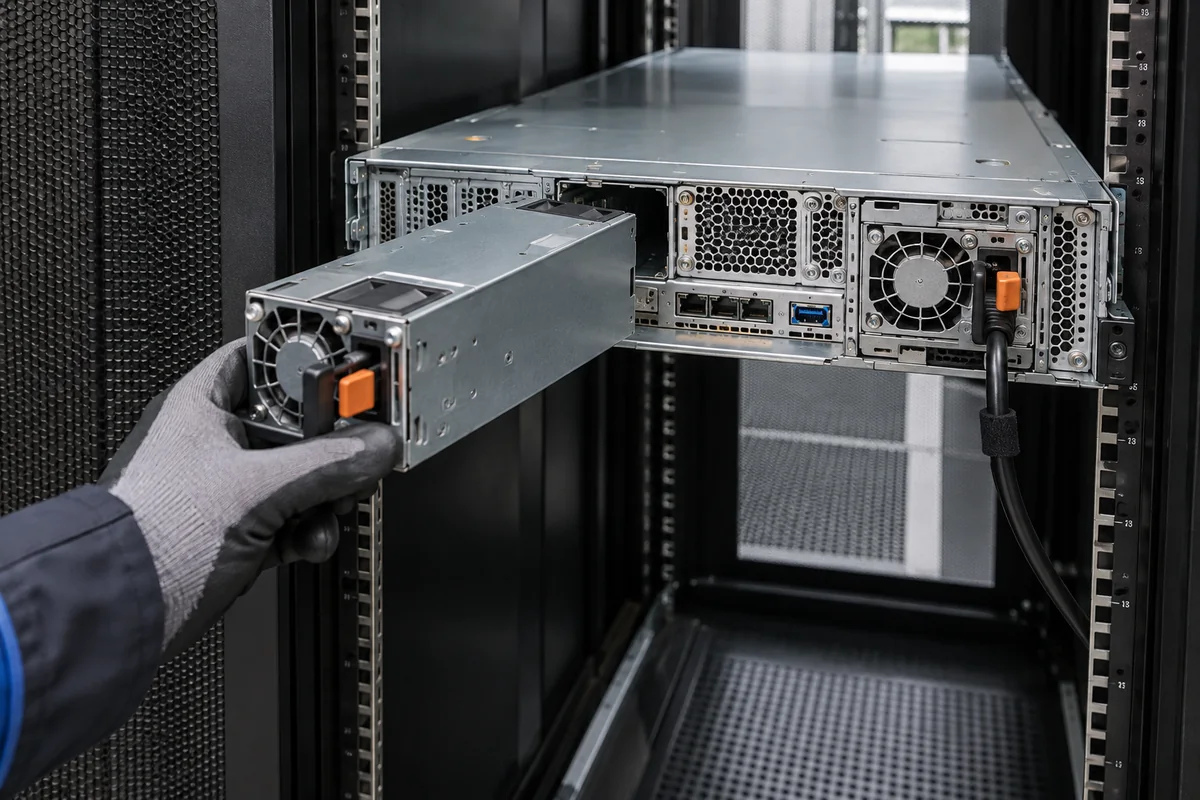
There is a useful distinction between fault tolerance and constant acoustics. A properly protected server can remain available while making considerably more noise for the duration of a fault. Trying to force the survivor’s fan to its ordinary speed would erase the thermal margin that allows continued operation. If a deployment cannot tolerate even temporary higher sound, the architecture may need more headroom, a different chassis cooling arrangement, or physical separation from the occupied room. Software fan overrides and improvised fan swaps are poor substitutes for a supported acoustic design.
Power restoration is another transition. Reinserting or re-energizing a module may prompt identification, self-test, fan spin-up, and redistribution of load. The pair can settle at a different acoustic point if its management mode changed during the fault. A short increase during recovery is not, by itself, evidence of incompatibility; persistent hunting, repeated alarms, or abnormal temperature is more concerning. The meaning of each event comes from the platform’s service documentation and its live status data, not a generic promise that redundant PSUs operate silently.
“Quiet” numbers are comparable only under the same sound test
Acoustic specifications can describe different quantities. Declared sound power characterizes the equipment as a sound source; sound pressure at a listener position depends on distance, room surfaces, rack doors, and background noise. A figure expressed in one form should not be ranked directly against a figure in the other form merely because both use decibels. A-weighting, operating state, load, inlet temperature, and measurement standard all matter. A reseller’s unqualified “quiet” label is weaker evidence than a manufacturer’s test report that names those conditions.
The Intel Server System SC5650HCBRP Technical Product Specification, Revision 1.2 (April 2010), section 4.1.1.2, gives a particularly instructive example: it calls for acoustic evaluation of a specific 600W PSU cage in both 1+0 and 1+1 configurations and ties PSU-fan speed to loading and inlet temperature. The same document describes its sound-power measurement and reporting methods. Its model-specific limits are not a target for today’s unrelated hardware; the transferable lesson is that redundancy state is part of the test setup. Consult the Intel server-system specification for that documented example, not for a universal server-PSU noise rating.
When comparing two candidate platforms, put their acoustic data on the same basis. A load-balanced pair at a cool inlet cannot be compared honestly with a single surviving module tested at a hotter inlet. Nor should an individual PSU’s bench result be treated as the noise of the assembled rack server. Ask what was populated, how many modules were active, what the DC load was, where air entered, and which fans were included in the measurement. A vendor may have excellent module data yet no published whole-server acoustic result for the intended drive and fan population.
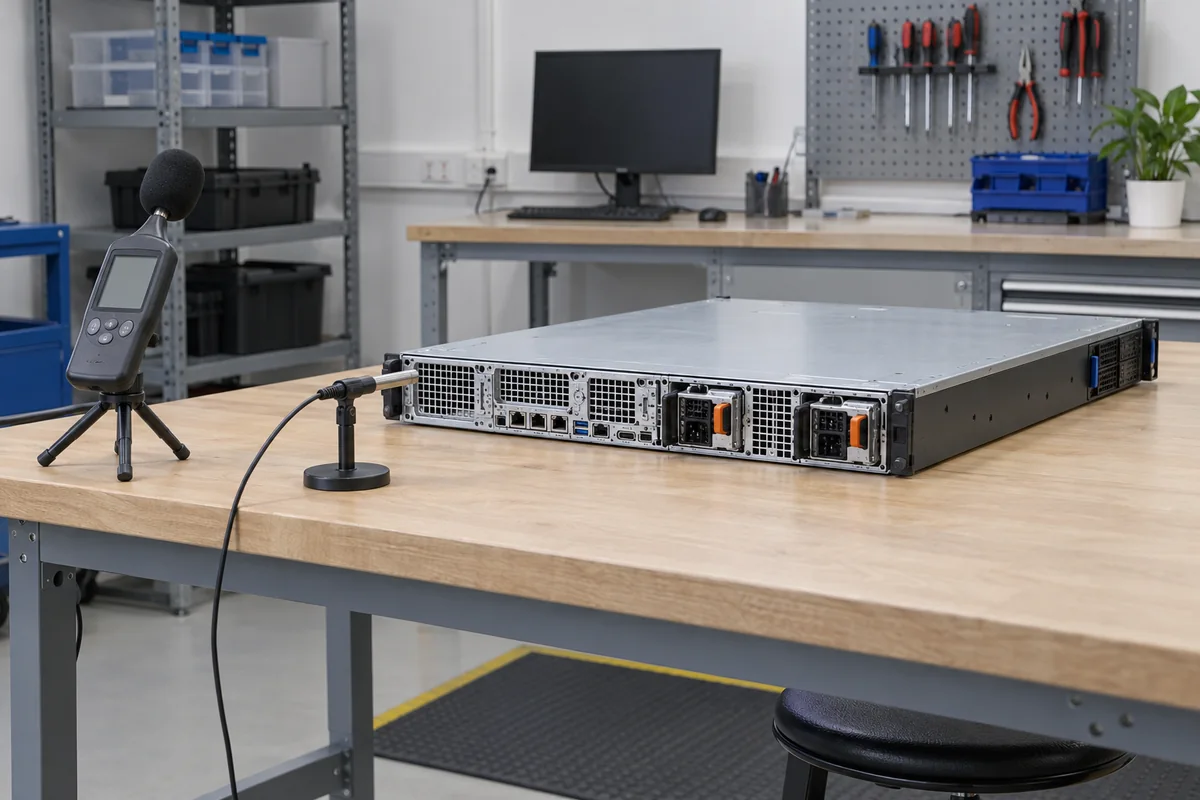
Tonal quality matters to occupants as well as the aggregate level. A high-pitched narrow fan tone or an intermittent pulse may be more objectionable in a small office than a steady broadband airflow sound with a similar reported level. The acoustic specification may not capture that subjective difference. If the target environment is sensitive, a representative listening test at the same operating states can reveal it without pretending that one person’s impression is a laboratory rating.
The rack and room can amplify a sound that the module did not create
A rack near a desk is not the same acoustic environment as a data-center aisle. Hard walls can reflect rear exhaust noise, a perforated door may add turbulence, and an enclosed cabinet may muffle one frequency while raising inlet temperature. The latter can cause every fan in the system to speed up, defeating the cabinet’s apparent benefit. A quiet installation should preserve the cooling path and the rack’s service access; sealing a server in a small box without an exhaust route changes the thermal problem, not just the sound.
Source identification should be performed while the server remains in a supported state. Compare the sound near the PSU bays, chassis fan region, and rack exhaust; watch platform-reported fan speeds and temperatures where available. If the room becomes louder after an input feed is lost, the relevant evidence is the timeline: which PSU changed output, which fan domains accelerated, and whether any temperature or fault alarm appeared. Those observations help distinguish normal degraded cooling from a failing fan bearing or repeated standby-mode cycling. They do not justify disabling alarms or bypassing a fan safety floor.
A product page may state that a server PSU has adaptive fan control. That is meaningful as a feature description, but it is not a measured acoustic promise in a particular chassis. The same module can face different inlet temperatures or system airflow restrictions in two approved applications. No Powernexu model should be presented as a quiet drop-in replacement here without verified host fit and acoustic data for the intended configuration. If a specific host has an officially supported low-noise module option, that option is a better starting point than a visually similar cartridge selected by a marketing adjective.
An office-rack example has three sounds, not one
Imagine a small edge server beside a staffed workspace. Its ordinary workload is modest, but it must keep running if one PSU or feed fails. With two supported modules sharing power, the room hears two converter fans plus the chassis cooling system. A supported standby mode might reduce one module’s steady contribution, although it could introduce occasional fan activity or a load-triggered transition. Neither normal arrangement says what occupants will hear when a module actually becomes unavailable.
In the degraded state, the survivor takes the load permitted by the platform’s policy. The fan and chassis may speed up until the fault is serviced. If staff cannot tolerate that temporary sound, the answer is not simply to order the cartridge with the lowest advertised noise number. The server may need to sit in a ventilated equipment room, use a host-approved power and cooling configuration with more acoustic margin, or accept a documented service interval in which the room is louder. Those are real trade-offs between availability, proximity, and cooling.
For this deployment, a useful acceptance statement is specific: the installed server remains within its approved thermal and electrical operating conditions during ordinary 1+1 service and the defined single-module event, while its sound in both states is suitable for the room. The first part can be checked against host and PSU documentation; the second needs comparable acoustic evidence or a representative on-site observation. “Quiet redundant PSU” is too short a specification to capture either state.