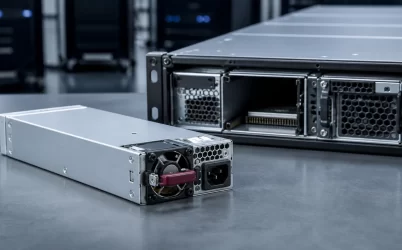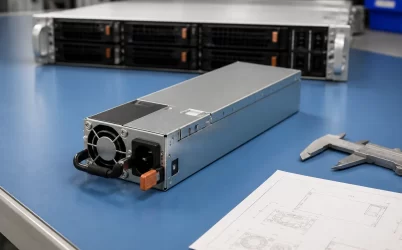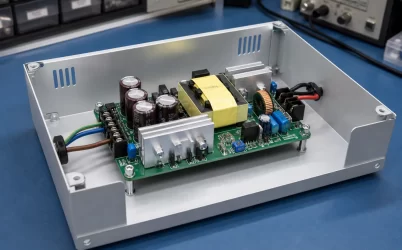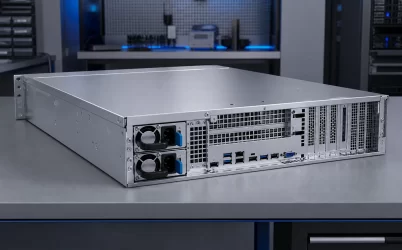
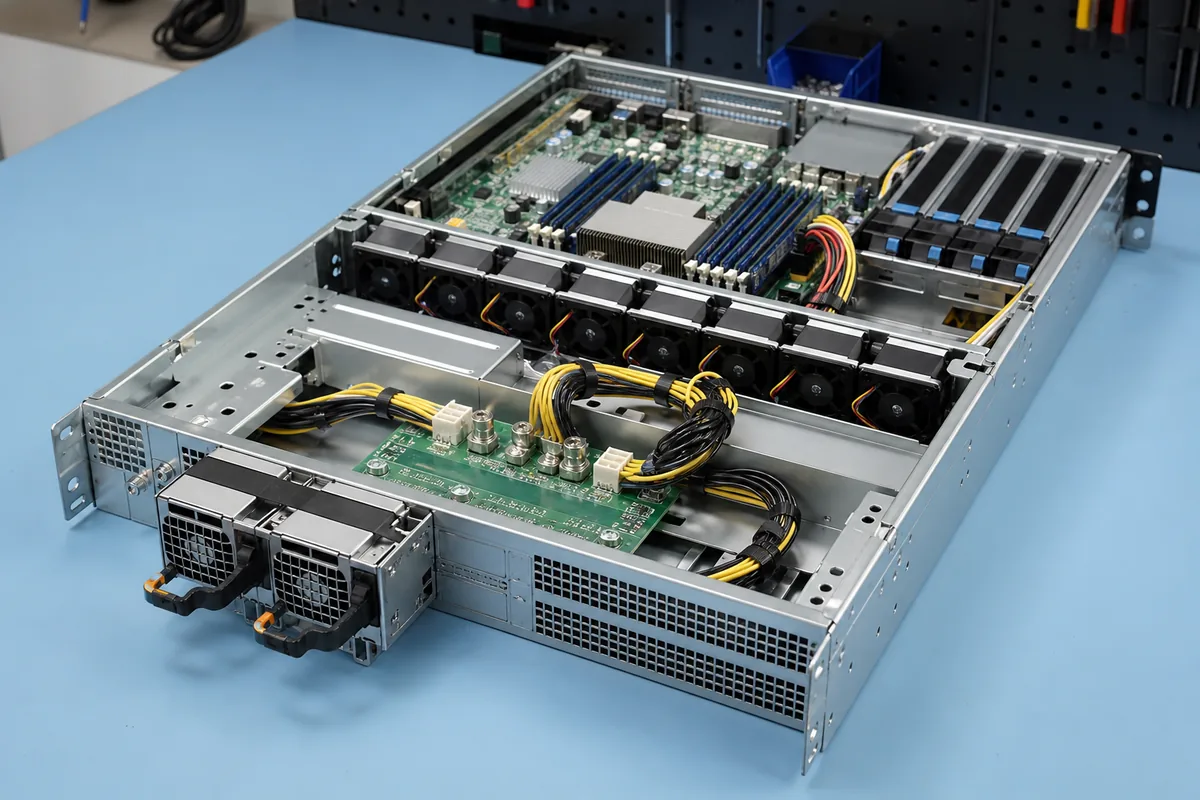
An 850 watt CRPS server PSU quote cannot be compared correctly until the seller states what the line item actually contains. The same search phrase may lead to one removable module, two modules sold as a pair, or a complete 2U 1+1 assembly with a cage, power distribution board (PDB), and harnesses. Before comparing price, normalize every offer to an exact manufacturer, model, revision, module quantity, included hardware, documented rating conditions, and supported host configuration. In a protected 1+1 system, capacity must also be evaluated with one source unavailable; adding two 850W labels does not establish 1,700W of redundant capacity.
Quick answer: identify the product boundary first
Ask each supplier whether “850W CRPS” means one PSU module, a two-module set, or an integrated redundant assembly. Require exact ordering identities and model-specific evidence for output conditions, dimensions, interfaces, efficiency, management, airflow, and redundancy. Compare capacity, platform compatibility, and commercial completeness as three separate questions. A low quote for one module is not equivalent to a higher quote that includes two modules, the mating PDB, cage, output harnesses, and required accessories.
The noun behind 850W sets the scope of purchase
CRPS commonly refers to a Common Redundant Power Supply module intended to work within a coordinated server power ecosystem. The keyword does not establish how much of that ecosystem is included. A product title may emphasize the removable converter, while another seller uses similar wording for the complete power assembly.
| Offer type | Likely physical scope | What remains unresolved |
|---|---|---|
| Bare module | One removable AC-DC PSU | Mating bay, PDB, harnesses, host approval, pairing policy, and whether the listed rating applies under the deployment conditions |
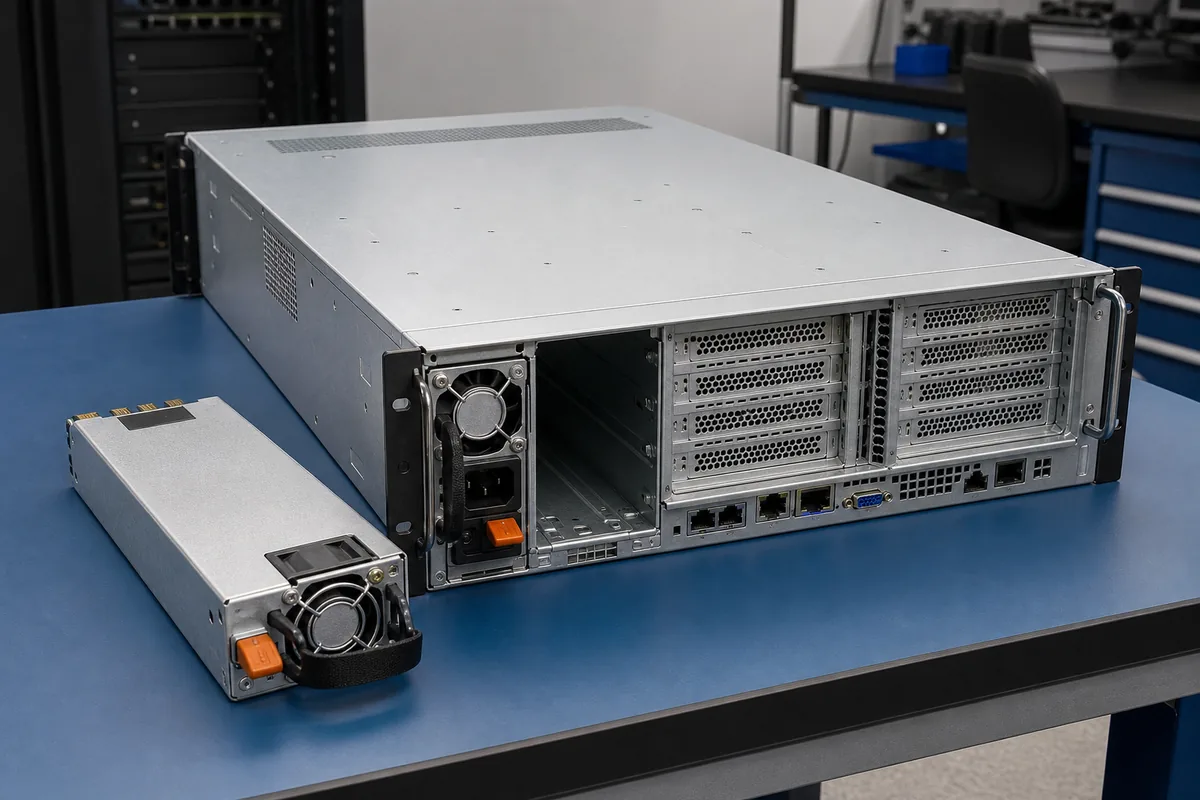
| Two-module offer | Two PSU modules, which may or may not be an approved pair | Cage and PDB inclusion, matching revisions, redundancy behavior, control support, and output distribution |
| Complete 1+1 assembly | Two modules plus some combination of cage, PDB, wiring, and mounting hardware | Exact bill of materials, host-side connectors, management documentation, installation boundary, and accessories not shown in the headline |
This distinction is visible in the live product market. The manufacturer page for the ERA85-CPA2V-BF identifies it as an 850W 1+1 2U CRPS redundant power-supply product. That is evidence for the identity and high-level configuration of that exact product; it is not evidence that every 850W CRPS listing includes the same parts or uses the same interface.
The “2U” wording also requires care. It may describe the intended chassis or complete assembly rather than the dimensions of a universally interchangeable PSU module. A buyer should not translate “850W,” “CRPS,” and “2U” into an assumed mechanical or electrical standard without the model drawings and interface documentation.
Turn each offer into the same evidence record
Quote normalization converts differently worded product pages and supplier proposals into one comparison structure. Empty cells are useful: they expose which candidate still depends on an assumption. Do not fill a gap using a specification from a visually similar model, another revision, or a distributor title.
| Evidence field | Required supplier response | Why the field changes the comparison |
|---|---|---|
| Manufacturer and exact model | Manufacturer identity, full model, orderable number, revision or suffix, and datasheet tied to that identity | Shared wattage and enclosure appearance do not prove interchangeability |
| Meaning of 850W | State whether the rating applies to each module, an assembly, or another defined operating state | Prevents the headline rating from being misread as protected system capacity |
| Quantity | Number of PSU modules supplied per quoted line item | Separates a unit price from a pair or assembly price |
| Assembly contents | List the cage, PDB, harnesses, brackets, cords, fasteners, blanking parts, and accessories included or excluded | Reveals integration work and hardware that would otherwise appear after purchase |
| Rating conditions | Document applicable input, ambient, cooling, and other conditions for the quoted output rating | A headline wattage may not represent every supported operating condition |
| Mechanical evidence | Controlled drawing for the exact revision, including module envelope and relevant mating or mounting relationships | “CRPS” and “2U” alone do not prove bay fit, seating, or service clearance |
| Electrical interface | Mating interface documentation, output architecture, required PDB, and host-side connection scope | Determines whether power can reach the intended server loads safely |
| Management evidence | Documented status, control, telemetry, communication, and host dependencies, if offered | A reference to PMBus or monitoring does not define commands, data, addressing, or BMC behavior |
| Efficiency evidence | Model-specific curve, report, or certification with its input and load conditions | Allows comparison at the intended operating point instead of by an unsupported headline |
| Redundancy arrangement | Defined module population, normal state, degraded state, supported load, and required PDB or host policy | Distinguishes installed converter count from protected capacity |
| Substitution policy | State whether substitutions are prohibited or require written approval with equivalent evidence | Prevents an unspecified “850W CRPS equivalent” from replacing the evaluated identity |
A document title is not enough if its model suffix differs from the quoted part. Suffixes can represent electrical, mechanical, airflow, firmware, market, or production differences. The supplier should either connect the document to the orderable item or explain the relationship with manufacturer-controlled evidence.
Run three comparisons independently
A normalized record prevents one favorable attribute from hiding a failure elsewhere. The evaluation should answer three independent questions: can the power architecture carry the required load, can the hardware operate in the target platform, and does the quoted package contain everything the project expects?
1. Capacity in the required degraded state
For a 1+1 architecture, define the server state that must continue after one module, cord, or permitted input path becomes unavailable. The useful capacity relationship is:
Required degraded-state server load ≤ documented output of the surviving configuration under the deployed conditions.
If 850W is the documented per-module output under the relevant input, temperature, and cooling conditions, two installed modules may share the normal load while one carries the protected load after a permitted failure. The pair should not be described as providing 1,700W of redundant capacity merely because two 850W labels are present. A nonredundant or power-boost operating mode may use modules differently, but that behavior must be explicitly supported by the platform rather than inferred from arithmetic.
The load side also matters. CPU, memory, storage, fans, accelerators, and motherboard regulators do not necessarily draw their maximum power simultaneously, but a credible configuration model must include the states the server can actually enter. Power caps may be part of a supported operating policy; they should not be used to conceal a capacity gap unless their enforcement and failure behavior are documented.
2. Compatibility with the target assembly
Mechanical resemblance is only the beginning. The module must seat against the correct connector datum, latch properly, follow the intended airflow direction, mate with the PDB, expose the expected standby and control behavior, and be recognized by the host where management integration is required. A different connector key, output architecture, signal definition, or firmware expectation can invalidate an apparently close replacement.
For a deeper module-level checklist, the CRPS compatibility buying guide explains the mechanical, PDB, host, and management boundaries in more detail. In the present evaluation, those fields should remain attached to each quoted model rather than becoming generic assumptions about the 850W class.
3. Commercial completeness
The commercially complete choice is not necessarily the offer with the largest hardware bundle. A module-only purchase can be appropriate for a controlled spare pool where the existing server, PDB, cage, firmware, and pairing rules are known. A complete assembly may be more appropriate for a new chassis integration because it reduces the number of unresolved mating parts.
Compare price only after assigning every excluded item and responsibility. If Offer A contains one module while Offer B contains two modules, a cage, and a PDB, their line-item prices answer different questions. Normalize the cost to the required deployable configuration, including separately sourced hardware, documentation, integration effort, and spare requirements. This does not require speculative monetary values; it requires the scope delta to be visible.
Missing evidence is a bid condition, not a blank to overlook
A missing specification should be classified according to its consequence. Some gaps block the purchase; others can be resolved before release; a few may be irrelevant to the intended use.
- Disqualifying until resolved: unknown exact model, undefined module quantity, no evidence of host or PDB compatibility, ambiguous meaning of the 850W rating, or permission to ship an unspecified equivalent.
- Commercial clarification: uncertain inclusion of cords, brackets, harnesses, mounting hardware, packaging, or spare accessories.
- Application-dependent evidence: detailed management functions, efficiency curves, acoustic information, or environmental options that matter only when the project specifies them.
“Supported” should also be attributed. A seller may say a module is compatible based on appearance or prior sales, while a manufacturer may document a specific host or assembly. Those are different levels of evidence. The quotation record should identify who supports the claim, the document that contains it, and the exact model or revision to which it applies.
Product photographs can help distinguish a module from an assembly, but they are not controlled interface evidence. Stock images may show another revision or omit accessories. Use them to formulate questions, not to approve mechanical fit, pin assignments, airflow, or included hardware.
RFQ wording should preserve the evaluated configuration
An effective request for quotation forces scope and identity into explicit fields. It should not ask only for “850W CRPS PSU, quantity two,” because suppliers may interpret that phrase differently. A stronger RFQ requests:
- manufacturer, exact model, ordering number, revision, and proposed lifecycle status;
- quantity of removable modules per line item and total module quantity;
- whether the offer is module-only, a paired set, or a complete 2U 1+1 assembly;
- a line-by-line list of included cage, PDB, harnesses, mounting hardware, cords, and accessories;
- the model-specific document defining the 850W rating and its applicable operating conditions;
- mechanical drawings and the identity of the mating PDB or host platform;
- documented redundancy mode and the supported load when one required source is unavailable;
- efficiency and management evidence only where those capabilities are part of the requirement;
- warranty, lead time, packaging quantity, and traceability expectations; and
- a prohibition on substitutions unless the buyer approves a complete evidence package in writing.
Ask suppliers to price optional components separately even when they recommend a complete kit. Separate pricing makes the assembly boundary visible and supports later spare purchases. It also avoids treating the cost of a PDB or harness as an unexplained difference between nominally similar PSU quotes.
The same identity should flow into the purchase order. Replacing the exact model with a shortened description such as “850W CRPS equivalent” discards the evidence collected during evaluation. The order should retain the approved manufacturer, model, revision rule, module count, assembly contents, and controlled substitution language.
Receiving should confirm the normalized record
Before installation, match labels, revisions, module count, and every promised cage, PDB, harness, bracket, cord, and accessory to the purchase record. Quarantine unexplained substitutions, mixed revisions, damage, contamination, bent hardware, or missing retention parts.
Record accepted hardware against the quotation, controlled documents, approved host, and reorder identity. Installation and redundancy testing must follow manufacturer and host procedures; receiving inspection cannot prove platform support or hot-swap behavior.
A comparable 850W offer has one unambiguous identity
The strongest 850W CRPS server PSU quote states exactly what is being sold and what evidence belongs to it. It distinguishes one module from a pair and a pair from a complete 2U 1+1 assembly. It defines whether 850W is a module rating, names the operating conditions behind that rating, and keeps capacity separate from compatibility and package contents.
Once every candidate is expressed through the same fields, price comparison becomes meaningful. A module-only spare can compete with another module-only spare; complete assemblies can be compared by their documented bills of material; and unresolved interface or management claims remain visible instead of being hidden beneath a shared wattage label. Quote normalization does not make dissimilar products identical. It reveals precisely where they differ before those differences become integration delays, unusable spares, or unsupported substitutions.