A 750W 80 PLUS Titanium hot-plug redundant server power supply rated for 200–240VAC is a high-line-only module, not a universal-input substitute with a better efficiency badge. The server, rack feeds, cords, PDU outlets, replacement policy, and redundancy mode must all support that input boundary. In a 1+1 pair, 750W normally describes the output capability of each module; it does not automatically mean that the server may consume 1,500W while preserving redundancy.
This specification is attractive for compact enterprise servers whose failed-state load fits within one 750W path and whose facilities provide high-line AC. Its value comes from combining an appropriate capacity envelope, certified conversion efficiency at defined load points, and live serviceability. Those three attributes answer different questions. Treating them as interchangeable is how a seemingly correct replacement becomes an unavailable server or a nonredundant installation.
The 200–240VAC range is the first compatibility gate
The input range determines where the power supply can operate at all. A module marked 200–240VAC should not be assumed to start, remain online, or deliver rated output from a nominal 100–120V circuit. That restriction matters in mixed-voltage facilities, regional spare pools, temporary staging areas, and disaster-recovery sites. A server that works in a production rack may fail its basic power-on test when moved to a low-line bench circuit.
High-line input can reduce input current for the same delivered power. As an illustrative calculation, assume the server needs 600W DC and the conversion efficiency at that exact operating point is 94%. Approximate AC input is 600 / 0.94, or 638W. At 208V, that is roughly 3.1A before considering power factor and waveform details. The same real power at 120V would require roughly 5.3A, but the comparison does not make a high-line-only module compatible with 120V. It only explains why high-line distribution is useful for power density and conductor loading.
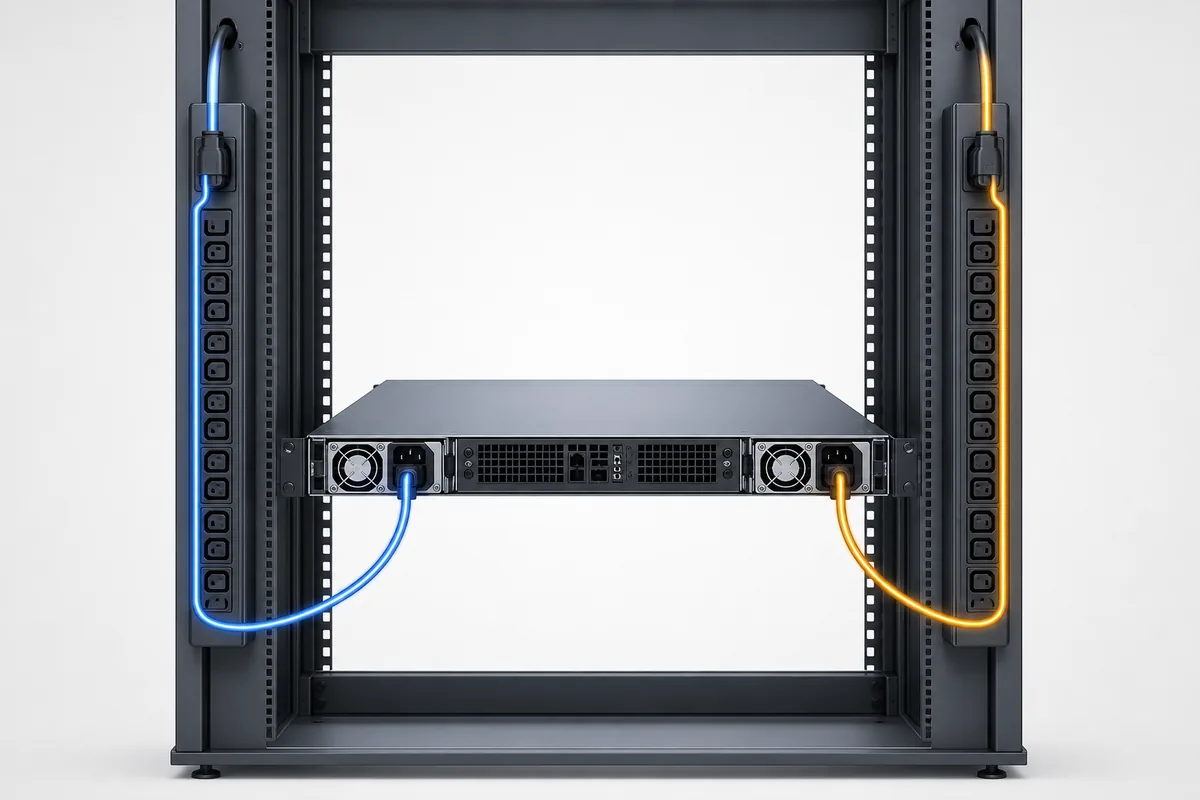
The installation record should therefore identify more than “AC available.” It should name nominal voltage, permitted variation, receptacle and cord type, PDU branch rating, A/B source arrangement, and the voltage present during bypass or maintenance states. If either redundant feed can be transferred onto a low-line source, a 200–240VAC module may lose both its intended operating condition and its redundancy story at the same time.
Seven hundred fifty watts belongs to the surviving path
Redundant capacity is defined by the state after a module or feed is lost. In a conventional 1+1 arrangement, two 750W modules may share the normal load, but one healthy module must carry the required server load after the other path disappears. The useful protected ceiling is therefore bounded by one module, along with any model-specific derating, transient limitation, thermal constraint, or chassis policy. It is not the arithmetic sum of both nameplates.
Consider a hypothetical server with a 520W sustained workload and short excursions to 650W. The normal two-module state might place about 260W on each converter if current sharing is reasonably balanced. After one module is removed, the survivor sees the full operating load and the excursion. A 750W rating appears sufficient at the nameplate level, yet the platform still needs enough margin for conversion losses, fan response, inlet temperature, component tolerances, and any manufacturer-defined power cap. This example is screening logic, not evidence that a particular chassis supports the workload.
The separate article on a 750W dual hot-plug redundant server power supply examines the general capacity and system-integration territory. The high-line Titanium specification adds a narrower question: whether that protected load can be supplied from the available 200–240VAC infrastructure at the certified efficiency class and with the exact host-supported module.
Titanium describes tested conversion points, not server availability
80 PLUS Titanium is evidence about AC-to-DC conversion efficiency under a defined certification category and test method. It does not certify the server’s PDB, fan system, current-sharing policy, hot-plug sequencing, firmware compatibility, or A/B feed independence. Those properties remain system responsibilities even when the module has a valid efficiency certificate.
For 230V internal redundant data-center power supplies, the official 80 PLUS rating criteria published by CLEAResult list Titanium efficiency points of 90% at 10% load, 94% at 20%, 96% at 50%, and 91% at full load. Those figures describe certification thresholds at specified conditions. They should not be copied into a product specification unless the exact model and its certification record support the claim.
The difference between output and loss gives the badge practical meaning. At 375W output, which is 50% of a 750W rating, 96% efficiency corresponds to about 390.6W input and 15.6W of conversion loss. At the same output and 94% efficiency, input would be about 398.9W and loss about 23.9W. The approximately 8.3W difference is small for one module but can affect rack heat and fleet energy when multiplied across many continuously operating supplies. The comparison assumes identical output, measurement boundaries, and operating conditions; auxiliary system loads can change the server-level result.
A certification tier also does not reveal the entire load curve. Redundant modules frequently operate well below half load during normal sharing, then move abruptly upward when one path fails. The most informative comparison uses the server’s normal and failed-state operating points rather than a single “typical efficiency” number. A deeper treatment of curves and loss calculations appears in the server PSU efficiency analysis.
Redundancy moves the converter between two efficiency regions
A protected server can spend most of its life with both modules online and only minutes in a single-survivor state. That time distribution changes the energy calculation. If a 500W server load is shared evenly, each 750W module operates near one-third of rated output. Losing a module moves the remaining converter to roughly two-thirds load. Neither point is identical to the 50% certification point, so an annual estimate should use an efficiency curve or model-specific data at the relevant loads.
Active-active and active-standby policies can produce different operating points. Active-active sharing divides current and may improve thermal distribution, while active-standby can keep one module lightly loaded until needed. The server manufacturer’s power policy, module firmware, and PDB implementation determine the actual behavior. A purchasing description that says only “redundant” does not establish which mode the host uses.
Feed redundancy is a separate boundary. Two hot-plug modules connected to one PDU may tolerate a module failure but remain exposed to a branch-circuit or PDU outage. Connecting the modules to independent A/B sources improves upstream fault separation only when both sources remain within the required 200–240VAC range in their normal, transfer, and maintenance states.
Hot-plug service is a controlled transfer of electrical state
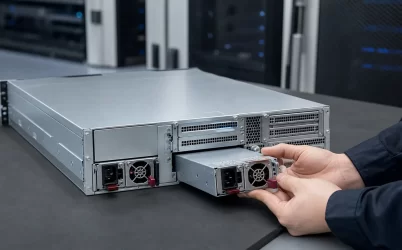
Hot-plug capability means an intended module can be removed and inserted while the supported host remains energized under defined conditions. It is not permission to substitute any physically similar 750W supply. Before withdrawal, the surviving path must have adequate capacity and healthy input. During removal, output isolation must prevent the departing module from pulling down the common bus. During insertion, connector sequencing and inrush control must keep the live bus within the platform’s limits.
The service sequence also exposes operational dependencies. A technician needs positive identification of the failed module, confirmation that the other feed is healthy, and a replacement approved for the specific server. Pulling the healthy module because two rear handles look alike converts a recoverable fault into an outage. Mixing modules with different electrical behavior or unsupported firmware can leave the server powered while redundancy remains degraded or alarms persist.

The replacement identity extends beyond four headline terms
“750W,” “Titanium,” “hot-plug,” and “200–240VAC” are useful filters, but they do not form a complete interchangeability key. A replacement must match the host’s supported part identity, mechanical envelope, insertion depth, latch position, blind-mate connector, output rail and standby behavior, airflow direction, communication interface, and firmware expectations. Even the cord inlet and handle orientation can matter in a dense rear panel.
Procurement records should preserve the exact manufacturer part number and the server platforms or option kits that officially accept it. Record the input range exactly rather than shortening it to “AC,” and retain the certification record for the specific model when efficiency is a requirement. If alternate parts are permitted, list them as approved identities rather than allowing a warehouse to infer equivalence from wattage and color.
This discipline becomes more important across regions. A global spare pool may contain universal-input and high-line-only modules that share a familiar form factor. Sending the 200–240VAC unit to a low-line site creates a predictable failure even if the module fits perfectly. Conversely, replacing a high-line Titanium module with a supported universal-input alternative may preserve service but change the certified efficiency class. The acceptable substitution depends on the platform’s support matrix and the organization’s efficiency requirement.
High-line-only power is an infrastructure commitment
A 750W Titanium redundant PSU is a coherent choice when one module can support the required failed-state load, the exact model is approved by the host, and both operating feeds remain inside 200–240VAC. In that environment, the specification can combine manageable capacity, efficient conversion, and online service without pretending that two modules create 1,500W of protected output.
The limiting fact is the voltage boundary. It follows the server from the rack PDU to the staging bench, the maintenance bypass, the recovery site, and the spare cabinet. Once that boundary is preserved in infrastructure diagrams and replacement records, the Titanium badge and 750W rating can be interpreted in their proper roles. If the boundary cannot be preserved, the correct response is not an adapter or an assumption; it is a different host-supported power-supply option.