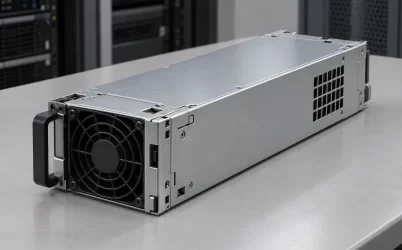
The HK2400B-S1 is Huntkey’s 2400 W, 12 V CRPS single module for data-center servers. Its published output table makes the most important qualification explicit: the main rail is listed to 98 A at 110 Vac and 195 A at 230 Vac. A buyer comparing this unit with another 2400 W CRPS should therefore begin with the available input and the server’s power path, rather than treating the wattage printed in the model description as available under every condition. Huntkey identifies hot-swap and N+1 operation, but the host shelf still determines how those functions work in a particular system.
The two input conditions tell different capacity stories
Huntkey publishes a 90–264 Vac, 47–63 Hz input range and lists support for 240 Vdc. The presence of a broad input range does not mean that one continuous output ceiling applies throughout it. The manufacturer’s table associates the +12 V output with a maximum of 98 A at 110 Vac and 195 A at 230 Vac. Multiplying those current entries by the nominal 12 V gives approximately 1,176 W and 2,340 W respectively. These are simple nominal-voltage interpretations of the listed rail currents, not substitute manufacturer ratings for every input voltage or operating temperature.
The 2400 W nameplate and 195 A at 12 V are close but not numerically identical. Preserve the manufacturer’s table rather than rounding 195 A to 200 A or claiming 2400 W main-rail delivery at every high-line condition. The public table does not resolve the nameplate accounting. For a system close to the high-line ceiling, request complete load and derating documentation.
A server installed where 110–120 V is the normal feed faces a materially different problem from a server fed at 230 V. The lower current entry can make a high-density configuration unsuitable even though the inlet accepts that voltage. A dual-feed rack also deserves a failure-case check: if one supply is on a lower-voltage source, the surviving source may not support the same load as the normal high-line path. Treat branch voltage, per-module capacity, and the intended redundant arrangement as one coordinated design question.
| Published condition | Maximum main-rail current | Nominal 12 V interpretation | Engineering implication |
|---|---|---|---|
| 110 Vac input | 98 A | About 1.18 kW | Check the server load against the low-line limit. |
| 230 Vac input | 195 A | About 2.34 kW | Check the high-line current, PDB, and redundant failure case. |
These rows are specific to HK2400B-S1. They should not be copied to Huntkey’s HKS models, to another HK suffix, or to an unverified 240 Vdc operating condition. The published support for 240 Vdc confirms an input option; it does not by itself publish a separate DC-input current or output derating curve.
What the Platinum claim establishes—and what it does not
Huntkey identifies the HK2400B-S1 as 80 PLUS Platinum, with a peak efficiency above 94%. Its product page also gives minimum efficiency entries of 90% at 10% load, 94% at 20%, 94% at 50%, and 92% at 100%. Those figures describe specified points, not a continuously flat conversion efficiency. The independently accessible 80 PLUS verification report for HK2400B-S1 records 95.37% at 50% load and 93.86% average efficiency, with measurements at nominal 230 V and 60 Hz. This supports the Platinum identification at that test condition without proving identical results at low line, 240 Vdc, every ambient temperature, or every server airflow pattern.
Efficiency matters here because a compact module converts a substantial amount of electrical power in a confined rear bay. As an illustrative calculation, 2,000 W of DC output at 94% efficiency implies about 2,128 W AC input and roughly 128 W of conversion loss. The arithmetic is output divided by efficiency; 94% is an assumed operating point for the example, not a measured HK2400B-S1 value at 2,000 W. At a different load or inlet voltage, loss changes. Server airflow must carry that heat away while adjacent modules, cables, and rack exhaust conditions alter the air available to the unit.
For annual energy estimates, use the expected workload distribution, not merely peak efficiency. A server spending most of its time at modest load will not necessarily operate at the report’s 50% point. In a redundant pair, load sharing changes each converter’s operating point. Cold standby can also change active-module loading according to shelf policy.
The 185 mm body is one part of the bay interface
Huntkey specifies typical dimensions of 185 × 73.5 × 40 mm. Those three dimensions are useful for identifying the module’s mechanical class, but they do not establish plug compatibility. A practical CRPS replacement must match the host bay’s insertion depth, guide rails, handle and latch geometry, connector position, mating length, airflow direction, and the server’s power-distribution board. A similar rectangular body can still stop short of the connector, seat at the wrong depth, or interfere with the rack’s rear service clearance.
The public product description does not supply a complete HK2400B-S1 connector drawing or pin assignment. It would be unsafe to infer pinout from dimensions or from another Huntkey series. Likewise, the generic word CRPS is a form-factor and architectural clue, not a host-qualified interchangeability certificate. For an existing server, compare the approved spare-part list or original module label with the proposed exact model and revision. For a new chassis, obtain the mechanical drawing and mating-connector specification from the relevant supplier before a PDB is finalized.
A rear-bay assessment should include AC inlet orientation and cable bend space. Removal needs a clear path past rack PDUs, cable managers, and door hardware. The 185 mm figure describes the module body, not its entire service envelope.

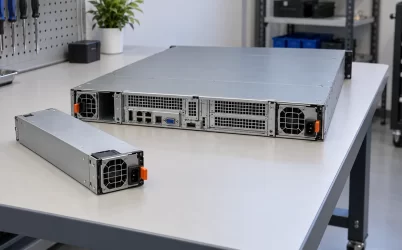
The illustration shows a generic server and removable module, not a dimensional drawing or evidence that a particular chassis accepts HK2400B-S1.
How a 12 V CRPS module reaches the server loads
The HK2400B-S1 has a published +12 V main output and a +12 VSB standby output rated up to 2.1 A. Those rails enter the server through a host interface and distribution assembly; processors, memory, accelerators, drives, and control electronics then receive the voltages appropriate to them through downstream conversion or distribution. The availability of 195 A on the module’s high-line 12 V rail does not imply that any one board connector or trace can carry that current. The PDB, contact system, busbars, harnesses, and local converters each have their own current and thermal constraints.
At this power level, small resistance in a connector or distribution path can produce significant heating. Current sharing across contacts, proper mating force, and stable insertion become practical concerns rather than abstract electrical details. If a server vendor approves a specific module, the approval ordinarily reflects the whole power path, including the mechanical mate and control behavior. If an integrator is building the shelf, the module rating is an input to the distribution design, not a substitute for it.
Standby power serves a different operating state. The +12 VSB rail can keep designated management or startup circuitry available when the main 12 V output is off, but the actual startup sequence and standby loads are host-defined. Huntkey lists standby power consumption at no more than 6 W. That is a product-page entry; it should not be confused with a 6 W maximum on the +12 VSB output, because the published standby output limit is 2.1 A. Confirm the exact control and monitoring signals needed by the motherboard or shelf before claiming compatibility.
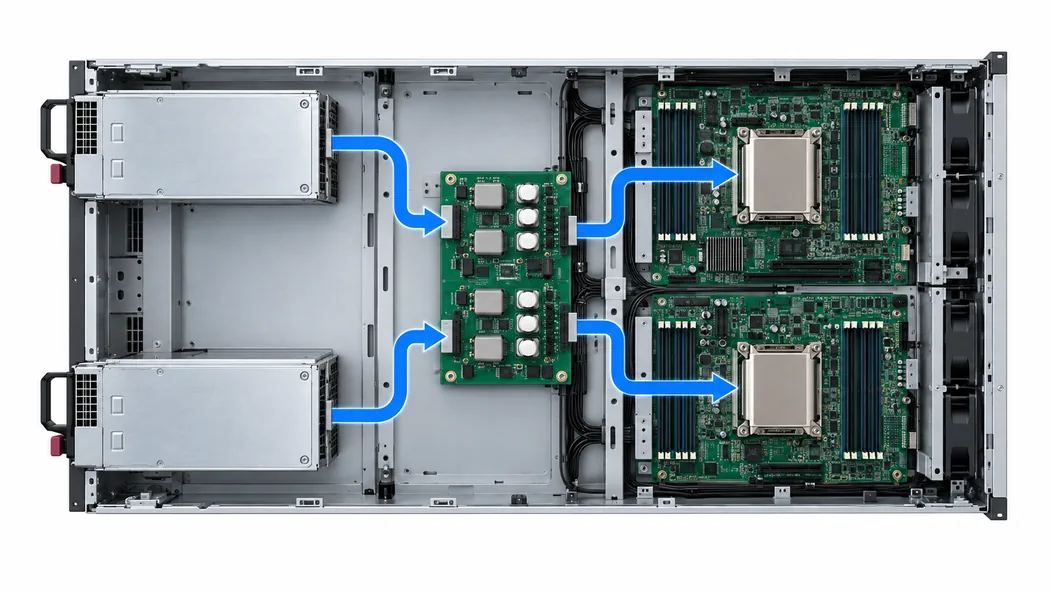
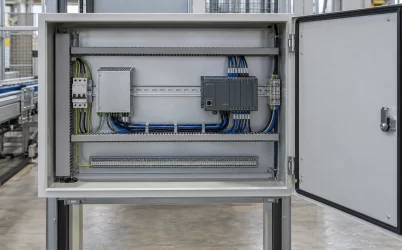
The generic open-chassis illustration traces modules toward a distribution board. It does not depict the HK2400B-S1 connector or a certified host arrangement.
N+1 and hot swap describe supported functions, not a free capacity multiplier
Huntkey states that the HK2400B-S1 supports N+1 redundant applications for 0≤N≤3, along with hot swap and cold standby. In a redundant server, the useful capacity is the amount left after the intended failure, not the sum of every installed nameplate. Two 2400 W modules in a 1+1 arrangement do not give a 4800 W failure-tolerant output. If either module must sustain the full server after the other is removed or fails, the remaining module and its input source must carry that demand within their applicable ratings.
Consider an illustrative server drawing 1,700 W from its 12 V bus. At a high-line condition, that lies below the nominal 2,340 W interpretation of the published 195 A entry, though actual design margin, transient behavior, ambient conditions, and distribution losses still require assessment. At the published 110 Vac current limit, the nominal 12 V interpretation is only about 1,176 W. The same server would therefore not have a justified 1+1 surviving-capacity claim on that low-line figure. This example uses a hypothetical load and does not assert an approved HK2400B-S1 deployment.
Hot swap means a properly designed host can remove and insert a module without shutting the supported system down under permitted conditions. The shelf must handle power-path isolation, inrush, connector sequencing, and the transfer of load to surviving modules. Huntkey’s product-level support does not reveal how a particular server behaves when a latch is released or an input feed is lost. A service plan needs the chassis maker’s sequence and the allowed load during one-module operation.
Cold standby raises host-level questions: which unit remains active, how the spare awakens, and how quickly the host responds to failure. The public module page gives no failover time or BMC policy.
Monitoring claims need an exact host-level match
Huntkey describes black-box fault recording and online firmware upgrading for HK2400B-S1. The public page does not expose the register map, connector pinout, firmware policy, or host command sequence. A buyer should distinguish a module feature from one usable through a particular server BMC. A system might read basic status without the tools needed for an online update.
The listed protection functions include input undervoltage and overvoltage, input current limiting, output overvoltage and overcurrent, output short-circuit, and overtemperature protection. The list shows protective categories, but it does not give trip thresholds or timing. Such settings affect how the module responds to a fault and whether the host sees a recoverable event, a latched shutdown, or a load transfer. Procurement comparisons should avoid claiming identical fault behavior from two modules that merely share protection names.
Huntkey’s published operating air-temperature range is 0–55 °C and relative humidity is 5–95% without condensation. Those are module environment entries, not permission to ignore inlet-air measurement or chassis airflow. The forced-air cooling entry likewise does not specify that an arbitrary fan wall will provide the right pressure and flow around the installed module. An unusually restrictive bay or hot rack rear can invalidate an otherwise comfortable power calculation.
Where the HK2400B-S1 record ends
The published evidence establishes the exact HK2400B-S1 identity, its CRPS single-module category, 12 V output, Platinum classification, 185 × 73.5 × 40 mm size, 90–264 Vac input range, 240 Vdc support, and the sharply different 110 Vac and 230 Vac output-current entries. Those facts are enough to reject several common misreadings: a 2400 W nameplate is not a low-line output promise, a matching mechanical envelope is not a pinout match, and N+1 language is not a guarantee that a chosen rack remains online after any power-path failure.
For an actual server, the remaining evidence is specific: a host-approved module or mating-interface drawing; the applicable input-voltage capacity and derating data; 12 V distribution and standby-load limits; the intended redundancy state; and the host’s service and management documentation. The Powernexu HK2400B-S1 product listing identifies the catalog item, while the exact Huntkey document and the server maker’s approval establish what can be installed and operated. That boundary is particularly important when comparing this HK model with higher-wattage HKS units: the series names and nearby ratings are not interchangeable technical evidence.