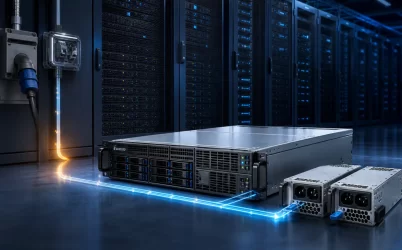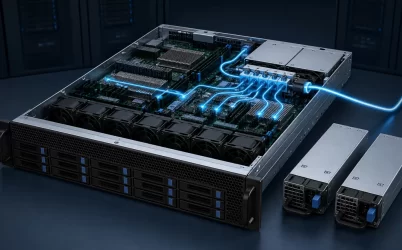
An 1100W hot-plug redundant server power supply is a removable PSU module intended to participate in a host platform’s redundant power system. The phrase does not, by itself, specify how many modules are installed, whether the topology is 1+1 or N+1, which server accepts the module, or whether 1100W is available at every input and environmental condition. For buyers and integrators, the useful interpretation is therefore: an 1100W-class module plus a platform-specific redundancy contract. Both parts must be identified before the product can be selected as a replacement, spare, or component in a new design.
The noun in the request is a module, not a complete redundancy system
Search results and quotations often shorten a complex assembly to “1100W redundant PSU.” That wording can describe a genuine power module, but redundancy emerges only after the module is installed in a host with another available power path, isolation, current sharing, a compatible backplane or power distribution board (PDB), and the control behavior needed to contain a fault.
The omitted word “dual” matters. A two-bay server commonly uses a paired arrangement, while a multi-bay shelf can use a different count and reserve policy. An individual replacement module may serve either kind of architecture if the platform supports it. Conversely, a module marketed for redundant use is not redundant while operating alone.
This article therefore treats 1100W as a module class and concentrates on identification, topology ownership, replacement compatibility, and fleet operations. Readers specifically analyzing a paired 1+1 state sequence can use the related 1100W dual hot-plug redundant server power supply resource.
One module class can appear in different host arrangements
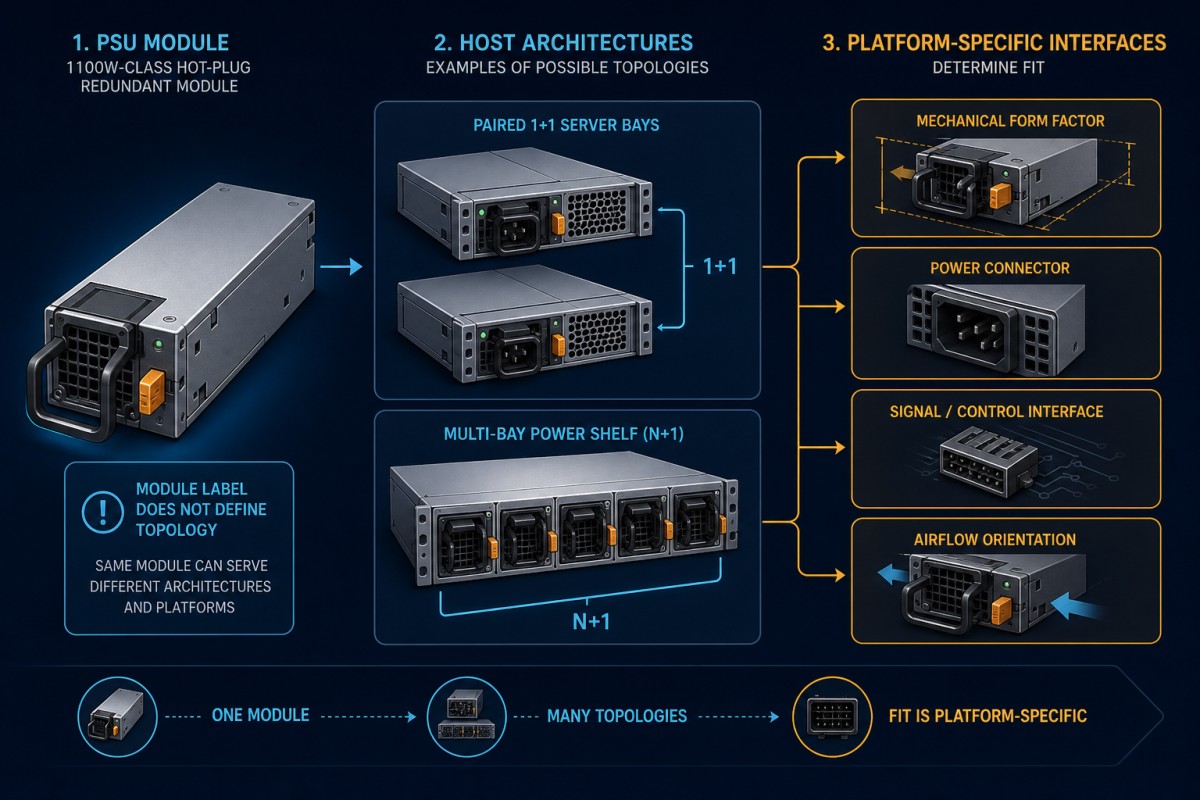
A module rating does not reveal the reserve policy. In 1+1, one remaining module must support the protected load after the other path is lost. In N+1, a set of modules supplies a larger shared load while at least one defined unit of capacity is reserved. Other architectures may separate loads or sources in ways that cannot be inferred from the product title.
| Item being specified | Question it answers | What it does not prove |
|---|---|---|
| 1100W-class module | Nominal power class of one PSU | Output under every input or ambient condition |
| Hot-plug capability | Designed for managed insertion and removal in a compatible host | Safe live exchange in an arbitrary backplane |
| Redundant-system role | Module can participate in an intended shared architecture | Topology, feed independence, or surviving capacity |
| Approved platform identity | The exact host and module combination is supported | Compatibility with visually similar servers |
This division changes how a request for quotation should be written. “1100W, hot-plug, redundant” is a useful search phrase, but it is not an adequate line-item specification. The host platform, approved part identity, quantity per system, reserve policy, input environment, airflow orientation, and management expectations convert it into a purchaseable requirement.
Wattage is a filter; identity closes the replacement question
Two modules can share an 1100W label and still be unsuitable substitutes. Mechanical envelope, keying, latch position, insertion depth, blind-mate connector, contact assignment, standby behavior, output characteristics, control signals, firmware expectations, and airflow direction can differ. A connector that appears to mate is not evidence that its power and signal contracts match.
For an installed server, the authoritative starting point is the platform’s supported-parts information and the identity of the working module. Record the manufacturer part number and applicable revisions exactly. Where a platform vendor maps its own spare identifier to an underlying PSU, preserve both identities; this prevents a visually similar commercial listing from being mistaken for the approved spare.
Mixed-module operation deserves explicit treatment. Some platforms permit only matching units; others define supported combinations or firmware requirements. Even when two modules power up together, differences in current-share behavior, fan curves, management reporting, or fault thresholds may create an unsupported or poorly observable state. Do not generalize mixing rules across the 1100W class.
The same caution applies to the term CRPS power supply. A common form-factor concept can improve modularity, yet it does not make every generation, connector, feature set, or implementation interchangeable.
The 1100W envelope belongs to a stated operating condition
Once identity is established, determine what the exact datasheet means by its rated power. High-output modules may have input-dependent capacity, environmental derating, or cooling conditions. The keyword provides no verified input range, efficiency level, temperature limit, or altitude behavior, so those values must come from the actual model documentation.
The platform configuration then supplies the load side of the comparison. CPU and accelerator limits, memory population, storage spin-up or activity, PCIe expansion, fans, and motherboard conversion losses contribute to demand. Short-duration changes can matter even when average utilization appears moderate. In a redundant arrangement, compare this permitted workload with the capacity available after the reserved module or path is removed from service.
There is an important procurement distinction here. A spare can be electrically compatible yet insufficient for a fully populated configuration under the site’s input conditions. Conversely, an 1100W module may be appropriate for the intended system without the server ever drawing 1100W continuously. The class defines an envelope; it is not a forecast of energy consumption.
Hot-plug describes a coordinated service interface
Hot-plug capability means the supported host is designed to manage module removal and insertion while another power path maintains the permitted load. It does not mean an operator may remove any PSU under any system state. Before service, platform indicators and management status should show that adequate redundancy remains and identify the correct unit.
During extraction, the module must disconnect without allowing its internal fault or stored energy to disturb the shared bus. During insertion, connector sequencing, inrush control, startup, output synchronization, and current-share engagement occur in an intended order. Those functions span the PSU and host interface; neither side can establish safe behavior alone.
Physical service conditions also matter. The rear of the server needs enough clearance to release the latch and withdraw the complete module without stressing adjacent cords. Cable routing should make feed identity unambiguous. A replacement module should be allowed to seat fully, latch, initialize, and reach the host’s healthy state before the incident is considered resolved.
The detailed electrical event belongs to the broader hot-swap PSU topic. For an 1100W spare program, the operational lesson is narrower: live serviceability exists only inside a compatible platform and a controlled procedure.
Fleet inventories need compatibility groups, not wattage bins
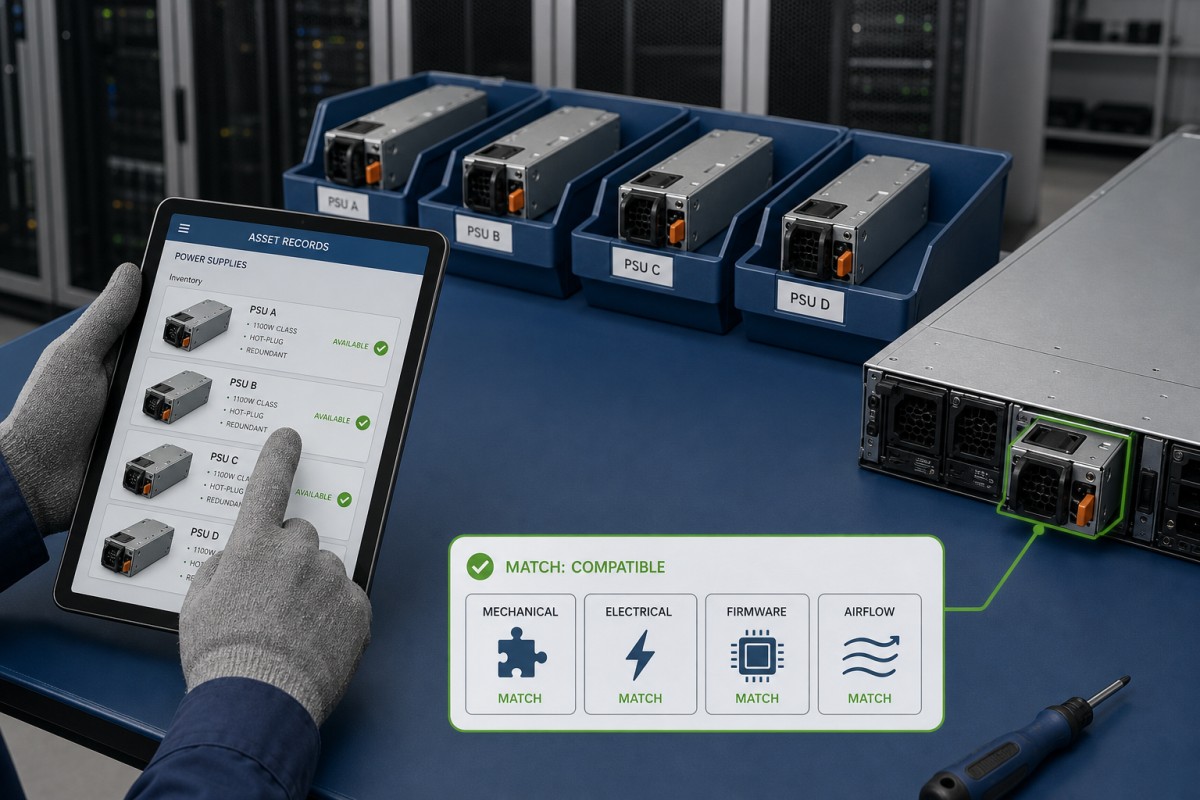
Organizing spares under a shelf label such as “1100W PSU” creates a false sense of interchangeability. A more reliable inventory groups modules by approved platform family and exact compatible identity, then records wattage as one attribute. The record can include revision constraints, airflow direction where applicable, approved mixed-module rules, and the servers that consume the spare.
This approach improves incident response. An operator can select a part from a known compatibility group instead of comparing marketplace photographs during an outage. It also exposes fleet fragmentation: if five server families each require a different 1100W-class module, the organization has five spare pools, not one.
Inventory quantities should reflect service objectives, installed population, failure replacement time, geographic distribution, and supplier lead time. No universal spare ratio follows from the wattage. A remote edge location with slow logistics may justify local stock that a staffed data center near a distributor does not.
Storage and handling deserve attention as well. Preserve protective packaging, prevent connector contamination and mechanical damage, and keep identity labels linked to the asset record. If firmware or platform policy can change compatibility, the inventory process should include a way to update affected groups without relabeling every 1100W module as universally usable.
Management visibility determines whether redundancy is actionable
A server operator needs to know more than module presence. Useful states include input available, output healthy, redundancy available, fault asserted, removal detected, and incompatible or unsupported module where the platform exposes such a condition. Exact sensors and PMBus behavior vary by design and should be taken from platform documentation.
Alerts should map to an action. Loss of redundancy may trigger prompt replacement even though the workload remains online. Repeated current imbalance may indicate a module, contact, or control issue. An unpowered second feed can look like a PSU failure unless monitoring preserves the difference between source loss and module fault.
After replacement, the meaningful outcome is restoration of the host’s declared redundant state, stable sharing under representative load, and normal reporting—not simply illumination of a module LED. That evidence can be captured in the maintenance record without turning every replacement into a broad system qualification exercise.
Choose the module by platform evidence
The phrase “1100W hot-plug redundant server power supply” is an effective category description for discovering products, but it should narrow a search rather than authorize a substitution. The module is suitable when its exact identity is supported by the host, its conditional power envelope covers the installed configuration under the intended reserve policy, its airflow and mechanical interface match, and its management behavior is recognized.
This interpretation keeps three decisions separate: the server designer chooses the redundancy architecture, the platform documentation defines compatible modules, and operations maintains the correct spare pool. Once those roles are separated, 1100W becomes useful context instead of a misleading universal compatibility code.